Feed on
Posts
Comments
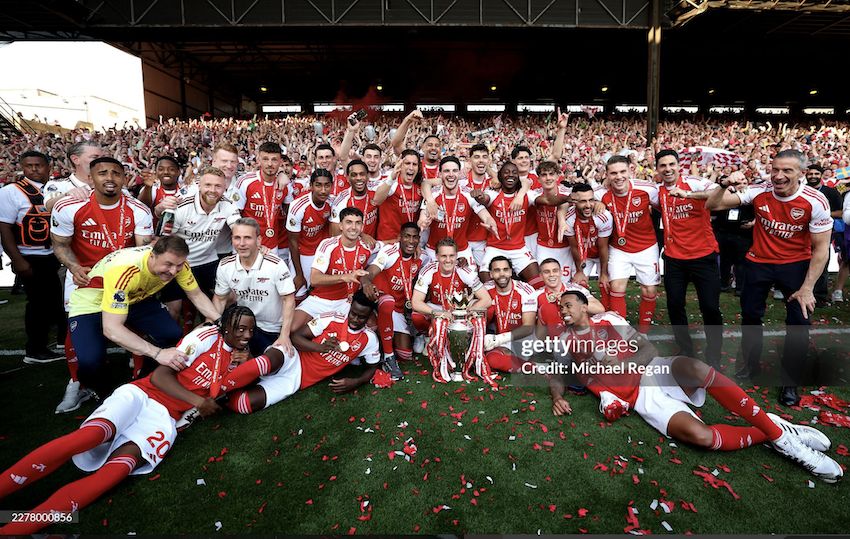
Selhurst Park, 24th May 2026

We have tried over the close season to enjoy the title success that we craved so much and for so long. To my surprise and disappointment, I’ve experienced a recent wave of negativity which seems to emanate partly from injury problems experienced in the World Cup and a disappointment that we’ve been outbid by Chelsea over Morgan Rogers (who’ve paid an outrageous premium à la Mudryk – remember him?).  I’ve even seen idiots claiming a Tottnumb side who escaped relegation on the last day of the season are better placed than us going into  next season – largely again, because they’ve overpaid for midfielders, out of desperation, after years of stinginess. 

I will give my thoughts on how I think we are placed for the new season nearer the start of the season, but I thought it would be instructive to look at how we have fared in the season after we have taken the title in all the years we’ve won the league since our famous Double season. The bad news is that we haven’t won back to back titles in any of those years. We have twice retaken the title in the next season after that, but we all want a ‘monster season’ next season by retaining the title so what can we learn from the past? To be honest, football has changed so much – note the level of transfer activity in many of those seasons, notwithstanding that a transfer window is a modern concept. In the past, a lot of deals were done at odd moments during the season – if deals were done at all.

Let us begin by looking at 1971/2: 

Before the season began, the club suffered a serious blow when Don Howe (who members of the Double team regard as the true architect of their success) moved to his original club, West Bromwich Albion, as Manager with George Wright, our trainer, accompanying him. Howe wasn’t really suited to management although he did later return and eventually manage Arsenal but coaching was his forte and the team suffered. 

There was no Charity Shield as Arsenal had won both trophies and chose a lucrative friendly with Benfica and when Arsenal pulverised Chelsea on a sunlit Highbury afternoon 3-0 to begin the season, hopes rose that we would maintain the consistency of the season before. Spoiler alert – we didn’t. In fact, we had a bad run in mid-autumn which saw us return to White Hart Lane, the scene of our title triumph, in a state of crisis, having conceded five goals to Derby. 

Bertie Mee produced a spectacular transfer coup, to sign Alan Ball for a British record transfer fee of £220,000, just before Christmas 1972. It was our only major activity and it wasn’t enough to lift us above fifth place. However, the season ended in a thriller. Two days after losing the Cup Final to Leeds United, Arsenal held title contenders, Liverpool, 0-0 at Highbury, while title favourites Leeds lost to Wolves. Derby County players were around a pool in Spain as they clinched the title. Ball’s signing failed to galvanise Arsenal. Mee carried out drastic surgery on the Double team too early and four years after winning the Double we were flirting with relegation. We finished 71/72 six points short of Derby who clinched the title with 58 points, seven short of our winning total in the previous season. 

We didn’t win the title again until 1989 on that thrilling night at Anfield. George Graham did very little transfer business prior to the 89/90 season  Siggi Jonsson whose time at Highbury was ruined by injury was one of only two additions during the season, the other being Colin Pates, which underlines that the habit of relieving Chelsea of surplus players started a long time ago! We began the season at Old Trafford during the brief tenure of Michael Knighton as their owner. We crashed to a 4-1 defeat and although the team was competitive throughout the season  Liverpool regained the title comfortably. We finished fourth with 62 points, one behind our noisy neighbours. 

That anti-climactic season provoked George Graham (who lest we forget, had himself  been a Chelsea player) into three purchases before the 1990/91 season. Those three purchases saw us win the title despite points deductions and the imprisonment of our captain. 

The following season (1991/92), we were expected to challenge again but a stuttering start (winning only two of our first seven games) saw us look to recruit Ian Wright from Palace, despite the fact that Kevin Campbell had made a huge impact the season before, and Alan Smith had won the Golden Boot in our title-winning season. After Wright’s signing, which was an immediate success, Smith was never as effective again despite scoring the winning goal in our last European triumph in Copenhagen. It was the season of the Benfica defeat and humiliation at Wrexham in the Cup. Midway through the season, Arsenal began to play the most exhilarating attacking football, scoring seven against Sheffield Wednesday, four against Liverpool, including a sensational long distance goal by Limpar, and, on the last day of the season, Wright won the Golden Boot with a hat-trick in a 5-1 win over Southampton, recording 24 goals for the season, in front of the North Bank mural. Arsenal finished fourth, on 72 points, ten behind the champions, Leeds United, and one point behind Wednesday the team they had put to the sword a few weeks before.

Arsenal went through considerable turmoil (and two managers) over the next six years before Arsene Wenger arrived to transform not only the club but also English football with our second Double. In the season after (1998/9 ) the club fought a titanic battle with a Manchester United team that were to achieve the treble of League, FA Cup and Champions League. But Arsenal ran them so close. We recruited a number of players during the season. The Argentinian international, Nelson Vivas, at the start of the season, Freddie Ljungberg early into the campaign, and Kanu and Kaba Diawara later in the season. It would be fair to say that of those last two players that Kanu had a greater impact! The league season looked as if we might pip United only for us to lose a pivotal penultimate  game at Leeds when Vivas lost track of Hasselbank who crashed in a late header. In the last game, United were at home to mid-table Tottenham while we played Aston Villa. An early Ferdinand goal saw us dare to dream but our neighbours showed their ability and willingness to lose to teams from Manchester if it deprives us of the title and, despite a late Kanu winner, we finished one point (78 against 79) and one goal in goal difference behind United. When one thinks that had Bergkamp scored from that penalty in injury time in the FA Cup semi-final, we might well have gone on to complete a Double in consecutive seasons.

The impetus stayed with United over the next few seasons but we completed the club’s third, and Arsene’s second, Double in 2001/2, winning the league at Old Trafford through Wiltord’s immortal strike. We introduced players of real quality into the squad in the next campaign 2002/3. Kolo Toure made his debut that season and we added a World Cup winner in the elegant and hugely underrated Gilberto Silva. Pascal Cygan is remembered slightly less fondly! We were favourites to win the League and broke a series of records at the start of the season, scoring in 55 consecutive games, going 22 away games without defeat, and going unbeaten for ten months, breaking United’s unbeaten Premier League run which had stood at 29 matches. Wayne Rooney changed everything with that famous late strike for Everton but we conducted a fierce battle with United which collapsed when we lost 3-2 at home to Leeds. The suspicion was that, head to head, Arsenal were the more skilful side and we had knocked United out of the Cup at Old Trafford en route to a second consecutive FA Cup success. We finished five points behind United amassing 78 points. Thierry Henry notched 24 goals and Robert Pires who had not returned from injury until November scored 14. Imagine a left sided attacker contributing at that rate and he scored the winner in the FA Cup Final too! 

The 2003/4 season saw the immense achievement of our Invincibles and we began the 2004/5 campaign by signing Van Persie, Flamini and  Almunia and during the season also added Eboue. We extended our unbeaten run to 49 games before we played the infamous game with United where Mike Riley’s refereeing performance could scarcely have been better designed to hand United the points. Like two seasons earlier, the impact of losing our unbeaten status caused us to stumble, but this time we were confronted with a new title rival in Mourinho’s Chelsea who lost only once during the season although we drew with them twice. We finished in second place, 12 points behind them, despite amassing 83 points, which was 6 ahead of United. We lifted the Cup beating United (more than a trifle fortuitously) on penalties, after a goalless draw, Patrick Vieira brought the curtain down on his Arsenal career in the most glorious way imaginable, clinching the Cup with his last kick in an Arsenal shirt. 

Last season was the culmination of what was an iterative process and we proved able to last the course better than any of our rivals. Prior huge investments by those rivals and their threatened further investments underline how difficult it will be to repeat our title success but the coherence of Arteta’s coaching and planning has built a strong foundation from which we can go again. 

So we move to season 2026/27. Might this be the season where Arsenal can retain their Premier League crown? As I write I’m receiving texts from across the Goonerverse about Arsenal’s interest in Vinicius Junior. It seems a trifle fanciful but under Arteta we have elevated ourselves to become major contenders in any competition and a potential home for world class star players. It would be interesting to poll Arsenal fans about what they believe should be the club’s priority for next season. Is it to retain the title, a feat that has been beyond us since we last achieved it in the 1930’s or finally to win the Champions League? Or is it feasible to believe we can win them both, given how close we came last season? I shall give my views in the season preview in a few weeks, (after I have carefully considered my Predictathon entry!) because until the impact of the transfer market and the effect of a protracted and demanding World Cup becomes clearer it is very difficult to decide the relative strengths of the contenders. 

This history emphasises that while we have seen Liverpool, United, Chelsea and Manchester City win successive titles and, in City’s case, dominate a number of recent seasons in the league, we  have failed to do this in modern times. What a wonderful thing it would be to see us repeat our triumph next May! 
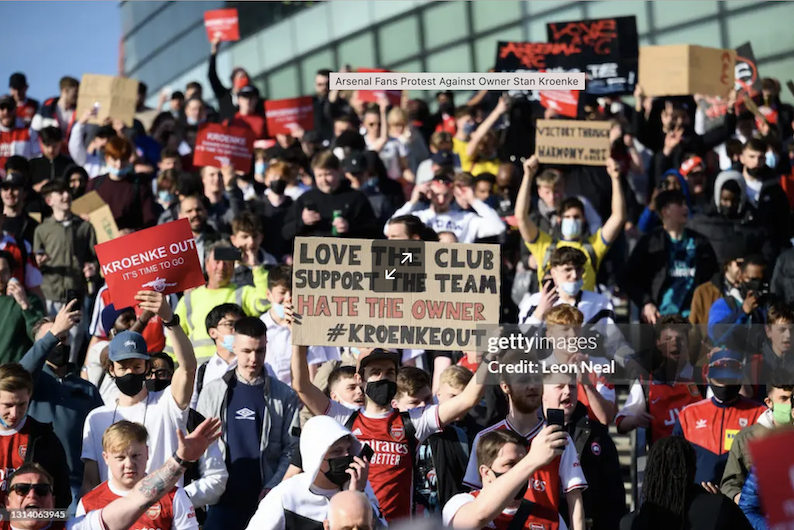
Since Kroenke Sports & Entertainment (“KSE”) completed the takeover at Arsenal in September 2018, the club has undergone a gradual, considered, methodical transformation at all levels. Like all revolutions – for that is what it has been – some of it has been bloody; some of it deeply unpleasant. Cast your mind back to April 2021. Arsenal, among a group of the very top-level European clubs – and Tottenham, more than a little incongruously – sought to break away from the Premier League and UEFA and create the European Super League (“ESL”). This prompted considerable societal wailing and gnashing of teeth and a massive fall-out with fans who saw the move as an unwanted break with our storied past. There was a mass protest at the ground before a game, which the players and staff certainly witnessed as they went past in the coach.

However, since KSE’s takeover, and in truth likely before, the Kroenkes have had a plan for the club. Undoubtedly they made a huge mistake with the ESL. But let’s take a wider look at what KSE has brought to the party across arguably the most significant areas and then add some thoughts on the direction of travel in the future.


Finance & Investment

Clearly the financing which KSE has brought to bear has underpinned the turning around of the tanker, which looked in serious danger of running aground. After buying out Usmanov, the previously parsimonious Kroenke approach changed radically. In hindsight, this approach was wholly understandable. Why should they pump money into a venture when the other major shareholder would benefit disproportionately? Unfortunately, the pre-takeover stasis only fed the inertia at the club, pulling us further down and eventually ensuring that we fell out of the lucrative Champions League.

It is estimated that, under KSE, the club has invested a gross £1.4bn in transfers. Up to May 31st 2024, KSE had also injected around £330m in shareholder loans, including around £180m essentially to buy back the outstanding bonds on the Emirates Stadium debt and refinance with loans from KSE itself. This was key as the previous loans were covenanted by gate receipts, which during COVID were zero. In the event of insufficient cash to pay the interest, technically bond holders may have been able to file for default. This move by KSE was also designed to take advantage of the globally lower interest rates prevailing as a result of quantitative easing, reducing the interest burden on the club. They had to pay a significant premium for early redemption of the bonds and to buy out the interest rate swaps used to turn the original slice of floating rate debt into fixed rate.

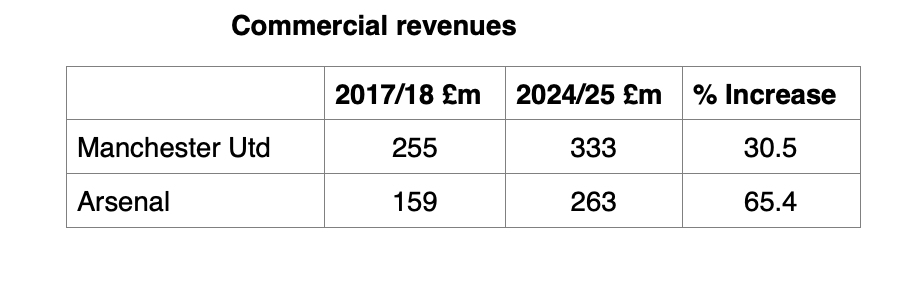
One area of the financial model at the club which lagged behind for years was the commercial revenue. Until the full purchase by KSE, this financial pillar was essentially a sleeping giant and significantly trailed Manchester United, the acknowledged leader in exploiting the “brand”. Since KSE’s takeover, the number and quality of “partners” and the revenue they generate has risen considerably, acknowledging the money which Arsenal had been leaving on the table hitherto. The volume and price of merchandising likewise. No Arsenal fan can fail to have noticed that commercial activities have gone from horse-and-cart pace to full-on Star Trek warp speed in recent years. The table below compares the commercial revenue figures from the season prior to the arrival of KSE to the latest available, sourced from relevant club accounts. I would expect the Commercial figures to rise again sharply in the 25/26 accounts as KSE works further to close this gap. The recently reported renewal of the Emirates sponsorship and stadium naming rights deal, with an annual uplift, should continue to lift revenues in coming seasons.

At the same time, KSE has knitted together commercial activities across its sporting portfolio, in order to enable a strategy, unique in the sports ownership world, of offering sponsorship opportunities across multiple sports simultaneously.

One note of caution in all this is that the club is highly dependent on continued financial support from KSE, to the extent that the auditors only signed the 24/25 accounts off after a legally binding commitment by KSE to fund transfer and operational deficits. This doesn’t pose a risk as long as Arsenal remains core to the ambitions of KSE. Rather it is a part of the overall KSE financial model, which is “buy, develop and hold”, focusing on growing the capital value rather than on extracting value through dividends. The Kroenkes put enterprise valuation growth at the centre of their financial model and as a result, have seen the valuation of KSE rise from US$8.4bn in 2019 to US$21.2bn in 2025.

Club Infrastructure
The owners believe deeply in the need for strong senior management and executive teams. The club had Ivan Gazidis as CEO when they took over in 2018– a man many Arsenal fans remember for the articulacy of his speech and the dissonant lack of action to back it up. Gazidis left in December 2018 to little outcry. Vinai Venkatesham assumed the Managing Director role at this point, having joined originally as Commercial Director, a role in which he failed to move the needle. In 2020, KSE put Tim Lewis in – a Magic Circle law firm partner whom they had engaged over several years – as an Executive Vice-Chairman, essentially to function as their eyes and ears in the boardroom. He inherited Raul Sanllehi, who left in August 2020, alarmingly shortly after Lewis’s arrival. That departure too caused little distress given that he was reportedly largely responsible for the record signing for £72m of Pepe the summer before. Venkatesham left in 2024. Since then, the owners have built a senior management team made up of acknowledged top-level operators, with the likes of Richard Garlick and Andrea Berta. In terms of the board, Josh Kroenke has moved in as have senior KSE executives Kelly Blaha, Otto Maly and Dave Steiner – in non-executive roles. All three had major roles in planning and delivering the SoFi stadium in LA for KSE. More of which later.

At first team level, the support team around Mikel Arteta has grown now to the level that the Tuesday Club podcast describes them as “The Pit Crew” – so many are they and the roles they fulfil. And when they move on – Carlos Cuesta for example – plans are in place to replace and adjust where necessary. Moreover, this summer we have seen the owners put considerable focus onto trying to ensure that our injury record is analysed with a view to improving it. A new Head of Medical is in place, as well as further hires in this area. Incumbents have been released. There is a pattern.

KSE has enabled investment in both the training ground and Hale End academy, helping to strengthen internal options for the first team. Per Mertesacker was allowed to develop the Academy and create his “Strong Young Gunners” ethos which now runs through the academy as though it were a stick of rock. Part of this is preparing players for the likelihood that they will not make it to the first team, ensuring that they have the tools to deal with this disappointment and move on to success elsewhere, within or outside of football.

Further, there are strong rumours that a stadium development – of what kind we know not – is being considered. The fact that KSE has seconded the serious big hitters named above from the KSE mothership would seem to be a major signal. They played major roles in the planning, financing and delivery of the SoFi Stadium, home to the now L.A. Rams. Property development and the development of venues alongside wider entertainment and shopping facilities have been a key part of the wider KSE strategy.

Following the ESL debacle, the ownership has put in place more direct links with supporter groups through fan fora as well as the Arsenal Advisory Board (AAB) consisting of board members and senior fan representatives. Overall, a serious upgrade on the days of the Hill-Woods and the “we thank you for your interest in our affairs” approach.

Looking to the Future
Past KSE behaviour probably gives us the best guide to what comes next. The pattern of KSE ownership tends to be one of patient building up of each “franchise”, setting up the infrastructure and a base from which to build, rather than Chelsea or City ownership models.

This can be witnessed not only in the way they have taken Arsenal from a pretty chaotic place, since taking full ownership in 2018, to Premier League success.

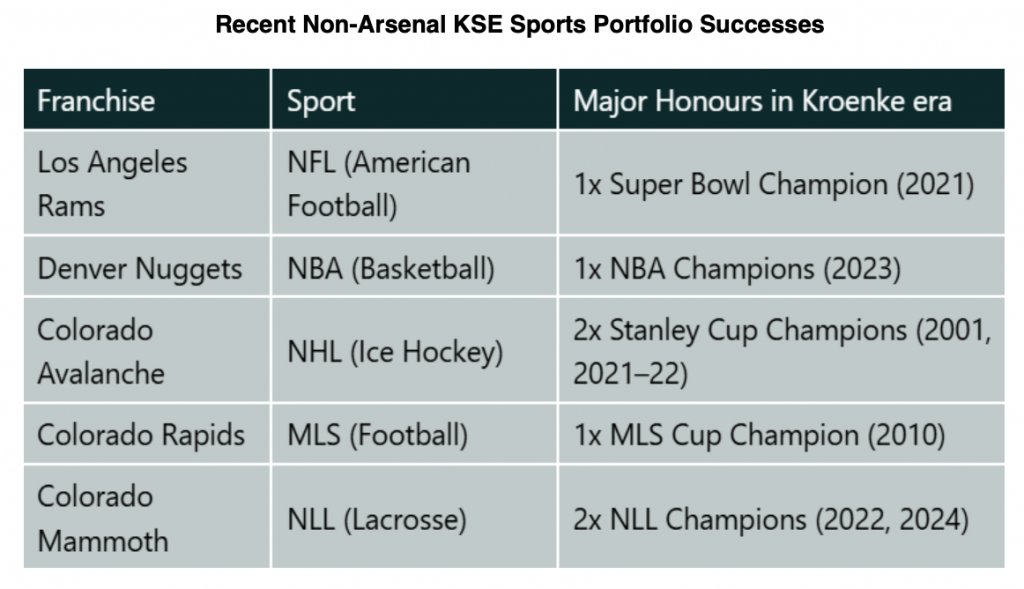
Similarly, it took 8 years of KSE ownership for The LA Rams to make the NFL play-offs, since when they have been regulars, as well as winning the Super Bowl. The Denver Nuggets have in recent years won the NBA championship as have the Colorado Avalanche in ice hockey. Clearly KSE is committed to sporting success.

However, it is notable that none of the KSE achievements, on an individual club basis, form part of what could be called a period of domination, as we have seen down the years in football. Perhaps the sheer scale and financial power required to do so in US sports make this a struggle; Perhaps the structural differences in the way the North American leagues work – e.g. draft systems, no relegation or promotion – make comparisons difficult or indeed unhelpful; Perhaps the North American leagues are in rather more of a “steady state” – hugely profitable with few if any new entrants, creating a situation where, for the ownership at least, there is little incentive to strive to create dynastic sporting success. In contrast, perhaps the Premier League rather more resembles a gold rush; New owners are coming in all the time; few profits are being made; but those owners with sufficient foresight and capacity to invest will win the day.

Arsenal, while not being profitable – true of almost all Premier League clubs – is highly cash generative, with revenues growing fast, aided by a now fully functioning commercial department. It makes sense for KSE to continue to back the club. All of this financial supercharging is designed to create an improved platform for sporting success for the club. And the model has, in large part, worked for the other clubs within the KSE sports portfolio. This is hugely encouraging from the perspective of us as fans. We crave the prolonged period of success we achieved in the 1930s and, to a lesser extent, in the early Wenger years.

Conclusions
I would expect to see further focused investment on the playing side in order to maintain our current competitiveness. As I write we are linked with all manner of top players, likely to require significant fees and wages. We are currently top of the pile in the Premier League. Our competitors will not stand still. City have already spent a Sheikh’s ransom on Anderson from Forest. Even the lowly neighbours are getting in on the act. Whether they have overpaid as a result of the feat of finishing 17th again, only time will tell. We certainly need cover for the players we know are still not physically right; Rice, Saka, Ødegaard, Saliba all went deep into the World Cup and may need extensive rest before being involved in the coming season. White and Timber have both had significant, and recurring, injury problems. This is all before we even consider adding the attacking firepower we all think is necessary to maintain our position and make our football more compelling again.

Perhaps linked to our lack of transfer activity, is the absence of a new contract for the manager, who is now into his final year. Given that Arteta has been absolutely key to our success in the pitch, it is difficult to imagine this is due to any unwillingness on KSE’s part to renew.

At Hale End, Mertesacker’s successor has been announced. I expect the Academy to continue to focus on raising the quality of players it produces, benefitting the first team. I also expect to see a greater focus on monetising the players produced. In comparison with Academies at City, Chelsea and even Liverpool, we seem to find it difficult to sell on home-grown players in volume for top prices. Such players, from an accounting and PSR standpoint, generate pure profit. This approach is something of a balancing act, however. I for one would not wish to see the Arsenal academy turned into a factory production line, treating young players as little more than indentured serfs. The soft side of Mertesacker’s reign is something the club ought to try to keep as a central tenet.

Overall, KSE ownership has thus far been a great benefit to Arsenal. After initial teething troubles, which nearly required a wholesale extraction, they have behaved as well as ownership of a medium-to-large business can. They understand that the aims of the fans – almost solely focused on the playing side – and their own aims – maximising the value of their investment – need to knit together. The have delivered a massive improvement in competitiveness both in the Premiership and Champions’ League and the title we all wanted in the Premier League. Neither have they been deaf towards the softer, cultural side, with Josh Kroenke in particular appearing to buy into what Arsenal means to us. Who would have thought that would be the case back in April 2021?

Sixteen Arsenal players joined national squads for Trump’s World Cup Extravaganza and Fan Exploitation Event. As a result, Gooners, should they so wish, could have had an interest in several teams other than their own national side.

Raya, Zubimendi and Merino: Spain

Saliba: France

Gabriel and Martinelli: Brazil

Hincapié: Ecuador

Rice, Saka, Eze and Madueke: England

Ødegaard: Norway

Havertz: Germany

Gyökeres: Sweden

Trossard: Belgium

Timber joined but had to pull out of the Netherlands squad

To this list we can add ten Gunner alumni: 

Tierney: Scotland

Xhaka: Switzerland

Kolasinac: Bosnia

Balogun, Turner and Trusty: USA

Ryan: Australia

Tomiyasu: Japan

Pépé: Ivory Coast

Martinez: Argentina

Ospina: Columbia.

I found the bloated group stages pretty dull and watched very few matches. This was primarily because most games looked uninteresting at a competitive level: either totally mismatched or both poor; or broadcast times were inconvenient. To be fair, some of those games that appeared mismatched on paper proved more difficult for established powers to negotiate than either they or I expected. There is also a school of thought in the Goonerverse, with which I have some sympathy, that this overblown jamboree is merely a distraction and, primarily represents a significant threat to the welfare of our best players, particularly to those who were running on fumes at the end of last season or were carrying injuries. A summer on a sun lounger with copious Factor 50 or leisurely exploration of some of the world’s finest museums and art galleries might have been far more beneficial. However, players clearly view participation in a World Cup differently.

Among those who left early, Tierney had a couple of unspectacular cameos for Scotland – no reprise of his superb qualifying goal; Hincapié apparently played well for Ecuador but achieved notoriety as only the second player to see red for covering his mouth when asking an opponent the time of day; Martinelli scored a crucial 95th minute winner for Brazil from a penetrating pass from alleged Arsenal prospect Guimaraes, to take Brazil past Japan; Gabriel looked somewhat less secure than usual without Saliba to his right; pleasingly, Tomiyasu looked solid at centre-back for Japan after all his fitness travails; Havertz led the line well for Germany and scored three goals; Gyökeres worked hard for Sweden, looked good at times, scored one goal in their romp against Tunisia but was in Saliba’s pocket when Sweden meekly lost to France; Kolasinac looked reasonably solid but barely mobile at centre back for Bosnia; Pépé had some moments for Ivory Coast and scored their two goals against Curacao to secure second place in the group; Balogun had an excellent start to the tournament with a couple of goals but achieved notoriety as the beneficiary of a POTUS phone call to Infantino arranging ‘suspension’ of his one match suspension for a red card; Trusty looked busy but unspectacular for the Trump Allstars; Ryan’s sole appearance for Australia was as a surprise goalkeeper substitute for a penalty shoot-out against Egypt – he didn’t save any; was Ospina actually there?

Up to the quarter finals, Arsenal players had contributed directly to 20 World Cup goals, the most of any Premier League club. Although the ‘Round of 16’ threw up a few interesting games (Mexico vs England, Brazil vs Norway and Argentina vs Egypt), the competition became interesting at the quarter-final stage. Arsenal player involvement remained prominent. The only team in the quarter-finals without a player with an Arsenal connection was Morocco (if we ignore rumours of ‘strong interest’ in Bouaddi). Saliba had played in every game for France since the group stages, despite rumours of a back issue and sciatica. This was said to have required pre-match pain-killing injections and to involve the possibility of surgery before next season. However, he wasn’t called upon to do anything strenuous in France’s quarter-final as Morocco were surprisingly passive throughout.

After Spain’s quarter-final victory, Merino had started only one game but had made 5 substitute appearances and spectacularly provided their ‘get out of jail card’ with two late winners in consecutive knock-out rounds to help Spain reach the semi-finals for only the second time in their history. Meanwhile we had seen only cheer-leader duties for Zubimendi and Raya. In contrast, Trossard started every game for Belgium, scored a pair of goals against New Zealand, and had a couple of outstanding performances. However, in the quarter final, he played on the right to accommodate Doku, and, while busy but not overly influential, was surprisingly hooked after an hour. Nonetheless, he was probably Belgium’s best player in the tournament.

England squeezed past Norway for whom Ødegaard had looked in good form and contributed three assists on their way to their first ever quarter-final. He produced another good performance here, dictating the pace of the game as when at his best for Arsenal. All four Arsenal players in England’s squad played a part in this quarter-final. Rice started but looked a shadow of his normal self, clearly drained by the illness reported earlier in the week. His lacklustre performance was unsurprising when it was revealed that he had been bed bound for nearly three days before the match! Montezuma’s revenge? He was hooked at half-time – much to his relief, I suspect. Madueke also started, contributed a few dribbles and crosses but, as is too common with him, provided little useful end product and was rightly replaced by Saka at half-time. Saka still looked below his best but contributed far more than Madueke and dinked several tempting balls to the far post that none of England’s front men met. Up to this point, Saka had started only twice and had come on as a sub four times, contributing three assists but no goals. I was impressed by how carefully Tuchel had managed his minutes but his ongoing fitness was clearly a concern. Eze came on for Rice at half time, taking over Bellingham’s ’10’ role with the latter dropping into Rice’s deeper role but the Arsenal man failed to seize his opportunity and fortunately for England, Bellingham was moved back into his starting position when James replaced Gordon midway through the second half and Eze was moved wide but, sadly, to no greater impact.

The fourth quarter final featured an ex-Arsenal player on each side and a player of tentative interest. The rehabilitated prodigal son, Xhaka, captained Switzerland, and the shameless exhibitionist, Martinez was glove-butler for Argentina. The alleged player of interest, (imho, a remote possibility), was Alvarez, who, almost certainly, seems destined for Barcelona. He scored Argentina’s critical second goal in extra time, and it was a cracker! Xhaka had an influential World Cup throughout, scoring a penalty in a rout of Bosnia and acting as mainspring of the Swiss mechanism but his team-mates lacked flair and fell short against Argentina, in part as a result of a second yellow card for a foolish dive just after Switzerland scored an equaliser. Martinez wasn’t tested much in the match but might have done better for Switzerland’s goal.

And so, there were just 4 teams left. In the semi-finals, the teams with the largest Arsenal representation, England (4) and Spain (3) were both competing for the privilege of reaching just their second World Cup Final. In the first semi-final, France, including one of our defensive rocks and an alleged transfer target in Barcola, faced Spain. France’s only Gunner had a major, perhaps decisive impact on the outcome. Saliba collapsed off the ball after 30 minutes with no-one near him. Later it emerged that this was due to his back problem and sciatica. At that point, France were trailing 1-0 and, thereafter, neither looked as defensively secure nor likely to get back into the game against a Spanish side that was imperious throughout and ran out deserved 2-0 winners. As has become Spain’s normal practice, Merino came on as a late substitute but on this occasion didn’t score. Once again, neither Raya nor Zubimendi got off the bench.

Only Declan Rice, of England’s Arsenal contingent, played in the semi-final against Argentina, having confidently asserted in a pre-match interview that he had fully recovered from the illness that had impaired his quarter final performance. Indeed, Rice played well for 60 minutes and his driving run and lay-off to Rogers was key to England’s goal. Alongside Anderson and Bellingham, he was instrumental in denying Argentina’s playmakers space and time until England scored. However, after 60 minutes, Rice and James both looked ‘leggy’ and England ceded possession and midfield control and, as a result, came under repeated waves of Argentinian attack (including alleged Arsenal transfer target Alvarez). Rice’s and James’ belated replacements, O’Reilly and Burn, failed to stiffen England’s resistance and the rest is history.

Despite his strange substitutions against Argentina, I did think that Tuchel had managed Saka’s minutes pretty well, given the concerns about his fitness, but starting Saka and Rice along with Eze in the meaningless third place play-off seemed perverse. At least Rice had the honour of captaining his country. Saliba dropped out of the French team due to his back issue and his absence proved significant. 

From kick-off, the Arsenal players took control of this game as England showed far more desire than France. Rice opened the scoring from 22 yards in under 3 minutes after a driving run from near halfway. Saka was bursting regularly down the right, had a goal correctly ruled off-side then had a shot deflected for a corner from which Konsa headed in Rice’s trademark corner for 2-0. On 36 minutes, a superb Saka ball out of defence set Rashford free who fluffed his one-on-one with the keeper but eventually returned the ball to Saka who passed it into the net. Before half-time, Saka ran through the centre of the French defence onto a beautiful Eze through ball and slotted it home. England were in dreamland! However, the second half was a different story and France played as well as they had done in this World Cup. They scored three – the third pure artistry – and Olise missed three but on 87 minutes, Saka completed his hat-trick from the penalty spot to stretch the lead after Spence was fouled in the box. However, Dembélé pulled France back to 5-4 before Bellingham scored a superb solo goal. Once again, as Rice’s legs looked to have become heavy, England’s midfield had been overrun. However, the late addition of Bellingham and Anderson restored midfield force to secure the bronze medals. Reassuringly, in his post match interview, Saka protested, “I’m fit! I’m fit!” On the other hand, at the end of the game, Rice looked completely spent and he collapsed to the ground. It was good to see Rice, later, share a joke on the pitch with a very relaxed looking Saliba. All three Arsenal players selected in the semi-final for England gave excellent performances. Unsurprisingly, Madueke did not get off the bench.

There were no Arsenal players on the field when the final commenced and this was a turgid affair between a technically excellent Spain and a gang of Argentinian spoilers sent out with a clear anti-football strategy under the eyes of a passive referee who failed to use his cards early in the game to restrain the South Americans’ violent tendencies. At least the referee did eventually find his cards. Spain’s victory had to await three key changes that influenced proceedings: Merino joining the fray on 75 minutes, Fernandez getting a deserved second yellow on 90+3 minutes and Zubimendi replacing Rodri on 99 minutes. Merino was heavily involved at both ends of the pitch, crafting a goal for Williams on 96 minutes that was harshly disallowed because Otomendi collapsed when Merino’s heel brushed his toe, later heading inches wide when a hat-trick of winning goals beckoned while at the other end he made several key interceptions and took a Messi shot full in the face; meanwhile, adding to Spain’s midfield dominance, he suffered several bouts of Argentinian GBH. On 99 minutes, Zubimendi replaced ‘the player of the tournament’ for his first minutes of this World Cup; he was quietly efficient, making the change seamless. Seven minutes later, Torres scored Spain’s winner. As usual, Raya was a cheerleader and he warmly hugged his glove-butler rival Simón after the final whistle. The game was dreadful, the result was justice and, truly, a victory for football!

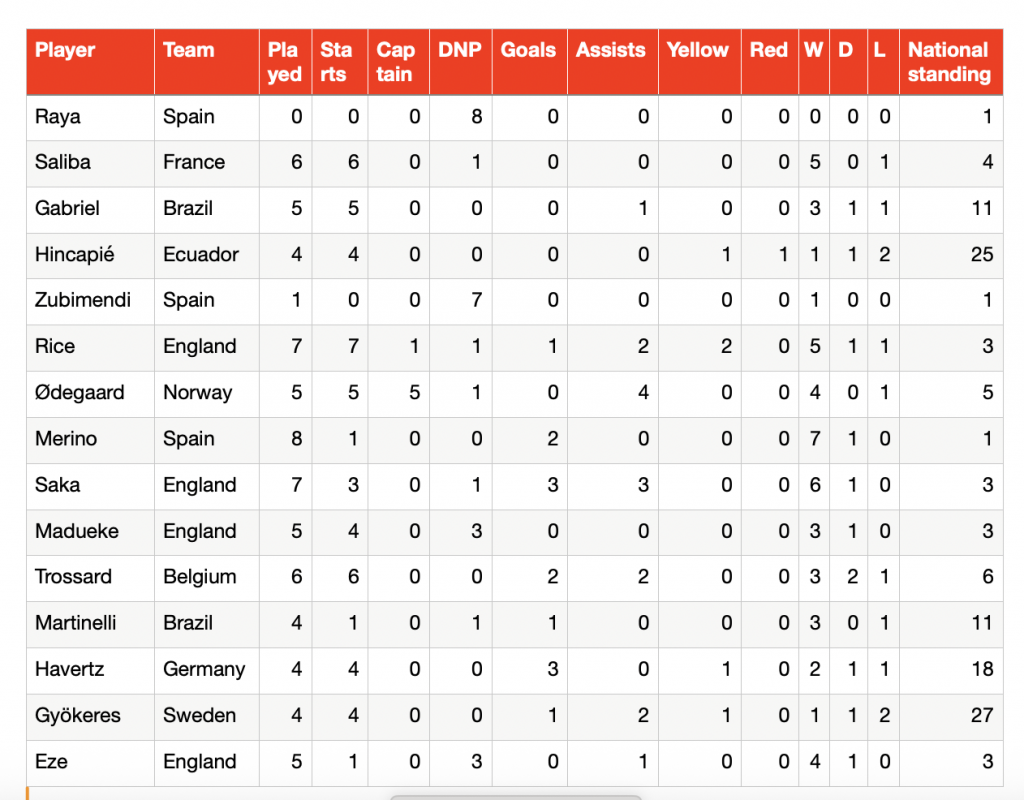
The contributions to the World Cup of the players on Arsenal’s books when it commenced are summarised in the table below based on data from soccer world cups dot com.

Data from soccer world cups dot com.

As the dust settles on another World Cup, we can begin to assess its impact on Arsenal’s forthcoming season. Clearly, the biggest concern has to be Saliba who had apparently been managing a back problem since late last season that culminated in his collapse against Spain. We wait with bated breath to learn whether he requires surgery which will doubtless impose a long absence. Hence the reported interest in Konsa and Stones. Saka’s performance and hat-trick in England’s last game and his assertion of fitness allayed the anxiety generated by his non-appearance as England drowned in waves of Argentinian attacks without an out-ball. I am optimistic that he will be fine after a rest and will be champing at the bit to make an impact on his return, as hopefully will Declan Rice, who looked even more in need of R&R than anyone else in England’s squad and there are rumours of longstanding neuralgia in a thigh. Clearly, Madueke will benefit from more work on his final ball over the summer. I am sure the Spanish Gunners will be looking forward to first team action in August, as will their team-mates scattered among the also rans.

A final word is required on this calumny of a competition, soiled by attempts to satisfy an obsession with maximising revenue which led to sponsored ‘hydration-breaks’ (aka commercial breaks) whether needed or not, an allegedly execrable 30 minute half-time show (as reported to me as I didn’t watch it) to give the final the air of the Super Bowl, countdowns to kick-offs (yuck!), a meddling POTUS, and the introduction of souvenir rings for players, mimicking a Super Bowl tradition. Hopefully, we will leave Disneyfication behind as football leaves Trump’s U.S. and returns to its traditional homelands.

The soul of the game has certainly been damaged by this competition. Hopefully, football will recover but, unfortunately, I fear that Infantino and his Cosa Nostra will have other plans.

I started writing this when I had a bit of free time. I wasn’t really sure what wanted to say. Nearly four hours later I had written this. It’s longer than I planned, and nothing if not sincere. I’m not normally one for spoilers, but if you haven’t got time for a long read then the short version is that I like Mikel Arteta. Otherwise, make yourself a cuppa, or pour your tipple of choice, and settle in.

No-One Likes Me. I Don’t Care
In the wake of last season’s title triumph, there was a slew of articles about Mikel Arteta. Revisionism was the order of the day (although many a snide remark made it through) but, to the surprise of no-one, as soon as he won something big it was time to reevaluate his unusual methods.

Mikel Arteta is not particularly popular outside of Arsenal football club. Hell, since he came through the doors there have been plenty of Gooners who have derided him and wanted him fired. I had the deep misfortune to watch last season’s home game against Brighton sitting next to one. He spent half the match shouting about how Arteta would never win anything and should be sacked. We won the match, 2-1, on the way to winning the league. But at the time, this chap was not to know we were going to win the league. Still, we had a manager who had taken us from a position of being a million miles away from Liverpool and City to three consecutive second place finishes and clearly being one of the best teams in Europe. Under most circumstances, you might assume that such a miracle worker would be revered and loved in his home stadium. Or, at least, would not be openly heckled. No such luck.

Mikel Arteta gets a bad press. Pundits, journos and morons on Twitter have led a strange campaign to denigrate his work and laugh at his methods. The All Or Nothing documentary saw him employ some unusual tactics to motivate a group of twenty-something millionaires. The hard of thinking were unable to grasp that these efforts were specifically tailored for the actual people he was leading and so labelled them ‘cringe’ because they would be laughed at if your boss at the office tried them on Monday morning. Or, just possibly, they realised that he was gonna turn Arsenal into a winning force again and wanted to caricature and ridicule him before he got the chance. As usual, he simply ignored the lot of it for the irrelevancy it was and got on with his own business. Remind me, how’s that going so far?

He is also characterised as being emotionally cold. I find this so weird. I would guess that he talks about ‘love’ more than any other manager. The scenes around the world where people came together to celebrate our league win were everything he has spent years going on about: bringing all our people together and feeling the energy and love.

He values family and community above almost all things, and one of his definitions of community is ‘everyone who supports Arsenal Football Club’. He makes no more distinction than that, and much like the club, he welcomes anyone and everyone who wants to jump on the boat (please see BtM if you need to purchase some wellies).

Sure, he can straight-bat pressers when he judges it in the club’s best interest, but when the time is right, he is thoughtful, passionate, kind and, dare I say it, actually quite funny!

He has huge emotional intelligence, and our entire squad clearly feel understood and know they can talk to him, and that he appreciates them and values them as human beings. Contrary to the false portrayal of him in the media, literally no-one who actually knows the man describes him as cold at all. It is just that he knows when it is the time for joking and when it is the time to work hard. And when it is time for hard work… he focuses on working hard. Joking goes out the window. No-one at the elite end of anything is unable to flick that switch, so why he gets hung out to dry for it is beyond me. He can be incredibly engaging and charismatic when he wants to be. Although, weirdly, you may have heard it here first.

Would You Risk It For A Biscuit?
There is that old phrase that says, “I’d run through a wall for him”. (Or her, of course!) It is usually said about a leader, to show how committed his charges are. It is a level of devotion that few leaders truly inspire. In a football context, it requires having a vision of something greater than just kicking a ball well. And it requires being able to communicate that vision in such a way that others take it into their hearts. It is about identity. Can you be the type of person who gives everything they have to the cause? The capacity to do this comes from understanding that doing so will both change you, turning you into someone capable of more than you believed possible, but will also contribute to a shared body of work that will elevate all involved to more than the sum of their parts; will create something that matters; something meaningful. No-one runs through a brick wall unless it is important that they do.

Great leaders inspire this way. There are plenty of military examples, both wartime political leaders and generals, but also further down the chain. In the life of, let’s say, a special forces unit, the possibility of death means that no-one gives their devotion frivolously, but there are countless soldiers who would follow their first-in-command into any danger without a moment’s hesitation. It is not only because these people are brave. It is because they believe in something bigger than they are. It is because they trust the man in front implicitly (as well as the other members of their team) and they know that there is no-one more committed to the cause than he is. It is because they know that no matter how hard they work, or how much they give, they will still never put quite as much into it as he does (unless, one day, they take up his mantle – but that is another story). They want to impress their leader. They want him to be proud of them. But they also understand that he also wants what is best for them, rather than what is best for himself. Great leaders want their teams, and each and every player on them, to ‘be the best they can be’ (to borrow from SteveT a well-known phrase oft heard in Dave’s bar!) They believe unshakably in the worthiness of what they are building. And they would never ask anyone to run through a wall that they would not run through themselves.

Leaders like this are rare. Those with vision, who can explain the vision, who are willing to work relentlessly and single-mindedly towards its completion. Those whose words align perfectly with their actions. Those people who keep their word, whose integrity is beyond doubt. When you meet someone like this in your life, and they want you to be a part of their team, it is an almost intoxicating feeling. There is a sense that if you fail to follow this person, if you give up, or get off the ride too early in search of some other destiny, that you will always look back with regret and wonder what could have been.

Just ask the Arsenal squad. Saliba, Saka, Gabriel and Rice (to choose a few big names) were all part of Arteta’s teams that came second three years in a row. They were all wanted by some of the biggest clubs in the world. Their commitment never wavered. One signed for us when we were far from the safe bet, the other three signed new contracts. If you hear any of them talk about their boss, all you hear is how brilliant he is. All our new signings say some version of, “when I spoke to him face-to-face, I was convinced.”

Martin Ødegaard’s exact words: “I challenge anyone to come away from a meeting with Arteta and not believe everything he tells you.” There are some pretty good liars in the world. There are a lot of people who believe their own hype but are unable to follow through. Our manager is not one of them. He delivers.

And the players know it. I did enjoy this from Declan Rice as he celebrated our title triumph, “They pointed and they laughed, they ain’t laughing now. I love this club and I love this manager”. He did not say that he loves the club and the team. I am sure he does, but he knows the manager is the linchpin. Arteta is the most valuable person at the club, and our most valuable player knows it.

Stand For Something, Or Fall For Anything
Mikel Arteta is a man of character. Character has, unfortunately, gone out of fashion. Indeed, it is seen as an old-fashioned idea. The sort of thing they had in the 1950s before society became more liberal and embraced freedom of individual expression. As many new attitudes were adopted (lots of them good!) the idea of ‘character’ was seen more as constraint to the new possibilities life held than a personal compass that would help one to navigate its increasing complexity. It got mixed up with other ideas of its time and was foolishly let go along with many attitudes more appropriately discarded. We lost the baby with the bathwater, much to our detriment. How many twitter threads have you seen discussing the value of character, in any context whatsoever? It might be good if there were a few more.

Now, perhaps there is an element of semantics to this. Many young people have a firm moral compass, even if they don’t think about the way they hold their personal ‘non-negotiables’ in terms of character. But, at its simplest, perhaps that is all character is? Defining what stuff in your life is ‘non-negotiable’ and then sticking to it. So few people manage this. It sounds simple but it is incredibly hard. We either don’t know what we stand for, and/or we are flexible about what we stand for, depending on what we could gain from ignoring it, or the level of hassle and hardship it would cause us to die on that hill. Unfortunately, that does not work; you either have character, or you don’t. You can’t turn it on and off.

For me, this has been a hard-won lesson, and an important one. When I was younger, I was quite wishy-washy about character. Especially about one aspect that Arteta spoke about in no uncertain terms even in his first presser: accountability. In my early twenties, I quite liked taking the credit for my good actions and finding excuses for my bad ones. As I got older, I realised that having my own creed and trying hard to stick to it was a personal necessity. I came to realise it was not the restriction I had imagined, but a path to a deeper freedom. For me, learning to take full accountability for my own actions has been a life-changing endeavour (and one which is still very much an on-going journey!)

It must then be said that I am fairly attuned to people who have their own codes and treat them as non-negotiable. It stands out to me. I aspire to be a person like this and admire those who are. Even those whose codes are completely different to my own. I might not like the goal – I may have reservations about the wisdom or compassion of someone who works hard with commitment to achieve something that makes the world worse – but I can, and do, respect the process. Having the courage of your convictions is rarely easy, whatever those convictions may be.

So, when Arteta gave his first press conference, I was sold. Of course, I kept a careful eye on his actions afterwards, to make sure that he followed through on what he said he was going to do. But I was not really worried. He looked into the eyes of the journos, and all of us watching and he laid out a vision. I believed it. It was laced with character. It was all about behaving a certain way and using the foundations of how we live to achieve our goals. “Every day is important. Every act is important.” Think about that. He was saying that every single act you take needs to be in-line with your goals. And when you live like that, even the goals themselves begin to shrink away. It is why I am not worried about us being mentally underprepared to defend our title. We have been trying to win a PL for four years. The way we have gone about that has gone far beyond the initial goal of winning a league – it has become who we are. You can’t turn that off. One goal leads to another. The work is never done. It is not about achieving something, it is about being something. If you truly are what you are trying to be, the trophies will come as an inevitability. He said it all along, didn’t he? Trust the process.

Empty Hands, Full Heart
I have a framed photograph of Mikel Arteta in my house. It is the only framed photo in my home that is not of a family member. I got it about three years ago. It is just him, alone, walking across the Emirates pitch, dressed in black, nothing in his hands. When I bought it, I was absolutely sure that in years to come, there would be many, many images of him holding trophies. But I did not want one of them. I already knew the thing that inspired me was not an image of a man who had followed his own vision with integrity and determination and emerged victorious. Instead, what spoke to me was an image of a man who was brave enough to follow his vision with integrity and determination when there was no guarantee of success. When the odds were stacked against him. Because it highlights a beautiful paradox; he chooses to live that way, but in order to be true to himself, he does not really have a choice. He lives the way he has to. If he does that fully and completely, then he has already won. Maybe not on the pitch, but in the much bigger game of life. Who could do more?

There is nothing fake about our manager. What you see is what you get. On a very fundamental level, Mikel Arteta is an embodiment of my vision of what it is to be a human being. Or, at least, to be a good one. Never mind his qualities as a football manager, I believe he is a good man.

That, for me, is such an important point, because it is where I differ from many (presumably the vast majority of) Arsenal fans. The fact that Mikel Arteta is, in my opinion, one of the three best football managers in the world (Pep and Enrique, since you asked) is almost incidental to why I value him. It is also why I’ve barely mentioned anything about his actual, and prodigious, skills as a manager. His understanding of football is above elite level. I do not believe you would need two hands to count the human beings on the planet who understand the beautiful game better than he does. I also believe he will win us more league titles and the Champions League.

But that is not what is most important to me about Mikel Arteta. He is essentially the perfect Arsenal manager. He wins major trophies. It may not be what is most important to me personally, but it is certainly right up there with the requirement of being Arsenal manager! But more than that, every day he does what Arsène asked of all of us, of all the Arsenal lovers – he takes care of the values of this club.

He knows what those values are. He lives by those values. He takes responsibility. That’s a neat summation of pretty much everything I aspire to be as a person. Of course I love him.

And he is one of us. He too, is an Arsenal lover. Of all the incredible and inspirational people in the world, this one shares my love of Arsenal. The thing that he pours himself into is the same thing that has been a fundamental part of my life since I was a little boy. All his hard work is to do something that makes me happy! We’ve all felt how strongly we can connect to anyone in the world in those moments when passion for our club bursts through. But it is rare indeed to feel that shared passion with a genius football manager whose impeccable personal qualities resonate deeply with who I am.

Arsène came along when I was still a boy. I looked up to him, but I was not yet a man myself (at least not when he started!) and so I could not appreciate his qualities in the same way as an adult could. And for all his fine qualities, Arsène had his blind spots. So does Arteta, but Arsène lacked his protégé’s fervent desire to correct his faults and learn from his mistakes. That stubborn streak only revealed itself over time and was not easy for me to grasp as young man with some good qualities of my own, but plenty of blind spots too.

I can see Mikel a bit more clearly. He is truly special, and he won’t be around forever. We will seriously miss him when he goes. How long until then? Well, who can say? He abruptly hung up his boots rather than play on, simply because he decided he had to be able to give everything at the highest level or it was not worth it. He will do the same thing when he leaves us. Whenever he does not have the energy for another season and he needs a break, he will just step away, regardless of how successful the previous season was. But we need to hang on to him until he is ready to call time.

Chapman, Wenger and Arteta are our three greatest managers. Time will tell who is the greatest, but I know who my money is on.

However, no matter how much he wins, to me personally, the man I admire most is not the multiple-trophy winning genius who scales new heights of glory at our club. It is the man with the empty hands and the twinkle in his eye who lives and breathes the values of this club.

Done and Dusted
So, yeah, that’s my tuppence worth. Although I suspect you’ve got quite good value from me for your modest outlay. Still, I think I’ve said what I needed to say. Cheers for sticking with it.

Given who I am, and who he is to me, of course I’ve always been on Mikel Arteta’s side. No choice, really.

I’m just glad he’s never asked me to run through a wall.

Until next time, ‘holics.

We have now reached our third and final group of ‘Holics who chose to answer TTG’s questions, with the premise that a season like 2025/26 doesn’t come around very often.  These ‘Holics are likewise spread about the globe, and bound to each other and you, dear reader, by the same love of the Arsenal. As with the answers from the first two groups, they cover a lot of the most important issues that came up during this amazing season.

This last time around we have answers from Potsticker, N7 Gooner, Countryman100, ClockEndRider, and Noosa Gooner. Enjoy!

What was the highlight of last season for you?
PS: Winning the league, of course.  If you’re asking what specific games or goals were highlights, it’s all a bit blurry now.  My wife says I have memory loss.  However, I always have TTG’s excellent season reviews to refresh my memory.
N7: Tempted to opt for the Dowman goal – it’s not often you get to watch a teenager announce himself with a drumroll beforehand. But it’s difficult to look beyond the night we won the title. 
Two decades of waiting, hoping, stressing, and occasionally praying to a deity I don’t even believe in, all suddenly and messily collapsed into a carnival of joy that felt like it would never end. A hundred thousand people outside the Emirates without a ball being kicked, old friends lit up by pure delight, strangers hugged by the dozen. City slain, the monkey off our back, the Champs League final still to come and Spurs teetering on the precipice.
It doesn’t get a great deal better than that.
C100: Beating Newcastle at St James’s with a last minute Gabriel winner from a corner
CER: The highlight of last season was the spontaneous descending on the Emirates after C130y had signally failed to beat Bournemouth in May, giving us the league. The sheer numbers, when taken alongside the incredibly joyous, friendly atmosphere, with absolutely no sign of trouble, facilitated by quite excellent light-touch policing, made this evening one almost to put alongside the celebrations after Anfield ’89, about which I have written in the past. For the young people – by which I mean anyone who hadn’t experienced winning the league before- including my son, 21CG- this was their Anfield ’89 moment. And they grasped it with élan. Well played, All!
Noosa: Winning and silencing the naysayers / non-believers and Eze’s hat trick against the Spuds. Brilliant.

When did you believe we were going to win the title?
N7: I fancied us more or less all season, by simple virtue of the fact that I didn’t think this City team were all that good. But the moment I knew in my gut it was our year was full time at the Etihad. A defeat that felt like a victory.
We’d outplayed them on the day, and although we were being all but written off, we didn’t look remotely ready to fold. As Haaland and co celebrated on the pitch the cameras panned to our players and you could see it written on their faces: this isn’t the beginning of the end, it’s the end of the beginning. And, despite everything, it’s still in our hands.
I never thought we’d stumble after that, and I never believed city would get out of Everton and Bournemouth intact. They were an overhyped boogeyman who simply gave up too many chances and rode their luck too hard to be favourites. We were better than them, and we were about to finally prove it.
C100: When we beat West Ham at the London stadium.
CER: This is a tough one. I first believed in October. This was a packed month, which saw consecutive victories against Olympiakos, West Ham, Fulham, Atletico Madrid (a whupping), Crystal Palace and Brighton. We were dispatching teams in some style, some of whom had given us difficulties in the past. It was at this point that our little group decided to buy flights and accommodation for Budapest. 
Noosa: When Citeh drew at Bournemouth.
PS: When I submitted my Predictathon entry.

Who was your player of the season?
C100: Declan Rice.
CER: My player of the season was Declan Rice. Not terribly controversial, but he displayed everything you want from a player of the season. Effort, steely determination, no small amount of skill, the charisma to inspire others and hold the team together during the wobbles which are almost always part of a title winning season. And he did all this while still remaining an approachable, charming human being.The complete player.
Noosa: David Raya – had a few brainfarts but saved us so many points he was critical to winning the title.
PS: I can’t pick out any single player of the season – as has been pointed out by many others, winning the league and getting to the finals of the Champions League was a collective effort.
N7: Two standouts for me, and two contrasting moments that felt like flip sides of the same coin.
Declan Rice at the end of the City defeat, the look on his face, the shake of the head and the immortal declaration: “it’s not over”. A player who had run harder, faster and longer than anyone else and who always felt like he wouldn’t allow us to finish second again. That sheer force of will that we felt all season long, embodied entirely in two seconds that will probably come to be the defining image of his career.
Then, on the other hand, Gabriel. Who spent the season monstering everyone on corners, who seemed to relish every fight he found himself in, and who – while he may lack the sheer class of Saliba – absolutely embodied a defence which very clearly hated to concede goals. 
His face at the end of the PSG game, after the missed penalty, will stay with me for a long time. He didn’t look upset, or chastened. He looked as if, even in that moment of defeat, he was making sure to drink it all in, to use it as fuel for whatever comes next. As if missing that penalty was an essential part of some invisible process that will get him to where he needs to be. He looked focused and hungry. Never seen that in a player after a moment like that before – a mentality well beyond elite.
On balance, I’m going to say Rice, with Gabriel’s time perhaps still to come.

Who would you most like us to buy?
CER: Morgan Rogers. He can strengthen the left wing position, while also providing excellent central attacking midfield cover. After the unnecessarily long World Cup, we are going to need cover for Rice, Zubimendi and Ødegaard. We also need to beef up the wide left options. Another Swiss Army Knife of a player. Right up Arteta’s straße.
Noosa: Whoever Mikel thinks will improve us.
PS: I don’t follow other teams unless they are playing Arsenal.  I can tell Messi and Mbappe apart, but otherwise if they don’t play for Arsenal, I haven’t much of a clue about other players.
N7: The absolute dream signing would be Khvicha Kvaratskhelia. Quite probably the best player on the planet right now, certainly the highest score in a game of Scrabble, and he plays in the spot where the first XI could most obviously be upgraded. 
Perhaps more realistically, I do like the look of Kroupi, not least for his part in unleashing ecstasy in North London. An Arsenal legend before he even wears the shirt.
C100: Khvicha Kvaratskhelia (won’t happen though).

Do you believe we had fair media coverage last season in general?
Noosa: The only media coverage I regularly read is that in the online Guardian where some correspondents are favourable and some not so much. I don’t really bother with much else other than Goonerholic and the commentators and various links therein.
Beyond that, as long as we win, who cares?
PS: I mainly get my football news from here, Arseblog, the Guardian, and the Athletic, and whatever links are posted in the drinks.  The Guardian and The Athletic are OK.  As for other media, and the wider internet, I don’t follow them or care what they say about Arsenal.  From some of the drinks I gather that other media are biased against Arsenal, but I don’t really know. 
N7: God no. One idiot after another talking nonsense about the team, inventing controversies and attempting to load pressure onto the players. If anything this was the season where it became clear that just because you’re paranoid doesn’t mean they’re not out to get you – the season when even level headed fans of other clubs started to ask why the media seems to loathe us so much. Why scoring from corners should suddenly have become an affront.
But, let’s be honest, it made the victory all the sweeter, didn’t it? All those morons, choking on their daft opinions in the face of the apparently invincible Guardiola being felled, one of the better sides we’ve seen in the Champions League being taken all the way to the wire and a million Gooners lining the streets in celebration. Come back and chat more shit next season, we’ll make you look foolish again if you like.
Oh, and special mention here for Gary “our biggest supporter” Neville. The moron’s moron, who spent the season blighting our commentary by simple virtue of the fact that he cannot distinguish what is actually happening from what he would like to happen.
C100: Some were fair and balanced (e.g. Alan Shearer, Wayne Rooney, Jonathan Liew). Most were not. A low point was when Alan Pardew said if we won the league we should have an asterisk attached to it. Utter cockwomble. Martin Samuel in The Times was a total anti-Arsenal bandwagon. He’s a well balanced man with a chip on each shoulder. 
CER: Our media coverage was quite frankly bizarre. In a world where flagrant breaches of financial rules are well known and publicised – breaches which have given other clubs unfair leverage in forcing their way to the top and winning honours – we were unreasonably attacked for scoring goals from set pieces. Because after all, this is an evil which must be stopped. The usual exercises in whataboutery and lookoverthereism were brought out by organisations which are not staffed by fools. It was plain and simple bias. The ways in which both TV and print media toadied around the offending clubs while creating non-existent causes to whip up their ever-supine, compliant viewer/readerships were quite simply nauseating to me.

Has Mikel Arteta done enough to warrant a statue at the Emirates yet?
PS: I’m not a big statue fan and if a statue is absolutely necessary, I prefer the subject to be dead first.  George Graham won more silverware for Arsenal but has baggage – is he up for statuehood?  Arteta may end up being a saint, but it’s too early for a discussion of statues.
N7: Not yet. He’ll have to settle for the one in my back garden for now.
C100: Not yet but he will!
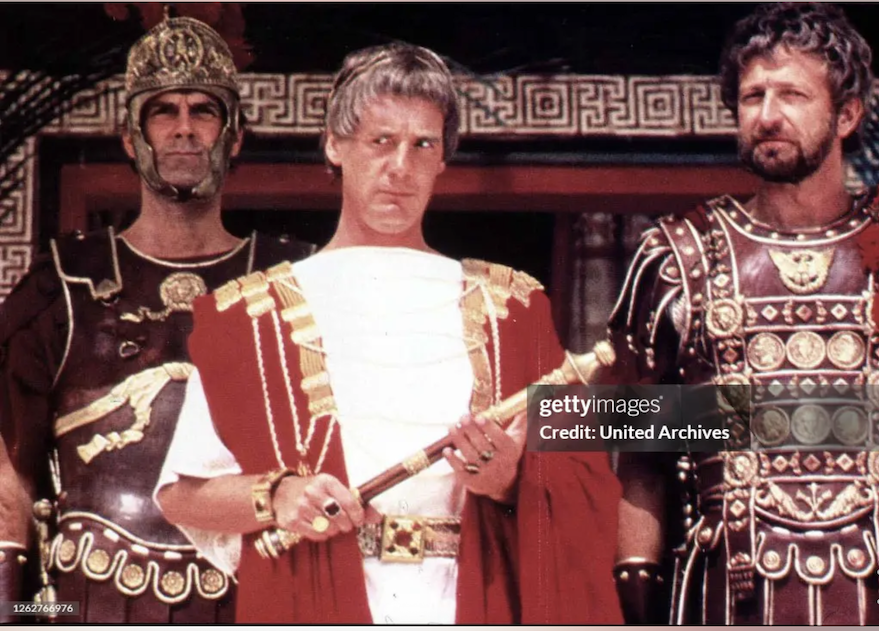
CER: I am not one for putting up statues, frankly, until the recipients have died. Arteta is clearly a great manager, who has turned round the club 180 degrees from chaos of the latter Wenger and Emery years and should be held in the highest regard. Quite apart from a, to my mind, healthy disrespect for this modernist desire to stauarise too much, it doesn’t allow for the perspective which the passage of time brings. Arteta is a young man. Who knows what else he can do. Or where his career will take him. The Roman Emperors used to be very fond of putting up their statues while alive. Evidence is plentiful to show that many of these statues, as well as coins and other representations were defaced on death, a process known as Damnatio Memoriae- the condemnation of the memory.  I’m not suggesting that Arteta is a modern day Caligula or Caracalla. But I believe public representations need to be few in number and large in significance. And all great men are flawed. Often the flaws are only made visible when they are no longer around.
Noosa: Yes – but obviously this should not happen until his tenure at the club has finished and his service can be fully appreciated. Current managers/players should not be immortalized until after they’ve left.

Is this the start of a golden era for the club or will our rivals catch us up very quickly?
N7: It was certainly a golden fortnight. I don’t remember many happier spells in my decades following Arsenal than the run from winning the second leg against Atletico to parade day. A rolling party that reminded English football what it should mean to win a title, and what a bloodless, low fat substitute we’ve been lumbered with during these City years.
Is it the start of a golden era? The head says wait and see, football rarely works out as you imagine it will. The heart says what are you talking about, we’re going to absolutely smash everyone next season. Heart wins.
C100: Golden era incoming.
CER: I very much hope it is the former.   With the manager and his team in place – and these need to be locked down – and with an ownership which seems to be committed to putting the necessary foundations and underpinnings in place, from the medical team to improvements at the academy as well as significant strengthening in terms of senior management,  it is quite possible that we may be witnessing the next great movement of our club – from a great, storied club, into a super-club.  We have a way to go yet.
Noosa: There’s a handful of clubs each season who have a chance of the title including the usual suspects and often a couple of outsiders. I’m not convinced that we are yet far enough ahead to comfortably look over our shoulders at who is chasing in what may be more photo finishes. But, strengthen the squad where needs must and we may yet see Mikel continue to add trophies for some years to come.
PS: Arsenal are in a good position to build on this season and go on a trophy run.  Still waiting for the hammer to drop on C115y.  Haha.

Are you concerned about the attractiveness of Arsenal’s football ?
C100: Not one bit. I watched George Graham’s teams!
CER: I believe that Arteta’s core style of play is attacking and exciting. He played this way for the 3 years in which we finished second. I think what we witnessed last season was a pragmatic replacement of this, sublimating his natural style in order to ensure we converted our overall play into a major trophy. Lest we forget, we had significant injuries and time out impacting 4 of our attacking players – Saka, Ødegaard, Havertz and Merino – and yet we still ended up 2nd top scorers.  I hope to see some ceiling-raising attacking players added (Morgan Rogers, please!) in the close season. This, along with an improvement in injuries will go a long way to seeing our play return from what at times was a real grind back to the broad, sunlit uplands of exciting, attacking football.
Noosa: I loved the golden years of peak Wengerball, who didn’t, but that didn’t always mean we won.
I loved winning under George Graham even though some of the football was often hard to watch.
I would rather the pragmatic approach usually taken by MA if it means we always win.
Winning has its own compensations and I prefer winning sometimes ugly to losing attractively.
PS: Nah, as long as Arsenal wins trophies.  That said, I don’t think Arsenal played unattractive football. 
N7: Concerned probably isn’t the right word. There’s a certain joy to triumphing while playing this style, and I’d be lying if I didn’t admit that there were moments I fantasised about winning the Champs League final purely via goals from corners, simply for the glorious boiling of piss in industrial quantities such a turn of events would inevitably provoke.
But – and this is the important bit – like most of us, I remain a child of the Wenger years. Football should be more art than science, and there’s at least some obligation to shoot for grace and beauty, isn’t there? To lift fan from seat and send you home babbling about the magic you just witnessed.
There were spells in the season where it felt as if we treated games as a horrible formality to be endured, rather than an opportunity to express our talents, and I’d like to see that trend reversed next term. Play quicker, take more risks and don’t be so afraid of a football match breaking out.
Unless it’s PSG again, in which case the corners thing still absolutely stands.

What other comments do you have on last season ?
CER: None.
Noosa: We should have had a penalty for the foul on Madueke and Big Ears was ours to add to the title – assuming that Eze didn’t subsequently take the spotty.
Up The Arse.
PS: N/A.
N7: It was a strange one. I don’t remember there being so much pain and worry in any other season where we ended up winning the title; the sense of quite so much riding on it. The question coming round and round again; but are we actually any good?
Without the balm of pretty football the end result becomes a bit of a raw need, doesn’t it. The paths between victory and defeat bisect at sharper angles, every game becomes a mini referendum on style and the overriding sense becomes of watching a formula one car race endlessly along a cliff edge.
The season, taken as a whole, felt like one of those narrow victories you watch from behind the sofa. But which, when screened again the following morning, knowing the result, all the jeopardy removed, take on a different complexion. Never really in doubt, always under control. 
With the fear gone, the moments come back to you. Martinelli against City, Gabriel against Newcastle. The Spurs games. Eze against Leverkeusen. Dowman every time he touched the ball. The period in the late Autumn where it felt like we might never concede again. Ødegaard coming on against West Ham and deciding the game. Hincapie’s shorts coming down, You can actually enjoy it all to the full, without that big “what if” hanging overhead.
So that’s what I wish for next season. More of those magic moments, with the team and support liberated from The Fear. Nothing left to prove to anyone, a great side free to express itself properly, the weight of history lifted. Second season Eze, post-GCSEs Dowman, and Gabriel to score the winner in the Champs League final. Mikel Arteta’s army, Arsenal through and through. COYG.
C100: With the exception of Wolves and the CC cup final, the 17 away games I went to were huge fun. The never-ending singing of our away fans lifts the spirit and must hugely encourage the team. The atmosphere at home has also been terrific.
The emergence of Max Dowman has been hugely exciting. That goal against Everton, right in front of us on the North Bank, will live forever in the memories. 

I love it when we score from corners!


Annnnnnd, we have one last Gooner to provide answers. Due to an email snafu, we missed Depressed Gooner’s responses, which should have been included in one of these three review posts. So, to make up for that, they get a special section here.

What was (were) your favourite moment(s) of last season?
DG: Gabrielle Martinelli lobbing the city keeper for what looked to be an unlikely last gasp equaliser has to be up there with but nothing will beat Max Dowman and his wonder goal moment, a true superstar in the making announced himself magnificently.

Who was your player of the season?
DG: Declan Rice without doubt, you could go for almost anybody in the team but his “its not over yet” to Martin Ødegaard turned out to be a decisive moment in the season, he never stopped believing and I think that belief transmitted itself throughout the team.

Are you concerned about the attractiveness of Arsenal’s football?
DG: Justified but understandable as playing pretty football for the previous seasons had not reaped rewards but I really would not want to see that every week again next season, when we cut loose we could be just as devastating while still holding that near impregnable defence back line to their impressively high standards.

When did you believe we were going to win the title?
DG: Being depressive is a bloody curse, I never believed it until it happened, truthfully it is still hard to believe, but a bloody good reason to smile every day.

Do you envisage that this is the start of a golden era in Arsenal history or will our rivals soon catch up?
DG:
If we start strongly and don’t do a Liverpool then I believe it could be a new golden era for Arsenal, I still think Mikel is learning on the job even now and hopefully will take some of that don’t concede even if it means not scoring another approach off the table more often as that did lead to some wobbles at times.

Has Mikel Arteta done enough to warrant a statue at the Emirates yet?
DG:
Not yet, rinse and repeat and not yet becomes hell yes.

Who would you most like us to sign next season?
DG:
A world class striker, we still miss that magic ingredient, maybe we could tempt Haaland away now Pep’s gone but would we want that egotistical nightmare.

Have you any other thoughts or comments about where Arsenal is at the moment?
DG:
I’m certainly big enough to admit when I’m wrong, still not sold on Madueke or Gyökeres completely but consider me on board the last carriage of the Mikel train, he only went and bloody well did it, as mentioned above there were times last season when we showed nervousness in games we should have been comfortable in as we decided not to go for a second goal and it cost us, but I’m hopeful that he has learnt from that and it was just cautious pragmatism to get us over the line and will be seen a lot less next season.


And that’s that. We hope you enjoyed reading the answers as much as those who submitted them enjoyed doing so. We’ve got some upcoming pieces from GSD, Bathgooner, and CER to look forward to, so be sure to check back regularly…

« Newer Posts - Older Posts »