In Arsenal’s first post-Interlull outing since losing the League Cup final on March 22nd, a stretch of 12 match-free days, on Saturday the Gunners travel to Championship side Southampton in the FA Cup quarterfinals. It is an important occasion for Arsenal in several ways, firstly to regain positive momentum to erase any doubts that may have arisen from Arsenal’s first loss since their home defeat to Manchester United in late January. Secondly, advancing in this competition is likely to be an essential aspect of Arsenal’s bid to make their season as successful as it has looked for months like it could be, with the prospect of multiple trophies looming at the end of our long exertions.
In his pre-match comments Mikel Arteta addressed the need for the team to get back to winning ways, saying: “When (we) didn’t manage to win that final…what you have to take on board is how this is going to make us stronger for the final push of the season.” With Arsenal now still competing in only three competitions, Arteta must balance his priorities just right in all team selection decisions in order to get the most out of his injury-strapped squad, and Saturday’s match provides the first of many interesting tests for him in that regard between now and the end of the season.
The opposition
As of March 22nd, the Saints were in sixth place in the Championship table after going unbeaten in their last 12 league games, qualifying them for the ultimate spot in the promotion play-offs, level on points with Wrexham but ahead of the Welsh side on goal difference. Southampton travel to Wrexham next Tuesday in what must surely be a massive league fixture in their minds, to be played the same afternoon Arsenal face Sporting Lisbon in the away leg of their Champions League quarterfinal.
Earlier this season Southampton’s board appointed manager Tonda Eckert after he performed well in an interim role, and few second tier clubs have been in better form since that time. It may be too late for Saints to earn an automatic return to the Premier League, but they have moved into the top six places in the Championship and their positive momentum will be difficult to contain. Saints have beaten Doncaster, Leicester and Fulham to reach this quarterfinal, and they are enjoying their best FA Cup run since reaching this stage in 2022. The Saints are currently unbeaten in 14 games in all competitions, having won 10 of those matches.
Arsenal team news
Our long-missing and long-missed captain Martin Odegaard is said to be targeting this tie for a return from a knee injury after laboring to get back to full fitness, but Arteta will be closely monitoring his minutes so he may or may not be in the starting XI.
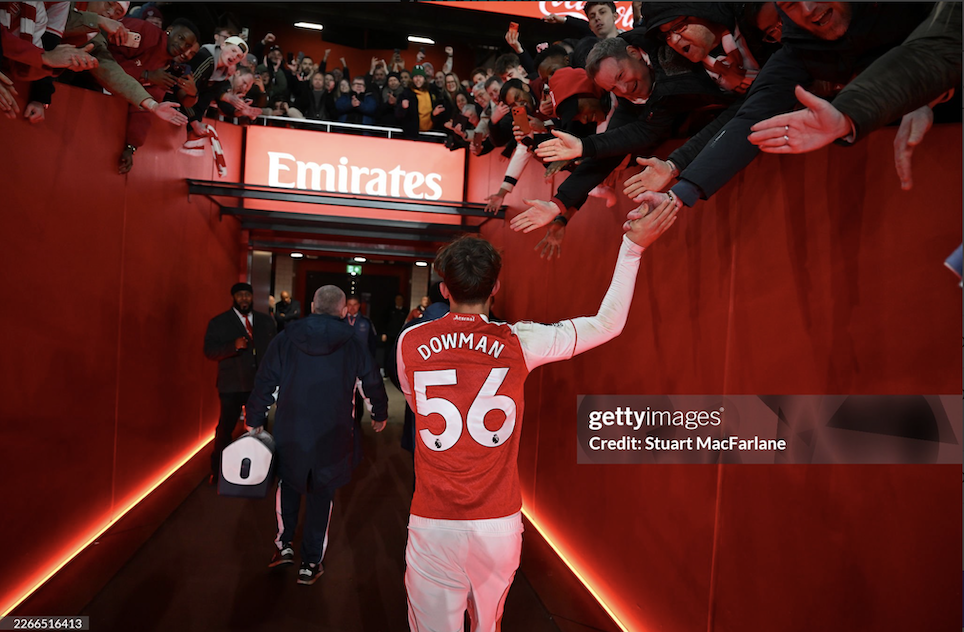
Arsenal had 15 first-team players involved in international matches, with Calafiori, Gyokeres and Norgaard in World Cup play-offs. All three of them played a significant number of minutes during their respective qualifiers. Saka, Rice, Madueke and White were originally all in the senior England squad, which faced Uruguay and Japan at Wembley, but only White featured much as the others thankfully dropped out early. Lewis-Skelly and Setford had England Under-21 Euro qualifiers away to Andorra and home in Norwich. Dowman played England under-19s Euro qualifiers in Portugal.
Martinelli traveled to North America for Brazil’s two friendlies. Raya, Zubimendi and Mosquera joined Spain for two home matches, while Havertz’s Germany played away and home. Hincapie joined Ecuador for two matches played in Europe. Eze (calf), Saliba (ankle), Gabriel (knee), Timber (groin) and Trossard (hip) missed their respective internationals due to injury, but the latter four could be in line for a return.
Madueke (knee) and Hincapie (hamstring) both limped out of their friendlies on the first Friday so both of them will miss this tie. In his pre-match presser Arteta said Madueke could be back in the squad within a few days: “Noni was really worried after he was (recently) out for six weeks. But no, he’s nowhere near that injury, so that was really good news.” But Arteta’s assessment of Hincapie’s injury was not so positive, confirming that it will keep the defender out for an indefinite period of time.
Arsenal XI
Largely by process of elimination, selecting players who are healthy and capable of winning the tie but who have travelled minimally during the break, Arteta seems to have little choice but to pick a side like this one:
Kepa
White Mosquera Gabriel Lewis-Skelly
Dowman Rice Havertz
Saka Jesus Trossard
Even if Arteta were to play a significantly weakened lineup, by bringing in Salmon at right back for instance, the Gunners should still have enough to win but must be ready for a proper battle because Saints will certainly offer significant resistance and threat in front of their own fans. Arsenal’s Tuesday Champions League quarterfinal at Sporting Lisbon must be an important consideration in Arteta’s planning, and he may not risk a number of top players or minimize the number of minutes they play. On Friday, el jefe described his thought process like this: “We are going to make the strongest line-ups and decisions that we possibly can to win every competition. We are two or three games away in the FA Cup and we know how important that competition is for us.”
Taking Arteta at his word, I expect Arsenal to come out with a spring in their step and to blow away a determined Saints side with a touch of quality here and a staunch determination all around to finish the season strongly. 3-0 to the away side.
After Wenger had led us to a Double in his first full season, expectation was high in N5. One problem – we had an implacable opponent in Manchester United whose treble in 1999 could so, so easily have been another Arsenal double. Further frustration in Copenhagen and in the FA Cup against Liverpool led to scurrilous suggestions that Wenger wasn’t a winner. As a result, Arsenal spent heavily in 2001-2 to remodel their side in an effort to clinch another title.
Ned tells us how that adventure played out, though primarily based in New York, the centre of the worst terrorist outrage in history, just as the 2001-2 season began.
TTG
2001-2: A Double Double
North Bank Ned
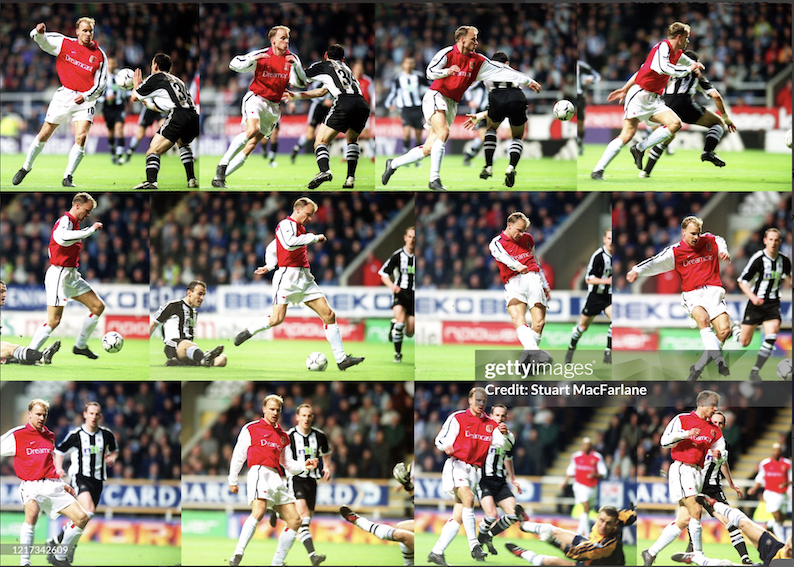
A composite image of Dennis Bergkamp’s goal for Arsenal during the League match at St James’ Park, Newcastle United on March 2, 2002.
What do you remember of that season and where were you mainly watching it?
I was mostly in New York. However, the 9/11 attacks occurred shortly after the season started. I had clear sight lines to the World Trade Center and saw both towers fall. Football took a back seat for quite a while.
It was a strangely detached season for an Englishman in New York, for other reasons, too. At that time, there was little coverage of English football in US newspapers. No inescapable social media. No blogsphere to talk about; Arseblog started in the second half of the season. Only occasional live games and highlights were available on a couple of cable channels. You had to find a dodgy internet stream or go to a sports bar that subscribed to the very expensive multi-sport cable service exclusively for sports bars, and was (a) open in the morning as some kick-offs were at 7 am, (b) showed English football, and (c) had our game on.
I didn’t discover Nevada Smith’s, the soccer pub in Greenwich Village, until quite late in the season. It is now sadly long-gone, a victim of the developer’s wrecking ball. It was many a New York Gooner’s matchday venue of choice, despite being a Man U bar. Geordies and Scousers congregated there, but followers of many clubs showed up as it showed so many games. I remember Roma fans there, sipping espresso. Heaven knows where they got it at that hour. Guinness was the breakfast of champions in Nevada Smith’s.
We had finished second for several seasons and fallen short in the UEFA Cup in 2000 and the FA Cup where we were unluckily beaten by Liverpool in 2001. Discontent with Wenger was growing among some Gooners. Do you see parallels with Arteta’s position now?
History can repeat itself, but never does so exactly. There wasn’t the toxicity of social media then. Abramovich and his £50-note-firing tanks were still a couple of seasons away. Another difference was that Wenger had already put serious silverware in the trophy room with the 1997-98 double.
The footballing competition with Fergie’s Man U was the dominant narrative —and the 6-1 defeat at the OT the previous season still stung. They had, after all, won seven of the previous nine Premiership titles. You saw Man U shirts all over NYC then, just as you see Barca and Real Madrid shirts today.
My recollection is that the Arsenal board, not Wenger, faced more criticism for failing to match United’s big-name signings due to the strict wage structure. But the FA Cup loss to Liverpool prompted the need for a rebuild. Still, I was a long way away, so it all might have looked very different from the other side of the pond.
Thierry Henry suggested we needed ‘a fox in the box’ before the season started, notwithstanding that we already had him. It’s interesting, isn’t it, that criticism of Arsenal as a goalscoring force is nothing new!
AW had bought a ‘fox-in-the-box’ before the start of the season: Francis Jeffers from Everton. Perhaps ‘cub-in-the-box’ would be more accurate, as Jeffers was 20. But he couldn’t stay fit, and when he was, he couldn’t displace TH14 or Sylvain Wiltord from the side. He was shipped back to Everton after playing fewer than two dozen games over two seasons. Checking the records, I see we still scored more goals in 2001-02 than every other team except Man U. They had van Nistelrooy, Solskjaer, and Cole up front. TH14 was the league’s leading scorer. It wasn’t as if Freddie Ljungberg, Bobby Pires, and Dennis Bergkamp couldn’t put the ball in the net.
Returning to your initial point, the club has a tradition of iconic, goal-scoring, big No 9s, and as fans, we feel somewhat bereft without one. That might explain the high expectations and disappointment surrounding Gyökeres.
We had been very active in the transfer market before the season. Which buys did you think worked particularly well?
It’s hard to think of anything that tops getting Sol Campbell on a Bosman. Beyond Jeffers, Giovanni van Bronckhorst, from Rangers, was the big-money arrival — when £8 million was big money. An OK buy, but had he not torn his knee ligaments early, we wouldn’t have gone out and bought Gilberto. Richard Wright arrived from Ipswich to be David Seaman’s long-term replacement, but that man would ultimately prove to be Mad Jens.
The best acquisition after Campbell was arguably Kolo Toure in the January window for £150,000, although he didn’t make his debut until the following season. Almost imperceptibly, the Invincibles were falling into place.
The sensation in the close season had been the acquisition of Sol Campbell. Can you remember the impact of that signing and how important a signing did you consider he was?
It was a stunning surprise, especially as he was coming down the Seven Sisters Road. You will remember the papers called it ‘a coup’. Wenger got kudos for talking Sol into signing for us rather than going to Barca or Inter, both top European clubs then and both of whom had offered him much better money. I seem to remember Denis Bergkamp presciently saying Sol was the missing piece of the jigsaw that would let the team break Fergie’s grip on the title.
Who do you think were our key players in our league title success that year?
The first choice team was probably: Seaman, Lauren, Campbell, Keown, Cole, Ljungberg, Vieira, Parlour, Pires, Bergkamp, Wiltord, Henry. I know that is twelve, but they were the most used players. We wouldn’t have won the double without one of them. If I had the invidious task of choosing just one, I would go for Denis Bergkamp for (i) being the bridge between the 1997-98 double side and what would become the Invincibles and (ii) his pirouette at St James’s Park—when he flipped the ball past the defender’s right side, spun past him on his left, and slotted home. That goal is up there with my all-time greatest Arsenal goals.
Can you remember when you began to believe we could win the league that season?
Looking back over the season’s records, I was surprised to see that we didn’t lose a game from Christmas on. I remember the title race being wide open well into April, with Man U and Liverpool on unbeaten runs. Liverpool weren’t mathematically out of contention until they lost at White Hart Lane with three games to go, their first loss since January, and Man U had only lost once over the same period. We still needed at least a draw at Old Trafford in the penultimate game. Having won the Cup the previous weekend, that was never in doubt!
We clinched the league at Old Trafford . Do you remember that night and how did you celebrate it?
It wasn’t a night for me, but a working Wednesday afternoon. So like, many of the games that season, I didn’t see it. I don’t think I was able to check the score until the game was over. So there was no real celebration until going to watch the last game of the season against Everton.
What other thoughts do you have about that season?
I can’t emphasise enough how monumental it felt to break Fergie’s three-year grip on the title after being runners-up each time — and having had to put up with the insufferable smugness of Man U fans for the duration. It was also pleasing to leave them without any silverware for the first time in what seemed like forever. However, in many ways, it proved to be a false dawn, and we had hit peak Wenger with this double team. The Invincibles were its Indian Summer, but they didn’t win as much as they should have and were quickly broken up. The move to the Emirates would soon have to be paid for and the slow slide into ‘fourth-place-is-a trophy’ territory started, Wenger said at the end of the 2001-02 season there had been a shift of power, which perhaps was true in relation to Man U, but he missed the shifting of the tectonic plates under both clubs that the money that was about to come into the game would cause.
Another Double was the outcome of a season that began with global turmoil. Wenger’s claims that Arsenal could go unbeaten all season were mocked after Rooney’s super strike but the team was growing into a very special force . Gunnersaurus Stunt Double takes up the story in 2003 and describes the most important season in Arsenal history.
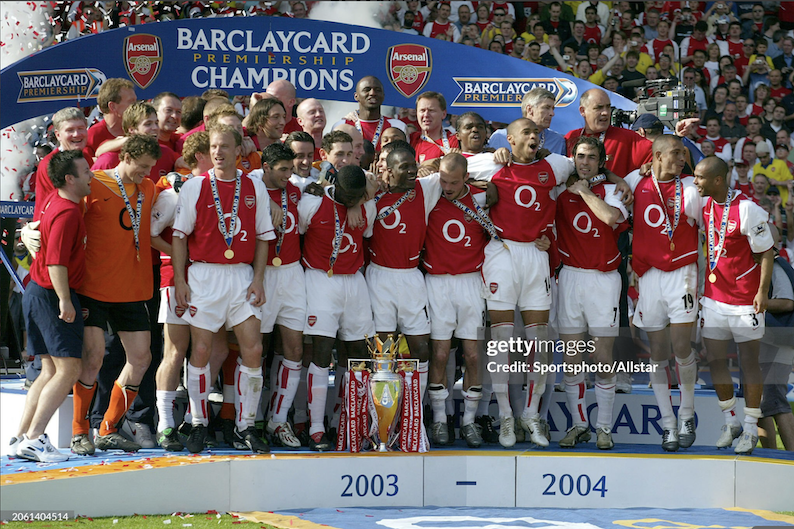
As we strive to clinch this year’s title we are besieged with jibes and barbs from the media that Arsenal have not won the title for 22 years . But that last title win was VERY special because during that season Arsenal were unbeaten. As Thierry Henry paraded around Highbury, he made the point that no team had ever achieved anything like Arsenal did that season. Gunnersaurus Stunt Double takes us back to that wonderful campaign and relives his memories of the Invincibles.
TTG
The Invincible Season
Gunnersaurus Stunt Double
The 2003/4 season was a particularly special season which saw Arsenal claim the title of ‘The Invincibles’. Did you ever anticipate that such an achievement was really possible at the start of the season?
A couple of years before the Invincibles season, Arsene Wenger had publicly stated that he thought it possible for a team to go unbeaten through an entire league season. For this hubris/idiocy, he was lambasted in the media. The British press at the time were, at best, xenophobic. They much preferred Sir Alex Ferguson, who they saw as one of their own, to the upstart Frenchman. Sure, they knew he was good, but they never resisted a chance to stick the boot in. Stop me if this sounds familiar.
Back then the media could get away with stuff that they can’t anymore. They regularly complained that Arsenal did not have enough English players and fumed over our starting lineups. We were ruining the English game. (Just like we are today).
Every year we would go to Old Trafford where thousands of their fans would chant that our manager was a paedophile. Just let that sink in; it is beyond disgraceful. But the fact that it was accepted by the media is even worse. It was not called out. We, and he in particular, just had to get on with it, amidst vile treatment. So, like most Arsenal fans, I was bullish about our team and our manager as the season approached. Everyone was out to get us. Bring it on.
In truth, I thought the inexcusable media were probably right that going an entire season unbeaten was a pipe dream. It seemed too big an ask, and as the season began it was not on my mind. I was optimistic about our title chances, but that was at least partly because I always am. I’ve squinted at plenty of worse opening day team-sheets and convinced myself we could win a title if things went our way. What usually happened was Wenger took us to a fourth-place finish that, judging by the calibre of our squad, looked like a bloody miracle, but in 2003, that was still years down the line. We were still at our peak.
Did you get a chance to see many games that season?
I was a teenager during this season, and so the journey our team went on meant a huge amount to me because, well, everything did. I did not get to a game at Highbury that year, and this was before the various online ways of watching a match that exist now, so I was limited to watching the matches on Sky, listening on the radio, watching highlights on MotD, and (if younger readers can imagine such a thing) reading the newspapers. I suppose I was reading Arseblog by then, but I don’t remember for sure.
At what stage did you realise that we were seeing something special? Were you firstly interested in winning the title or did you always believe that we could go unbeaten throughout the season?
It’s funny to look back given the stature the Invincibles now have, but during that season I felt we drew too many games. We were hard to beat, and tough enough to stand up to some rugged outfits, which I loved. But there were games where I’d watch Bergkamp, Henry, Pires and the rest, and think to myself, how are you lot drawing with Portsmouth? Not in a modern, ‘lose my shit and spray anger all over social’ media kind of way. More in a, ‘this is a top team and you are capable of better’ kind of way. And, of course, I was as scarred as we all were from United teams winning league titles that we should have got over the line. Our failure to win back-to-back league titles during this period still rankles. So, early in the season, every draw felt like it could come back to bite us. No matter how good we ended up being, as it was unfolding it felt like winning the league would be tough enough without saddling the added burden Arsene had willingly drawn down on us with his comments. Sometimes, it felt like he wanted the pressure. Personally, I could have done without it!
We had a wobbly moment when we went out of the Champions League to Chelsea (ouch!) after losing in the Cup to Manchester United. Did you have a temporary loss of faith then? Could we have avoided that Chelsea defeat given we had beaten them three times already that season (sound familiar?).
I don’t want to think about that Wayne Bridge goal. Ever! I still remember feeling sick when it went in. Genuinely nauseous. That is the year we were the best team in the world and other big-name clubs fell away in the CL too. It was there on a plate. The final was Porto v Monaco (hardly a clash of titans) and it spawned the uprising of one Jose Mourinho. Proper sliding doors moment.
For what it is worth, yeah, we could have avoided defeat. The goal that sunk us was the kind of naïve concession that was to become a hallmark of later Wenger teams and that fortunately we don’t see often from Arteta teams. But, ultimately, it’s all a bit ‘if my auntie had balls’. And it all worked out in the end.
The FA Cup loss sucked. By that point, I’d be lying if I said thoughts of the treble were not on my mind. After our ’98 double, I cannot express how pissed off I was that United bettered it a year later. We could all see how good our team was in 03/04, and I dearly wanted to match their achievement. Instead, we went out of both cups in a week and I was gutted. Back then it was hard to imagine us not challenging for top honours every year, but even so, there was the sense of a glorious chance wasted. Getting done by a Man Utd side who were by then miles below us in the league made it no better.
However, it was over that period that we drew at home with Manchester United in the league and then beat Liverpool with that Henry hat-trick to stop our season from falling apart – at least if you believed the hype. So, even though it was a time of tremendous disappointment, it was also the first time that I started to believe we could really go unbeaten. I had hoped that for a while, but by that point there were less than ten games to go, and we had gotten through our toughest tests. Make no mistake, Man Utd could see that we were gunning for something truly special and they wanted to stop us in our tracks. Getting past them without loss felt big. We still had to play Spurs, who would obviously be well up for it, and go to St James’s Park to play a good Newcastle outfit, but it was getting close enough to believe.
Truth be told, it suddenly meant more after the two cup exits. We were strong favourites to win the league, but that team were so good it would have been somehow underwhelming if all they got to show for it was a league title win.
I was also incredibly protective of our club and our manager. The media have never liked Arsenal, and that is just fine. I don’t like them. But I wanted to rub their noses in it after Arsene earned his vindication, did what most people thought was impossible and upset all of the received wisdom about English football. Every one of those nasty, agenda driven journos who piled in on Arsene were close to getting the largest slice of humble pie they’d ever seen (even if, when it did eventually come, many of them lacked the good grace to eat it). Yet, the flipside was clear. If we lost to Leeds, or Birmingham, or whoever, then the entire establishment could breathe a sigh of relief and get on with the happy job of ridiculing us (for getting so close to achieving something they said could not be done). It felt like we were against the world. By that point, I did not care about the draws. 1-1 against Portsmouth was not, in isolation, a brilliant result. But it left us with only two more games to get through, and not losing had become far more important than winning. I was thrilled to get out of Fratton Park with a point!
Every game was stressful. The enormity of the achievement was clear, the simplicity of messing it up equally so. All it took was one bad day, one dodgy penalty and red card (which we were no stranger to!) and it could have all gone wrong. To fall in that final run would have been heart-breaking. We had the league sewn up, but this felt much bigger than a mere league. This was immortality, up for grabs.
When we did it, I was on cloud nine. With hindsight, I suspect that if we had gone on in the cups, we would not have gone unbeaten in the league. I have always rued not winning the CL that year, but in truth, would I have swapped it for the unbeaten season? The answer is no. One team wins the CL every year. It is less of an achievement than what we did in the PL that year. It was also the most Arsene Wenger thing ever; an achievement born out of the twin abilities to dream bigger than anyone else, and to dig his heels in with an almost pathological stubbornness. It was so very Arsenal.
Do you believe any team will ever repeat the feat of going unbeaten all season in the league again?
I cannot see how it will ever be matched. In the last couple of months this season, every time I watch Wolves, I think they are a decent outfit, and they are bottom of the league! The PL has too much strength in depth and is too physically challenging. It took over a hundred years for anyone to do it (since Preston in what we can reasonably say was a very different football landscape) and I don’t think we will see it again.
Do you remember when it became obvious we were going to win the League? Do you remember clinching it at Tottenham and how that felt?
I honestly have no idea exactly when the league felt inevitable and all eyes switched to the unbeaten season. It was a while ago and I tend to remember how I felt much more than I remember individual results, even goals. I am amazed on those occasions when one of our number (often the inimitable Doc Faustus) references some specific Rosicky goal from a group stage game that I cannot recall for love nor money. I never know how other fans do that. Thank God for Youtube.
I do remember feeling incredibly proud of what we had done so far, a sense that it was job done. But also, a strange sense that our brilliance had created a new opportunity that was unlikely to come around again. Winning the league was weird in a way. Until that point, all talk of the unbeaten season could be batted away with ‘we haven’t even won the league yet’. So, after that was done, there was nowhere to hide. It felt like the pressure grew when we won the league, instead of fading away. I don’t think any other team has ever had to face that.
Winning the league at Tottenham was hilarious and brilliant. So, so good. I would have preferred to actually win the match, but watching them celebrate the annoying last-minute equaliser when the result was still enough for us to win the league at their place said everything about the relative aspirations of the two clubs. Always in our shadow.
Who stood out in what was a wonderful team?
It is not possible to pick out one player. That was such a good team, and they carried no-one. But, as I’ve just been thinking about winning the league in the enemy heartland… I love Sol Campbell. I just love him. For him to win the league for Arsenal at WHL was epic. And a sickener for them. Beautiful.
What other reflections do you have on that season?
I was talking a few days ago with a younger Gooner who does not remember any of this. He has never seen us win a league. I could not explain to him what it was like that year. We did not just win it, we managed what may be most remarkable achievement in modern football. It was stunning. And it felt like sticking two fingers up at the world, at all who doubted us. Everything was perfect. Just walking to the shops felt better than it usually would. Arsenal were champions. Arsenal were unbeatable. It was pure magic!
What was best about that team?
Well, there are too many right answers here. It was so strong. But I’ll pick something. I loved how directly we broke. Seeing five, six, seven red shirts just bombing forward in unison, it was like watching the Red Arrows. Backtracking defenders did not know what to do. We were devastating. And such athletes too. Fast, strong, determined, ruthless. But also skilful, with a clarity of thought matched by the ability to execute at breakneck speed. We were a multicultural, multiracial, all-singing, all-dancing, all-fucking behemoth. We tore up the rulebook and did things our way, inspiring a new generation whilst enthralling the longstanding faithful. That team had an impact on football, even society, that few can match. Thierry Henry is still a global icon. Sol Campbell still takes the piss out of Spurs whilst selling phones in big money campaigns. Dennis Bergkamp is known to all Gooners simply as ‘God’.
They were, and are, iconic.
Final thoughts?
For me, it all comes back to the visionary who imagined it all. Even when that team was defending, we always felt that in ten seconds we could have the ball in the back of the opposition’s net. They worked things out for themselves, Le Boss never being too prescriptive in how they played. That team and that achievement itself were the dream of one man, the almost perfect realisation of his football philosophy – right down to not winning any other tournaments in an effort to win the league perfectly. He was always, for better or worse, the most stubborn idealist you will ever encounter. As much as I love everyone associated with that triumph, it can be truly laid at the door of one man, and one man only.
He took more shit than anyone. But now, he gets the glory.
Arsene Wenger, Invincible.
We now hope against hope that Mikel Arteta will lead Arsenal to their fourteenth title , one that will be part of a very special season . Come on you Gunners!
We begin the second part of our look back at Arsenal’s league titles by examining the very controversial 1990-91 season. Trev was kind enough to supply his recollections of what was a momentous season.
TTG
1990-91 –A Controversial Title
Trev
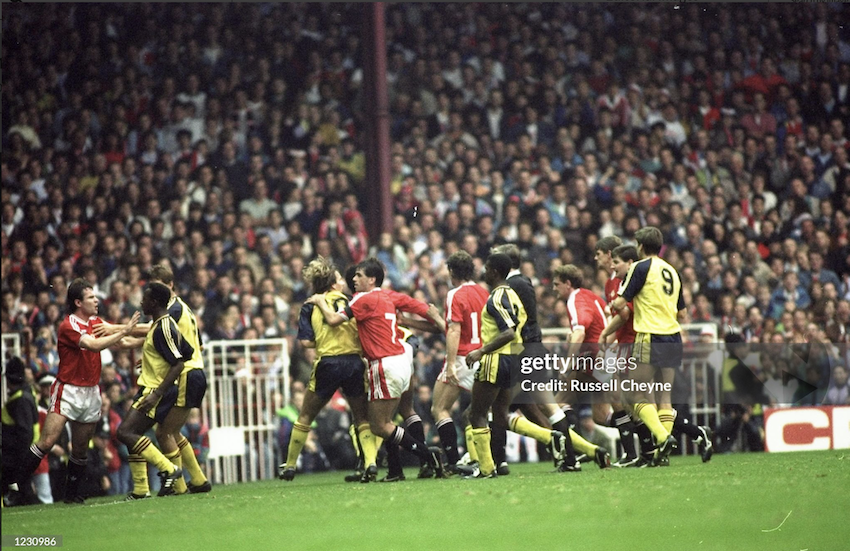
Manchester United and Arsenal players fight on the pitch during the League Division One match at Old Trafford, 20 Oct 1990. Arsenal won the match 1-0.
What were you doing when the 90/91 season began? Were you a regular attender at Highbury and did you get to any away games at that time?
When the 1990/91 season began, I was getting settled into the second year of my Sports Physiotherapy practice. Ironically, I was probably one of my most important patients, having just undergone another couple of knee surgeries as a result of which I had reluctantly decided to give up my North Bank season ticket. So, no, I was not a regular attender at Highbury and away games had sadly become a thing of the past.
We had won the league in 1989 but the following season was rather flat. Were you optimistic when the new season began?
Despite the refreshing of the squad and the eventual success of the new recruits, I can’t say I started the season with great optimism due to the predicament that Tony Adams had got himself into. He was Mr Arsenal and integral to the defence, the team and the spirit of the team.
We’d had a bit of a splurge in the transfer market in the close season, particularly bringing in Seaman in goal and Limpar on the wing. What did you think of the new signings as the season unfolded?
During the summer of 1990, George Graham had decided to update the squad. David Seaman arrived from QPR for a fee of around £4 million as the replacement for John Lukic who headed to Dirty Leeds; Anders Limpar arrived from Cremonese and Andy Linighan was bought from Norwich City as cover for Tony Adams and Steve Bould. Brian Marwood and Martin Hayes left for Sheffield United and Celtic respectively.
David Seaman’s record needs no repeating by me. Andy Linighan proved to be a very able deputy and played a lot more than he would probably have expected – 156 games for Arsenal over 8 seasons and, of course, he scored the winner in the 1993 FA Cup Final – as he had to cover for Tony Adams when he was forced to take a break at Her Majesty’s pleasure. More on that later. Anders Limpar was a big success, scoring 13 goals in his first and title winning season. He was with the club until 1994 and only left when he mysteriously wasn’t offered a new deal by George Graham.
The season featured a points deduction after the ‘brawl’ at Old Trafford. How did you feel about the way that incident was viewed and dealt with?
The “brawl’ at Old Trafford blew up after a bit of a running battle between Nigel Winterburn, Denis Irwin and Brian McClair. Irwin started the trouble with a nasty tackle aimed at Anders Limpar’s ankles. Winterburn, sticking up for his teammate, repaid the favour to Irwin. McClair, who I remember as a persistently nasty piece of work, then took the opportunity to give Nutty’s back a good kicking – payback presumably for Nige taking the piss out of him for missing a penalty.
McClair’s thuggery provided the starting shot for 21 players to rush into the ensuing “brawl”. In truth, most of them were trying to pull the main protagonists apart amidst the flurry of handbags being flung in all directions.
Both clubs admitted their indiscretions and fined some of their own players in a failed attempt to avoid further sanction from the FA. Both teams were fined £50,000 for misconduct and disrepute charges, and both teams were punished with a points deduction. Manchester United were deducted one point while Arsenal – who had been involved in on-field trouble during their home match with Norwich the season before – were handed a two-point deduction.
My memory is that the media, as we’ve grown accustomed to experience, presented Arsenal as the villains of the piece while the fact that Man Utd started the whole thing was barely mentioned. It’s over 30 years ago now. I’ve detested Man Utd ever since and we’ve suffered unfairly at their hands more than enough.
Tony Adams went to prison in December for drink driving. Was he victimised in your view and how did you think the team would respond?
First, some context:
On 6th May 1990 Tony was expected at Heathrow to join his teammates for the end-of-season tour of Singapore. He unfortunately decided to have a couple of beers with some mates before leaving for the airport. A couple turned into far too many at a boozy barbecue in the garden of friends in Essex. He eventually reluctantly accepted he needed to pack and head for Heathrow.
As he wrote in his autobiography, ‘Addicted’: “I did not want to go to Singapore and was beginning to think I might not have left enough time to do what I needed to at home then drive the 60 or so miles to the airport. In fact, I barely got 60 yards.”
While doing almost 80mph in a residential street, he lost control of the car, clipped a telegraph pole, span onto the other side of the road, and head-first into the brick wall of the garden in front of a resident’s house. Thankfully and miraculously neither he nor any other people were harmed.
A breathalyser revealed him to be four times over the legal limit. He was charged with reckless driving and driving with excess alcohol, but was nevertheless released to await trial in court at a later date. In the meantime, Arsenal were able to start the season with Tony Adams still available.
Given the circumstances, I don’t think you could say Tony was victimised by the various public or sporting authorities as his indiscretions could have had catastrophic outcomes. The press, of course, were not slow to make hay but this was serious and bound to attract enormous attention. In December 1990 he was sentenced to four months imprisonment, of which he served two months before his release.
He did recognise his problems with alcohol addiction, as detailed in his book ‘Addicted’, and transformed his life. Ten years later, still trying to atone for his troubles and establish the kind of support he could have done with himself, his charity Sporting Chance was founded in 2000, providing a service for athletes with emotional and mental health problems including various types of addiction.
So, no, he wasn’t really victimised in terms of the punishment he received. However, the media certainly made the most of his situation which was, after all, an illness. As an Arsenal fan though, I can’t talk about this without also mentioning that he went on to play 674 games for the club over 22 years, retiring in August 2002 as the Premier League and FA Cup Double winning captain and, as we knew him, “Mr Arsenal”. To this day I still can’t talk about him without getting a major lump in the throat.
The team in 1990 responded to all this as I knew they would and always did in times of adversity. They fought back and won the league.
What do you remember of the title run-in? Were you always confident we would win the title?
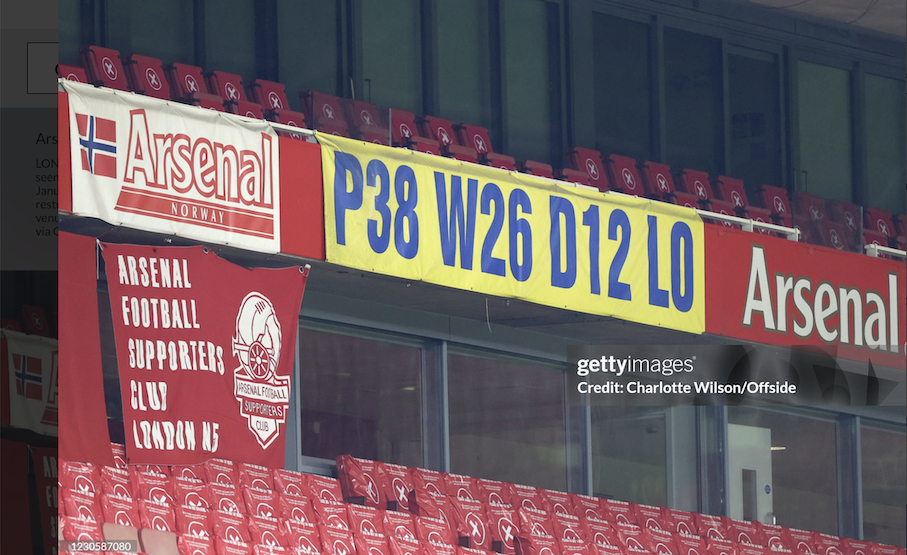
What with getting my practice running and undergoing more knee surgeries, I don’t remember much of individual matches, and neither can I say I was especially confident that we would win the title. What I remember was that we had an almost impenetrable defence, relentlessly drilled by George Graham, that conceded only 18 goals across the season as we became the ‘Almost Invincibles’ losing only once. Despite all that, I do remember being constantly worried that the title would somehow be kept from us by the FA. Our discipline was not good and everyone except Arsenal fans wanted us to lose because they hated our direct style, our hard, mean defence, and our success.
When we won it we were at home to Manchester United that evening. Were you there and do you remember how you celebrated?
No, I wasn’t there due to the recent knee surgery. I do remember the voice of Brian Moore on TV commentary and feeling relieved, smug, proud and elated by myself at home.
That team only lost once all season. Do you think it got the credit it deserved?
It definitely did not get the credit it deserved due, as previously stated, to our direct, uncompromising style of play and admittedly poor disciplinary record which was widely criticised by all around. To lose only once and concede just 18 goals across 38 matches was a tremendous achievement. We had a goal difference of +56 (almost 20 better than Liverpool in second place with +37), and were also the division’s second highest scorers with 74 goals, just 3 behind Liverpool.
It was certainly odd that our mean, direct playing style was the work of George Graham, known during his playing days as Stroller, for his relaxed, elegant skills.
Who, in your view, were the outstanding players that season?
I would nominate two players for that award. Anders Limpar, for his goals and the speed at which he integrated into the team, and Andy Linighan who arrived expecting in all honesty to be a reserve and finished up filling in for months for Tony Adams during his absence, a massive task for a new recruit.
Looking back, how do you reflect on that season?
If I had to do a “What 3 Words” for that season, they would be:
Worry – over what would become of Tony Adams and, therefore, Arsenal.
Defiance – over continuing to love the club everyone else hated.
Pride – that despite everything and everyone, we’d won the league again.
It really was a time of “no-one likes us and we don’t care!”
So what’s new?!
Trev captures the essence of that controversial season superbly. I remember a pivotal game at Anfield round about this time of year. It was effectively a title decider and in the first half they battered us only to find Seaman unbeatable in goal. That season, particularly, he was a cheat code and he operated behind a superb defence. George Graham had created a siege mentality that saw us win the league comfortably that season. Two titles in three years was highly impressive.
Bathgooner takes up the story seven years later. The Graham era has ended ignominiously, Bruce Rioch has come and gone and in his place we have a new coach who assumed control after the start of the 1996-97 season, Arsene Wenger, a Frenchman who arrived from Japan. Arsene Wenger did not waste time in propelling us forward as bathgooner relates.
1997-98 – Arsene Wenger’s First League Title
bathgooner
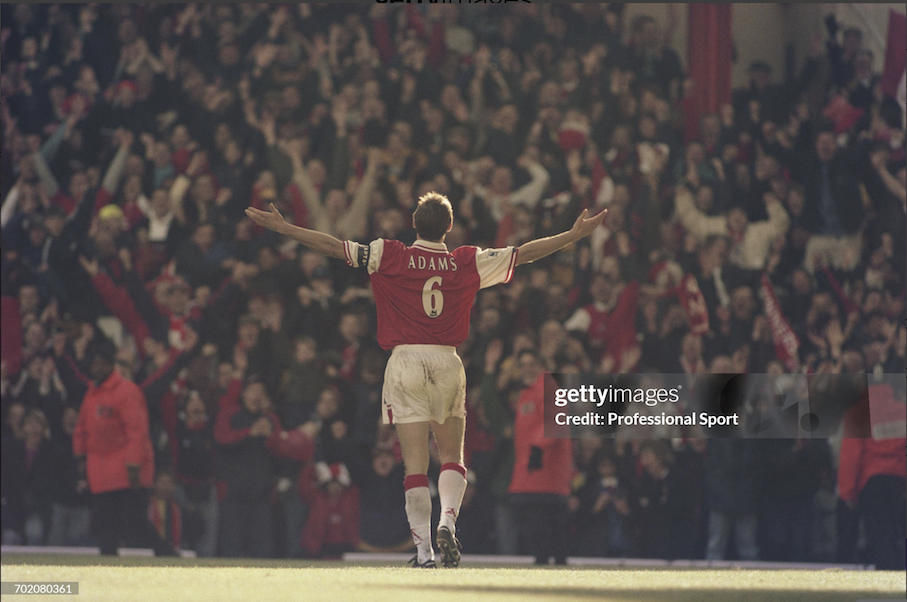
Tony Adams celebrates with open arms after scoring a goal in Arsenal’s 4-0 Premier League victory over Everton at Highbury Stadium, 3rd May 1998.
When the season began Arsene Wenger had been at the club for just over half a season. What impression had he created in those first few months?
In his first year as the Arsenal coach, Arsene Wenger had quickly established a cerebral, almost ‘professorial’ image and had brought transformative players to the club in Vieira and Petit but also, then, he also seemed to have a Zen-like quality on the touchline which over the years, he subsequently lost! Leaks from the dressing room suggested that he quickly revolutionised the lifestyles of the first team players’, not all of whom were happy with the new dietary regimen!
We had been very active in the transfer market in the close season. Did any signings particularly excite you?
I had already been extremely impressed with Arsene’s eye for a player when I saw Vieira come on as a sub against Wednesday the previous season and beat a midfield opponent by chipping the ball over him and then later that season when Anelka joined the forward line. Our style of play was far silkier with his additions and the team certainly looked better prepared to compete than they had looked at the beginning of 96-97. The purchase of Marc Overmars in the 1997 close season was a very exciting prospect and he proved to be even more influential than we had hoped but the player I quickly came to love in 97-98 was Manu Petit who solidified the midfield, covered every blade of grass, complemented Patrick Vieira perfectly and frequently played a sumptuous chip over the opposition defence for Overmars or Anelka to run onto. Alex Manninger was also an excellent signing as back-up keeper while Boa Morte and Wreh were important additions as squad players especially as Merson was allowed to leave, I suspect due to his resistance to changing his lifestyle. All three of those back-up signings would play key parts as the season progressed.
Did you anticipate how successful the season could become? If so, what produced this optimism?
I was optimistic at the start of the season, iprincipally because of the radical change in playing style that Arsene had introduced the previous season. The team was now building from the back with Seaman passing the ball to either Dixon or Winterburn and the attack being built through an elegant midfield containing Vieira, Platt and Bergkamp rather than the previous formula of missing out the midfield by the keeper simply pumping the ball down a channel for Ian Wright to chase.
There was an infamous meltdown among supporters and some players after we lost to Blackburn at Highbury before Christmas. Do you remember that moment and how did Wenger arrest the slide?
I do. The team produced a shocking performance in that game against Blackburn and the mood in the ground was as bad as I’d experienced until encountering the vitriol of the late Wenger years. Wrighty was booed off by a section of the crowd when he was substituted because he was having an absolute ‘mare’. He later leaned out of the East Stand dressing room window to give back some of the abuse! I subsequently learnt from Kenny Sansom on a tour of Highbury Stadium, before we left that lovely old ground, that this episode led to those windows being screwed shut!
After that game there was a famous first team meeting where it was said that Tony Adams rather than Arsene led the postmortem and bashed some heads off the wall with some home truths. Some years later, I did the Legends Tour of the Emirates with Lee Dixon soon after it opened (whom I recommend strongly as a guide) and he said that Arsene virtually never lost his temper in the dressing room. He recalled only one occasion (probably not this one) where he had done so when he gave the team a proper tongue lashing which absolutely shocked them. When he’d finished, he angrily crumpled the plastic cup in his hand and threw it emphatically at a bin sitting in the corner of the dressing room, turning to leave the room. But the cup missed the bin. Lee said that at that point he thought, “Don’t do it, Arsene. Don’t pick that cup up. Leave the room in high dudgeon!”. But Arsene turned, went over, picked up the cup and placed it carefully in the bin before leaving the room. Lee said, “The contrite and mortified mood of the room was immediately broken!”
The highlight of a long winning run was the 1-0 win at Old Trafford. Did you see this as a turning point in the season?
At the time, I did see that game as a turning point as the win blew the title race wide open and left us feeling that we had a great chance of winning the title but now it feels more like the culmination of a redemption arc that began at the turn of the year. Our trajectory in the first half of the season had been somewhat tortuous. We started the season slowly but playing very nice football and three consecutive wins in September (including Wrighty’s record-breaking 179th goal against Bolton and Nutty’s late rocket to win at the Bus Stop) took us to the top of the table one point ahead of Man U. However by the end of October a series of draws had left us one point behind them. A stirring 3-2 home win over Man U in early October (with Platty’s superb header providing the winner) was needed to keep us one point behind them but a series of defeats, culminating in that one against Blackburn, left us in 6th place, 12 points behind the leaders as December 1997 ended.
From the beginning of 1998, a run of 5 wins and 2 draws changed the dynamic completely. By the end of February we had clawed the gap back to 9 points and moved up to second place with 2 games in hand. As a result, there was a growing sense of momentum amid the tantalising possibility of catching the league leaders. However, by the time that match at Old Trafford came round in mid March, a Manchester bookie had already paid winnings out to punters who had backed Man U to be champions despite the fact that we had clawed our way back to second place, still 9 points behind, but now with 3 games in hand. Arsenal’s dogged pursuit had rattled Man U who, like that bookie, had clearly thought the league was in the bag. I thought we were the better side from the off at Old Trafford and we knocked repeatedly at the door of a clearly nervous Man U before Marc Overmars ran onto an Anelka nod-on and stroked the ball calmly past Schmeichel. My memory of that game is capped by a Rasputin look-alike animatedly celebrating our victory in the away end (or was that the later title winning victory at Old Trafford – mists of time and all that!).
That victory was a massive achievement but the title could clearly still have eluded us during the remainder of the season had we not gone on to win the next 8 consecutive games, culminating in that title winning victory against Everton setting a then record of ten consecutive victories.
Who were the outstanding players for us that season?
I find it difficult to pick out individuals in what was a superb squad performance throughout a season in which so many players contributed to the final outcome. Although our top goal scorers in the league were DB10 with 16 goals (including that famous hat-trick in the draw at Leicester), MO11 with 12 goals, IW8 with 10 goals (in only 22 starts), and NA9 with 6 goals, crucial winners were scored by several others: Nutty at the Bus Stop, David Platt at home against Man U after the visitors had pulled level from 0–2 down, Gilles Grimandi with the only goal at home against Palace, Christopher Wray with the only goal in the rescheduled match at Wimbledon (remember that suspect floodlight failure?) plus another critical winner at Bolton and Manu Petit with the only goal against Derby at home. Ray Parlour provided a crucial equaliser at Tottnumb. Stephen Hughes contributed 3 league goals in 7 starts.
David Seaman was terrific in goal all season long and Manninger proved an extremely able substitute when he was unavailable – I have a vague memory of a crucial penalty save but can’t confirm it was that season. However this was definitely an iconic season for Gorgeous George’s original back four: Dixon, Bould, Adams and Winterburn with 108 league starts between them with Martin Keown contributing 18 league starts. Wenger’s dietary revolution had given them a new lease of life – the end of the ‘Tuesday Club may also have been a factor! That defence seemed more secure than ever except for that day against Blackburn. The midfield of Vieira and Petit was imperious and has only been matched as a combo since by Gilberto and Vieira and by Rice and Zubimendi. Grimandi added some Gallic sangfroid and venom when required, as did the rarely seen Remi Garde. Player of the Season for me was undoubtedly the unparalleled Dennis Bergkamp.
Were you able to watch us win the League at home to Everton? How did you celebrate that moment?
I was, but tickets had sold out when I got through by phone to the ticket office on the day they went on sale. However, I was so confident that we were going to win the league that day with the way we were playing that the kids and I, resplendent in red and white went to the ground to soak up the atmosphere. We bumped into a gentleman who had spare tickets and I bought three from him. Although he assured me that these tickets were close together in the North Bank, the seats turned out to be widely separated in the away end! The teller on the turnstile at the Clock End instructed us to take off our scarves and reverse our Arsenal jackets – he seemed familiar with the phenomenon of home fans coming in through his turnstile. I ended up in the West Stand while the kids were far apart from each other in the Clock End. It took me several years to confess to my wife that her 14 year old daughter had been sitting alone in the Clock End surrounded by Evertonians – though Miss B did tell me that they were very nice to her. I would have been far less comfortable with the situation had it been certain other groups of fans! I’ve never bought tickets in that way since.
In the West Stand, I had a superb view of Bouldy breaking out of defence and lofting a superb ball to TA6 to race onto and blast into the Everton net for our fourth goal. When the final whistle went, dozens of Gooners emerged from camouflage in the West Stand and Clock End. I will never forget going eyeball to eyeball with Martin Keown who came running straight over towards the little knot of Gooners congregated in the now otherwise empty away section of the West Stand. We had 4 goals and a league title while Everton had 5 yellow cards! After the game, we met up with my wife in central London and had a celebratory meal in a nice restaurant off Knightsbridge before driving home for just a few more celebratory beverages.
What other reflections do you have on that season?
That was the season that I realised that Arsene Wenger was a coaching genius and what a huge privilege it was as an Arsenal fan to be able to watch his teams on a regular basis. Little did I know that this team would go from strength to strength and provide me with over a decade of pleasure, thrills and spills. That season was also a lesson in how tortuous the journey to a league title can be and how much mental fortitude contributes to a successful challenge. It was the first time that I had been in the ground when the Gunners had won a trophy and while I had loudly celebrated Anfield ’89, the domestic cup double in 1993 and the Cup Winners Cup Final in Copenhagen in 1994 in front of my TV, that first live experience of seeing us lift a trophy will stay with me forever.
It was a season that also saw us complete our second Double and put to bed (for a while) with vibrant football, the popular image of ‘boring, boring Arsenal’ despite retaining our superb defence. It ushered in a very exciting new era which we will explore in the next instalment.
How we have pined for another Interlull! Not really of course, although, hopefully, we can use the time without club football to get some of our walking wounded fit for action.
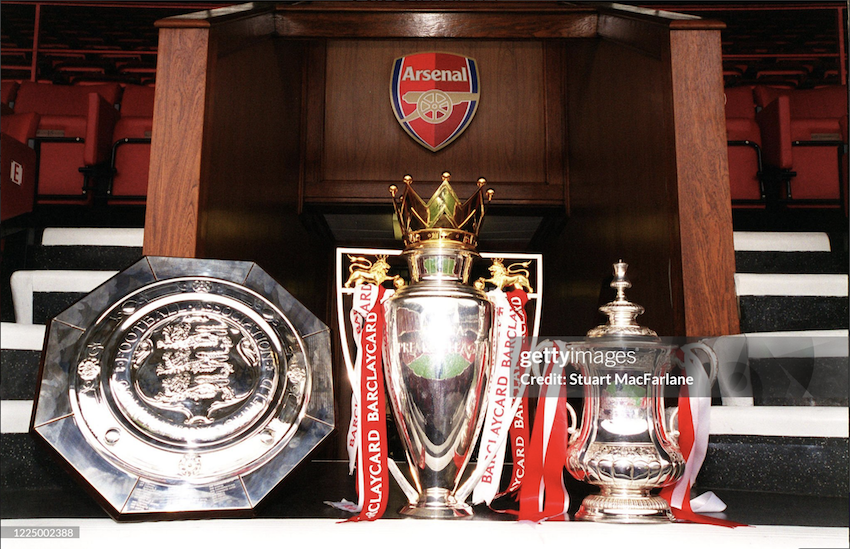
The tension of the title race has been particularly severe this year. Many Gooners have not experienced a successful title race before so we thought we would compare previous title wins, reliving the agony and ecstasy of our title successes in the last fifty years or so, in an attempt to relieve some of the tension and to establish that sometimes you can survive it! And sometimes even enjoy it!
We have asked several of our regular correspondents to recall their memories of the six titles the Arsenal have won in the last fifty or so years. I’ve interviewed Clock End Rider, Trev, bathgooner, North Bank Ned and Gunnersaurus Stunt Double to get their very personal recollections of those title seasons, what it took to win each title and how they celebrated them!
TTG
We kick off with a double header: my recollections of the 1970/71 double season prompted by bathgooner (I can’t remember most of what happened yesterday but the events of that season are engraved on my heart and soul!), followed by Clock End Rider’s memories of the glorious 1988/89 title.
1970-71 – A Glorious and Very Unexpected Double
TTG
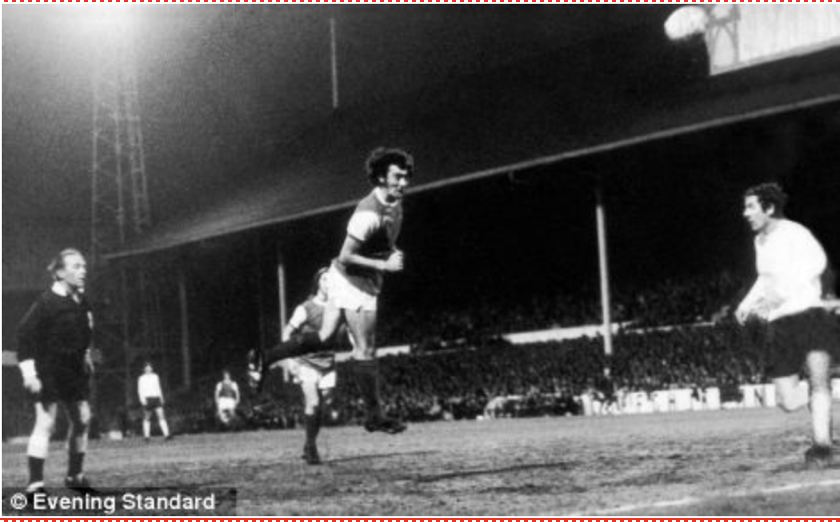
Ray Kennedy scores to clinch the league title for Arsenal at White Hart Lane, 4th May 1971
In the summer of 1970, did you anticipate a title challenge from this Arsenal squad?
Arsenal had just won the Fairs Cup but finished in mid-table the season before but I never anticipated that a squad where we didn’t make one incoming transfer could challenge teams of the quality of Leeds, Liverpool, Manchester City, Chelsea and Derby who were the most impressive sides then.
Were your expectations raised or lowered by the opening games of the season?
We suffered three major injuries, including Charlie George breaking his leg at the start of the season and squads were so much smaller (it was a 42 game season). But we started well, thrashing Manchester United and Spurs early on and only losing at the Bus Stop. Moreover, our early consistency away from home suggested we might be contenders.
Was there a point in the season that you felt the title challenge had ‘gone’?
Several! In September, we got thrashed 5-0 at Stoke, who figured heavily in our season. We lost a series of away games in the New Year and we fell several games behind because of Cup replays but we then hit a glorious run in the Cup and League where we developed real momentum in March, only to lose to Leeds in a ‘summit meeting’ with three games to go. But by this time, it felt like it was going to be a special season.
Which match(es) were turning points in that season?
I remember playing Wolves at Highbury before Christmas. We kicked off early because of the power crisis and in the Times on Monday the report of a 2-1 win said something like ‘if you haven’t already realised it, this Arsenal team are going to win the League or go very close to it this season’. After we knocked out Manchester City in the Cup at Maine Road, we went on a terrific run with away wins at Wolves and Forest. Gradually, we were slicing Leeds’ advantage at the top of the table.
At what point of the season did you really come to believe the title was a distinct possibility?
I was playing football on most Saturdays then (no Sunday football) and I remember kicking off late one day in mid April. Arsenal were on Leeds United’s heels at the top of the league. We were playing Newcastle at home, Leeds were ‘entertaining’ West Brom in a game that became notorious! My game kicked off when the league programme was at half time and, from memory, I think both games were scoreless. During the game a mate shouted that we were top of the league! That improves your own game no end!
Charlie George had scored a spectacular winner for us but at Elland Road Leeds were beaten 2-1 with one of the most offside goals you’ve ever seen, scored for West Brom by Jeff Astle. There was a pitch invasion because their fans realised that with about five games to go it was a crucial moment in the title race. That night I started to believe we could win it. A few days later we played Burnley at home and won that and we became favourites for the title.
Which player(s) contributed most to the title win?
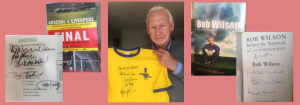
It was a huge team performance. When we interviewed Bob Wilson and Pat Rice for our 70-71 anniversary podcast it was noticeable how confident the team had been in each other. The defence was brilliant and Bob was almost flawless in goal. He was so different in style to Raya but as brave as a lion. But above all Frank McLintock was a wonderful captain. He earned massive respect from his men and to this day the remaining members of that squad call him ‘Skipper’. I also loved the tireless George Armstrong, the elegance of George Graham and Peter Simpson was incredibly underrated as Frank’s partner at centre back.
Were you confident that the Arsenal could get the result they needed in the final match at WHL?
I was very confident, in that I felt it was our year and that we’d prevail at the Lane but I also had huge butterflies before and during the game which I was locked out of! Pat Rice said that he never felt opponents could score against Arsenal and that night they just refused to concede. It was a titanic game but that Arsenal team was the ballsiest side you could find and they stood up to everything Tottenham threw at them. I was incredibly proud to be an Arsenal fan that night.
How did you celebrate the title win?
I’d been locked out so I went back to Liverpool Street and caught a bus home to my parent’s house in South London.
The game wasn’t on TV and wasn’t even live on the radio but they kept flashing across to it. They checked in with three minutes to go at 0-0 but then immediately went back to White Hart Lane … to announce Ray Kennedy’s goal even though there was still jeopardy if Spurs equalised because the League used goal average not goal difference then. Arsenal needed a 0-0 draw or better to finish above Leeds on goal average When the result came through I phoned my Dad who was producing that night’s edition of the Times and we had a moment … Then with his permission I helped myself to his Glenfiddich! But no parties or dancing girls for me and the suburb of Croydon where I lived was not an Arsenal hotbed!
Our second title triumph recollections are in the capable hands of local Islington boy Clock End Rider. The 1988-89 season became a tragic and then incredibly dramatic one. CER navigates us through the heady climax to the season and a night no Arsenal supporter will ever forget.
Anfield ‘89 – It’s Up for Grabs Now
Clock End Rider
Michael Thomas scores the title winning second goal at Anfield, 26 May 1989
What were you doing when the 1988/9 season began and were you going to Highbury regularly?
I had left University the year before and returned to London to start work. In terms of The Arsenal, it was as though I had never been away, and I slipped comfortably back into the usual pattern of attending all home games and getting to away games as and when I could.
At the start of the season did you have big expectations?
We began the 88-89 season, not in expectation, but hopeful of good things to come. Buoyed by my start in a job and the fact I had in my pocket rather more of what I had, up until that point, regarded simply as “Beer Vouchers”, I purchased my first season ticket – Clock End, just to the right of the goal.
Did you have confidence in George Graham as manager?
The previous season we had finished 6th as well as losing in that awful game at Wembley to Luton. I was there that day, in the Luton end (another story for another day!). It would have been more fun nailing my ears to a wall and then trying to dance the Macarena.
Things were clearly beginning to step up a notch under George though, after the awful periods in both mid 70’s and 80’s. He had begun to tighten his grip on the squad which had far too many freeloaders and good-time guys there. There were some very good players – Rix, Sansom, Williams, Nicholas – but they had grown complacent and there was not a winning mentality. George fixed this uncompromisingly. Of course, it helped that he had such good young players coming through – Adams, Merson, Thomas and my personal favourite, Rocastle. He had brought in Winterburn and Dixon to solidify the defence. It felt as though we were starting a season, for the first time in a while, with an end in mind rather than simply on a road to nowhere.
Which of the players really impressed that season?
It’s really difficult to single players out. What we saw that season was the despatch of the concept of star players and the arrival of the concept of the team being greater than the sum of the parts. Of course, for those who had seen the Double winning team (too young, too young, I’m afraid!), I suppose it came as no surprise that George should understand and look to implement this. At the same time there were three in particular who stand out in the memory, although everyone was mighty that season. Alan Smith became a veritable goal machine. From his first day of the season hat-trick, until getting on the end of that free kick at Anfield, he just gave everything, played unselfishly and banged in the goals. He was aided by a winger, who those wiser than me say reminded them in many ways of Geordie Armstrong – Brian Marwood. He was quick, skilful and with a quite remarkable ability to beat his man, get to the byline and cross with unerring accuracy. Finally, it was the emerging David Rocastle. As a midfielder, he just had it all. Strength, tenacity, speed and most importantly touch. I loved watching him play.
We had a big lead that was gradually eroded by Liverpool (sounds familiar). Did you lose faith as they cut our lead down? Was there a particular game that crystallised your views?
I never entirely lost faith, but the title looked unlikely as we headed to Anfield. Remember, by that game, to win the title Arsenal needed to win by 2 clear goals and Liverpool hadn’t lost at home by 2 goals for eons which the media banged on about endlessly in the run-up to the game. I suppose the low point was the home defeat to Derby a fortnight earlier which eliminated our points advantage. That was a pretty miserable Saturday night in N1.
We come to the momentous night at Anfield! Where did you watch the match and what were your emotions during the match?
Context for the younger and overseas reader – there was very little live football broadcast in the UK, outside of Cup Finals, at that time. The fact that the title decider was live on TV, on a Friday night, was like manna from heaven. I actually had the opportunity to go to the game, but passed it up because, as I said above, Liverpool were never beaten by 2 goals at Anfield. We had not beaten them up there since Queen Victoria had been an Arsenal trialist. So I bottled it. There, I’ve said it. Perhaps if it hadn’t been live on TV, I would have gone.
A group of us decided to watch the game in the Brownswood Tavern on the corner of Brownswood Road and Green Lanes. One of my university mates, also back in London, came with us. His great-grandfather had watched The Arsenal at Dial Square and he brought along his watch to the game, a touching tribute and hopefully lucky charm. I also bumped into some guys whom I had not seen since we had been friends just up the road at primary school 12 years earlier. An omen?
It was nervy in the pub but we did our best to calm ourselves via the medicine kindly available on tap. We couldn’t hear the great Brian Moore’s ITV commentary as the pub was pretty raucous, but when the players came out and handed bouquets to the Liverpool fans – this was only a month after the awful, entirely preventable disaster of Hillsborough – the spontaneous applause from everyone in the pub seemed to soothe nerves. We had seen nothing like this before and as well as being clearly the right thing to do, it was equally clearly, such a classy, Arsenal thing to do.
We saw the team – hang on – we’re starting with 3 centre halves in a game we need to win? Ahh well, “George Knows”! We were further buoyed when Bould had that header cleared off the line after a Michael Thomas cross and began to think that it might be possible. At half time, the talk was how we had played calmly and ought to be in front. We were beginning to believe!
1-0 straight after half time. The pub went ballistic. Hang on – Liverpool players are complaining. Now for those who didn’t get to see Liverpool in the 70s and 80s, great as they were, they were the biggest bunch of whiners you have ever seen. They ganged up round the referee and linesman, asking for offside; “Smith didn’t touch the indirect free kick”; “My dad’s bigger than your dad!”; anything they could think of, to coerce or cajole the officials into changing their minds. It was pitiful gamesmanship, but it usually worked. Our hearts sank! Despite all the cajoling both officials stood firm. Relief! Deep breaths. Deep swallows of rapidly warming amber fluid. We could do this, you know! Couldn’t we? Nah, it’s the Arsenal. Of course we’ll find a way to muck it up. We always do….
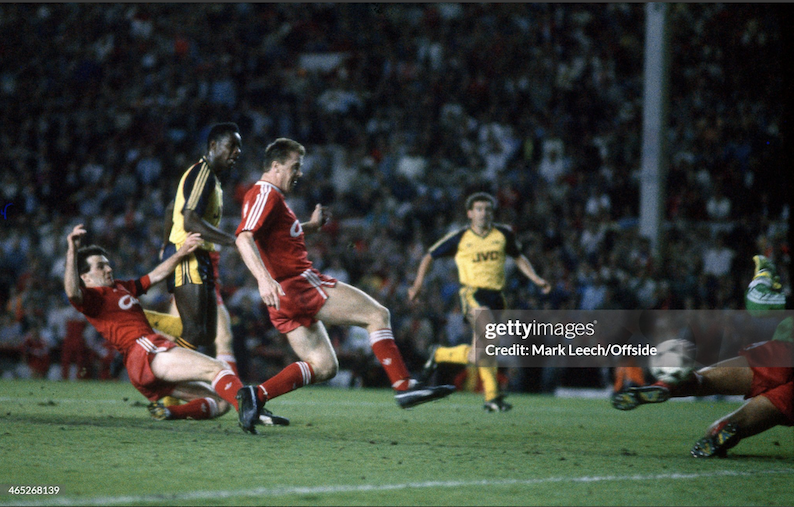
We carried on playing with increasing confidence. Kevin Richardson played a lovely through ball to Mickey Thomas in the box. “He can score. Oh, for ***** sake Thomas! Don’t poke it, leather it man.” 200 frantic Gooners saying the same thing 200 times, in the same place, at the same time. As close to a communal prayer as you’ll find outside of an official place of worship. For all the good it will do…. “That’s it,. That was our chance. We’ve blown it. This close. This bloody close!”
Last minute of the 90. Kevin Richardson, bought from Everton that season, had a really solid game but had now cramped up and was suffering. Hayes and Groves – two subs only in those days – were already on. If Richardson had to go off, we were down to 10 men. There was an air of approaching resignation at the likelihood of not winning the league by the narrowest margin. Not silence, but downbeat. Pride at the effort of the preceding 89 minutes, at the entire season. Huge disappointment. But while there’s life there’s hope! Some of those less prone to the need to put up emotional walls against the pain of dejection could still see silver linings where others of us, externally at least, could only see clouds.
The abhorrent McMahon was going round telling his teammates that there was only 1 minute left. Oh **** off McMahon. Richardson robs Barnes in the area. Lukic throws out towards Dixon. Silence. Stillness. Pandemonium. Beer, bodies everywhere! The plate glass windows in the pub, yards of them, all go out. Not through anger but through the inarticulate expression of joy, the sheer release after 90 minutes, after a whole season, after 18 years! The combined sweat and beer fumes of 200 Gooners are replaced by fresh air. So sweet!
We’ve all seen Fever Pitch and understand there was a bit of a party atmosphere in N5 that night ! Knowing you as a quiet, abstemious chap, did you take part in the celebrations?
The pub landlord made sure everyone chipped in to fund replacement of the windows. Otherwise, he wouldn’t put the TV’s on again and we wouldn’t see the trophy presentation. I hope he made a profit. He deserved to. We watched and then were off into the night. Fever Pitch is quite brilliant. But the scenes portrayed outside Highbury capture a hundredth of what it was like.
Eventually – somehow, I really can’t remember how – we got back down to Islington Green and met others for post-match beers. I say I can’t remember how, not simply as a result of intoxication – alcoholic and spiritual – but because my abiding memory is of Upper Street being totally blocked to traffic by people spilling onto the streets out of the pubs and their homes. All of Islington was there and it was a glorious cacophony. Cars and buses hooting – and not because they wanted to get through – there was simply no chance of that. Hugging, kissing, crying. Even the women! Islington became an Arsenal champagne bottle and boy did that cork fly out.
We left one pub – The Champion? That ghastly Aussie place? I can’t remember – when it was drunk dry and found several other pubs in a similar state. We went back towards our regular, off Essex Road. From there things get hazy. I do remember finding myself inside some kind of shebeen on Camden Road. Next thing I knew, I’m walking home along Brecknock Road, up Market Road, looking at the Astro pitches and reliving the glory of the night before; over Caledonian Road, the sun coming up. Pentonville Prison never looked so kindly. Then home.
The video (remember them?!) not only had been set but had actually worked. I watched the full re-run, this time the experience augmented, if that were possible, by the authoritative yet gently emotional commentary of the great Brian Moore. As in the movie, I railed at Pleat and his comment just before the second goal. My language may not have been so kindly. Bed. Up at midday. Rinse and repeat. And then again on Sunday for the parade!
The two First Division titles described here were Arsenal’s eighth and ninth, the former coming after an eighteen year drought and the latter after a further eighteen year gap. Although we have many venerable Holics in our ranks, none of our regular contributors are venerable enough to provide a personal account of the first seven titles won between 1930-31 and 1952-53, the first five of which were won over seven extraordinary years of domination in the 1930’s. So, in a couple of days we will turn our attention to Arsenal’s next two titles.
Well, that was harrowing stuff. We did ok in the first half but got outclassed in the second. Of course, it helps when your goalkeeper drops the ball right in front of an opposition player and that could’ve easily been avoided by not playing our backup keeper, but we absolutely deserved to lose this.
Both goals were scored in the space of a few minutes just after the hour mark by makeshift left back, Nico O’Reilly. I really don’t think anyone wants to read a blow-by-blow account of the match so instead let’s just look at reasons to be positive.
Numero Uno is we are still going to win the league. Probably. We sit nine points above City having played a game more but a win over Bournemouth and any sort of result at the Etihad should see us over the line. We have seven games left and it’s unlikely we’ll need to win them all.
Numero Dos is we can still win the treble which would be amazing. Going into this game we were still in with a chance of the quadruple and on the train to Highbury and Islington I had the thought of referring to Arteta as “The Quadfather”, had we managed it. Ah well! The Trebfather doesn’t really have the same ring to it. I think the Treble is also unlikely, but the double would still be very cool, and we are only a handful of wins away from that happening. That’s a perfectly realistic ambition for the rest of the season.
Numero Tres is Spurs are going down. Probably. Whilst we shouldn’t really bother concerning ourselves with what’s going on down the road, it would be really funny. If you didn’t see the videos circulating on social media, before the game they would have looked like some sort of parade supposedly to “get behind their team” but it really was pathetic stuff. They then proceeded to get battered 3-0 in a relegation six-pointer by a Nottingham Forest side who have barely been able to muster a shot on target in recent weeks. At home! In their God knows how many billions of pounds stadium. What a trip that will be for the Lincoln City fans next season. I think in many ways, that’s almost as good as another trophy!
Ultimately, yesterday was a real low point in what has been a season of mostly highs and one that will likely culminate in the type of glory we’ve not experienced in over 20 years. To still be in contention for the Treble going into April is a major achievement in itself. We haven’t been in that position since the invincible season, and they were a decent side!
I hope this relatively short piece has given you renewed optimism instead of an unpleasant retelling of yesterday’s unfortunate events.