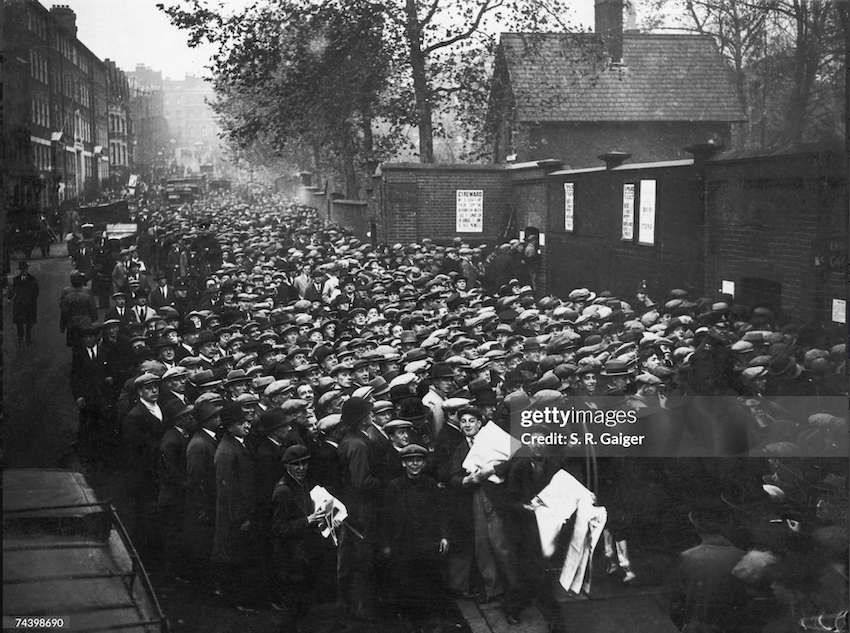
How many times have you heard during commentary “of course, XYZ FC are a big club”? The idea of the “Big Club” is often presented to us as a matter of fact. Usually delivered by some pundit or other, whose skills are almost invariably as a player and whose analytical abilities, as shown in coaching / managing roles as well as poor attempts on tv, are at best negligible. It baffles me why anyone should pay attention to the ramblings of the likes of Rooney, who, when you can understand what he’s saying, talks in third-rate soundbites and hackneyed phrases. Much less the likes of Gary Neville, whose only consistency appears to be in finding ever more contrived, bizarre ways to tell you not to believe the evidence of tv cameras. Or journalists simply following instructions and providing click bait, shock-jock level analysis, designed to generate “engagement,” otherwise known as revenue generation for the person / media outlet in question. Hugh McIlvanney, where art thou?
As with so many things in real life, the reality of the “Big Club” is less black and white, more multi-dimensional, nuanced. Clubs are described as “Big” with no clarification as to what that means. So, what are the actual criteria for being a “Big Club”?
I won’t try to produce a mathematically and statistically precise model. Rather I will try to set out the main characteristics which I believe go towards categorising clubs in this way, focusing on the tangibles. As I see it, there are a number of components which feed into the equation. They are not weighted equally. To use Orwell’s famous phrase, “some are more equal than others”. I will attempt to work through them in decreasing order of importance.
The single most important constituent of the formula is success as measured by sheer numbers of titles. I refer to domestic and European titles – forgive me for excluding other regions of the world, about the football of which I know nothing. Taking this as the primary filter, there are clubs which clearly fit the description. These are the behemoths of European football. It is impossible not to class Real Madrid, Juventus Internazionale, AC Milan, Barcelona, Bayern Munich, Ajax, Liverpool and Manchester United in the top drawer. These are clubs with a massive history of domestic and European success.
- Real Madrid: 36 titles; 14 EC
- Internazionale: 20 titles; 3 EC
- Barcelona: 28 titles; 5 EC
- Bayern Munich: 34 titles; 6 EC
- Man United: 20 titles; 3 EC
- Liverpool: 20 titles; 6 EC
- Juventus: 36 titles; 2 EC
- Ajax: 36 titles; 4 EC.
The sheer numbers take the breath away. Perhaps Ajax is an outlier there, with their last European Cup / Champions league victory being 30 years ago, and because they play in a not-terribly competitive league. On balance I include them as they meet the rest of the criteria below, to greater or lesser extents.
Those who have achieved many domestic titles, but fewer European successes score less highly in this category but have to be included. Let us start with those who have won the European Cup, even if just the once. How can we not include the likes of Villa, Forest and Celtic? Who amongst us, of a certain vintage, can forget the Villa of Mortimer, Morley and Shaw? The Forest of Clough, McGovern, Withe and Robertson? The Celtic of Jock Stein, Tommy Gemmell and Jimmy Johnstone? – the first UK winners of the competition and indeed the first Northern European winners according to the truth engine that is Wikipedia. Although I, and many Northern Italians, would venture to suggest that Milan is certainly Northern and not Southern Europe.
Unfortunately, and as distasteful as it may seem, we have to include both FC Chelski 2003 – 6 league titles, only 1 before Abramovich and 2 CL’s, none before Abramovich; and FC Manchester C130y -10 Premier League titles, 2 before the oil money arrived (the last of which was in 1968) and 1 CL, in no way down to the influx of money. It would be churlish to exclude them, dubious as the provenance of their European and domestic histories are. Paris St Germain, only formed in 1970 are another example. The recency bias I propose to include in the algorithm, which works against Ajax, works for these otherwise insignificant clubs.
Once we strip out European competition – and for the purposes of this exercise I have excluded minor competitions, which I define as all those below the Champions League in Europe and below the principal domestic cup in England – we look at the clubs with a record of domestic success.
Arsenal meet these criteria with 13 league title wins and a record 14 FA Cups. Everton have 9 league titles and 5 FA Cup wins. Both haven’t been out of the top-flight for a long time, in Arsenal’s case in living memory. Others, however, are often included under the “Big Club” banner, but have far less to crow about. Spurs have 2 league titles, the last one as we know more than 60 years ago. They have 8 FA Cup wins, the last being 34 years ago. Newcastle have 6 FA cup wins, the last in 1955 and only 4 league titles, the last in 1927. Blackburn Rovers have the same number of FA Cup wins as Newcastle and only one league title fewer. Is anyone calling them a “Big Club”? A storied club. A club with a great deal of history, for sure, but a big club?
The component which figures next, and which in modern times has risen in importance in our hypothetical equation, is that of filthy lucre. The days of clubs being owned by the local butcher, baker or candlestick maker done-good are well and truly over. As football has grown in popularity, as the football world has grown wealthier, more interlinked, the forces of progress have enabled an evolution in terms of the finances supporting football and in particular the clubs in Europe. To the extent that they are now owned by states, or their sovereign wealth funds, hedge funds or billionaires. In turn, this has enabled those clubs to put distance between themselves and the bunch in terms of the players they can buy and the infrastructure – physical, organisational, human – they can deploy.
The difference between the English top-flight and the European leagues becomes most apparent here. Many of the Premier League clubs, certainly those who have longevity in the division, now have the resources to compete strongly, as we have seen with the success in European competition over the last 10 years. This, I suspect, is a component of our equation which is becoming stronger. However, until it delivers the requisite success as mentioned above, it is not enough for me on its own to push clubs into the bracket we are discussing.
Sheer numbers of fans, both through the turnstiles and in terms of size, number and dispersion of fan clubs is also a component. This is, of course, linked to financial power. The difficulty here is in the latter two classes which are easily manipulated and difficult to verify. Undoubtedly Manchester United and Liverpool have massive overseas fan clubs. You only have to travel to Asia to see the support these two have, way in excess of any other. Other clubs are playing catch-up, but overseas tv revenue is huge. Of course, this is equally split giving of itself no advantage within the Premier League. I would like to see how many worldwide supporters actually buy genuine club merchandise. Bums on seats is the real measure here and the sheer size of football grounds, regularly filled, helps propel some clubs into the next rung on the ladder. Newcastle regularly fill their ground. Of course, bar Sunderland, they have no other professional club within 30 miles. The next closest is Middlesbrough, nearly 40 miles away. It is easy to pull in a crowd when you have a huge, unopposed catchment area.
Finally, there is something to be said for including some clubs as “Big” on the basis of a storied past. I’m afraid these don’t make the cut for me. The same recency bias I factored into the success criterion above comes into play here as well. Factors such as when these clubs were last in the top division, when they last achieved success. It is truly sad to see the lowly standing and travails of clubs such as Sheffield Wednesday. Perhaps a more accurate description for these would be historic clubs. Clubs with a big past, playing huge roles in the history of British football, and thus providing the bedrock for the modern Premier League in particular. As such they are to be valued and cherished. Huddersfield Town have won 3 league titles. These were on the spin. Like another club I could mention. This is only 1 fewer league title than Newcastle, 1 more than Spurs. But the last was in 1926. Preston have won the league twice, the last time in 1890. To apply the designation “Big Club” is to my mind patronising and inaccurate in equal measure. I do not make these points to ridicule these great clubs.
Our Arsenal still have some way to go to get into the ultra-elite. I believe Mikel, backed by a hugely supportive board, are on their way to doing it. There are other clubs which I seriously doubt will ever make it. You know who you are.
So, thoughts?







Good piece, can’t argue with any of the logic, especially regarding the dodgy-money-effect of the Premier League years. There are some other clubs that “feel” like a big club, not historic like Wednesday but because of the impact in their communities and maybe the fact that they are in the Premier league. Wolves spring to mind here, whereas other clubs like Norwich or Portsmouth are massive locally but could never be called a big club. Likewise Ipswich, even with a European Cup.
Thanks CER, good piece on a happily subjective issue,
I will have a think before answering.
Can we include Ned’s final drink on player salaries from
the last drinks? My thought processes were still slowly
plodding through that one too 😀
Fine by me, Matt!
OM@2: Reposting from the previous drinks:
Here is something to wile away the interminable interlull hours.
The statistical modellers at CIES Football Observatory have come up with a list of who they say should be the 100 highest paid footballers based on performances over the past year plus factors like playing time, level of matches and rate of games in the starting XI. (That last one might explain why Saka doesn’t make the list, whereas ten of his teammates do).
Ignoring other clubs’ players, because, well, why wouldn’t you, ours come out in the order below. The most deserving of the biggest pay cheque is at the top. The first number in the brackets is what CIES’s model reckons the player deserves to be paid, and the second is what the player has to scrape by on each year. The number outside the brackets is the player’s rank in the top 100:
Raya (£12.8m v £5.2m ) – 24
Ødegaard (£12.8m v £12.5m) – 25
Merino (£11.8m v £6.8m) – 34
Martinelli (£11.4m v £9.4m) – 41
Saliba (£10.8m v £13.0m) – 46
Trossard (£10.8m v £4.7m) – 48
Rice (£10.0m v £12.5m) – 56
Gabriel (£9.0m v £7.8m) – 78
Timber (£8.8m v £4.7m) – 81
Gyokeres (£8.6m v £10.4m) – 85
Performance isn’t the only determinant of a salary, of course. But what do you think of the list and the relative order?
Before you dismiss the whole thing as poppycock, CIES sells its salary modelling to clubs, players and their agents as the basis for real salary negotiations.
https://football-observatory.com/WeeklyPost521
CER: That was a thought-provoking read. I like your distinction between ‘Big’, ‘storied’, and ‘historic’ clubs.
Success in several decades is another marker of a Big Club, I would suggest. Having one golden generation does not make a club a Big Club.
Factoring in fandom is tricky. International followings at scale are a digital-era phenomenon, and measurements of bums in seats will be unreliable for pre-all-seater grounds.
CER
An excellent and thought- provoking read . We are one of the Big 6 in English terms but that should really be a big 5 because S***s are not a big club . We just need better European credentials and as you say they are on their way
Thanks for an excellent, thought-provoking piece. It is inarguable that we have underachieved in Europe and as much as we want to claim parity we therefore are not in the top drawer of big clubs.
Those sliding door moments that snatched European silverware from our grasp still hurt: Naim from the halfway line (even if it was the minor tournament), Wayne Bloody Bridge scoring at Highbury when we should have finished the tie in the first leg at the Bus Stop, Eboue’s stupid challenge at Anfield conceding a needless and game-changing penalty, that stupid foul by Jens Lehman getting himself sent off though we still almost won the final with ten men. We really have shot ourselves in the foot repeatedly. Time to stop that!
I think you have classified the Big Clubs correctly and those fraudulent cash-doped poseurs need to take a few steps back from the podium. I have far more respect for the historic winners of times past who won their trophies fair and square many years ago and now live in straightened circumstances with limited prospects of glory.
I do so hope that MA8 can break our duck in the Champions League.
Thanks for reposting Ned,
My first thought to be honest was that CIES are doing well
to sell that model! However, I suppose it’s just a guideline and
no reason to follow if it fails the common sense test in some cases.
I also thought Timber was underpaid ( I wish I was underpaid 4.7m
a year but then football long ago lost touch with reality).
I guess you the old rule of you get what the market will pay still holds.
Good goals from Saka and Eze for England last night apparently,
hope Saka is rested for the next one after 90 minutes last night.
Here are the goals from last night Matt
https://streamff.com/v/51eee3e4
https://streamff.com/v/53d183e9
Thanks CER for something a lot more meaningful than ex-player proclaiming his ex-employer as “of course a massive club.” I too like your divisions of Big, Storied and Historic.
Tottenham not only fail to make any of your three cuts, but will be disappointed that you’ve not included a fourth category of “Clubs with the biggest cock on the roof of the stadium.”
Thanks vm Trev.
I think I may not to re-write, folding in your suggestion.
Need to….
OM@8: I guess it also depends on the point a player is in his contract. Timber’s £4.7 million a year might have looked at lot more like fair value when he put pen to paper in 2023 than it does now, given the way he is playing. Similarly, Saliba’s pay packet may look like a bargain at the end of his new contract in five seasons’ time.
I was most surprised by Raya topping the list, as goalkeepers are usually neither the most expensive nor the highest-paid members of a squad.
@10 thanks C100, great goals both. Eze must be in with a shout for the left wing starting role if his season goes well with us.
@14 yes, fair point on Timber.
I noticed that on Raya too, but just put it down to one of those things algorithms sometimes come up with. Although I imagine the info will be useful for his agent at the next salary review 😀
Leo probably deserved his recent increase looking at those numbers,
The Athletic are reporting that Arsenal are close to recruiting Maurizio Micheli as a major figure in their scouting team reporting to Andrea Berta . Micheli has grown a massive reputation as a discoverer of talent at Brescia and Napoli where he discovered among others Hamsik, Kim Min- Jae and Kvaratskhelia !
CER is more au fait with Italian football than I but asking around I understand he is very highly regarded for his work in Naples and is another indication of the infrastructure that we are building . The deal is not done yet but is described as ‘ close’ .
Ned – some strange suggestions by CIES as to what our players should be paid .
Merino , and Martinelli more than Rice, Saliba , Gabriel and Timber !
Trossard more than Gyokeres .
A flawed algorithm? Sorry to be so late to it
Thanks CER, better late than never but I think your distinctions are fine too.
For me there are only 3 big clubs in the PL, ourselves, Manure and Liverpool as
a big club has to have a history of success and still be relevant now in the
league over the last decade or so. There can be fallow periods but a big club
always comes back. Cheaty 115ty and Cheatski are ruled out for obvious reasons
and there is no one else.
In European terms, it’s hard to argue with your list, though personally I think financial clout has done for the likes of Ajax and Benfica, great club sides of the past but somewhat doomed to feederdom in our brave new world. The Serie A sides too are facing a major challenge to stay relevant in the CL in future too but seem to be still standing for now.
I think Bath has summed up our situation well though I would add all to his list of bad memories – all those missed chances against Benfica that night in GG’s time as a real chance if we had gone through. I’m afraid I just can’t remember getting done by the great early 70’s Ajax side well enough to say if we had any chance!
Afraid I hadn’t heard of Micheli. Clearly a Berta hire. Napoli have spent most of the last 15 years towards the top end of Serie A, the only blip being 23/24, and won it last season, the first season in ages. Micheli seems to have been there, on and off for most of the last 15 years. In the early 2000’s I think Napoli’s were in the lower leagues, as low as C1 I think. Berta appears to be a smart man so I imagine he has moved for Micheli for a reason.
Thanks Matt. I tried to remove as much emotion and subjectivity from my piece, relying in fact and holding my nose on certain clubs. I can’t fault your thoughts above and I agree.
I was at the Benfica game at Highbury and thought we were battered gay night. I still wake up in cold sweats over that Brazilian, Isaias, tore us apart. George took from this game that we needed to buy one of their players. Unfortunately it was Stefan Schwarz, not Isaias. I remember him as a kind of proto Granit Xhaka, albeit not as much of a head case, but equally slow, immobile and in the final analysis, mediocre.
Gay? Jeez, meant ‘that”. My typing goes from badderer to worstest.
TTG@18: CIES isn’t transparent about its algo. If it weights scoring goals in international matches heavily, I could see that explaining Merino and Trossard’s relative places. Also, those two and Raya were playing in the Nations’ League at ‘A’ level whereas Rice was playing in the ‘B’ tier. VG, I assume, loses points for having played half the past year in the Portuguese league and not scoring in a poor Swedish side. But those are all guesses.
Talking of coming to things late, a carrier pigeon has reached Castle Ned bearing October’s Gooner. Pieces by both you and C100. What a treat in store.
Ned,
If CIES are valuing players on the basis of the Nations League group they are playing in, heaven help us ! Scoring goals in internationals against minnows doesn’t really compare with Premier League matches either .
I don’t know if anyone heard the audio relating to Van Dijk’s disallowed goal last Sunday. In the VAR booth one voice stridently says that it is definitely offside and tells Kavanagh to disallow it. That decision has now been declared wrong by the Review Panel. The referee in Kavanagh’s ear??…..why it’s Michael Oliver who always seems to be very favourably disposed to C130y . I believe they have even employed him previously .
What a coincidence !
TTG@24- Casablanca. Claude Rains. Bogart. Rick’s Café Americain. Gambling. You know the drill.
@21 I wasn’t there that night and watched on the tv, but my memory, with possibly rose-coloured glasses, was we were 1-0 up for quite a while and through at that, but we played a very attacking side and kept getting caught on the counter and that eventually killed us in extra-time. At no time did I think we were going to lose until late in extra-time and it was a terrible shock to me at the time. I thought GG became more defensive=minded after that, which was a pity really as we had some fine attacking players. But you’re right, he did buy the seriously mediocre Schwartz too.
Looking back now, I wonder if the drinking culture in that team did for our legs in extra-time.
An idea from the grauniad – a kind of unheralded XI.
We only have Leo, though Iwobi of seasons past is there too
https://www.theguardian.com/football/2025/nov/13/premier-league-side-deserves-more-credit
I actually thought a couple of them were overrated 😂
>>>>>>>