Feed on
Posts
Comments

Much Better

Embed from Getty Images

And so, to the last of the pre-season friendlies. The Arsenal team contained a few surprises, and a few still, thankfully, missing, e.g. Zubimendi, Rice and Saka. The starting team was:

Kepa

Julienne Gabriel Salmon Hincapie

Nwaneri MLS Eze

Dowman Jesus Martinelli

We had our first sight of goal in only the 3rd minute, with Eze hitting a free kick from the left-hand side of the box 25 yards out a couple of feet over the bar.  Lots of power, just needed a bit more direction. The pattern of sustained pressure and high press from Arsenal continued and in the 6th minute we ought to have had a goal, when a well delivered Eze corner from the left-hand side found Gabriel unmarked in the box. Unfortunately his header struck the unfortunate Julienne on the line and went over.  

From the resulting goal kick we really ought to have opened the scoring. A poor short pass from the goalkeeper into a Como player was excellently intercepted on the stretch by Nwaneri. The resulting loose ball went directly forward to Eze who was still in an offside position. That said, Eze’s touch was poor and resulted in his needing to pass the ball outside him to Jesus who managed to hit the post rather than score.  Offside was called, which looked correct, but perhaps a sign of understandable pre-season rust. The press-trap was excellent, that being said.

We kept up the pressure with Julienne providing some excellent cover and attacking support down the right.  Nwaneri continued to do some nice things in the box and managed to force a corner on 12 with a clever backheel after holding possession well led to a blocked shot. 

The pressure was kept on. However Como had the next chance on 21 when Kepa was forced to make a save low towards the left-hand post in front of the North Bank. It was a smart save, but one he ought to make. 

The breakthrough came on 33 when another good piece of pressing, this time from Martinelli, resulted in the Como keeper once again attempting to play out from the back unconvincingly, knocking the ball straight out to Lewis-Skelly, whose knock forward resulted in a one-two with Martinelli. This left MLS with the simple task of sidefooting into the bottom right of the goal in front of the Clock End.  MLS displayed his pleasure to the whole ground.  I do hope there is nothing behind the rumours being put about.

The goal was the cue for the first round of subs, with Eze and Jesus making way for Vieira and Gyokeres. 

Dowman and MLS were pretty much in charge of the game at this point and anther smart piece of play saw MLS freed up for a shot from 25 yards, this time way over.  

Just on half time, Como equalised when a good piece of skill in the right-hand side of the box saw Dowman and Julienne made to look foolish, with the Como winger Baturina nipping between the two and hammering home at Kepa’s near post.  He made and took it very well, but 1-1 at half time did not reflect the run of play. The reaction from the Arsenal defenders, Gabriel and Salmon particularly, was most pleasing to see. They were not impressed.

Half-time saw more subs with Kepa, Gabriel, Nwaneri and Dowman replaced by Raya (Alleluia), Mosquera, Odegaard and new boy, and former boo-boy, Guimaraes.

The pattern resumed, with Arsenal on top, dominating with their press and finding it fairly easy to break through an attempted counter-press from Como. Gyokeres held up the ball impressively on a number of occasions. Odegaard buzzed around the pitch as he did before his injury a couple of years ago and was generally a pleasure to behold.  On 53, the aforementioned Odegaard worked his magic on the right-hand side of the box before putting Vieira in with a cute pass inside the full back.  Vieira, who yet again was about as convincing as an argument that the sun orbits the earth, limply padded his shot straight at the keeper.

More subs, with the impressive Julienne, Hincapie, Lewis-Skelly, Martinelli, Gyokeres and the invisible man Vieira replaced by Ben White, Calafiori, Merino, Tzolis, Havertz and Madueke respectively on 62. 

On 70 a bobbling ball in the Como box fell for Madueke on the edge and his hammered shot was well saved by the Como keeper. The resulting corner from Madueke was dealt with unconvincingly by Como and another corner resulted, this time from the opposite side. Tzolis took it and floated it in excellently, almost resulting in a goal direct. The keeper made a curious flap and kept it out. It appears that we have another couple of decent corner takers in addition to Rice and Saka.

Arsenal were very much on top, and chaos continued to reign in the Como defence from corners. That said, the replacement Como winger gave Ben White a few hairy moments and required a decent save from Raya.

All in all, a better turn out than the last couple of friendlies, with some genuine progress in terms of style of play. Highlights for me were Julienne, Salmon and MLS, who all looked very comfortable. 

One final point. This is just pre-season and therefore quite possibly out of any meaningful context, but I’m not quite sure what all the fuss is about regarding Fabregas as a manager.  They were a shambles at the back.  My impression was that he must employ an excellent PR team.

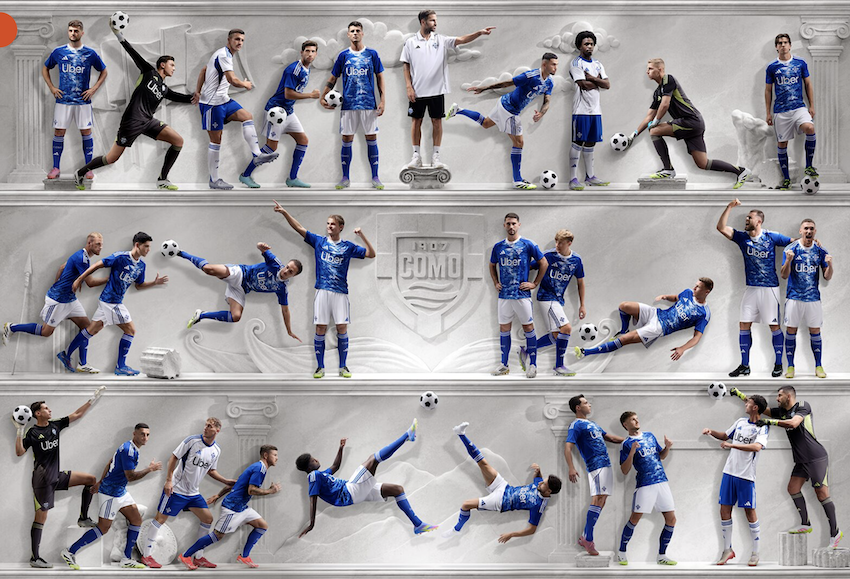
Our final pre-season warm-up match is against Como 1907. It’s a club that has suddenly appeared in the upper reaches of Serie A, seemingly from nowhere. Como’s rise to prominence is probably not unrelated to having the richest owners in Italian football, the Hartono brothers, who have a combined wealth of over $40b, and own one of Indonesia’s largest conglomerates. The club can also boast a couple of Arsenal links with current head coach Cesc Fabregas and Thierry Henry, both minority shareholders since 2022, perhaps, giving an element of football romance to the project.

Given Como’s mysterious and rapid rise from the depths, I think it’s worth exploring the details behind the scenes. If you have no interest in that background, and want to stick to the forthcoming match, simply scroll down to the horizontal separator and begin reading there.

Apparently, the club president, Mirwan Suwarso, a longterm employee of the owners, was instrumental in persuading the brothers to purchase Como 1907 from the wife of Michael Essien, as a project for a television programme. At the time, he was managing one of their TV stations in Indonesia. According to Suwarso, the owners have no interest whatsoever in the club or in football in general and prefer to watch badminton. The TV project appears to have changed soon after the club was purchased.

Ryan Shelton, the Chief Business Officer, describes Como 1907 as ‘the hub of a wheel of other commercial interests’: a tourism division, a private members’ club in a nearby lakeside villa, ‘The Club on the Lake’, an international retail division that, as well as marketing expensive products related to Como 1907, has a fashion line called ‘Lago di Como‘ and paraphernalia for Como Hiking Club and Como Running Club. The club has been carefully aligning itself with upmarket sponsors but has also actively engaged with its local community to build the fan base. Impressively, to reward their loyalty, Como 1907 has maintained the Serie D price point for 644 surviving fans who were season ticket holders when the Hartono brothers bought the club.

Como 1907 claims to be more than a football club in a beautiful destination. The Como brand is now said to stand for something. According to Suharto, the brand is being ‘modelled on Disney’ with the aim of becoming a ‘premium global football destination’ with a ‘football experience equivalent to the Disneyland experience:

“Our aim is to build an attractive team so that when people come to watch us, they enjoy the experience. If we do things the right way, 60% of our new audience will come from tourists who suddenly discover there’s a football club here. If they visit for the first time and we play with a low block and in a boring way, they will never be interested in Como. Our goal as a company is to become the world’s leading football tourism destination. If you want to be a premium football tourism destination, then the football itself needs to be fun and exciting”……….”Our goal is to position Como 1907 as the heartbeat of luxury football travel. We’re not just hosting fans – we’re inviting the world to live football through the lens off Como: stylish, soulful and uniquely Italian”.

VIP packages started at 490 Euros in 2025.

On the other hand, Thierry Henry praised the club’s focus on the local community, stating “a club is nothing if commercial goals break that heart”.

Some of the aims expressed appear fanciful and others appear contradictory.

For a glimpse of how this club has been going about its business check out this piece on YouTube with the Como Chief Business Officer, Ryan Shelton (it’s quite long). Despite Jake Humphries being his inquisitor, it’s an insight into the club’s professed philosophy though it has more than hint of ‘motherhood and apple pie’.

Although over a year old, this YouTube piece provides a different perspective on Como 1907 and also reveals where the money comes from (also rather long).

Before its renaissance, Como had been a yo-yo club throughout its history. It also has the distinction of having been re-founded twice. Originally, a group of Como locals were inspired to found a football club after playing a game on the shore of Lake Como against members of the Buffalo Bill Circus in Spring 1906. That match was apparently refereed by Cody himself and ended in a draw.  

The club’s first incarnation in 1907 was as ‘Como Foot-Ball Club‘. It was promoted to Serie B in 1931, then, for the first time in its history, to Serie A in 1949. Como preserved its Serie A status for 4 seasons but then dropped as far as Serie C1. After promotion to Serie A for a second time in the early 1970s, Como again descended to Serie C1 then rose again to Serie A in 1980 and enjoyed 5 years in the top flight – its most successful period to date. By the 1990s, the club was back in Serie C1 then returned to Serie A for a single season in 2002. However, due to financial difficulties the club experienced consecutive relegations and was declared bankrupt in 2004. 

Refounded as ‘Calcio Como‘ in 2005, the club was admitted to Serie D, the top level of non-professional football in Italy, and in 2007, achieved promotion to Serie C2 but a further bankruptcy followed in 2016.

A new club, ‘Como 1907‘ was founded in 2017 and admitted to Serie D. This club was subsequently bought from Mrs Essien by the Hartono brothers in April 2019 while it was still in Serie D. Como was promoted to Serie C in the same month with a record-breaking points total, then won the Serie C trophy and promotion to Serie B in 2021, and to Serie A in 2024, after 21 years’ absence.

Cesc Fabregas ended his playing career at Como in 2023, moved into coaching as an assistant, stepped in as interim manager during the 2023-24 season and became head coach in 2024. In 2025-26, under Cesc Fabregas, Como finished 4th in Serie A and qualified for the Champions League, their first ever qualification for a European competition. Como finished with the second highest goals tally in Serie A (65 goals in 38 matches), also conceding the fewest goals (29) and with the highest ball possession throughout the season.

The wealthy owners have clearly facilitated the club’s success as much as Fabregas’ genius. The ownership are said to be building revenue that doesn’t depend on the football because the football currently earns very little: match-day income is capped by their small, 12,000 capacity stadium – about to be redeveloped into a community hub (but, according to Suharto, “the football is secondary” in the redevelopment!) – and TV income is relatively low. Como 1907 spent over $100m each summer after promotion to Serie A in 2024. This was bankrolled by the owners. The wage bill has also rocketed since the club reached Serie B. Allegedly, the Italian Football Federation enforces financial criteria aligned with UEFA’s framework but has not raised any issues with Como as it “operates debt-free and is backed by wealthy owners”. Nevertheless, the club’s annual loss of over 105m Euros in recent seasons will surely be an issue for UEFA’s financial sustainability rules, now that it has qualified for European competition.

I’ll allow you to decide for yourself, dear reader, whether Como 1907 is a heartwarming fairy tale in the style of Cinderella or represents yet another example of mega-wealth distorting the game. Well done, if you’ve waded through all this waffle.


I have to confess that I recognise only a few names in the Como first team squad. England international Trevor Chalobah was signed last weekend from Chelsea, German forward Nicolas Kühn was signed from Celtic last season and much-travelled Àlvaro Morata is another listed forward. That’s it! The other 26 look to be a mixture of fit looking young men (oo er, matron!) and a sprinkling of experience. The club’s philosophy has been to use data analysis to build a team of internationally sourced, talented, young players and the squad is the youngest and most international in Serie A.

Nico Paz, the current star player is an attacking midfielder bought from Real Madrid, with a propensity to shoot and score; he played 71 minutes for Argentina in the recent World Cup – Real Madrid hold a punitive £8m buy-back clause. Baturina, a creative midfielder, played 324 minutes for Croatia in the World Cup and scored one goal and Diao, a tricky forward, played all of 9 minutes for Senegal. A young Greek attacker, Anastasios Douvikas was last season’s top goalscorer with 14 goals. Maximo Perrone came through the C115y academy and plays a ‘Cesc-like’ role, setting the tempo in midfield. Maxence Caqueret is a young defensive midfielder who quietly makes Como’s system tick. Jesùs Rodrìguez is a talented Spanish international winger acquired from Betis.

Under Fabregas, Como plays possession-dominant football blending Spanish positional play with fluid rotations, aggressive pressing and vertical transitions. Nominally starting in a 4-2-3-1, the shape shifts constantly with centre-backs widely splitting while full-backs or midfielders form a temporary back three or diamond shaped midfield. The players generally adopt a technical build-up from the back, using short combinations and third-man movements to bypass opponent presses. However, goalkeeper Jean Butez, who looks very comfortable with the ball at his feet, will occasionally shake things up with a vertical pass to Morata at the halfway line, who will lay the ball off to a runner, leaving the opposition press behind. In possession, midfielders and inverted wingers drift into half-spaces to create central overloads while strikers often drop deep allowing runners from deep or wide areas to exploit space behind centre-backs who have been dragged out of position. Without the ball, Como morphs into a 4-4-2 using a high-intensity press to regain possession quickly and spring rapid transitions.

What of the Arsenal? All our English and Spanish World Cup participants returned to training on Monday. The only players now missing are Timber, who is “weeks away from returning” and Saliba who is “on compulsory rest”. I can’t imagine any of the returnees will get more than 30 minutes game-time against Como but that may be enough to get them match-fit enough to play 45-60 minutes in the Community Shield on Sunday. I expect Bruno Guimarães to get at least half an hour to help him build new midfield partnerships and Ødegaard, who had a very good 30 minutes against BVB, to play for up to an hour in this game.

I would start with the following XI though Mikel will certainly have other ideas:

Raya

White Mosquera Gabriel Calafiori

Ødegaard MLS Guimarães

Dowman Gyökeres Tzolis

I expect most of Saka, Rice, Eze, Martinelli, Havertz, Merino, Zubimendi, Hincapié, Nwanerii, Salmon and Kepa to join the fray at half-time or during the second half unless they have played the first 30-45 minutes.

After two consecutive defeats, albeit in unimportant friendlies, it would be nice to get a victory and a clean sheet under our belts before facing the Creative Accountants on Sunday. How about 2-0 to the Arsenal?

One more thing, Holics ….

Firstly, it’s time to sharpen your pencil, get your thinking cap on and enter the new season’s Predictathon ….


Predictathon 2026-27

Enjoy our fourth season playing the Goonerholicsforever Prediction Contest, in aid of the Willow Foundation!

Again, the contest’s purpose is twofold. First, to enhance the enjoyment of the upcoming season by providing a degree of light-hearted competitive rivalry as the season progresses. Second, to support Bob Wilson’s Willow Foundation with another generous collective donation. 

The rules of the game are straightforward:

1. The object of the contest is to predict the final 2026-27 Premier League table.

2. The winner will be the player whose predictions are closest to the table at the end of Matchweek 38.

3. This will be determined by a points score using the Difference Squared system. The lowest total score wins. The reward for winning is a full year’s bragging rights as the bar’s top know-it-all.

For full details and how the scoring works, check out the GHF Predictathon tab at the top of this page.

To enter, download the entry blank (be sure the entry blank you download is for 26-27!). Email your completed entry form to ghfpredict@yahoo.com. We must receive your completed entry no later than one hour before the new season kicks off, i.e., by 1900 UK time on Friday, August 21.  No changes to entries or new players are permitted after that deadline.

Contestants are honour-bound to donate to the Willow Foundation (link here) at least £25. This covers entry into the League Positions contest and the three bonus predictions (first manager to get the tin tack, and the winners of the two domestic cups). You can donate more to Willow — we encourage you to do so — but it will not guarantee a higher placing!
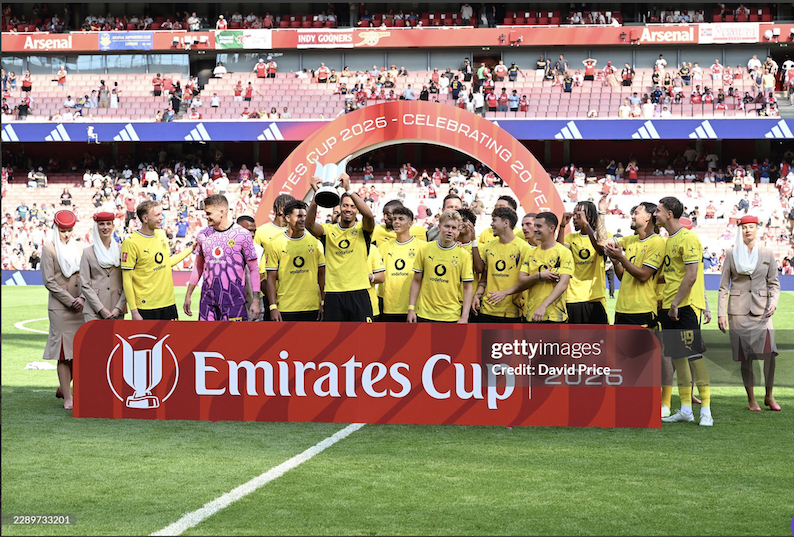
Mikel Arteta made two changes from the team that started against Betis for the Emirates Cup starting line-up against BVB, bringing Gabriel in for Hincapié and Ødegaard for Nwaneri. New signing Guimarães neither made the team nor the bench but did take the field wearing a home shirt to wave to the crowd from whom he received an enthusiastic welcome while Christos Tzolis made his Emirates debut. Encouragingly, given Kepa’s recent difficulties, David Raya was involved in the warm-up though not part of the match-day squad.

Dortmund kicked off in blistering sunshine before the rendition of ‘North London Forever’ was completed and Arsenal responded briskly with swift interplay. Gyökeres won an early corner and the keeper had to tip a deflection over the bar. In return, a raking BVB cross from the right was returned from the far side but was turned behind by a backtracking Tzolis – not his final piece of fine defending. That proved a warning because after only 6 minutes, a lovely through ball by Nmecha from the edge of our box was turned into the net by Inacio who had run off Mosquera, into the 6-yard box, far too easily. [0-1] Thereafter, BVB did look by far the sharper team and for ten minutes our good early start seemed a distant dream. Then a neat piece of interplay between Havertz and Tzolis set Ødegaard free running directly towards goal but he was tripped on the edge of the box. Gyökeres hammered the free kick high, wide and ugly.

Gyökeres was busily bustling around the Dortmund centre backs and running onto forward balls. A square pass to him from Havertz, darting behind the defence onto a lovely through ball from Ødegaard, was cut out by the BVB keeper. Havertz then ran onto a lofted ball down the left from Ødegaard and crossed, but Gyökeres’ header flew wide. As we entered the second quarter, [:0)] Dowman darted into the box past a defender and cut the ball back for Gyökeres who turned and shot but hit the bar. Arsenal had fought back into control of the game when, somewhat against the run of play, they fell further behind. Karetsas was allowed to run from his own half and hit an unsaveable left foot shot past Kepa into the far top corner. [0-2]  Gabriel was slow to close down the Greek but this was perhaps also evidence that MLS as a single pivot doesn’t cover the width of the field quite as effectively as Rice does. Nwaneri replaced Ødegaard after 30 minutes, who had been looking lively on the ball and had been pulling most of the offensive strings, but the youngster found it hard to get involved in the remainder of the first half.

On 37 minutes, Dowman appeared to be tripped at the edge of the box near the bye line, but Gabriel’s powerful header from Tzolis’ excellent free kick flew over when he really should have hit the target. Tzolis then cut out a threatening ball at the edge of our box and broke forward, the ball ultimately reaching Gyökeres in the BVB box. The Swede fell after a buffeting from a big defender but was not rewarded with a penalty. However, he did get a free kick on the right flank a few minutes later from which Tzolis hit a beautiful cross, met by Havertz but the German’s header went straight to the keeper. Before half time, Gabriel was rather harshly booked for a foul after a heavy touch.

Half Time: Arsenal 0 – 2 BVB

Another disappointing half-time scoreline but, given that game-time is currently more important than the result, it was slightly assuaged by good performances from Tzolis, Ødegaard, Dowman, Gyökeres, Havertz and MLS. We definitely looked undercooked for a spell after the first goal but we looked to be recovering our creative edge when we conceded the second goal.

Meslier replaced Kepa at half-time. We started the second half with more energy and worked harder off the ball – did Mikel have a half-time word?.A lovely early move saw a sweet reverse pass from Dowman to White but his shot was deflected into the side netting. Some lovely work by Tzolis in our own half ended with him juggling the ball in the BVB area before cutting it back to Nwaneri on the penalty spot who fired it into the net on 53 minutes. [1-2] Finally, chants of “Arsenal, Arsenal” rang out from the previously somnolent crowd.

However only 3 minutes later, failure to clear a corner resulted in a stramash (props to Arthur Montford) in front of Meslier’s goal and a close range shot from Gadou landed in the net. [1-3]

On the hour, Salmon and Hincapié replaced Gabriel and Calafiori.

Dowman released Havertz in the box but his shot was blocked for a corner then Nwaneri’s fine shot from 18 yards forced the keeper into a good diving save low to his right. A Dowman shot from a similar range then gave the keeper another, somewhat easier, save. Gyökeres was then released by a nicely threaded pass by Dowman, but the Swede’s lack of pace allowed the BVB defence to recover and force him away from goal. At the three-quarter mark [:0)], Tzolis was tripped as he traversed the box and Gyökeres cooly stroked the ball low into the right corner of the goal from the spot. [2-3] 

Salmon made crucial sliding challenges to prevent two BVB breakaways before the second hydration break on 75 minutes after which we had seven substitutions:

Martinelli for Tzolis, Jesùs for Gyökeres, Vieira for Dowman, Ibrahim for MLS, O’Neill for Havertz, Julienne for White and Ogunnaike for Mosquera with Hincapié moving to left centre-back.

This opportunity for youngsters and fringe players to make a case for more game-time was pretty much spurned. Vieira made a good pass into the box which Jesùs badly mis-controlled and then the Portuguese player had a mazy dribble towards the box but finished with a poor final pass. Arsenal’s youngsters did have territorial dominance and BVB didn’t threaten our goal while O’Neill stood out for his work rate but the game wound down uneventfully until the last minute of added time. Martinelli ran along the byeline after a neat pass by Jesùs. His shot was deflected into the goal by the Dortmund keeper, sadly only for the lineswoman to flag for offside. It looked a very borderline call from the far side of the pitch but there was no VAR to fall back on. And that was it.

Full Time: Arsenal 2 – 3 BVB

Strangely, even though Dortmund had won the game, a penalty shoot out was provided to end the entertainment. Meslier saved one of the five penalties he faced. Jesùs, Vieira, Hincapié, Martinelli and Nwaneri all scored their penalties to win the shoot-out 5-4.

That was clearly not the result we wanted, but the Arsenal played better than they had done in Dublin and several key players provided strong performances before they were subbed. Tzolis gave an excellent performance on his Emirates debut, Dowman showed touches of genius and both Gyökeres and Ødegaard look ready for action. In addition to those who had shone in the first half, Nwaneri was more involved in the second half and he took his goal well while Salmon again looked very composed at centre back.

At the end of the day, this match was primarily about getting minutes into legs and developing match sharpness. It’s an ugly trophy anyway! We shall seek silverware elsewhere this season.

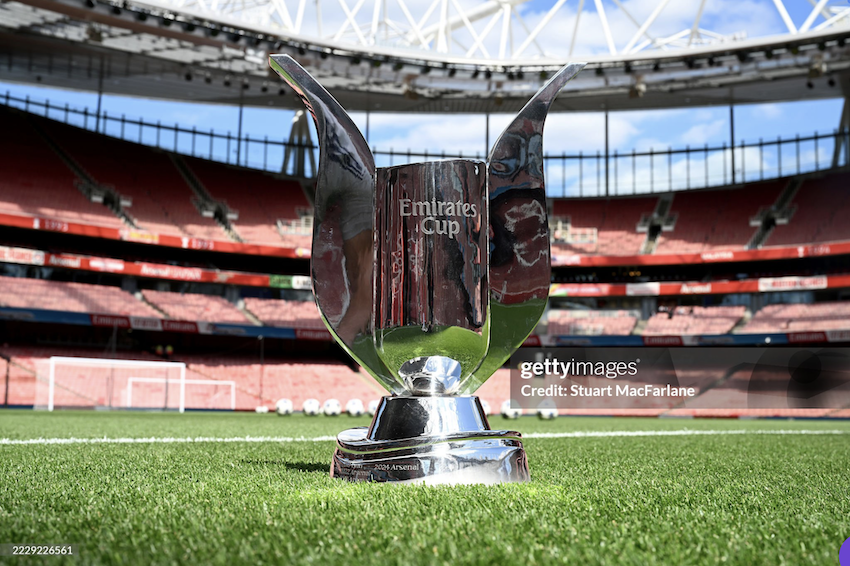
Ballspielverein Borussia 09 e. V. Dortmund (BVB) provides our next preseason warm-up opponent and may represent a stiffer challenge than we have faced to date. Hopefully, we won’t be as lethargic as we looked in Dublin against Betis. This is also the Grand Final of the 2026 Emirates Cup so there’s silverware (of a sort) at stake!

BVB was founded in 1909 and the name Borussia (Latin for Prussia) was taken from the local Borussia Brewery – football fans appear to have the same interests the world over! The club boasts the second largest membership in Germany after Bayern Munich and allegedly the fifth largest club membership in the world. Wherefore art thou, Arsenal? BVB’s Westfalenstadion is the largest stadium in Germany and contains the notorious Yellow Wall, and the club has the highest average attendance of any football club globally.

Dortmund is the second most decorated German club (after you know who) with 8 Bundesliga titles, 5 DFB-Pokals (equivalent to the FA Cup) and 6 Super Cups (equivalent to the Community Shield). BVB slightly eclipses us in European competition, having won the Champions League in 1997, the European Cup Winners Cup in 1966 and the Intercontinental Cup in 1997 and being runners-up in the Champions League in 2013 and 2024 and in the UEFA Cup/ Europa League in 1993 and 2002. However, their UEFA rank this season has slipped to 10th (Arteta’s Arsenal has risen to 2nd behind Bayern Munich, but astonishingly above PSG and, unsurprisingly, above Real Madrid).

Since Jurgen Klopp departed in 2015, after delivering 2 championships, 1 cup and 2 supercups, BVB has been in a period of flux, appointing 10 coaches and picking up 2 cups and 1 supercup. Their last trophy was the cup in 2021 under interim coach Edin Terzić. The current coach is the Croatian legend, Nico Kovač who was appointed 18 months ago.

Last season, was fairly disappointing for BVB who finished their usual 2nd in the Bundesliga, 16 points behind Bayern Munich, to whom they lost home and away. BVB was surprisingly knocked out of the DFB-Pokal in the ‘round of 16’ by Bayer Leverkusen and finished only 17th in the League Phase of the Champions League, missing the cut for automatic qualification for the Knock Out Phase then losing the play-off to Atalanta 4-3 on aggregate.

Over several decades, BVB have gained a justifiable reputation of developing world class players from a young age and selling them on to bigger clubs (usually Bayern!). Exemplars include Matthias Sammer, Mario Götze, Pierre-Emerick Aubameyang, Erling Haaland, Jude Bellingham and Ousmane Dembélé. 

Looking through their current squad, I don’t see anyone in that class, but that may simply reflect my ignorance rather than a lack of talent. Few names stand out to me, but BVB does still have many experienced internationals despite wide forward Karim Adeyemi, creative midfielder Julian Brandt and defensive midfielder Salih Özcan leaving this summer and centre back Niklas Süle retiring. Nico Schlotterbeck and Emre Can have not yet taken part in pre-season due to injury.


Goalkeeper

Gregor Kobel, first-choice Swiss international goalkeeper, played all league games last season. 

Three other keepers didn’t get a look in: Patrick Drewes, Silas Ostrzinsky and Alexander Meyer.

Defence

Nico Schlotterbeck, German international central defender and vice captain; 

Waldemar Anton, German international centre back/right back; 

Ramy Bensebaini, Algerian international left back/centre back;

Joane Gadou, 19, newly signed, French U-19 international centre back, 19.5m Euros; 

Julian Ryerson, Norwegian international fullback/wing-back.

Daniel Svensson, Swedish international fullback;

Luca Reggiani, 18, Italian international defender. 

Midfield

Emre Can, experienced German international and team captain; 

Jobe Bellingham, England U-21 international defensive midfielder; 

Felix Nmecha, press-resistant, box-to-box German international midfielder; 

Carney Chukwuemeka, Austrian international attacking midfielder/left winger

Marcel Sabitzer, Austrian international midfielder/winger/second striker;

Konstantinos Karetsas, 18, marquee signing, Greek international playmaker/winger, 30m Euro, slated to replace Brandt.

Justin Lerma, 18, newly signed, Ecuadorean U-20 international playmaker; 4m Euros;

Mussa Kaba, 17, newly signed, German U-17 international defensive midfielder; free.

Attack 

Servo Guirassy, Guinean international central striker, 22 goals last season;

Maximilian Beier, German international forward, second striker/winger; 10 goals last season;

Samuele Inácio, 18, newly signed, Italian international forward/attacking midfielder; free;

Fábio Silva. Portuguese international forward; ex-Wolves; underwhelming.


Kovac’s Dortmund is known for a pragmatic, direct, defence-first playing style, centred on a reliable back-three, aggressive physical duels and wing-orientated attacking overloads with fluidly rotating wing-backs and attacking midfielders in a disciplined 3-4-2-1 structure. Kovač prioritises game management and structural discipline over attacking flair, utilising an intense, high-energy press to force turnovers in the opponent’s half. Winning the ball back triggers direct, vertical counter-attacks into open space. Guirassy is the focal point of the attack and acts as a target man but also drops deep to open up space for Beier or inverted midfielders and the Guinean is the primary target for dead-ball situations.

Arsenal and Borussia Dortmund have faced each other eight times, always in the group stage of the Champions League and only this century. We first met in 2002, winning 2-0 at home then losing 1-2 away. Nine years later, we met again, drawing the away game 1-1 and winning the home game 2-1. Two years on, we didn’t do so well, losing 1-2 in London but winning 1- 0  in Dortmund. Only a year later, in 2014, we lost 0-2 away, winning by the same score at home. Thus, our head-to-head record stands at 4 wins, 1 draw and 3 defeats.

This game against Arsenal represents BVB’s fifth pre-season friendly, so once again we can expect to face a team that is probably fitter and more match sharp than we are. Since 18 July they have beaten RW Oberhausen 3-1, and Düsseldorf 2-1, lost to Cerezo Osaka 0-1, and beaten FC Tokyo 1-0.

I expect that BVB, like Arsenal, will start their strongest team and replace them with multiple second-string players in the second half.

Who else might Mikel Arteta have available to invigorate the pedestrian performers from Dublin (I blame the Guinness!)? It’s too early for Bruno Guimarães to make his debut though he might be there to give the Emirates crowd a wave. The English and Spanish Gunners will still be lounging in the elite resorts of the world. I expect Gabriel and Martinelli to get more game-time than their Dublin cameos offered, perhaps 45 minutes, and Ødegaard, who joined training before Dublin, might get 30 minutes or so. With that in mind, and no more signings emerging, I expect the following starting XI, though I, personally, would start Meslier over Kepa and Havertz over Gyökeres but I don’t have to manage the egos of slighted players who might have to be called upon during the season:

Kepa

White Mosquera Gabriel Calafiori

Ødegaard MLS Nwaneri

Dowman Gyökeres Tzolis

I was unimpressed with our chance creation and finishing and the first half defending in Dublin. I don’t expect a sudden epiphany, so I don’t anticipate a high scoring game with multiple goals from the Arsenal. Meanwhile, Dortmund have lost much of their firepower and creativity over the summer and are bedding new signings into key roles. Therefore, I predict a 1-1 draw and an Arsenal victory on penalties!

COYG – it’s time to find fourth gear!

So, after the farce of the Girona game where Arsenal’s IT department managed to prove that ,in an increasingly tech-savvy world, there is still a place for the enthusiastic amateur, we move on to Betis. 

The starting team was identical to that which took the field in Spain.  Betis had Bellerin, resplendent with full-on “1970s porn star” hair and tache look.  

Lansdowne Road looked full, with a great presence from the Irish Gooners. I imagine the bars of Dublin 2 received a hammering pre-match.  The stadium controllers had clearly taken their lead from Wembley with regard to sound levels of the pre match “entertainment”. It was deafening on the telly, nicely ensuring that very little actual match atmosphere could develop, so far as I can tell.  In fairness, NLF received a rousing rendition from the crowd at kick off.

The game itself was not terribly interesting. We ought to have scored in the first minute after a fantastic move, sweeping across the pitch resulted in Havertz feeding Gyokeres 2 yards out, but the Swede fluffed his lines. That’s fine. Save it for the real games, Viktor.

Shortly after, Kepa made a tame long-distance shot look like the entrance exam for the Chinese Civil Service, pushing out needlessly to Mosquera who himself looked somewhat panicked as he hammered the ball out for a corner under precisely no threat at all. From the ensuing corner, Kepa, a giant of a man, was seemingly baulked in the smallest way and collapsed like a cardboard box left out in the rain, leaving a Betis player unmarked at the back post with oodles of time to hammer home. I suspect, and indeed hope, he won’t be in goal vs Coventry.

On 17 minutes, it was the turn of the Betis keeper to make a cock up, passing out far too close to Tzolis, who had to stretch to cut out the pass and in doing so couldn’t kill the ball and take full advantage. 

Gyokeres did well to get a free kick on the right side of the box, holding off a Betican defender and being thrown to the floor judo-style.  Nwaneri did nothing from the resulting free kick. 

On 26 minutes, Betis went further ahead with a cracking 22 yarder. Kepa could do nothing about this one. 2-0. Great shot, but no pressure on the striker.

On 32 minutes, we crafted a good break resulting in a corner from Tzolis, after his shot was well blocked by a returning defender rapidly blocking his shot. 

From that corner, taken by Tzolis, the Betis keeper, presumably taking industrial action in support of his fellow goalkeeping union member, reprised our Keeper’s faux pas for the first goal and simply allowed Hincapié to nod in on the goal line.

The recovery wasn’t to last, though, and just before half time Betis scored again. Poor defending yet again, with Havertz simply gifting the ball to the Spaniards just outside our box allowing Fornals, formerly of the Stratford Relegationists, to drive home from the edge of the box, again unchallenged. Perhaps we were just trying to lull the rest of the Premier League into a false sense of security, after the excellence of our defending last season. 

Half time was called and thankfully fans in the ground could get a well deserved Guinness to take the edge off what had been a pretty incoherent first half display. 

For the second half there were lots of subs. 

On: Copley, Salmon, Jesùs, Gabriel, Martinelli, Nelson, Vieira.

Off: White, Dowman, Mosquera, Tzolis, Gyökeres, Hincapié, Havertz.

None of them made any difference whatsoever and, to be frank, nothing of any note happened in the second half, apart from a very unfortunate injury to Louie Copley who went down clearly in pain under the slightest challenge. I thought the way he went down merited the referee stopping the game, as it clearly did not look like a piece of play acting, but he played on for another minute anyway. Copley had to be carried off the pitch by two of The Pit Crew, not putting any weight on his leg and clearly in pain.

What else happened? Salmon was rightly booked for a foul having been badly skinned on 65 minutes, on the right wing (intelligent foul, showing maturity – ed). Ibrahim came on and gave a good cameo of the defensive midfield role. I like him. Gabriel and Martinelli came on at half time, somewhat curiously I thought, given they only returned to training late last week. I suspect this was a move by Arteta to help prevent a cricket score and in that regard it worked. They both went off after 30 minutes. 

Take aways:

We need to look at this through the lens of a pre-season friendly with the season kick off 2 weeks away. We were missing: Raya, Saliba, Timber, Ødegaard, Zubimendi, Rice, Eze, Madueke, Saka, Merino. And possibly new signings.

In the first half, everything good went through Lewis-Skelly, and there were a few good things. He was far and away our best player. He is clearly not a fringe player and looks seriously ready to play as a starter.

That said, this was really a chance for fringe players to stake a claim. Nwaneri, Nelson, Vieira in particular. In truth, none did. Nwaneri doesn’t look like the player he was 2 years ago. At times, Kepa makes Manuel Almunia look like Lev Yashin. The reserve keeper slot at the moment is up for grabs. From what I have seen of Tommy Settford in u-21 games, I’d be tempted to have him as stand in keeper.

Onward.

« Newer Posts - Older Posts »