Real Betis Balompié S.A.D. is our next preseason opponent and for a reason that I have so far been unable to discover, we are playing them in Dublin. Could it have been arranged so that Andrew can just wander down the road (perhaps, via a familiar hostelry or two) to see his favourite team?
Betis, founded by students from the local polytechnic in 1907, hails from Seville and has a somewhat chequered history. Hence its motto: ¡Viva el Betis masque perda! (Long live Betis even when they lose!) The club’s name derives from Baetis, the Roman name for the region and for the Guadalquiver River that flows through Seville. The prefix ‘Real’ was added in 1914 following patronage from Alfonso XIII after a merger between Betis and Seville Balompié. The team initially played in blue shirts and white shorts but changed to green and white striped shirts matching the Andalusian flag, when the club captain, while studying in Scotland, obtained the material that Celtic used for their shirts but reorientated it to produce stripes rather than hoops.
Betis won their only La Liga title in 1935 (under an Irish coach), three years after becoming the first Andalusian team to play in La Liga after they had won their first Segunda Divisiòn title in 1932. When La Liga resumed after the Spanish Civil War in 1939-40, the club was promptly relegated. Despite one season back in La Liga, decline continued and Betis was relegated to the Tercera Divisiòn where it languished for a decade. Many fans see this period as key to the ‘soul’ of the club during which it became renowned for filling its stadium and for its huge away support, known as the “Green March’. Betis returned to the Segunda Divisiòn in 1954 and to La Liga in 1958-59 peaking in third place in 1964, but subsequently became a ‘yo-yo club’ until consolidating a La Liga place in 1974-75 and winning the Copa del Rey against Athletic Bilbao, 8-7, in 1977, after a 21 penalty shoot-out! The club won a second Copa del Rey in 2005, beating Osasuna 2-1 in extra time and finishing fourth in La Liga to become the first Andalusian club to qualify for the Champions League. However, Betis’ participation was unspectacular, apart from a 1-0 home win over Chelsea. The club finished third in its group and only reached the round of 16 in its subsequent participation in the UEFA Cup.
In the late noughties off-field financial issues rocked Betis but the teens saw the club achieve European qualification several times and under Manuel Pellegrini, who remains their coach, Betis won its third Copa del Rey in 2021 beating Valencia 5-4 on penalties after a 1-1 draw, its first trophy in 17 years. Pellegrini initiated a successful period for Betis, qualifying for the Europa League from its La Liga position for three consecutive seasons then qualifying for the Conference League and reaching the final only to lose to Chelsea 1-0. Betis qualified for this season’s Champions League for the second time in its history through last season’s fifth place finish in La Liga.
Thus, we can expect a sterner test from Betis whose 5th place last season with 60 points and a goal difference of +11 eclipses Girona’s 19th place finish with 41 points and -16 goal difference. A further benchmark, however, is the team that finished above Betis in fourth place with 69 points and a goal difference of +18 – Atlético Madrid, whom we tonked in the League Phase of last season’s Champions League and knocked out in the Semi-Final. Of course, neither of those clubs was within touching distance of La Liga champions Barcelona on 94 points.
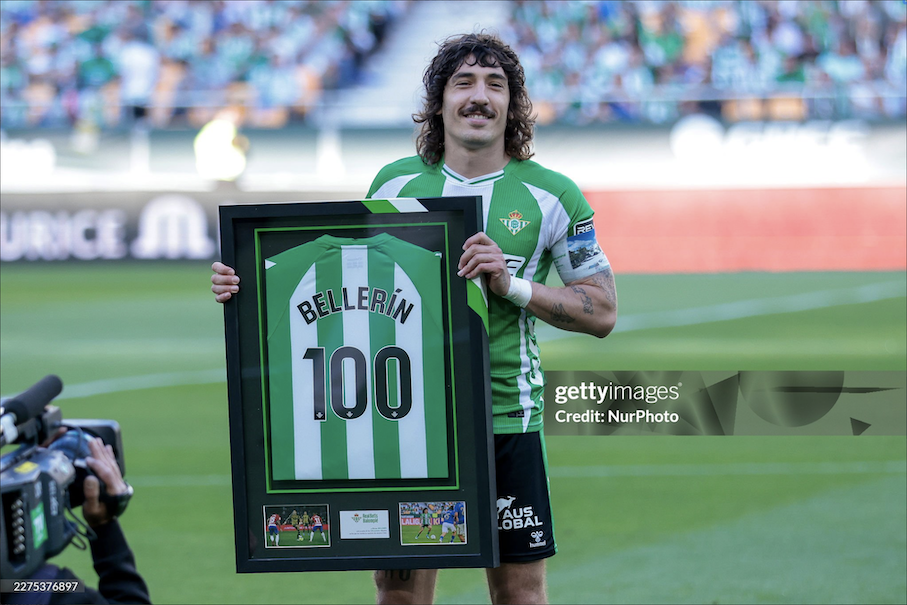
Betis’ current first team squad includes several familiar faces. We can expect to see much loved alumnus Hector Bellerín play against Arsenal for the first time; now 31, he is listed as ‘third captain’. Two of the defenders had spells at Leeds United: centre back Diego Llorente, and left back Junior Firpo. Betis also has the much despised, Lo Celso, once of the Marshdwellers, and the tricky, ex-Hammer Pablo Fornals in midfield. Up front Betis has the even more despised Antony, once of Manure. You will probably also recognise Isco who spent 9 years in and around Real Madrid’s first team. This summer, Betis has added defensive midfielder Facundo Bernal from Fluminese for 10.5m Euros, left back Fran Garcia from Real Madrid for 4m Euros and goalkeeper Diego Conde on loan from Villareal.
The Betis starting line up is fairly predictable. Valles remains first choice goalkeeper ahead of newly arrived loanee Conde. The likely back four will comprise Bellerìn, whose overlapping threat remains a key strategy; centre back Llorente organises the back line; Natan, a physical, progressive stopper logged most starts last term; Garcia will replace the departed Rodriguez at left wing back; Bartra and Gomez provide defensive depth. Roca is first choice holding midfielder and the defensive anchor when fullbacks push forward; marquee signing Bernal will join Roca in a double-pivot; Isco, now 34, is the creative heart of the team with licence to roam; Lo Cesco and Fornals are alternatives in midfield providing energy centrally or out wide. Up front, the hapless Antony will hug the right touchline; Cucho Hernandéz, last season’s top scorer with 11 goals, provides the central attacking threat; speed-merchant Abde Essalzouli scored 10 league goals last season and offers raw pace and directness cutting in from the left. Losada and Petit offer striking depth and youthful energy.
Betis play a pragmatic, possession-based style under Pellegrini, typically adopting a 4-2-3-1 formation with a focus on wide overloads using wingers and full-backs, often rapidly switching play to the opposite wing when the opposition has been drawn to one side. Out of possession, they adopt a compact mid-block before initiating high pressure and falling back into a 4-4-1-1 if that pressure is bypassed.
Mikel Arteta gave playing time to 24 of his 27-man squad in Girona, so it’s difficult to predict his starting eleven in Dublin. I thought I saw Martinelli among the players at the end of that game despite not being in the match day squad so he too may get minutes against Betis. However, I expect the starting eleven to be a similar to his choice for the Girona game, I.e:
Kepa
White Mosquera Hincapié Calafiori
MLS Havertz Nwaneri
Dowman Gyökeres Tzolis.
I do suspect Meslier may get the starting gloves ahead of Kepa, given how he excelled in his 30 minutes on Saturday.
Of course, the result doesn’t matter – this is all about developing match fitness, but it would be nice to maintain our winning momentum. How about 3-1 to the good guys?
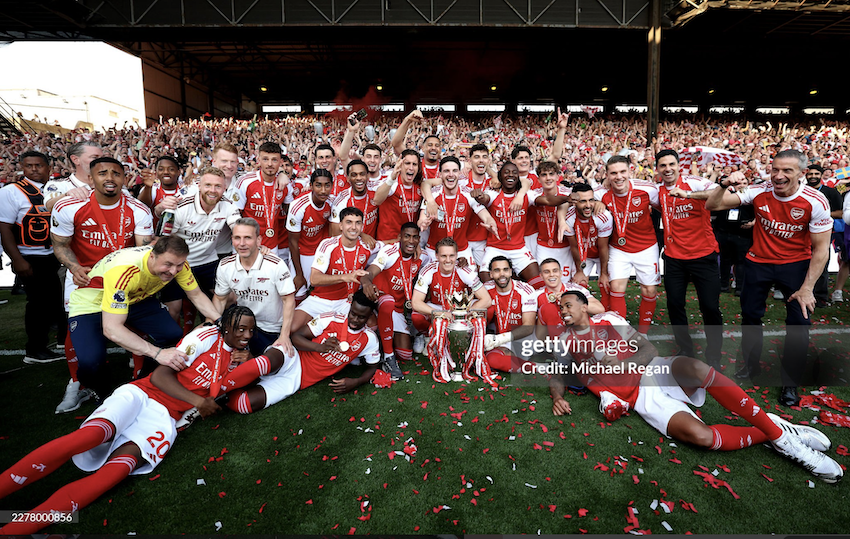
The Premier League Champions kicked off their pre-season preparations with a 4-1 win over recently relegated Girona on a warm summer’s evening in Spain.
Despite many of our players going deep into the World Cup with their countries, Mikel Arteta was still able to name a very strong side from the start. Ben White, who missed the final couple of weeks of the season as well as the World Cup, was deemed fit enough to start. There were also starts for Piero Hincapié, Kai Havertz and Viktor Gyökeres who had all been knocked out of the World Cup at the first knockout round. There was also a start on the right wing for the mercurial Max Dowman with Ethan Nwaneri playing in a central role.
Arsenal looked sharp from the off and it only took a quarter of an hour to break the deadlock. Max Dowman got away brilliantly from two Girona players and split the defence with an exceptional through ball for Havertz who slotted away calmly into the bottom corner. It will be interesting to see how many minutes Dowman gets over the course of the season. Despite his age, he certainly played his role in our title winning campaign. His cameo won us the game against Everton in March and who knows how differently the season could’ve panned out had we dropped two points that day. At times he makes the wrong decision, but most 16-year-olds make bad decisions although most 16-year-olds don’t play for the Champions of England!
As for Havertz, it’s a big season for him after missing so much of the last 18 months through injuries. He popped up with some massive goals towards the end of last season, and it appears that his finishing has really improved since he first joined three years ago. His goal in the Champions League Final was superb and would be talked about a lot more had we won. Let’s just pray he stays fit.
We doubled our lead on the half hour mark through our only outfield addition, (so far) Christos Tzolis. It took a slight deflection on the way through, but he showed some promising signs that he can provide some big moments for Arsenal. He was prolific with both goals and assists for Club Brugge so let’s hope the fella from Greece can emulate some of that over in N5.
Girona pulled one back five minutes into the second half from a corner which will have, no doubt, annoyed Arteta and Nicholas Jover but it only took a few minutes for us to restore our two goal cushion and, what a splendid goal it was from Max Dowman. He received the ball from Myles Lewis-Skelly, drove inside and flashed the ball home at the near post from about 20 yards out. What a prospect he is, if he continues on his current path.
Moments later, it was four. After a mix up from Girona, Gabriel Jesùs found himself in acres of space and poked the ball home to wrap the game up beyond doubt. It will be interesting to see what happens to him over the next few weeks. He has a year left and is on hefty wages, although he is still capable of producing magical moments on occasion.
Arteta made a raft of youthful substitutions in the final quarter of the game which is always nice to see. There was also a debut for Meslier in goal and whilst he certainly isn’t the most exciting signing we’ll ever make, he made some very impressive saves and his distribution looked up to scratch.
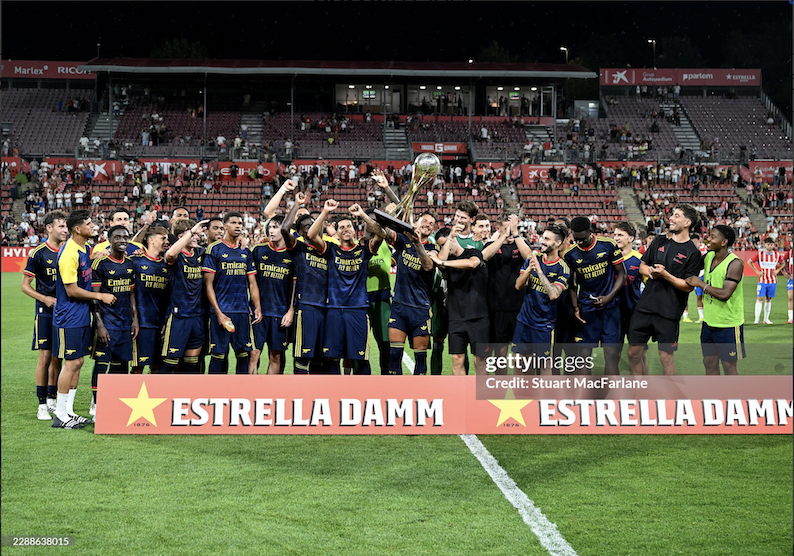
After the game there was a trophy presentation, as there often is for these preseason games. We witnessed arguably the most lacklustre trophy lift of all time. Ben White could barely contain his excitement. At least there was no penalty shootout!
Overall, it was a good workout and whilst you can’t draw any real conclusions from preseason, we appear to be in a good place going into the season. We will face Real Betis in Dublin on Wednesday evening, followed by a couple of games at the Emirates against Borussia Dortmund and then Cesc Fabregas’ Como side in the annual Emirates Cup followed by the traditional Community Shield curtain raiser as the Premier League Champions take on a Manchester City side now managed by a slightly less odious bald man than the last one but still every bit as bald. That will be in Cardiff and not Wembley.
Then five days later the Premier League Champions take on Fat Frank’s newly promoted Coventry City under the N5 lights. Will we have a couple of new Brazilians in the squad by then? Only time (and David Ornstein’s tweets) will tell……
The 2025-26 Premier League Champions travel to Catalonia this weekend to take on Girona FC at the Estadi Montilivi in our first preseason match, and our only away match before we go to Birmingham to face Villa in the league on the last day of August.
Girona By the time Girona Futbol Club rose from the ashes of Unió Deportiva Girona in 1930 they’d spent most of their time in the lower reaches of non-professional football in Spain. While they rose to the Secunda División in 1935-36, they narrowly missed promotion that season. The Spanish Civil War interrupted all of Spanish football, and it would be another 81 years before they could manage to crack the ceiling and win promotion to Spain’s top flight.
Their 2017 promotion brought them to the attention of the City Football Group (the multi-armed kraken that owns Manchester City, NYCFC, Troyes, and Palermo, among others), who purchased 44% (now 47%) of the club and invested substantially in their training facilities. Success was not instant. After two years in La Liga Girona was relegated in 2019, leading to three years in the Nah Liga wilderness. Promotion in 2022 brought improvement each year in La Liga; finishing 3rd in 2024 earning automatic qualification to the Champions League in 2024-25. Our preseason match is the second Arsenal have played at the Estadi Montilivi; our first was in the Champions League league phase, in January, 2025, where we came from behind and ran out 2-1 winners on goals from Jorghino and Nwaneri. With only 3 points from 8 games, including losses to PSG, Liverpool, and AC Milan, Girona finshed 33d of the 36 teams.
And so, despite the heightened level of investment the Blanquivermells are coming off a year that ended in even more disappointment. After four years in La Liga, and sixteen months after they last played Champions League football, they were relegated by drawing Elche in the last game of the season (Girona would have stayed up had they won).
While players like Marc-André ter Stegen (whose loan from Barcelona ended), Vitor Reis, Claudio Echeverri, Hugo Rincon, and Thomas Lemar have all departed Girona this Summer, there are some players whom are recognizable: Donny van de Beek, Bryan Gil, Paulo Gazzaniga, and Alex Moreno all have Premier League experience. Others were involved in that league phase game, including 3/4 of their defense, and 2/3 of their forward players. Notable among them is ex-Barcelona Spanish international Abel Ruiz, who we can expect to lead the line on Saturday.
Arsenal While it is just one game, it looks like we’re taking a rather thin squad on the trip, with only 5 first-team defenders, including those who are recovering from injury (White, Timber); Saliba and Gabriel are either too injured or too fatigued to make this trip. New signings Meslier and Tzolis are on the plane, as are loan returnees Nelson and Vieira. Gyökeres, Havertz, Martinelli, and Hincapié have made it to Spain upon their return from the World Cup, whereas Saka, Rice, Eze, Madueke, Raya, Merino, Zubimendi, and Ødegaard are still in recovery after their exertions in the Americas.
Fortunately, Arteta decided to fill the emergency raft with 11 of our up-and-coming youth, including Dowman, Salmon, Harriman-Annous, Kabia, and Ibrahim, all of whom have made their first team debuts. Besides Salmon, any of Clarke, Ogunnaike, or even Julienne can play at various positions in our back line. O’Neill, Ranson, and Augustien can play in midfield or up front.
So what will our lineup be? Impossible to say, especially since there will probably be wholesale changes at halftime. Nonetheless I hope we won’t see any of White or Timber, which would leave us to start the game with something like the following:
Whom Arteta mixes and matches after that (assuming those wholesale changes) is hard to say. We should certainly see a debut for Meslier (sorry Setford, you’re hard done by), and perhaps some final Arsenal playing time for Nelson, Jesus, and Nørgaard. I’d like to see how Harriman-Annous is coming along, and both Kabia and Ibrahim showed promise last season…let’s hope they can use this preseason to push their way into Arteta’s plans for the coming year.
The ‘Holics Pound Kind of silly, right? I think, if I had to, and without knowing the odds, I’d put a punt on Dowman to score, and maybe parlay that with a goal from Gyökeres, maybe even on an assist from Tzolis. I just hope we get a good run-out, a good look at the young’uns, some shop window time for our probably departees, and no injuries. After all, isn’t that the point of this type of exercise at this stage of the (pre)season?
We have tried over the close season to enjoy the title success that we craved so much and for so long. To my surprise and disappointment, I’ve experienced a recent wave of negativity which seems to emanate partly from injury problems experienced in the World Cup and a disappointment that we’ve been outbid by Chelsea over Morgan Rogers (who’ve paid an outrageous premium à la Mudryk – remember him?). I’ve even seen idiots claiming a Tottnumb side who escaped relegation on the last day of the season are better placed than us going into next season – largely again, because they’ve overpaid for midfielders, out of desperation, after years of stinginess.
I will give my thoughts on how I think we are placed for the new season nearer the start of the season, but I thought it would be instructive to look at how we have fared in the season after we have taken the title in all the years we’ve won the league since our famous Double season. The bad news is that we haven’t won back to back titles in any of those years. We have twice retaken the title in the next season after that, but we all want a ‘monster season’ next season by retaining the title so what can we learn from the past? To be honest, football has changed so much – note the level of transfer activity in many of those seasons, notwithstanding that a transfer window is a modern concept. In the past, a lot of deals were done at odd moments during the season – if deals were done at all.
Let us begin by looking at 1971/2:
Before the season began, the club suffered a serious blow when Don Howe (who members of the Double team regard as the true architect of their success) moved to his original club, West Bromwich Albion, as Manager with George Wright, our trainer, accompanying him. Howe wasn’t really suited to management although he did later return and eventually manage Arsenal but coaching was his forte and the team suffered.
There was no Charity Shield as Arsenal had won both trophies and chose a lucrative friendly with Benfica and when Arsenal pulverised Chelsea on a sunlit Highbury afternoon 3-0 to begin the season, hopes rose that we would maintain the consistency of the season before. Spoiler alert – we didn’t. In fact, we had a bad run in mid-autumn which saw us return to White Hart Lane, the scene of our title triumph, in a state of crisis, having conceded five goals to Derby.
Bertie Mee produced a spectacular transfer coup, to sign Alan Ball for a British record transfer fee of £220,000, just before Christmas 1972. It was our only major activity and it wasn’t enough to lift us above fifth place. However, the season ended in a thriller. Two days after losing the Cup Final to Leeds United, Arsenal held title contenders, Liverpool, 0-0 at Highbury, while title favourites Leeds lost to Wolves. Derby County players were around a pool in Spain as they clinched the title. Ball’s signing failed to galvanise Arsenal. Mee carried out drastic surgery on the Double team too early and four years after winning the Double we were flirting with relegation. We finished 71/72 six points short of Derby who clinched the title with 58 points, seven short of our winning total in the previous season.
We didn’t win the title again until 1989 on that thrilling night at Anfield. George Graham did very little transfer business prior to the 89/90 season Siggi Jonsson whose time at Highbury was ruined by injury was one of only two additions during the season, the other being Colin Pates, which underlines that the habit of relieving Chelsea of surplus players started a long time ago! We began the season at Old Trafford during the brief tenure of Michael Knighton as their owner. We crashed to a 4-1 defeat and although the team was competitive throughout the season Liverpool regained the title comfortably. We finished fourth with 62 points, one behind our noisy neighbours.
That anti-climactic season provoked George Graham (who lest we forget, had himself been a Chelsea player) into three purchases before the 1990/91 season. Those three purchases saw us win the title despite points deductions and the imprisonment of our captain.
The following season (1991/92), we were expected to challenge again but a stuttering start (winning only two of our first seven games) saw us look to recruit Ian Wright from Palace, despite the fact that Kevin Campbell had made a huge impact the season before, and Alan Smith had won the Golden Boot in our title-winning season. After Wright’s signing, which was an immediate success, Smith was never as effective again despite scoring the winning goal in our last European triumph in Copenhagen. It was the season of the Benfica defeat and humiliation at Wrexham in the Cup. Midway through the season, Arsenal began to play the most exhilarating attacking football, scoring seven against Sheffield Wednesday, four against Liverpool, including a sensational long distance goal by Limpar, and, on the last day of the season, Wright won the Golden Boot with a hat-trick in a 5-1 win over Southampton, recording 24 goals for the season, in front of the North Bank mural. Arsenal finished fourth, on 72 points, ten behind the champions, Leeds United, and one point behind Wednesday the team they had put to the sword a few weeks before.
Arsenal went through considerable turmoil (and two managers) over the next six years before Arsene Wenger arrived to transform not only the club but also English football with our second Double. In the season after (1998/9 ) the club fought a titanic battle with a Manchester United team that were to achieve the treble of League, FA Cup and Champions League. But Arsenal ran them so close. We recruited a number of players during the season. The Argentinian international, Nelson Vivas, at the start of the season, Freddie Ljungberg early into the campaign, and Kanu and Kaba Diawara later in the season. It would be fair to say that of those last two players that Kanu had a greater impact! The league season looked as if we might pip United only for us to lose a pivotal penultimate game at Leeds when Vivas lost track of Hasselbank who crashed in a late header. In the last game, United were at home to mid-table Tottenham while we played Aston Villa. An early Ferdinand goal saw us dare to dream but our neighbours showed their ability and willingness to lose to teams from Manchester if it deprives us of the title and, despite a late Kanu winner, we finished one point (78 against 79) and one goal in goal difference behind United. When one thinks that had Bergkamp scored from that penalty in injury time in the FA Cup semi-final, we might well have gone on to complete a Double in consecutive seasons.
The impetus stayed with United over the next few seasons but we completed the club’s third, and Arsene’s second, Double in 2001/2, winning the league at Old Trafford through Wiltord’s immortal strike. We introduced players of real quality into the squad in the next campaign 2002/3. Kolo Toure made his debut that season and we added a World Cup winner in the elegant and hugely underrated Gilberto Silva. Pascal Cygan is remembered slightly less fondly! We were favourites to win the League and broke a series of records at the start of the season, scoring in 55 consecutive games, going 22 away games without defeat, and going unbeaten for ten months, breaking United’s unbeaten Premier League run which had stood at 29 matches. Wayne Rooney changed everything with that famous late strike for Everton but we conducted a fierce battle with United which collapsed when we lost 3-2 at home to Leeds. The suspicion was that, head to head, Arsenal were the more skilful side and we had knocked United out of the Cup at Old Trafford en route to a second consecutive FA Cup success. We finished five points behind United amassing 78 points. Thierry Henry notched 24 goals and Robert Pires who had not returned from injury until November scored 14. Imagine a left sided attacker contributing at that rate and he scored the winner in the FA Cup Final too!
The 2003/4 season saw the immense achievement of our Invincibles and we began the 2004/5 campaign by signing Van Persie, Flamini and Almunia and during the season also added Eboue. We extended our unbeaten run to 49 games before we played the infamous game with United where Mike Riley’s refereeing performance could scarcely have been better designed to hand United the points. Like two seasons earlier, the impact of losing our unbeaten status caused us to stumble, but this time we were confronted with a new title rival in Mourinho’s Chelsea who lost only once during the season although we drew with them twice. We finished in second place, 12 points behind them, despite amassing 83 points, which was 6 ahead of United. We lifted the Cup beating United (more than a trifle fortuitously) on penalties, after a goalless draw, Patrick Vieira brought the curtain down on his Arsenal career in the most glorious way imaginable, clinching the Cup with his last kick in an Arsenal shirt.
Last season was the culmination of what was an iterative process and we proved able to last the course better than any of our rivals. Prior huge investments by those rivals and their threatened further investments underline how difficult it will be to repeat our title success but the coherence of Arteta’s coaching and planning has built a strong foundation from which we can go again.
So we move to season 2026/27. Might this be the season where Arsenal can retain their Premier League crown? As I write I’m receiving texts from across the Goonerverse about Arsenal’s interest in Vinicius Junior. It seems a trifle fanciful but under Arteta we have elevated ourselves to become major contenders in any competition and a potential home for world class star players. It would be interesting to poll Arsenal fans about what they believe should be the club’s priority for next season. Is it to retain the title, a feat that has been beyond us since we last achieved it in the 1930’s or finally to win the Champions League? Or is it feasible to believe we can win them both, given how close we came last season? I shall give my views in the season preview in a few weeks, (after I have carefully considered my Predictathon entry!) because until the impact of the transfer market and the effect of a protracted and demanding World Cup becomes clearer it is very difficult to decide the relative strengths of the contenders.
This history emphasises that while we have seen Liverpool, United, Chelsea and Manchester City win successive titles and, in City’s case, dominate a number of recent seasons in the league, we have failed to do this in modern times. What a wonderful thing it would be to see us repeat our triumph next May!
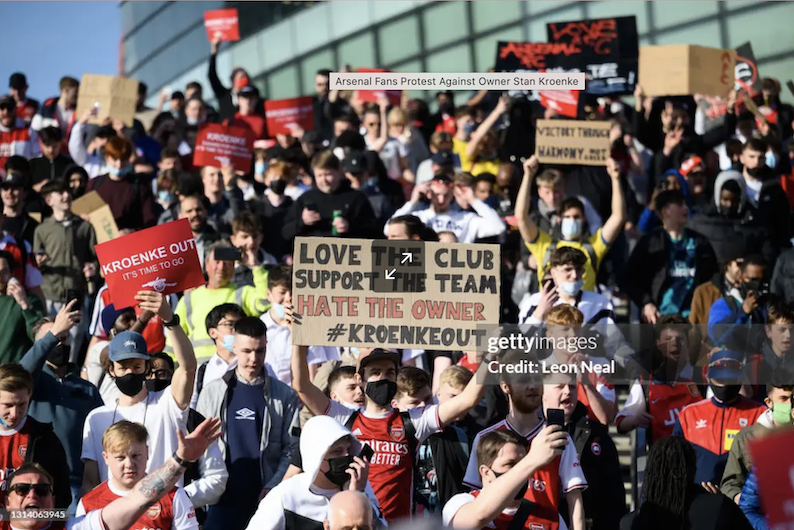
Since Kroenke Sports & Entertainment (“KSE”) completed the takeover at Arsenal in September 2018, the club has undergone a gradual, considered, methodical transformation at all levels. Like all revolutions – for that is what it has been – some of it has been bloody; some of it deeply unpleasant. Cast your mind back to April 2021. Arsenal, among a group of the very top-level European clubs – and Tottenham, more than a little incongruously – sought to break away from the Premier League and UEFA and create the European Super League (“ESL”). This prompted considerable societal wailing and gnashing of teeth and a massive fall-out with fans who saw the move as an unwanted break with our storied past. There was a mass protest at the ground before a game, which the players and staff certainly witnessed as they went past in the coach.
However, since KSE’s takeover, and in truth likely before, the Kroenkes have had a plan for the club. Undoubtedly they made a huge mistake with the ESL. But let’s take a wider look at what KSE has brought to the party across arguably the most significant areas and then add some thoughts on the direction of travel in the future.
Finance & Investment
Clearly the financing which KSE has brought to bear has underpinned the turning around of the tanker, which looked in serious danger of running aground. After buying out Usmanov, the previously parsimonious Kroenke approach changed radically. In hindsight, this approach was wholly understandable. Why should they pump money into a venture when the other major shareholder would benefit disproportionately? Unfortunately, the pre-takeover stasis only fed the inertia at the club, pulling us further down and eventually ensuring that we fell out of the lucrative Champions League.
It is estimated that, under KSE, the club has invested a gross £1.4bn in transfers. Up to May 31st 2024, KSE had also injected around £330m in shareholder loans, including around £180m essentially to buy back the outstanding bonds on the Emirates Stadium debt and refinance with loans from KSE itself. This was key as the previous loans were covenanted by gate receipts, which during COVID were zero. In the event of insufficient cash to pay the interest, technically bond holders may have been able to file for default. This move by KSE was also designed to take advantage of the globally lower interest rates prevailing as a result of quantitative easing, reducing the interest burden on the club. They had to pay a significant premium for early redemption of the bonds and to buy out the interest rate swaps used to turn the original slice of floating rate debt into fixed rate.
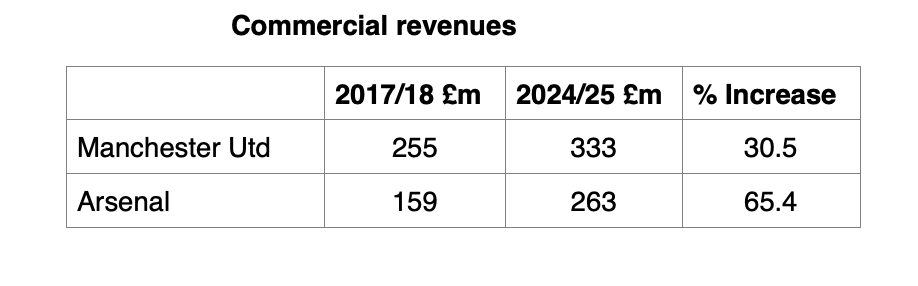
One area of the financial model at the club which lagged behind for years was the commercial revenue. Until the full purchase by KSE, this financial pillar was essentially a sleeping giant and significantly trailed Manchester United, the acknowledged leader in exploiting the “brand”. Since KSE’s takeover, the number and quality of “partners” and the revenue they generate has risen considerably, acknowledging the money which Arsenal had been leaving on the table hitherto. The volume and price of merchandising likewise. No Arsenal fan can fail to have noticed that commercial activities have gone from horse-and-cart pace to full-on Star Trek warp speed in recent years. The table below compares the commercial revenue figures from the season prior to the arrival of KSE to the latest available, sourced from relevant club accounts. I would expect the Commercial figures to rise again sharply in the 25/26 accounts as KSE works further to close this gap. The recently reported renewal of the Emirates sponsorship and stadium naming rights deal, with an annual uplift, should continue to lift revenues in coming seasons.
At the same time, KSE has knitted together commercial activities across its sporting portfolio, in order to enable a strategy, unique in the sports ownership world, of offering sponsorship opportunities across multiple sports simultaneously.
One note of caution in all this is that the club is highly dependent on continued financial support from KSE, to the extent that the auditors only signed the 24/25 accounts off after a legally binding commitment by KSE to fund transfer and operational deficits. This doesn’t pose a risk as long as Arsenal remains core to the ambitions of KSE. Rather it is a part of the overall KSE financial model, which is “buy, develop and hold”, focusing on growing the capital value rather than on extracting value through dividends. The Kroenkes put enterprise valuation growth at the centre of their financial model and as a result, have seen the valuation of KSE rise from US$8.4bn in 2019 to US$21.2bn in 2025.
Club Infrastructure The owners believe deeply in the need for strong senior management and executive teams. The club had Ivan Gazidis as CEO when they took over in 2018– a man many Arsenal fans remember for the articulacy of his speech and the dissonant lack of action to back it up. Gazidis left in December 2018 to little outcry. Vinai Venkatesham assumed the Managing Director role at this point, having joined originally as Commercial Director, a role in which he failed to move the needle. In 2020, KSE put Tim Lewis in – a Magic Circle law firm partner whom they had engaged over several years – as an Executive Vice-Chairman, essentially to function as their eyes and ears in the boardroom. He inherited Raul Sanllehi, who left in August 2020, alarmingly shortly after Lewis’s arrival. That departure too caused little distress given that he was reportedly largely responsible for the record signing for £72m of Pepe the summer before. Venkatesham left in 2024. Since then, the owners have built a senior management team made up of acknowledged top-level operators, with the likes of Richard Garlick and Andrea Berta. In terms of the board, Josh Kroenke has moved in as have senior KSE executives Kelly Blaha, Otto Maly and Dave Steiner – in non-executive roles. All three had major roles in planning and delivering the SoFi stadium in LA for KSE. More of which later.
At first team level, the support team around Mikel Arteta has grown now to the level that the Tuesday Club podcast describes them as “The Pit Crew” – so many are they and the roles they fulfil. And when they move on – Carlos Cuesta for example – plans are in place to replace and adjust where necessary. Moreover, this summer we have seen the owners put considerable focus onto trying to ensure that our injury record is analysed with a view to improving it. A new Head of Medical is in place, as well as further hires in this area. Incumbents have been released. There is a pattern.
KSE has enabled investment in both the training ground and Hale End academy, helping to strengthen internal options for the first team. Per Mertesacker was allowed to develop the Academy and create his “Strong Young Gunners” ethos which now runs through the academy as though it were a stick of rock. Part of this is preparing players for the likelihood that they will not make it to the first team, ensuring that they have the tools to deal with this disappointment and move on to success elsewhere, within or outside of football.
Further, there are strong rumours that a stadium development – of what kind we know not – is being considered. The fact that KSE has seconded the serious big hitters named above from the KSE mothership would seem to be a major signal. They played major roles in the planning, financing and delivery of the SoFi Stadium, home to the now L.A. Rams. Property development and the development of venues alongside wider entertainment and shopping facilities have been a key part of the wider KSE strategy.
Following the ESL debacle, the ownership has put in place more direct links with supporter groups through fan fora as well as the Arsenal Advisory Board (AAB) consisting of board members and senior fan representatives. Overall, a serious upgrade on the days of the Hill-Woods and the “we thank you for your interest in our affairs” approach.
Looking to the Future Past KSE behaviour probably gives us the best guide to what comes next. The pattern of KSE ownership tends to be one of patient building up of each “franchise”, setting up the infrastructure and a base from which to build, rather than Chelsea or City ownership models.
This can be witnessed not only in the way they have taken Arsenal from a pretty chaotic place, since taking full ownership in 2018, to Premier League success.
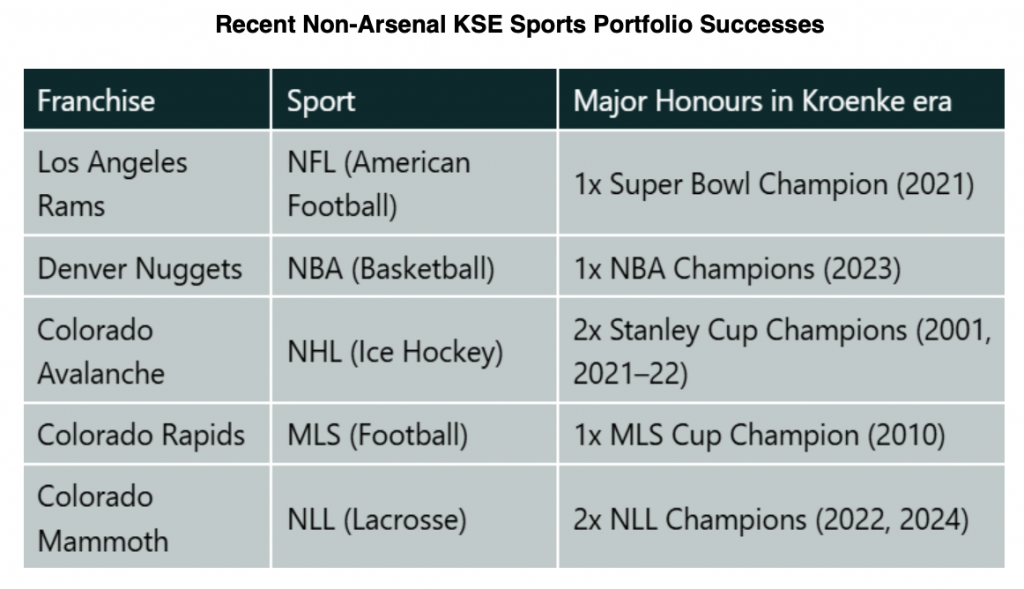
Similarly, it took 8 years of KSE ownership for The LA Rams to make the NFL play-offs, since when they have been regulars, as well as winning the Super Bowl. The Denver Nuggets have in recent years won the NBA championship as have the Colorado Avalanche in ice hockey. Clearly KSE is committed to sporting success.
However, it is notable that none of the KSE achievements, on an individual club basis, form part of what could be called a period of domination, as we have seen down the years in football. Perhaps the sheer scale and financial power required to do so in US sports make this a struggle; Perhaps the structural differences in the way the North American leagues work – e.g. draft systems, no relegation or promotion – make comparisons difficult or indeed unhelpful; Perhaps the North American leagues are in rather more of a “steady state” – hugely profitable with few if any new entrants, creating a situation where, for the ownership at least, there is little incentive to strive to create dynastic sporting success. In contrast, perhaps the Premier League rather more resembles a gold rush; New owners are coming in all the time; few profits are being made; but those owners with sufficient foresight and capacity to invest will win the day.
Arsenal, while not being profitable – true of almost all Premier League clubs – is highly cash generative, with revenues growing fast, aided by a now fully functioning commercial department. It makes sense for KSE to continue to back the club. All of this financial supercharging is designed to create an improved platform for sporting success for the club. And the model has, in large part, worked for the other clubs within the KSE sports portfolio. This is hugely encouraging from the perspective of us as fans. We crave the prolonged period of success we achieved in the 1930s and, to a lesser extent, in the early Wenger years.
Conclusions I would expect to see further focused investment on the playing side in order to maintain our current competitiveness. As I write we are linked with all manner of top players, likely to require significant fees and wages. We are currently top of the pile in the Premier League. Our competitors will not stand still. City have already spent a Sheikh’s ransom on Anderson from Forest. Even the lowly neighbours are getting in on the act. Whether they have overpaid as a result of the feat of finishing 17th again, only time will tell. We certainly need cover for the players we know are still not physically right; Rice, Saka, Ødegaard, Saliba all went deep into the World Cup and may need extensive rest before being involved in the coming season. White and Timber have both had significant, and recurring, injury problems. This is all before we even consider adding the attacking firepower we all think is necessary to maintain our position and make our football more compelling again.
Perhaps linked to our lack of transfer activity, is the absence of a new contract for the manager, who is now into his final year. Given that Arteta has been absolutely key to our success in the pitch, it is difficult to imagine this is due to any unwillingness on KSE’s part to renew.
At Hale End, Mertesacker’s successor has been announced. I expect the Academy to continue to focus on raising the quality of players it produces, benefitting the first team. I also expect to see a greater focus on monetising the players produced. In comparison with Academies at City, Chelsea and even Liverpool, we seem to find it difficult to sell on home-grown players in volume for top prices. Such players, from an accounting and PSR standpoint, generate pure profit. This approach is something of a balancing act, however. I for one would not wish to see the Arsenal academy turned into a factory production line, treating young players as little more than indentured serfs. The soft side of Mertesacker’s reign is something the club ought to try to keep as a central tenet.
Overall, KSE ownership has thus far been a great benefit to Arsenal. After initial teething troubles, which nearly required a wholesale extraction, they have behaved as well as ownership of a medium-to-large business can. They understand that the aims of the fans – almost solely focused on the playing side – and their own aims – maximising the value of their investment – need to knit together. The have delivered a massive improvement in competitiveness both in the Premiership and Champions’ League and the title we all wanted in the Premier League. Neither have they been deaf towards the softer, cultural side, with Josh Kroenke in particular appearing to buy into what Arsenal means to us. Who would have thought that would be the case back in April 2021?