Feed on
Posts
Comments

This season just concluded, we became the first side in the Premier League’s 34 editions to go through a campaign without conceding a penalty or receiving a red card. We did, of course, concede a penalty of consequence in the Champions League final, and two others on the way there. However, that is beyond the scope of this disciplinary review.

The editors requested an examination of our record both in a historical context and in comparison with the teams we have competed against for the PL title in recent seasons.

They may have hoped that this would reveal a deep conspiracy among referees to do us down. Not to bury the lede, as they used to say when journalism was still honest and thoughtful, it is really, really difficult to find coherence in how the employees of the Professional Game Match Officials Limited brandish the two cards they carry in their pockets.

Perhaps ‘Limited’ should be at the start of their name, not the end.

There was a foul roughly every four and a half minutes in the league last season, an average of 21 per game. Our average of 10.3 per game was slightly below our fair share. Wolves committed the most, at 13.0 per game, and City the fewest, at 9.7. Yet thirteen of the 20 PL clubs were roughly within half a foul per game of our figure.

The blue line in the chart below shows that our number last season was close to the midpoint of the narrow range of our foul rate over the past decade. Myth no. 1 to dispel: Arteta has got his team fouling less. He hasn’t. Where the fouls are conceded is a different matter, and that has affected our yellow-card count. More on that later.
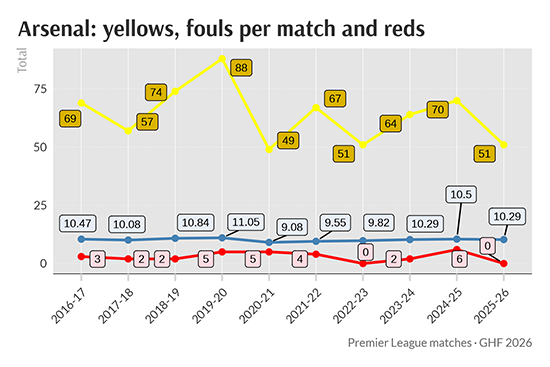
Next, let’s consider red and yellow cards, represented in the chart by, er, the red and yellow lines. Last season’s yellow card count was relatively low, but not the lowest over the past 10 seasons. Nor has there been a steady decline during the Arteta years. This term was the first since 2022-23 when we received fewer yellow cards than the previous season.

In general, in the Premier League, the correlation between fouls committed and yellow cards issued is very strong, as one would expect. However, for Arsenal, considered in isolation, the correlation is weaker than in the league as a whole, though it remains reasonably strong.

That, I shall argue later, is not a coincidence.

The red line shows no correlation with either yellows or fouls conceded. We should not expect one. Red cards are relatively rare, and VAR puts its oar in, not always for the best. The Key Match Incidents panel reckoned we should have had four reds last season, not zero. The previous season, the panel had said we should not have had as many as we did.

However, the tally is what it is, making last season the second of the past four seasons without any red cards. For the record, the most red cards we’ve had in a season in the Premier League era is seven in 1998-99.

Where we ranked for fouls, yellow cards and red cards among the other PL clubs over the past ten seasons underlines the randomness of red cards.

Last season we ranked joint 18th for red cards (City and Brighton also had no red cards last season) but 16th for fouls. The previous season we were 17th for fouls but top for reds. In 2020-21, we were second for reds but 20th for fouls. Go figure.
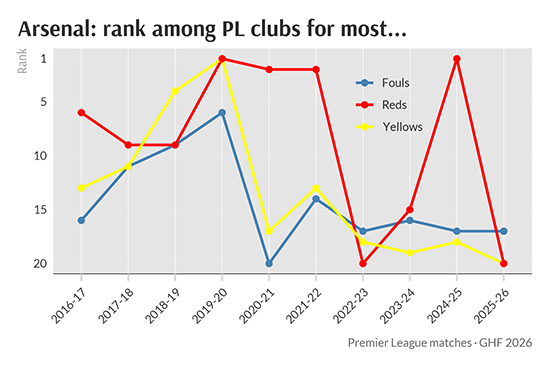
It would be easy to see a conspiracy afoot. Yet, as the next pair of charts show, the same erraticity in yellow and red card issuance applies to the other members of the Big Five and the neighbours, over the past ten seasons.
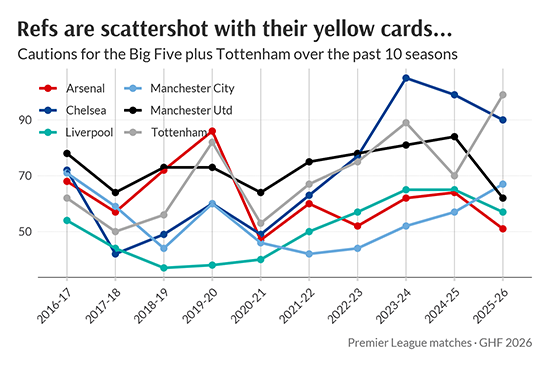
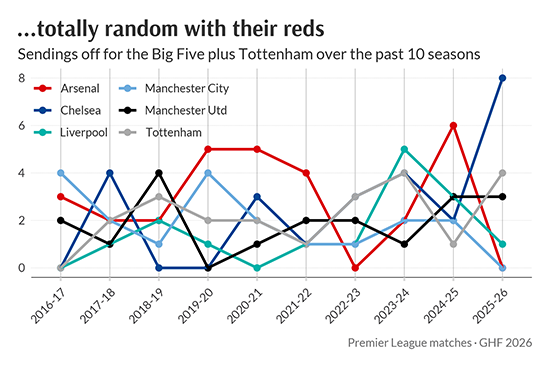
The only reasonable conclusion the man on the Clapham omnibus could draw is that there is no coherence or consistency among Premier League referees.

No surprises there, then.

The final chart shows our yellow card count by player for last season. Two-thirds were for fouls, roughly one-sixth for time-wasting or delaying restarts, and the remainder for a miscellany of infractions.
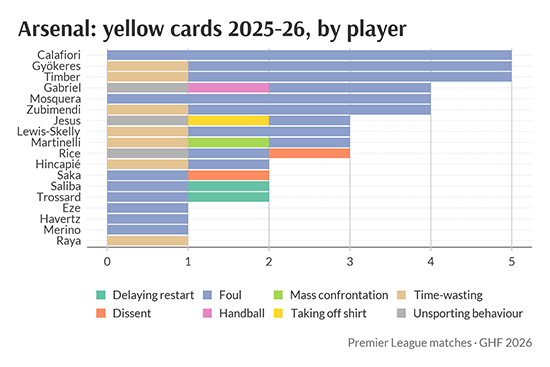
I draw your attention to the numbers for Gabriel and Saliba, four and two, respectively, of which only half were for fouls.

I would suggest that these figures hold the key to why our yellow card count has been relatively low compared with other clubs in recent seasons, and that this season our red card count has evaporated, even though we are still fouling as much as ever.

Gabriel ranked 33rd and Saliba 62nd, respectively, for yellow cards last season, not among all PL players but among just PL centre-backs. The top 10 included Brighton’s Dunk and van Hecke, with 10 and nine yellows, respectively. Newcastle’s Burn had nine. Everton’s Tarkowski had eight, as did Bournemouth’s Senesi. Wolves’ Mosquera led the way with 11. There was a sprinkling of red cards among that cohort, too.

I would argue that those extraordinarily low figures for Gabriel and Saliba are a consequence of the discipline and organisation Arteta has instilled in the team, rather than the result of specific measures to reduce cards.

I will acknowledge that after Saliba was sent off at Bournemouth in October 2024, Arteta said, “we cannot continue to play with 10 men at this level”, and that the team needed to eliminate red cards. I will pair this with Arteta’s oft-stated maxim that one quality he values in a player is availability, which includes avoiding suspensions.

Yet, to my mind, it is the defensive organisation built on strict positioning principles and the discipline to hold that structure for long periods in games, allied to a game plan based on control and on making the opposition play where we want them to play, i.e., away from yellow and red card-prone areas in front of our goal, that has made the difference to the card counts.

Our defenders have fewer desperate last-ditch tackles to make — and in Saliba’s case, as I mentioned in a previous drinks, while his numbers for the dirty work of defending are anything but impressive, his positioning and anticipation stats are off the charts compared with any centre-back in Europe’s top five leagues, let alone the PL. He rarely needs to make last-ditch challenges, and when he does, he has the Rolls-Royce qualities to make them cleanly.

I would ask you to guess — without first looking at the answer in the next paragraph — how often Saliba and Gabriel foul on average.

The answer is 0.8 of a foul every 90 minutes. That is remarkable given the intensity and physicality of the Premier League. Even our most carded players, Jurrien Timber, Ricardo Calafiori and Viktor Gyökeres, all with five yellows last season, were committing only 1.4 fouls every 90 minutes on average.

That further suggests a systemic effect from team discipline and organisation. Control of the ball makes players less likely to commit fouls, and even less likely to commit the desperate fouls that result in cards. We got a yellow for every 7.66 fouls last season, down from every 5.7 fouls in 2024-25

There are second-order dimensions to this. Our out-of-possession 4-4-2 midblock rarely exposes individual players. A study of all 20 PL teams, conducted after 10 games last season and dividing the defensive third into ten zones, found that we were the only team to foul below the league average in all ten.

Another is our high defensive line when in possession. Most of our fouls are committed near the halfway line. In the Palace home game, all six of our fouls were committed in the Palace half. One benefit of fouling high up the pitch is that referees view such fouls as less serious offences and are less likely to reach for their cards. Another point is that free kicks conceded in the middle third are not in direct shooting range.

Paolo Maldini, who would feature in many all-time XIs at centre-back, once said that if he had to make a tackle, it was because he had already made a mistake. Artetaball is built on avoiding mistakes, in the sense of avoiding jeopardy.

We now have a mature, disciplined team that is confident in its tactical organisation. It no longer fouls in the most dangerous areas out of desperation, but rather where it is tactically most effective. The foul count hasn’t declined, but the card count has as a result.
The European Odyssey 2025-26

Having reached the semi-finals of the Champions League last season there were high hopes, indeed expectations, that Arsenal could  mount a serious challenge for the trophy this year. Arsenal had adjusted to the new league system very effectively last season and comfortably qualified in the top eight places in third place. In theory, the higher a team finished, future progress would be more facilitated in the draw but, last season, Liverpool were drawn against PSG in the last 16 after finishing first in the expanded league group so there was still a random element to the system!

Arsenal set out on their 2025-6 European journey with a visit to Athletic Bilbao, a testing start but one that we coped with comfortably. It took until the 72nd minute for Arsenal to break through. Gabriel Martinelli scored then Trossard secured victory with a few minutes to go. A shut-out with an excellent defensive performance illustrated how well-placed Arsenal were to go deep into the competition.

Our first home game was against Olympiacos and although an early Martinelli goal set Arsenal on their way a quite remarkable save by Raya from Podence was necessary to preserve the lead and the game was not wrapped up until Saka scored in injury time. 

One of the glamour games in the first eight matches in the expanded league was a home match against Atletico Madrid, a seasoned European campaigner, managed by the notorious Simeone and a side expected to pose significant problems for Arsenal. Apart from a spectacular effort by Alvarez early in the second half which rebounded off the woodwork, Arsenal picked off Atletico with ease after the interval. Gabriel headed in an excellent Rice free kick, a superb Lewis- Skelly run set up Martinelli for a second and Gyökeres then poached two close-range goals to complete an impressive victory. 

Arsenal then travelled to Prague to take on Slavia and benefited from a VAR intervention to give them a penalty which Saka converted. Merino carried on a very helpful club habit of scoring immediately after the interval with a slick finish and added a third goal, with a header, twenty minutes from time. 

Arsenal had a 100% record but faced their most significant challenge in the next game against Bayern Munich at home. Harry Kane returned to his usual warm welcome at the Emirates but this time was not awarded a penalty as he usually is when he visits. Hincapié was deputising for Gabriel at centre back, and he did so very capably, while the team carried enormous momentum into the game, having thrashed Tottenham a few days before. 

Timber gave Arsenal the lead from a corner but a superb and very direct counter from Bayern saw the young prodigy Karl equalise. Arsenal’s second half performance was even more impressive than we had seen against Tottenham. Calafiori produced a superb overlap and cross which substitute Madueke turned in for his first Arsenal goal and a great long pass from Eze drew Neuer from his goal only for Martinelli to race around him and turn the ball home. This was a real statement victory. On my way back to my hotel in Marylebone after the match, I hopped into a taxi. The driver noted my scarf and had also been at the game. “F***ing hell mate, I’m just starting to realise how good we are!” was his prescient comment. Ahead of the game, Bayern were reckoned to be the big threat to PSG but they were put firmly in their place by Arsenal that evening, and Kane spent the match firmly confined within Saliba’s pocket . 

Arsenal had soared into the  upper reaches of the Champions League table and were close to qualification for the last sixteen before they played FC Brugge in mid- December. Arteta rotated the team significantly but Arsenal still comfortably took care of the Belgians. The Gunners were set on their way by a spectacular effort from Madueke who then added a second just after the interval with a header. Martinelli, who was having a barren time in domestic football, continued his European scoring streak with a goal in the 56th minute for another solid 3-0 victory. 

The Inter Milan away game loomed as a serious challenge, especially as Arsenal had suffered their first defeat in the previous campaign in very unfortunate circumstances at the San Siro. Arsenal were able to rotate the side significantly but still won with a very professional performance. Jesùs opened the scoring but Sucic hit a spectacular equaliser only for those physical monsters Trossard and Jesùs to combine to give Arsenal the lead from a corner. Arsenal then coped comfortably with the Inter attack and substitute Gyökeres banged in a long distance effort to clinch a 3-1 victory.

Arsenal’s final game in the league phase was a home fixture against Kazakhstan’s finest, Kairat Almaty, who were lying at the bottom of the 32 team league. When Gyökeres scored early on, Arsenal fans expected a rout but we then conceded a penalty which Jorginho (no, not that one) converted. Havertz and Martinelli put us into a 3-1 lead but to their credit Kairat kept going to the end, and Ricardinho scored a goal in the last minute to suggest a game that was much closer than had actually been the case! 

We had qualified top in the league with a 100% record, had conceded only two goals and this proved very significant in helping us to navigate through the knockout stages. We entered the competition again at the last 16 stage and were able to play our home legs as the second match for the rest of the competition.

Our first opponents in the knockout phase were Bayer Leverkusen. There was no repeat of the 7-1 away victory we had achieved against PSV last season and we struggled in Germany lacking our normal control and fluency and conceding from a corner which Andrich headed in just after half-time. It was a goal from the Arsenal playbook and our response was a long time coming. Eventually an enterprising run from Madueke was met with a heavy challenge and the referee adjudged that it was a penalty. Later in the competition, a very similar situation did not have such a happy outcome. Havertz coolly slotted home the  penalty and we gained a rather fortuitous draw. 

In the home leg, we gave a controlled performance sparked by a quite superb strike by Eze midway through the first half. Rice clinched victory in the second half, with another fine finish following a corner. We then shut Leverkusen down very effectively and were able to move smoothly into the quarter finals . 

We met Sporting Lisbon whom we had thrashed last season when Viktor Gyökeres was their main striker. The away leg in Lisbon was cagey but a beautiful combination between Martinelli and Havertz enabled the German to finish elegantly to give us a priceless 1-0 lead. The second leg was closer than most Arsenal fans had anticipated. Sporting rarely threatened but neither did we and a fairly sterile game ended 0-0.

Our semi-final opponents were expected to be Barcelona, but they had been upset at home by Atletico Madrid, and Atletico prevailed after a tense second leg. Arsenal played a textbook European away leg in the first half in Madrid and were awarded a penalty which Gyökeres blasted home. In the second half, Atletico improved and White was penalised for the sort of handball that is punished in European games. Alvarez equalised but Arsenal’s defence held firm thereafter and it finished 1-1 .The second leg was tense and the highly charged atmosphere seemed to lift Arsenal who scored a precious goal just before the interval when Saka turned the ball home after Oblak had parried a Trossard effort. Arsenal showed all their European knowhow  to preserve their lead in a tense second half, Simeone came to blows on the touchline but what’s new?! When the final whistle blew we saw huge rejoicing around the Emirates. We were off to Budapest! 

Bayern and PSG had played a remarkable, high scoring semi-final first leg but PSG were  much more pragmatic in the second leg and advanced after a 1-1 draw.

Our final with PSG was played in Budapest and despite a huge exodus of Arsenal fans only 16,000 tickets were available through the club although it was estimated that we occupied three quarters of the stadium. Havertz gave Arsenal a dream start with a fine breakaway goal, after only six minutes with a shot that he rifled into the roof of the net at the keeper’s near post. Despite overwhelming PSG possession the French side made very few chances in the first half. 

Kvaratskelia had been the player we most feared but he was generally beautifully played by Mosquera, starting in place of Timber ….. until the 63rd minute, when he mistimed a tackle in the box and Dembele despatched the penalty. An attritional  game moved into extra-time and Madueke was clumsily challenged by Mendes but the referee who had made few friends in North London, waved away Arsenal’s claims.  It looked every bit as much a penalty as the one we gained in Leverkusen. Barcola hit the post with virtually the last kick of the match but we moved on to penalties. Eze missed Arsenal’s second after Gyökeres had scored. Raya then saved from Mendes and Rice and Martinelli scored. However, Gabriel blazed Arsenal’s fifth penalty over and the Champions League  belonged to PSG for a second consecutive year. 

Football judgments are very binary and Arsenal have alarmed a lot of rival clubs and their fans this year. A lot of the negativity towards us  is borne of fear.  Arteta has turned them from a club with no worthwhile recent European pedigree to a serious challenger for the Champions League in three years. In those three years, Arsenal have narrowly lost to Bayern in the quarter final in 2024, made the semi finals against PSG in 2025 (having already beaten them in the league stage) and lost two tight games whilst recording a significantly higher xG than PSG. This year’s  version of Arsenal is a much more streetwise and resilient outfit. Ironically having not conceded a single penalty in 38 league matches, Arsenal gave away three (all scored) in the Champions League  in 15 matches ….. and their ultimate fate was decided by penalties in that fateful shootout . Two of those conceded would have been unlikely to have been given in the Premier League but the penalty at Leverkusen was debatable (I thought it was a penalty) and I believe Madueke was fouled in the box during extra time in the final.

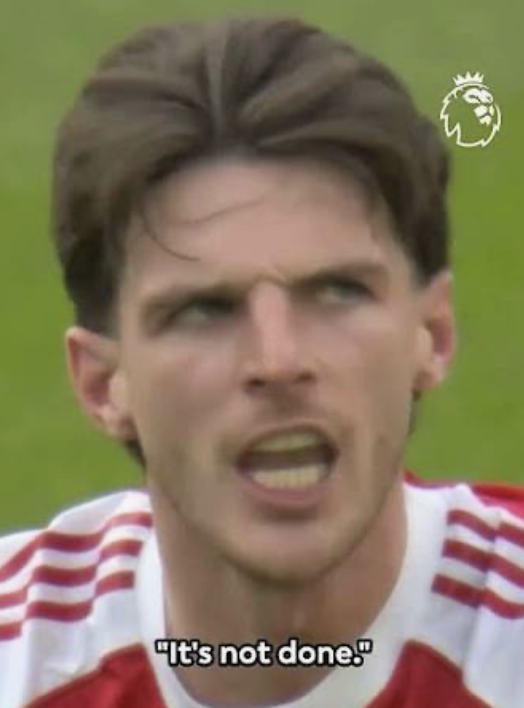
To come so close to such a big prize and to see it slip away is very hard to take but this Arsenal side is made of very stern stuff and this type of experience may harden their resolve even more . We have come very close to the League title three times and eventually clinched that prize. Let that be the case with the Cup with Big Ears. As a very determined young man once said, “This is not done!” 

2026 arrived  with Arsenal top of the table but facing a daunting January schedule. The last game of 2025 had brought Aston Villa, a potential title rival, to North London. Villa had been the last team to beat Arsenal and had recent history of thwarting Arsenal’s title ambitions. After a tight first half Arsenal broke through as Emi Martinez fumbled a corner with the deadly Gabriel pouncing and then Arsenal let out the clutch and destroyed them. Zubimendi scored from a delightful Ødegaard pass, then Trossard and Jesus put them into an unassailable 4-0 lead. We even had time to concede our usual goal to Ollie Watkins before wrapping up a very impressive victory. 

Arsenal’s defence had  built an incredible reputation so it was a matter for general astonishment when, in Arsenal’s next game at Bournemouth, Gabriel presented Evanilson with an early goal as a result of an errant pass. Stung by the mistake, he immediately struck an equaliser and in the second half, Declan Rice drove home two well-taken goals before Junior Kroupi retaliated with a very well-taken effort. Arsenal’s narrow 3-2 victory was the last game that Bournemouth lost in the season and they were to play a very big part in the title story that unfolded.

Liverpool, the defending champions, were next up at the Emirates as Arsenal sought to build a significant lead. The Merseysiders had endured a disappointing campaign, but they neutralised Arsenal with one of their best performances of the season, and a rather tame 0-0 draw resulted. 

Early January brought the FA Cup third round.  Arsenal seem to have developed an aversion to the FA Cup in recent seasons and their tie away to Portsmouth began in challenging fashion when they immediately fell a goal behind. Christian Nørgaard helped to force an immediate equaliser and Gabriel Martinelli completed a hat-trick which featured a couple of headers to take us through 4-1. Madueke could even afford to miss a penalty as we cruised home. 

Fixture congestion was a major challenge for Arsenal in this most demanding of months. Next up was the two leg semi-final of the Carabao Cup. The first leg was away to Chelsea and although we won 3-2 the feeling lingered after the match that we had let the residents of the Bus Stop off rather lightly. Ben White scored an early goal from a corner and Gyökeres made the most of an awful Sanchez mistake early in the second half. However Garnacho brought Chelsea back into the game before Zubimendi scored a delightful solo goal only to see Garnacho score again. The result still represented a very decent start to the tie. 

Last season we had travelled to a very in-form Nottingham Forest and been held to a 0-0 draw. This term we travelled to a much less successful Forest team and despite dominating play replicated a scoreless draw. Sean Dyche had produced a combative team and we seemed to lack the energy and inspiration to take all the points.

We then welcomed Manchester United to N5 hoping to pull away again and took the lead from a Martinez own goal after fierce early pressure. Zubimendi then gifted Mbuemo an equaliser with a poor sideways pass and Dorgu put United ahead with one of two incredible long range shots from which they were to score. Merino equalised late on with a header in his last game before  sustaining  a serious foot injury but Cunha wrapped up a surprise win for United with a spectacular injury-time goal. 

Arsenal travelled to Leeds aware that the home team were undergoing something of a revival but dismissed them comfortably. Zubimendi opened the scoring before Madueke’s curling corner was allowed to creep in by Darlow. Gyökeres entered from the bench to add a third and Jesus completed a 4-0 rout with a great piece of improvisation. It was an encouraging result that restored a bit of momentum and in our next game we reached Wembley when a very late Havertz goal took us through against Chelsea after an attritional semi-final second leg.  Our defensive solidity had rarely been threatened by ‘Linked In Liam’s’ boys and a few pundits started unwise talk of a quadruple. 

Our next performance where we took care of a very decent Sunderland side underlined the strength of the squad. Zubimendi continued his useful habit of scoring goals with the first and a Gyökeres double highlighted the increasing impact he was having upfront . 

The difficulty of contesting so many London derbies was underlined by Arsenal’s match at Brentford, one of the most improved sides in the league. A fiercely contested game appeared to be heading Arsenal’s way when Madueke gave us the lead with a spring-heeled header but we struggled with Kayode’s long throws throughout the game and Lewis- Potter latched onto one to equalise. Two more points were dropped, albeit against a side with genuine aspirations of playing in Europe and one of the success stories of the season.

The FA Cup continued with a fourth round tie against Wigan at home. The result was done and dusted by the 28th minute by which time we led 4-0. Madueke, Martinelli, a Hunt own goal and a delightful Jesus finish saw us through to a fifth round tie away to Mansfield Town. 

Driving to a meeting before we played Wolves, I heard Stuart Pearce claim there would be no chance of an upset at Molineux that evening. When the meeting finished we led 2-0 through Saka and Hincapié but a Bueno goal and a late Calafiori own goal after a misunderstanding with Raya saw us give away two more precious points, very unnecessarily. 

That concession on a frantic night in the Midlands was not ideal preparation for a North London Derby at the Armitage Shanks but  Spurs in their wisdom had brought in Igor Tudor, a forbidding figure with no experienhce of English football. Arsenal steamrollered the Spuds for the fourth successive time in their own stadium. Eze continued to be their Nemesis with two goals and Gyökeres also collected two goals in a barnstorming performance. Tudor looked a peculiar and ill- judged appointment but one that typified the inability to plan and recruit intelligently at the Lane.  

Chelsea and ‘Linked in Liam’ returned to N5 to play us in the league and gave us a very tough game. Saliba put us ahead from a corner but an unfortunate Hincapié own goal brought them  level on halftime before Jurrien Timber forced in a corner in the second half to clinch victory.

Brighton proved stiff opponents at the Amex in our next game but an early Saka goal which owed a great deal to a significant deflection was enough to give us victory thanks to a great defensive performance. Our victory did not go down well with Fabian Hurzeler who betrayed his youth with an immaturity that Arsenal fans find particularly galling. He criticised our approach to football, but Arsenal fans who witnessed the cynicism and downright deceit from his side in their match at Arsenal last season had little sympathy. Hurzeler later recanted his remarks.

Attention switched to Mansfield in the FA Cup. Arteta rotated his side giving starts to Dowman and Marli Salmon. Madueke gave us the lead with a spectacular strike in the first half but Mansfield drew level after an under-hit pass from Salmon. Eze showed his explosive quality with a blistering shot that clinched victory in the second half. 

The Everton match at the Emirates  was one of the most memorable played during the season and climaxed with a very special moment that nobody who was there will ever forget . Everton were organised, obdurate and resisted everything Arsenal threw at them until Arteta turned to Dowman as a substitute. With two minutes left his brilliant, swinging cross deceived Pickford, bounced off Hincapié’s groin and Gyökeres tapped home. Then, in the last minute of injury time, Everton earned a corner. Jordan Pickford, their keeper, was waved forward but Gyökeres headed the ball clear, Dowman seized on it, beat two defenders and careered forward. It was obvious from a long way back that he possessed the pace, ability and composure to run the ball home to guarantee a vital victory. The 16 year old Hale Ender slotted home triumphantly for his first Premier League goal, the youngest player ever to do this. It was perhaps the most thrilling individual moment of the season.

Theoretically, we were well set up for the Carabao Cup Final which followed a week later but this was to be emphatically Man City’s day, secured by two second half headers by Nico O’ Reilly. Kepa gifted City their first goal but this was one of those days when the final just passed us by. So much for the Quadruple! 

We then moved on to Southampton for the FA Cup quarter final, a game in which we rotated significantly with Dowman starting in a number 10 role. Southampton had already begun a long unbeaten run and were very well organised. They were significantly stronger than the side we played in the last game of the 24/25 season and opened the scoring through Stewart. Gyökeres came on on as a substitute and steered home a neat equaliser but, with the game heading for extra time, Southampton snatched the tie with a clever finish from Shea Charles. So much for the Treble!

Arsenal, freed from involvement in domestic cups, now had to narrow their focus onto the league to ensure that the deterioration in results did not escalate into a crisis. Unfortunately, Bournemouth, their next opponents, proved extremely uncooperative. Junior Kroupi gave them an early lead and although Gyökeres responded with a well taken penalty in the second half, Scott finished off a penetrative passing move and Arsenal could not get back into the game. With an away trip to Manchester City next up, Arsenal’s title prospects were suddenly looking much gloomier.

Perversely, though Arsenal lost to Manchester City, the game at the Etihad signified a big uptick in morale and quality of performance. An early  Cherki goal was immediately cancelled out by Havertz who pounced on a Donnarumma mistake. Eze hit the post and Havertz headed a glorious Trossard cross just over, but a sharp Haaland finish in the second half gave City the points. As the final whistle blew, Declan Rice could be clearly seen asserting, “This is not done!” Was that a knee – jerk reaction or a genuine  statement of intent? 

It was generally felt that we had easier remaining fixtures than Manchester City. Effectively, we had a shootout over five matches. The first was a home match with the Barcodes. The crowd groaned, each time, as we tried a series of  short corners, ignoring our giant, goal-scoring defenders, but when Havertz fed Eze, who finished sublimely, the jeers turned to cheers. The rest of the game was a hard watch but Arsenal stayed defensively secure and secured three valuable points. 

It had been a dour struggle, but the following week, Fulham came to visit and were swept aside by an Arsenal side suddenly playing with confidence and a swagger. Gyökeres scored two first half goals and Saka combined with the Swede to put us three goals up at halftime. The mood among the  fans was transformed and although Arsenal did not improve their position in the second half, a 3-0 win was hugely appreciated by the fanbase. 

Everton had held City to a draw which meant that if Arsenal won their last three games they would be champions. The trickiest fixture looked to be against West Ham at the London Stadium and the game was a hard fought derby struggle. Raya produced an incredible close range save from Fernandes before Ødegaard set up Trossard to put Arsenal ahead with only a few minutes left. West Ham piled on the pressure and appeared to have equalised through Callum Wilson only to see the goal rightly ruled out for two separate fouls on David Raya. Chris Kavanagh’s announcement of the disallowed goal has become the stuff of memes and folklore but there is no doubt that this was a pivotal moment in the season. Arsenal’s revival meant that City had no margin for error and their involvement in the FA Cup had pushed two matches into midweek slots which, given the league’s insistence on a finish by the 24th May and Sky’s wish to transmit every twist in the title race, increased the pressure on City despite their lack of involvement in European football after their exit to Real Madrid. 

This left us to overcome Burnley and to try, if possible, to improve our goal difference into the bargain. Kai Havertz opened the scoring in an inevitably tense game and while Burnley rarely threatened us it wasn’t a comfortable watch. 

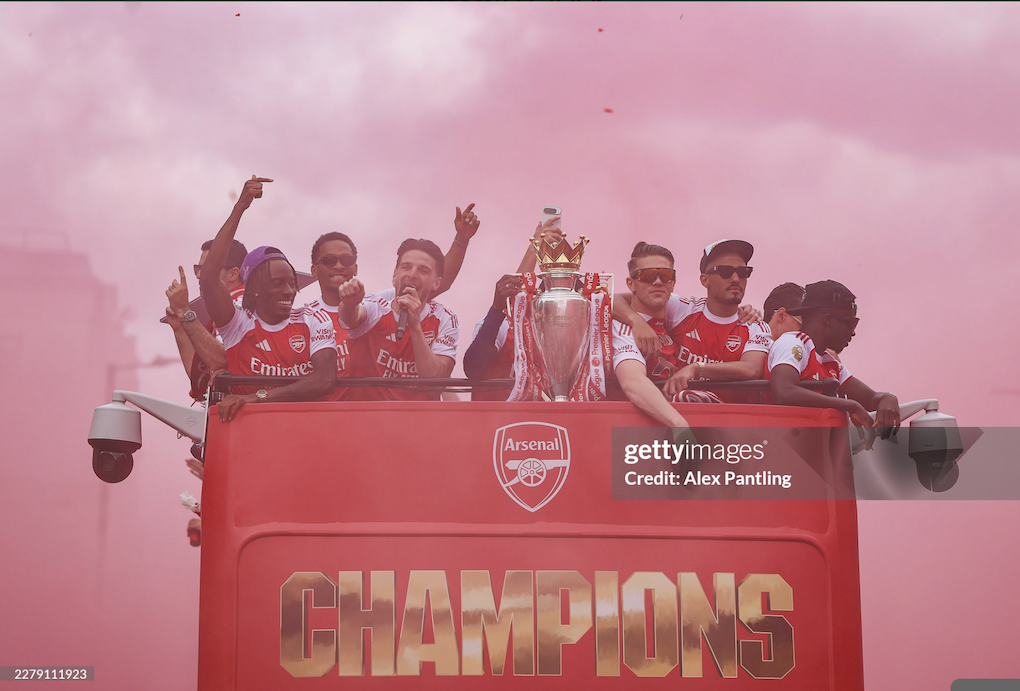
A 1-0 win left us five points ahead and the following night Bournemouth took a tired looking City to the cleaners. A beautifully executed Kroupi goal threatened to start an avalanche but slack finishing by Bournemouth meant that City stayed in the game until the last minute when Haaland equalised. The final whistle at the Vitality produced a tidal wave of sound, an impromptu gathering of over 100,000 Gooners at the Emirates, and saw the title go to Arsenal – our first Premier League in twenty two years, as we have been persistently reminded this season. At least, that stick that has been regularly used to beat Arsenal, has been taken away.

The dramatic title denouement gave Palace and Arsenal the opportunity to rotate heavily before their respective European finals. Goals by Jesus and Madueke gave Arsenal a 2-0 lead which Mateta reduced in the dying minutes. Pino had an even later goal disallowed for offside and Arsenal were able to finish the season seven points ahead of second placed City. Arsenal players and fans exulted in the sunshine and the strains of ‘North London Forever’ rang around Selhurst Park. It was a perfect day, albeit we were celebrating on another club’s soil. This made little difference to the euphoria on display. 

It has been a magnificent performance by Arsenal despite the rollercoaster ride that had latterly ensued. Over the season, Arsenal dominated top spot. Defensive efficiency highlighted by a spectacular goalkeeper and superb holding midfielders made Arsenal incomparably the strongest defensive side. Injuries were again a huge problem but the squad strength so effectively supplemented by eight new signings gave Arteta the squad flexibility he had lacked in previous years. Raya, Timber, Gabriel, Saliba and Rice were all exceptional and we still have the promise of Dowman to fully enjoy. 

Arsenal had not done the double over any side in the top six but had not lost to any side below sixth and had played twelve London derbies and remained undefeated in all of them. That is a significant accolade. 

After three successive domestic runner-up placings which attracted the description ‘bottlers’,  this success makes it possible to reinterpret the data and  to plot a different trend and to believe that this hard-won triumph possibly  represents the start of a period of domination and domestic success for Arsenal, especially given the travails and disruption at some of their rivals.

Domestic success was effectively secured but Arsenal also had European ambitions which they pursued ferociously. In the third part of our season review we will examine how Arsenal coped with integrating Champions League football into their challenge for the League title. 

Part 1

When Arsenal began their league season in August it was against an intolerant media backdrop amazingly supplemented by a cohort of Arsenal fans who suggested Arteta was ‘drinking in the last chance saloon’. The prevailing wisdom of this remarkable group provoked by ex-pros and tabloid journalists was that if Arteta couldn’t get Arsenal over the line this season, he never would. The majority of sensible folk however,  rejoiced in the gradual, incremental improvement of the squad which had been carefully assembled with our new technical director Andrea Berta who had acquired 8 new players in that summer’s window. Gabriel Jesus was hors de combat, as was Ben White, and they were soon joined by Kai Havertz who was sidelined for several months in the first match of the season.

Our campaign began at Old Trafford where United’s squad had been revitalised by three shiny new  attacking signings and indeed United played promisingly going forward, but failed to deal with an Arsenal corner midway through the first half. The goalkeeper flapped and Calafiori nodded in at the far post. United protests were in vain. A template was set for the season – an obdurate Arsenal defence behind which Raya was in prime form and ruthless efficiency from a set piece saw us to a rather fortuitous 1-0 win.

Our first home game was against newly-promoted Leeds. The game was preceded by the unveiling of a beaming Eberechi Eze and we steamrollered the Yorkshiremen. Timber headed in from a set piece and Saka slotted home before the interval. Then, in the second half, we saw Gyökeres collect his first Arsenal goal latching on to a long pass, barging aside the opposition and slotting home. A promising beginning!  Timber scored again and a Gyökeres penalty earned by 15 year old Max Dowman completed the scoring. A very satisfactory start to the  home league season!

Our next trip was to Anfield. It seemed like THE  big one, given their huge expenditure in the close season on top of last year’s canter to the title. We decided to make it an attritional contest and were doing so very well when with ten minutes left, Szoboslai curled an incredible free kick past Raya at the Kop end. We switched tactics, but too late to rescue the game, and the Kop rejoiced, having possibly seen off their biggest rival. 

Nottingham Forest were next up at the Emirates and we saw confirmation of the quality of Martin Zubimendi who scored a stunning volley and followed it up with a second half header. Gyökeres had earlier  turned in a delicious Eze cutback and the 3-0 victory was the straw that broke Ange Postecoglou’s back at the City Ground after a lightning quick and conspicuously unsuccessful spell in the hot seat.

Manchester City came to town for another summit meeting, smarting from a 5-1 defeat a few months earlier. They set up as cautiously as any Guardiola side ever seen, ceding possession to Arsenal but pouncing on defensive slackness to take the lead through our humble Nemesis, Haaland. I was unable to make the game and watched it on my iPad as time ticked down. Just as I had given up hope, a blessed message ticked up on my screen that Martinelli had equalised – the delay was about thirty seconds and there was Eze playing a delightful ball through to Gabigol who brilliantly lobbed Donnarumma. That goal arguably won us the title although, at that stage, Liverpool were several points clear and C130y were not thought to be contenders.

Several faithful Holics made what turned out to be a charming and enjoyable trip to the Potteries to see us take on Port Vale in the Carabao Cup. Eberechi Eze scored a neat early goal but the home side gave a good account of themselves and the only other score was a late Trossard goal.

Newcastle had been very difficult opponents at St.James Park in recent years and when a stonewall Gyökeres penalty claim was overturned by VAR because his leg hadn’t been smashed in several pieces, and then  Woltemade scored, it looked as if we might come up short again. A late flurry saw a beautifully executed Merino back-header and a thumping Gabriel  header seal three well deserved points for us. This was the first sign this season  of a resurgent Arsenal taking control of a potentially tough fixture and ringing out a result. 

West Ham were another team who had troubled us in recent seasons but we took care of them easily at home in our next match with Rice notching the first goal and a Saka penalty clinching victory. There was a feeling of momentum building as we took over at the top of the table and continued to deprive opponents of even a shot on target throughout ninety minutes.

Regrettably price hikes and new seating arrangements deprived a number of us from a chilly autumn evening beside the Thames at Craven Cottage. Calafiori had a goal of the season contender ruled out (as ‘left backs’ do!) but a  close range Trossard finish in the second half gave us a precious 1-0 victory. A talented Fulham side failed to get a shot on target. 

Arsenal continued the ‘1-0 to the Arsenal’ sequence at home to Palace. Every Palace fan I knew (and I know a number) anticipated Eze would prove the match winner and they were not wrong as he scored an acrobatic volley following a corner in the first half. By this stage, a head of anguished steam was building up about the efficiency of Arsenal’s set pieces and the number that were impacting results in Arsenal’s favour. Any stick to beat Arsenal is firmly seized by the anti-Arteta brigade that, unfortunately, includes a large number of Arsenal fans, and a campaign expressing disgust at Arsenal’s anti-football because of the quality and creativity of their corners and free kicks began to build up. Meanwhile the rest of the league feverishly tried to improve their productivity from set pieces!

Our League Cup tie at home to Brighton allowed us to welcome the much loved Fabian Hurzeler back to THOF. A heavily rotated Arsenal side gradually gelled and Nwaneri gave us the lead after an excellent move midway through the second half. Saka, a late substitute, confirmed victory with a goal just before the end. We waved a tearful  farewell to Fabian but knew he would  be back soon. 

We then travelled to Burnley in prime form and in a mood to squeeze the life out of the opposition. Two first half headers by Gyökeres and Rice gave us total control of the match which we won comfortably. 

Talk of an Arsenal title challenge had rumbled all summer but now had even more credence as our magnificent defence attracted a mixture of admiration, fear and contempt but our next game at the Stadium of Light was a real contest. Dan Ballard, once of this parish, scored an early goal on a rampage forward, and we trailed at halftime. Saka equalised early in the second half and a Trossard ‘worldie’ appeared certain to give us the points until a concerted Sunderland attack induced that most rare of things – uncertainty in the Arsenal defence – and a rather rash advance by Raya saw Mr. Brobbey claim a late equaliser. But a point at Sunderland at that stage of the season proved no disgrace. 

The first North London Derby was held at Ashburton Grove and saw table-topping Arsenal play mid-table Tottenham. (The sound of the term ‘mid-table’ in connection with Tottenham evokes better times at the Armitage Shanks. How they must wish that to have continued!)  It was Thomas Frank’s first (and possibly only) NLD. At the start of the season, a hilarious piece of film found its way  into circulation from Tottenham TV. There they were, the poor loves, relishing the moment when Eberechi Eze would hold up his Tottenham shirt and the Goonerverse would go  into meltdown. I don’t know if there has been a bigger example of dodging a football bullet than Eze’s experience but a serious injury to Kai Havertz prompted Ebs to phone Arteta to check if we were still interested in signing him and he got an affirmative answer. Eze decided to celebrate in his first NLD. He notched a hat-trick as a very disorganised and negative Spud team were totally outclassed in a 4-1  victory for Arsenal. Not that we cared, but that accelerated the idea of moving on from Frank for the Tottenham fanbase. 

Our next game was an away derby with Chelsea and it was the only game we didn’t win of the four we played against them this season. Despite Caicedo being sent off in the first half, Chelsea were decent value for the lead given them by Chalobah (from a corner!) just after the interval. Merino equalised midway through the half with a header from a Saka cross but we could not press home our advantage and the game ended 1-1.

Brentford’s visit a few days later underlined the extra pressure that faces London title contenders with seven London clubs in the Premier League as well as the build up of fixtures that reaches a crescendo in December and January, the least enjoyable months climatically to watch English football. Arteta rotated again but saw the reliable Merino score an early goal. We retained control without too many problems and Saka clinched victory at the end after coming on as a substitute.

Aston Villa had emerged as one of our most credible title challengers and our match at Villa Park underlined why. Neither Gabriel nor Saliba made this game and we trailed to a Cash goal at the break. Trossard soon equalised and a see-saw struggle ensued which we lost unluckily to a Buendia goal with virtually the last kick of the match. Cue rejoicing around the West Midlands, the rest of the league, and in several media outlets.

Our next league game was against Wolves at home – surely a gimme? – but it was a real struggle. After taking the lead with a late own-goal we conceded an equaliser in injury time. Gabriel Jesùs who had just returned to the team forced a second own-goal just before the end but it was a less than impressive victory .

We travelled to the Hill Dickinson for the first time on a cold December Saturday night close to Christmas. It was a predictably tough battle but we were given a helping hand, literally, when O’Brien inexplicably handled a corner. After that, our brilliant defence helped us to secure the three points.

Palace were drawn to meet us in the quarter finals of the Carabao Cup at our place just as they were last season. Again it took an own-goal (by Lacroix) to put us ahead, but in the dying seconds of injury time Guehi equalised for Palace. The game went to a penalty shootout. It was held at the North Bank. We have had three shootouts in official fixtures at the Emirates and the two taking place at the North Bank proved victorious whereas we lost the one at the Clock End. We scored all our penalties, as did Palace, until Kepa saved from the unfortunate Lacroix who probably ran his cat over when arriving home.

Our last game of the year brought Fabian and his popular Brighton lads back to the Emirates. We struck first through a rare Ødegaard goal and guess what, Havertz forced an own-goal early in the second half.  Brighton surprisingly got back in the game immediately with a goal very much against the run of the play, and then we had one of the moments of the season – a quite incredible diving save by Raya to tip over a vicious swerving shot from Minteh. That save delivered our 2-1 victory and Fabian left the ground bemoaning time-wasting, Brexit and all manner of other civil rights injustices. We wished him a very happy New Year and sent him on his way.

The first half of the 25/26 season had generally been good to Arsenal. We had only lost twice in the league, both to late goals against good teams, our defence was imperious and although we had seen serious injuries to the likes of Havertz, Saka, White, Ødegaard  and regular  absences by Calafiori our results had been very consistent. Of the new signings, Zubimendi had been excellent as had Hincapié and the extremely promising Mosquera. Eze gave us a creativity we had lacked before and Gyökeres, although suffering one significant injury, was improving even if he wasn’t blessed with the first touch of an angel. But a long, intensive second half of the season lay ahead. Could we go one better than last season and finally become champions? 

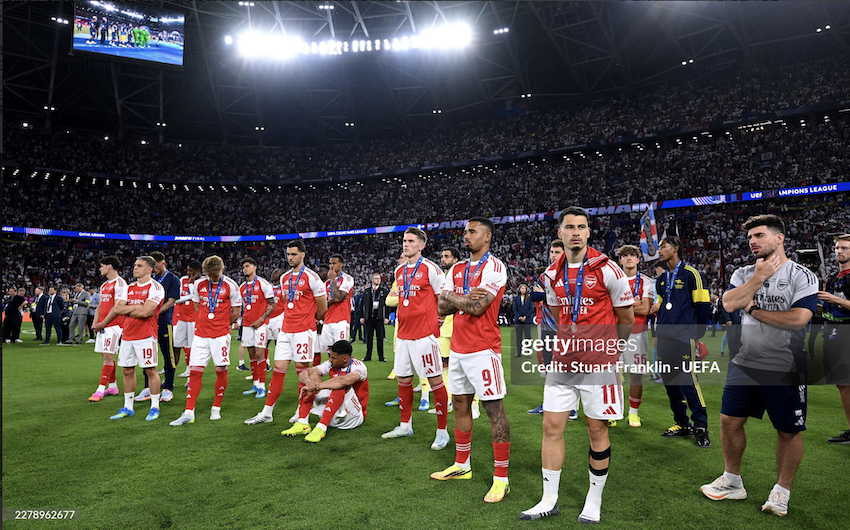
In strength-sapping heat and unbearable tension Arsenal lost the second part of what would have been a wonderful double in a penalty shootout in Budapest tonight. The Champions League slipped from our grasp in the cruellest possible way.

What made the loss so cruel was that the crucial penalty was missed by one of the great heroes of the season, Gabriel. Eberechi Eze had earlier hooked a penalty wide but David Raya made a brilliant stop to foil Mendes from the next penalty. Gyökeres, Rice and Martinelli converted their penalties brilliantly but ultimately Arsenal lost their third penalty shootout in a European final. Arsenal had executed Arteta’s game plan brilliantly with huge efficiency, dedication and courage.

Kai Havertz gave Arsenal a wonderful start with a sensational goal in the 6th minute and they remained ahead until deep into the second half when Mosquera, who had an excellent game against Kvaratkskelia, made his only mistake mistiming a sliding challenge on the Georgian winger. Nevertheless Arsenal deserve enormous credit for taking a hugely talented PSG side to penalties and making a side who have been scoring for fun in Europe against all-comers look desperate and frustrated at times.

Arteta had a detailed idea of how to neutralise PSG and this began with his team selection. He didn’t risk Jurrien Timber at right back, preferring Mosquera with the Dutchman able to make the bench (and make a significant contribution from an hour into the game). MLS took the starting midfield role ahead of Zubimendi and Havertz started upfront ahead of Gyokeres with the hope that he could prove to be a match winner in a Champions League Final. PSG’s fitness doubts all resolved with Hakimi, Mendes and Dembele starting. They began with the same ten outfield players who started in the Final last year.

The starting atmosphere was incredible and emotional. Our second Champions League final at the end of a very special season was such an amazing way to climax nine incredible months, and the Arsenal fans who had poured into Budapest, many without tickets, produced a wave of noise and emotion in the hours leading up to the game and as the game began.

Just before the opening ceremony the camera picked out Arsene Wenger, a man who has done so much to build the foundation of the modern Arsenal. A penny for his thoughts. Did he hark back to Paris in 2006?

The Killers did a set climaxing with the iconic Mr. Brightside, they were the smartest looking band I’ve ever seen immaculately attired in evening dress and another reminder if any were needed that this was not an ordinary football match.

Arsenal fans were very much in the majority – it looked as if we covered 75% of the ground. Thierry Henry helped to put the Cup with Big Ears in place and our club was ready to start the biggest match of their lives.

It started tumultuously. After gaining a free kick from the kickoff and then seeing PSG unsurprisingly dominating possession, in the 6th minute Havertz initiated a move with deft control and as it moved left, Trossard blocked a clearance, the ball rebounded into space, and Havertz was in behind the PSG defence. He moved the ball on, looked for support and decided to shoot. His shot cascaded past Safonov into the roof of the net, a phenomenal strike and an incredible start for Arsenal.

Arsenal 1 PSG 0 – Havertz 6

If your game plan involved scoring first and drawing PSG on, that represented a perfect start. PSG dominated possession but we defended the box brilliantly. Gabriel and Saliba both made a number of superb clearances and blocks and Rice and MLS looked to try and get us forward when we could get possession.

The best two moves of the first half came from Arsenal. Havertz slid in Saka whose excellent low cross was almost reached by Trossard but Safonov made a superb block which cost him a painful bang on the head.

PSG were struggling to make chances despite overwhelming possession and were confined to long distance shots. Both Dembele and Doue blazed over in frustration. Just before half time Havertz combined superbly with Trossard and saw Marquinhos block his goalbound shot. The idea that we were going to dominate from set pieces didn’t materialise. We obtained our first corner on the stroke of halftime and the referee promptly blew to signify the interval!

Half-time Arsenal 1 PSG 0

Little changed at the start of the second half although Mosquera picked up the first yellow card of the second half for timewasting. It left him very vulnerable, having to mark one of the finest attacking players in the world in Kvaratskelia. He stuck to the task manfully and the Arsenal defence kept its shape superbly and was clearly starting to frustrate the French champions. Eventually the Georgian played a brilliant give and go and was brought down by Mosquera. I think the penalty award was correct.

Arsenal 1 PSG 1 – Dembele penalty 64

Arsenal responded by bringing on Gyökeres and Timber for Ødegaard and Mosquera. Arsenal were not able to retain the ball well enough despite a monumental performance by Havertz who moved into midfield. We needed better offensive possession to reduce the pressure on our defence. Nevertheless we didn’t lose composure or shape and stayed in the game although the game became increasingly stretched as players tired. We created very little, and Kvaratskelia, their substitute Barcola, and Vitinha put in dangerous efforts. Arsenal took off Saka who had put in a tremendous defensive shift and Trossard and replaced them with Martinelli and Madueke.

PSG had to take off an exhausted Kvaratskelia and Dembele as we approached extra time. Arsenal were threatening less but a long throw from Rice caused chaos in the PSG defence but we could not take advantage. Unfortunately Gyökeres couldn’t replicate the impact that Havertz had produced and was unable to hold the ball up  and the game moved into extra time but not before Barcola hit the post in the last minute of normal time.

End of normal time – Arsenal 1 PSG 1

Arsenal brought on Eze for Havertz and extra time was more even though the exhaustion was coursing through both sides. In the 102nd minute Madueke raced outside Mendes and appeared to be bowled over. It was every bit as much a penalty as the one we gained in Leverkusen. It did not appear to attract much attention from VAR even though Rice was livid and was booked for his protests. Zubimendi came on for MLS who had been excellent in such a challenging situation.

One telling statistic that flashed up in extra time was that PSG’s passing accuracy was 92% as opposed to Arsenal’s 72%. It told a story that we had not been able to retain possession against such an outstanding opponent but our defensive discipline and spirit were wonderful.

Losing in such a heartbreaking and narrow way is a sad note on which to conclude the season but let us not forget what a wonderful season this has been. Tonight I was so proud of our team, our coaches and our fans who provided wonderful support. We have moved into the executive suite of international club football and are now a powerhouse in England and Europe.

It seems invidious to pick out heroes from tonight but I thought the two centre backs were immense, Hincapié, though crippled with cramp, was magnificent and Declan Rice showed the stature of a special leader. Arsenal will come again but this loss should not tarnish our parade and celebrations tomorrow in any way. This was a monumental effort and caps a great season.

We will reflect on the season over the next few weeks but we can all be very proud Arsenal fans tonight. Mikel Arteta and Declan Rice gave dignified interviews biting back their disappointment but vowing to bounce back stronger. Arteta has engineered a progressive improvement in our performances season-on-season and we are now incredibly well placed. A loss on penalties to an outstanding PSG side should not diminish our admiration for what has been achieved.

« Newer Posts - Older Posts »