Sixteen Arsenal players joined national squads for Trump’s World Cup Extravaganza and Fan Exploitation Event. As a result, Gooners, should they so wish, could have had an interest in several teams other than their own national side.
Raya, Zubimendi and Merino: Spain
Saliba: France
Gabriel and Martinelli: Brazil
Hincapié: Ecuador
Rice, Saka, Eze and Madueke: England
Ødegaard: Norway
Havertz: Germany
Gyökeres: Sweden
Trossard: Belgium
Timber joined but had to pull out of the Netherlands squad
To this list we can add ten Gunner alumni:
Tierney: Scotland
Xhaka: Switzerland
Kolasinac: Bosnia
Balogun, Turner and Trusty: USA
Ryan: Australia
Tomiyasu: Japan
Pépé: Ivory Coast
Martinez: Argentina
Ospina: Columbia.
I found the bloated group stages pretty dull and watched very few matches. This was primarily because most games looked uninteresting at a competitive level: either totally mismatched or both poor; or broadcast times were inconvenient. To be fair, some of those games that appeared mismatched on paper proved more difficult for established powers to negotiate than either they or I expected. There is also a school of thought in the Goonerverse, with which I have some sympathy, that this overblown jamboree is merely a distraction and, primarily represents a significant threat to the welfare of our best players, particularly to those who were running on fumes at the end of last season or were carrying injuries. A summer on a sun lounger with copious Factor 50 or leisurely exploration of some of the world’s finest museums and art galleries might have been far more beneficial. However, players clearly view participation in a World Cup differently.
Among those who left early, Tierney had a couple of unspectacular cameos for Scotland – no reprise of his superb qualifying goal; Hincapié apparently played well for Ecuador but achieved notoriety as only the second player to see red for covering his mouth when asking an opponent the time of day; Martinelli scored a crucial 95th minute winner for Brazil from a penetrating pass from alleged Arsenal prospect Guimaraes, to take Brazil past Japan; Gabriel looked somewhat less secure than usual without Saliba to his right; pleasingly, Tomiyasu looked solid at centre-back for Japan after all his fitness travails; Havertz led the line well for Germany and scored three goals; Gyökeres worked hard for Sweden, looked good at times, scored one goal in their romp against Tunisia but was in Saliba’s pocket when Sweden meekly lost to France; Kolasinac looked reasonably solid but barely mobile at centre back for Bosnia; Pépé had some moments for Ivory Coast and scored their two goals against Curacao to secure second place in the group; Balogun had an excellent start to the tournament with a couple of goals but achieved notoriety as the beneficiary of a POTUS phone call to Infantino arranging ‘suspension’ of his one match suspension for a red card; Trusty looked busy but unspectacular for the Trump Allstars; Ryan’s sole appearance for Australia was as a surprise goalkeeper substitute for a penalty shoot-out against Egypt – he didn’t save any; was Ospina actually there?
Up to the quarter finals, Arsenal players had contributed directly to 20 World Cup goals, the most of any Premier League club. Although the ‘Round of 16’ threw up a few interesting games (Mexico vs England, Brazil vs Norway and Argentina vs Egypt), the competition became interesting at the quarter-final stage. Arsenal player involvement remained prominent. The only team in the quarter-finals without a player with an Arsenal connection was Morocco (if we ignore rumours of ‘strong interest’ in Bouaddi). Saliba had played in every game for France since the group stages, despite rumours of a back issue and sciatica. This was said to have required pre-match pain-killing injections and to involve the possibility of surgery before next season. However, he wasn’t called upon to do anything strenuous in France’s quarter-final as Morocco were surprisingly passive throughout.
After Spain’s quarter-final victory, Merino had started only one game but had made 5 substitute appearances and spectacularly provided their ‘get out of jail card’ with two late winners in consecutive knock-out rounds to help Spain reach the semi-finals for only the second time in their history. Meanwhile we had seen only cheer-leader duties for Zubimendi and Raya. In contrast, Trossard started every game for Belgium, scored a pair of goals against New Zealand, and had a couple of outstanding performances. However, in the quarter final, he played on the right to accommodate Doku, and, while busy but not overly influential, was surprisingly hooked after an hour. Nonetheless, he was probably Belgium’s best player in the tournament.
England squeezed past Norway for whom Ødegaard had looked in good form and contributed three assists on their way to their first ever quarter-final. He produced another good performance here, dictating the pace of the game as when at his best for Arsenal. All four Arsenal players in England’s squad played a part in this quarter-final. Rice started but looked a shadow of his normal self, clearly drained by the illness reported earlier in the week. His lacklustre performance was unsurprising when it was revealed that he had been bed bound for nearly three days before the match! Montezuma’s revenge? He was hooked at half-time – much to his relief, I suspect. Madueke also started, contributed a few dribbles and crosses but, as is too common with him, provided little useful end product and was rightly replaced by Saka at half-time. Saka still looked below his best but contributed far more than Madueke and dinked several tempting balls to the far post that none of England’s front men met. Up to this point, Saka had started only twice and had come on as a sub four times, contributing three assists but no goals. I was impressed by how carefully Tuchel had managed his minutes but his ongoing fitness was clearly a concern. Eze came on for Rice at half time, taking over Bellingham’s ’10’ role with the latter dropping into Rice’s deeper role but the Arsenal man failed to seize his opportunity and fortunately for England, Bellingham was moved back into his starting position when James replaced Gordon midway through the second half and Eze was moved wide but, sadly, to no greater impact.
The fourth quarter final featured an ex-Arsenal player on each side and a player of tentative interest. The rehabilitated prodigal son, Xhaka, captained Switzerland, and the shameless exhibitionist, Martinez was glove-butler for Argentina. The alleged player of interest, (imho, a remote possibility), was Alvarez, who, almost certainly, seems destined for Barcelona. He scored Argentina’s critical second goal in extra time, and it was a cracker! Xhaka had an influential World Cup throughout, scoring a penalty in a rout of Bosnia and acting as mainspring of the Swiss mechanism but his team-mates lacked flair and fell short against Argentina, in part as a result of a second yellow card for a foolish dive just after Switzerland scored an equaliser. Martinez wasn’t tested much in the match but might have done better for Switzerland’s goal.
And so, there were just 4 teams left. In the semi-finals, the teams with the largest Arsenal representation, England (4) and Spain (3) were both competing for the privilege of reaching just their second World Cup Final. In the first semi-final, France, including one of our defensive rocks and an alleged transfer target in Barcola, faced Spain. France’s only Gunner had a major, perhaps decisive impact on the outcome. Saliba collapsed off the ball after 30 minutes with no-one near him. Later it emerged that this was due to his back problem and sciatica. At that point, France were trailing 1-0 and, thereafter, neither looked as defensively secure nor likely to get back into the game against a Spanish side that was imperious throughout and ran out deserved 2-0 winners. As has become Spain’s normal practice, Merino came on as a late substitute but on this occasion didn’t score. Once again, neither Raya nor Zubimendi got off the bench.
Only Declan Rice, of England’s Arsenal contingent, played in the semi-final against Argentina, having confidently asserted in a pre-match interview that he had fully recovered from the illness that had impaired his quarter final performance. Indeed, Rice played well for 60 minutes and his driving run and lay-off to Rogers was key to England’s goal. Alongside Anderson and Bellingham, he was instrumental in denying Argentina’s playmakers space and time until England scored. However, after 60 minutes, Rice and James both looked ‘leggy’ and England ceded possession and midfield control and, as a result, came under repeated waves of Argentinian attack (including alleged Arsenal transfer target Alvarez). Rice’s and James’ belated replacements, O’Reilly and Burn, failed to stiffen England’s resistance and the rest is history.
Despite his strange substitutions against Argentina, I did think that Tuchel had managed Saka’s minutes pretty well, given the concerns about his fitness, but starting Saka and Rice along with Eze in the meaningless third place play-off seemed perverse. At least Rice had the honour of captaining his country. Saliba dropped out of the French team due to his back issue and his absence proved significant.
From kick-off, the Arsenal players took control of this game as England showed far more desire than France. Rice opened the scoring from 22 yards in under 3 minutes after a driving run from near halfway. Saka was bursting regularly down the right, had a goal correctly ruled off-side then had a shot deflected for a corner from which Konsa headed in Rice’s trademark corner for 2-0. On 36 minutes, a superb Saka ball out of defence set Rashford free who fluffed his one-on-one with the keeper but eventually returned the ball to Saka who passed it into the net. Before half-time, Saka ran through the centre of the French defence onto a beautiful Eze through ball and slotted it home. England were in dreamland! However, the second half was a different story and France played as well as they had done in this World Cup. They scored three – the third pure artistry – and Olise missed three but on 87 minutes, Saka completed his hat-trick from the penalty spot to stretch the lead after Spence was fouled in the box. However, Dembélé pulled France back to 5-4 before Bellingham scored a superb solo goal. Once again, as Rice’s legs looked to have become heavy, England’s midfield had been overrun. However, the late addition of Bellingham and Anderson restored midfield force to secure the bronze medals. Reassuringly, in his post match interview, Saka protested, “I’m fit! I’m fit!” On the other hand, at the end of the game, Rice looked completely spent and he collapsed to the ground. It was good to see Rice, later, share a joke on the pitch with a very relaxed looking Saliba. All three Arsenal players selected in the semi-final for England gave excellent performances. Unsurprisingly, Madueke did not get off the bench.
There were no Arsenal players on the field when the final commenced and this was a turgid affair between a technically excellent Spain and a gang of Argentinian spoilers sent out with a clear anti-football strategy under the eyes of a passive referee who failed to use his cards early in the game to restrain the South Americans’ violent tendencies. At least the referee did eventually find his cards. Spain’s victory had to await three key changes that influenced proceedings: Merino joining the fray on 75 minutes, Fernandez getting a deserved second yellow on 90+3 minutes and Zubimendi replacing Rodri on 99 minutes. Merino was heavily involved at both ends of the pitch, crafting a goal for Williams on 96 minutes that was harshly disallowed because Otomendi collapsed when Merino’s heel brushed his toe, later heading inches wide when a hat-trick of winning goals beckoned while at the other end he made several key interceptions and took a Messi shot full in the face; meanwhile, adding to Spain’s midfield dominance, he suffered several bouts of Argentinian GBH. On 99 minutes, Zubimendi replaced ‘the player of the tournament’ for his first minutes of this World Cup; he was quietly efficient, making the change seamless. Seven minutes later, Torres scored Spain’s winner. As usual, Raya was a cheerleader and he warmly hugged his glove-butler rival Simón after the final whistle. The game was dreadful, the result was justice and, truly, a victory for football!
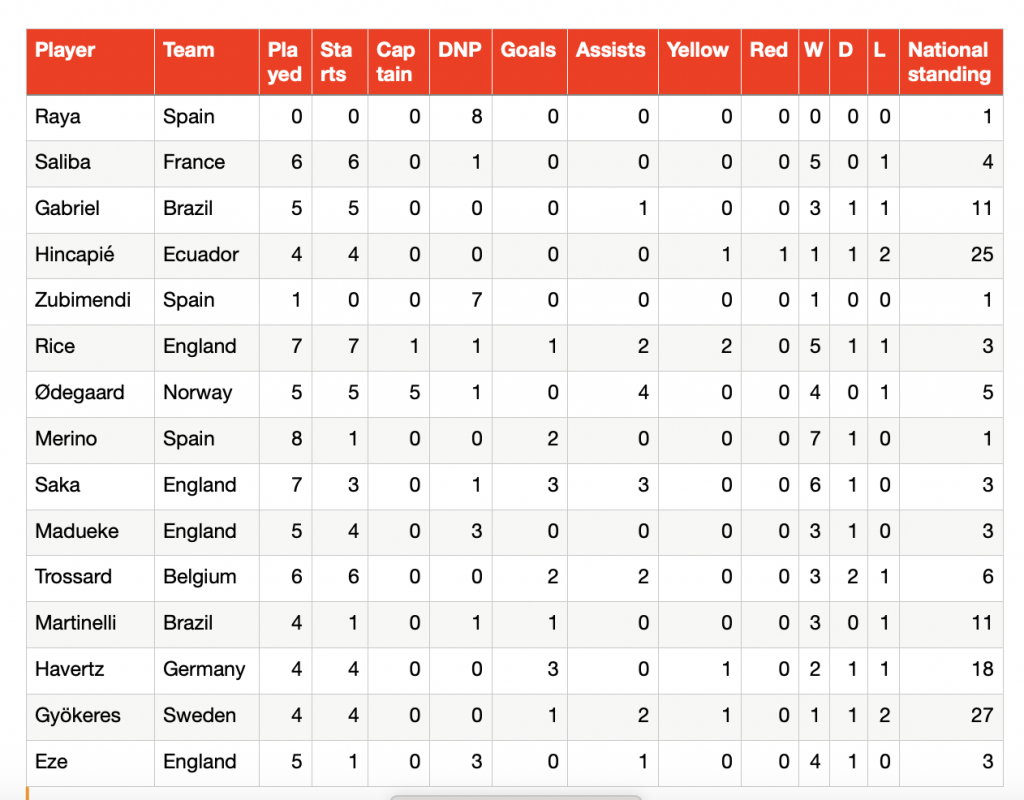
The contributions to the World Cup of the players on Arsenal’s books when it commenced are summarised in the table below based on data from soccer world cups dot com.
As the dust settles on another World Cup, we can begin to assess its impact on Arsenal’s forthcoming season. Clearly, the biggest concern has to be Saliba who had apparently been managing a back problem since late last season that culminated in his collapse against Spain. We wait with bated breath to learn whether he requires surgery which will doubtless impose a long absence. Hence the reported interest in Konsa and Stones. Saka’s performance and hat-trick in England’s last game and his assertion of fitness allayed the anxiety generated by his non-appearance as England drowned in waves of Argentinian attacks without an out-ball. I am optimistic that he will be fine after a rest and will be champing at the bit to make an impact on his return, as hopefully will Declan Rice, who looked even more in need of R&R than anyone else in England’s squad and there are rumours of longstanding neuralgia in a thigh. Clearly, Madueke will benefit from more work on his final ball over the summer. I am sure the Spanish Gunners will be looking forward to first team action in August, as will their team-mates scattered among the also rans.
A final word is required on this calumny of a competition, soiled by attempts to satisfy an obsession with maximising revenue which led to sponsored ‘hydration-breaks’ (aka commercial breaks) whether needed or not, an allegedly execrable 30 minute half-time show (as reported to me as I didn’t watch it) to give the final the air of the Super Bowl, countdowns to kick-offs (yuck!), a meddling POTUS, and the introduction of souvenir rings for players, mimicking a Super Bowl tradition. Hopefully, we will leave Disneyfication behind as football leaves Trump’s U.S. and returns to its traditional homelands.
The soul of the game has certainly been damaged by this competition. Hopefully, football will recover but, unfortunately, I fear that Infantino and his Cosa Nostra will have other plans.