Feed on
Posts
Comments
Embed from Getty Images

This is the third time I’ve written a piece about what we need to do this summer to improve our team. There are so many ways we could approach it that my mind has gone back and forth both in terms of what I think we should do, and what I think we will do.

So, this final version will just highlight some of the choices the club have to make in the summer and some of the options. Hopefully, there will be thoughts in the drinks from lots of you about my suggestions and what you would do yourself, because there really is a lot to consider.

The most obvious starting point is to highlight the, well, obvious… we are an excellent defensive team who need to improve our attack. Pretty much everything from here on in assumes that as an agreed premise.

One simple way of being more dangerous is buying better attacking players. It looks like we are serious about trying to buy Morgan Rogers, and it is easy to see how he would be an upgrade in the left-attacking position. He’s an excellent player I like very much, and his running power and athleticism highlight one potential road we might go down: leaning into qualities we already have rather than trying to reinvent our entire team dynamic. This makes sense to me, and I hope we get a deal done.

It looks like we are after a new midfielder. Some want a passer, like Wharton. Others advocate for a talented youngster, like Bouaddi, who has room to develop but whose game is not yet set in stone. Personally, I do think we need someone who can cover for Rice, who has played too much in recent years. Of course, we won’t get a like for like option, but I think we should aim for someone who could at least do a similar job ie, mobile and can cover ground. MLS and Zubi are both excellent players, and perhaps a simple way of improving is to focus them on quicker ball progression?

Martin Odegaard’s situation is not clear cut. He has two years left on his contract, so it is the usual time to offer a new contract or look for a sale. I don’t think he has done enough to justify a new contract, especially on the type of wages he would want, but I don’t really want to sell him either. I think he’d be better if we used him for games that suit his skills, rather than having him as a nailed-on starter, but that can be a hard role for a captain to accept. If he shakes his injuries, then he could easily return to form, but it would be tough to bank on it. We could really do with him rediscovering his creativity, as well as his goal contributions. His off-field importance is obvious, but I would like to see us transition towards Declan Rice taking over the captaincy in the coming year. However, the Englishman’s respect for Odegaard is shared by the rest of his teammates and I don’t think the club will be in a hurry to pass the mantle. Lots of interesting possibilities, so let’s see what happens.

Similarly, there are a wide range of outcomes for Ethan Nwaneri and I don’t know what his future will look like either. Personally, I’d keep him for another season and see how he goes. He is much more physically developed now he’s started properly growing into his man’s body. He has also had no summer football, so will be ready for pre-season and the start of next season. I expect our team to feature some players in the first few weeks who might not be starters if the whole squad were fit and available (Mosquera and MLS to get some starts, Salmon and Dowman PL minutes, etc), but someone like Ethan could genuinely play his way into the team. Towards the end of last season, Arteta spoke revealingly about how he had to speak to Myles three or four-times during the season before he was able to explain what he wanted from him. Since they got on the same page, Myles has been immense. I think Arteta needs to do the same with Ethan, and that watching MLS take ownership of his place in the starting 11, in his favourite position, will remind Ethan that is what he wants for himself. I think he might be just the type of 10 we need; incisive, direct, risk-taking, rather than a possession merchant. At least, I hope he gets one more shot.

We could go and buy a striker. Personally, I would… I’d buy Kroupi, or possibly the big Italian lad at Inter. Or some other guy who the club have watched but I’ve never heard of. Essentially though, what I want is a young, talented striker who can be part of the group with Havertz and Big Vik, and who will be ready to take on more responsibility over the coming years whenever the others move on. It would be great to get a couple more highly talented players between about 20 and 24, just for the age profile of the squad. Keeping Havertz fit would be a huge help, and I expect Gyokeres to push on after a much-improved second half to his first season. But with only those two, we would be one light (although I suppose Merino could cover).

Personally, I am not particularly interested in Alvarez. He’s a good player but I don’t think he is worth the money Atleti want for him, he clearly wants to play for Barcelona anyway, and the whole thing looks complicated and fraught. I’d swerve it myself, but perhaps things will change and there is a deal to be done. As ever, it is hard to know.

From a tactical perspective, I do struggle to see how we fundamentally change the midfield dynamic. We could use Rice as a 6 and then play two 8s, but I suspect that instead we will stick with last season’s double pivot (Rice and either Zubi or MLS) with a 10 in front of them. Maybe a player like Bruno Guimares might shake it up a little, but I am not expecting a big change.

So, I think we should take a leaf from PSG’s book and push our fullbacks up high. To be fair, we did often do that last season, but both Timber and Calafiori got injuries, and their understudies don’t have the same attacking threat. Personally, I would try to buy an attacking fullback on both sides, as close to the style of PSG as possible. Hincapie does not offer enough in attack, and he is needed to share the left CB position with Gabriel. If Ben White can stay fit then we could keep him for another year, but personally I’d try to sell him and get in a younger guy. We have such a solid defensive platform, and all of our central midfielders are adept at covering the space left by roving fullbacks, that I would lean into turning our fullbacks into serious attacking threats. As well as extra bodies, it is important to have real quality from those positions, and I think we should be scouring the market for the right players.

I’d be happy enough to sell Trossard and/or Martinelli. We should definitely try to get Jesus off the books. Same with Norgaard. We don’t want to mess too much with a winning squad, but there needs to be some turnover. We really must bring in some real top quality attacking talent, as well as change how quickly we get the ball forward and how we structure our attacks. We play so many low blocks where teams block the centre and funnel us out wide (the horseshoe of death exists because that’s where teams give us the space to keep possession) that it makes sense to me to lean into that with attacking fullbacks.

But there are other options. Weirdly, given that Declan Rice is one of the best midfielders in the world, I don’t think he’s that easy to find a complimentary partner for. Zubi was good for the first half of last season, but I don’t think we’ve quite got that area sorted yet. Like Zubi, there are other players who we can hope for more from next season now they’ve had a year to bed in – Gyokeres. Madueke and Eze can certainly become more consistently influential. And even an extra five goals from each of them would be very handy. Is this the year that Max Dowman steps into the first team on a regular basis? Could we bring in someone like Bradley Barcola, a top talent bought from a big team who hasn’t quite been the main star and is ready to show the world what he can do? There are so many ways this could play out.

Let me offer a few final thoughts. Arteta often overcorrects whatever he saw as our biggest problem the previous year, so I think we can be pretty sure he is plotting ways to score a lot more goals. Oh, goody! Josh Kroenke is fully on board, and he’ll be fighting the Arsenal corner with his Dad, making sure that money is there if the deal is right. We have an excellent (and growing) recruitment team who are identifying young talents as well as players at the very high end of the market. The twin goals next year are retaining the Premier League and winning the Champions League. The pool of players who move the needle for us is pretty small, and I expect us to be very serious about bringing in people who can help us win the biggest trophies in the club game. We are in a strong position and everyone at the club is working to leverage it. What’s not to like?

I dunno how this is gonna play out, but I am excited to find out…

Until next time, ‘holics.
Arsenal has always been a singing club. It’s one of the things I most love about going to football. The creativity mostly comes from away fans as they make up songs on trains, in buses, in pubs and in away concourses all over the land. I remember my son and I going to Leicester away and visiting an away pub just ten minutes from the ground. As we walked in we were hit with a wall of noise. A lad was standing on a table, pint in hand, leading chorus after chorus of a song which was new then, but soon became a terrace favourite.

Danny Ceballos
Danny Ceballos!
Drinks Estrella, Eats Paella
The boy is f*cking magic!

I first went to Highbury in the seventies. Apart from the band of the Metropolitan police, there was another ritual in front of the North Bank. As the players warmed up, we would sing their names and their songs. Liam Brady was my favourite back then. We serenaded him with

One Liam Brady!
There’s only one Liam Brady!

But that wasn’t good enough for Chippy. He wouldn’t acknowledge the fans until we broke into a song which actually had been Charlie George’s originally, now reworked for Brady.

Brady, Brady, Brady, Brady
Born is the King of Highbury!

At which point he would raise an iconic arm and salute us!

Another one was

“We all agree
Rixy is better than Hoddle!” (Spoiler – he wasn’t).

There are so many favourites over the years. A couple just for memories (share yours in the drinks)

He’s tall
He’s shit
He plays when no-ones fit
Big Cygan, Big Cygan, Big Cygan!

Don’t blame it on the sunshine
Don’t blame it on the moonlight
Don’t blame it on the good times
Blame it on Eboue!

But this piece is about this last, Premier League winning, season. There are fans that make a lot of noise (Palace, Newcastle). There are fans that only have one song (Sp*rs and that dreadful dirge). Right now, I don’t think there is any team with more songs about individual players. I counted 18 of the current first team squad who had their own songs sung this last season. Here they are, with just the first line (full lyric available on request).

Individual players

Hincapie (Pierro Hincapie, the Arsenal get excited just to see him play)

Saliba (Tequila!)

Gabriel (You’ll fall in love, I know you will)

White (Benny Benny White, Benny White, Benny Benny White!)

Saka (Saka, Saka, running down the wing! Saka, Saka, hear The Arsenal sing!)

Lewis-Skelly (49, 49 Lewis-Skelly!)

Rice (“We got him half price” which morphed into “He said it’s not done, he said it’s not done” in May)

Zubimendi (Last Christmas I gave you my heart, but the very next year you gave it away, this year, to save me from tears, I’ll give it to Zubimendi!)

Martinelli (His name is Gabi! He’s from São Paulo! And he plays for Arsenal!)

Trossard (Trossard again ole ole!)

Havertz (Waka waka hey hey!)

Gyokeres (He comes from Sweden, the girls are very nice)

Odegaard (first heard at Goodison three years ago, “Been dreaming all day of our number 8, Martin Odegaard Oi! Oi! Oi!)

Merino (woah, woah woah woah woah, woah woah woah woah, Mikel Merino!)

Timber (Jurien Timber, he’s our Dutch defender, he never gives the ball away!)

Dowman (Super, super Max, super, super Max, super, super Max, super Maxie Dowman!)

Eze (My favourite player song of the year and worth quoting in full)

You can hear them crying at the Lane
Eberichi scores again
He called Mik Arteta, he said Wow!
F*ck off Tottenham, I’m a Gooner now!

Madueke (da da da, Noni Madueke!)

I can only count four current players without their own song: Raya, Calafiori, Mosquera and Norgaard. Work in progress!

Team songs

You know all the usual ones and they all appeared, including  a ten minute long version of “So Paddy got up” at Portsmouth. The most frequently sung team song as the season went one was of course

We won the league at Anfield!
We won it at the Lane (Twice!)
Stamford Bridge, Old Trafford
No-one can say the same!
Mikel Arteta’s Army!
We’re Arsenal through and through
We’ll sing this on the North Bank
And in the Clock End too!
Ole, ole ole!

The brilliant North London forever was one of the sounds of this season. And the old self deprecating Arsenal humour follower the spirit of “Boring Boring Arsenal!” with

“Set piece again!
Set piece again
Set piece again Ole Ole!”

At West Ham, as we began to believe, a couple of songs rang out. Firstly, when Trossard scored and some of the Arsenal fans in the home end outed themselves by celebrating and were roughed up, the away fans immediately struck up with

“We sit where we want!
We sit where we want!
We are the Arsenal
We sit where we want!”

And quickly followed by a repost to all the Arsenal haters out there

“We are unbearable!
We are unbearable!
We are unbearable!
We are unbearable!”

But my favourite team song of the season, was the one sung when Thomas Frank was the manager up the road and pictured holding an Arsenal branded coffee cup. It was particularly loud and frequently repeated as we stuffed them at White Hart Lane.

“Arsenal Boys, are on a bender
Thomas Frank is a silver member!”

Have a good Summer all.


The Prologue

When I received the request to do this piece I was in the middle of a horribly complicated wrangle with Virgin Media who, on 8th May, right before the final, season defining three weeks of the season, accidentally disconnected my services. All of them. Internet, TV, landline (not that I’ve had one plugged in for years) – the lot ! In fact, as a result, I hadn’t received the original request.

When I eventually spotted the ‘memory jogger’ request, I misread it in haste as a brief to pick out the outstanding performers of the season. One of the few serious points I have often made in this bar is that I am loathe, considering the team ethic that Mikel Arteta has fostered in the club, to ever pick out a Man of The Match. Every player in this team, and this squad, is so dependent on all the others, I feel it makes individual awards unfair and even a bit redundant.

Having subsequently re-read the brief, I was both relieved and simultaneously perturbed to discover it was a good deal farther reaching than that. A squad review detailing “Who was outstanding, who disappointed and the most noteworthy improvements this year.” To quote Scooby-Doo, “Yikes!” – this requires TTG levels of summarising skill. And I’m afraid that for all of you who like your football articles to contain lessons in classic literature and ancient history, Scooby-Doo is all you’re getting from me!

The Disappointments

I don’t think anyone in the squad has been a disappointment per se. The great strength of the squad has been the spirit, the togetherness and the genuine warmth this group have demonstrated towards each other.

I have felt disappointed for a number of players because their playing time and contributions have been seriously curtailed by injury. Those that fall into this category would be – number of games in (x) – Gabriel Jesus (13), Kai Havertz (24), Mikel Merino (14), Ben White (9), Martin Odegaard (13), Riccardo Calafiori (9), and Jurrien Timber (8). Add to that a cautionary note concerning Max Dowman who was also unavailable for 13 games with the ligament injury he suffered – a good reason to be extremely careful when considering playing a 16 year old against cynical old professionals. I have concentrated on those injuries that have caused successive weeks of unavailability. They add up to a total of 103 weeks and that is a lot of talent to have missing from the squad over a season.

I guess this section would also have to include Christian Nørgaard. It’s fairly clear that the manager decided he was not at the required level to rotate in midfield – a pity because it would have enabled Martin Zubimendi to pace himself better over the season and not suffer the dip in form caused by a relentless first term in English football. It should be stressed here that Zubimendi proved a tremendous addition to the team, allowing Declan Rice to progress more into his “8” role knowing that the back door was securely guarded (no, don’t titter, Missus!). It should also be noted that the manager and players have made the point that Nørgaard, despite his lack of playing time, has been a tremendous example to the squad in terms of the standards he sets.

If I really have to be critical in a title winning season, I would say Noni Madueke has disappointed me. He clearly has ability and, hopefully, his second season will see him come good but, after all the step overs and feints, his final delivery has often been poor. And I absolutely hate to say I fear this could be the end of the road for Gabriel Martinelli. I’m not sure left wing is his best position. He is not a tricky player and being marked by a touch line does him no favours. His pace is his greatest strength but going round the outside and ending on his weak foot renders his end product underwhelming too. He has seldom to never been deployed through the middle – where I personally think he is best suited – but I suppose there must be a reason for that. He has a tremendous work ethic and has been here so long he is one of our own. A thoroughly likeable, genuine member of the squad. I would love to see him still here but if the club is looking to strengthen the attacking department of the squad, I do feel only one of Martinelli, Jesus and Trossard will survive.

The Most Notable Improvements

My own first nominee for this award is Viktor Gyökeres. He eventually arrived last summer for a reported fee of €64 million with a phenomenal goal scoring record behind him in Portugal, no pre-season and, it must be said, a fair amount of scepticism that he would be able to transplant his skill set directly into the higher class environment of the Premier League. For a good while it seemed the sceptics were right. He looked slow, clumsy and weak in the challenge, lacked ball control, failed to hold the ball up or bring other players into the game and, to my memory, only scored either against the weaker sides in the Premier League, from the penalty spot, or in the more comfortable conditions of the Champions League. If Gyökeres was the answer to our goal scoring problems, what on earth had been the question?

It looks quite clear now that the newly recruited Gabriel Heinze has been of massive benefit to Gyökeres over the season. Apart from improving his sprinting speed, he now has a totally different attitude to how he receives, controls and holds the ball up. It starts with a determined step across his centre back locking him in place with his arms, a step and push backwards to clear a yard of space in which to control the ball and provide the vision of where his team mates are. He has begun to integrate far better into team play and has accumulated a total of 21 goals across the season which is a very decent first season return.

My next two suggestions might surprise a bit in this category. They are Leandro Trossard and David Raya. I have to admit to being a little disappointed and quite surprised when Trossard was offered significantly improved terms on his contract before the start of the season. I thought he had looked past his best the season before, only really impressed as a substitute and generally, much like a prawn cocktail, disappointed as a starter. As it transpired, the new season found him in much better form. Despite a dip in form in the second half of the season, he turned in twelve goals in all competitions, worked really hard and proved a valuable squad member considering the long absences of Gabriel Jesus and Kai Havertz, and the unfortunately underwhelming form of Gabriel Martinelli.

David Raya had clearly made himself a very obvious first choice before last season. However, I thought he scaled even greater heights last term, pulling off saves that earned the team several highly valuable points. When he first arrived he was, by his own admission, quite nervous about stepping into a team where expectations were at a different level to his previous clubs. He was also replacing a fans favourite in Aaron Ramsdale and in his first season he often looked quite jittery, seemed to unsettle the defence to me and took up some very odd positions between the posts. Last season though he built even on the season before. He plays as a sweeper keeper and is an integral part of how the team plays out from the back. He is now regarded by many as the best in the world. We have come to regard the truly exceptional as almost the norm now as David Raya looks practically unbeatable. (Except on penalties, shh!)

The Outstanding

I could almost list the whole of the rest of the squad in this section. The obvious choices would be Declan Rice, Gabriel Magalhäes, and William Saliba who were inexhaustible at the core of the defensive formation on which the title bid was built. Gabriel also made a fantastic contribution to the attack, creating havoc at our anti-football set pieces although I was surprised to see that he only scored four times across all competitions during the season. It seemed a lot more.

I want to mention Martin Zubimendi again here too. C100 referred to him earlier in the season as a “Swiss gold watch of a player”, a phrase that has stuck in my head since. His quality absolutely shone through at the beginning of the season as his defensive covering helped to release Declan Rice to go forwards whenever possible. He was available for the whole of the season although it’s physicality eventually took its toll on him, requiring some time for him to recover during the final few weeks. That, in turn, led to the emergence of the first of my three, intentionally possibly less obvious, main nominations for this section – Myles Lewis-Skelly.

We had all been impressed with Myles when he stepped up to fill the troublesome left back slot – an inverting left back slot at that – the season before. It was something of a surprise not to see him featuring at all at the beginning of last season. Mikel Arteta clearly preferred to go with the physicality, experience and extra defensive capability of Riccardo Calafiori, and for a lot of last season it appeared that, sadly, the writing might be on the wall for Myles.

What we didn’t know was that behind the scenes the manager was schooling Myles in exactly how to play his boyhood and academy midfield role in a highly demanding first team setup. And then, just as Zubimendi began to tire and Mikel Merino remained sidelined with his broken foot, up stepped Myles Lewis-Skelly again to absolutely help to save our season. He slotted into our midfield like he’d been playing there for years, displaying strength, tenacity and an ability to win and carry the ball past opponents as well as anyone in the team. He played with a lovely calm and desire to always try to look for the positive forwards option. Declan Rice must have breathed a huge sigh of relief to see the Lewis-Skelly cavalry arrive, and possibly took a quick look over his shoulder at the young man showing the potential to match him in a few seasons time. Myles was entrusted with the remaining league games of the season and was then paid the highest compliment with a start in the Champions League final. A quite brilliant contribution from such a likeable, talented young man at a critical time of the season.

Christhian Mosquera is my second personal choice for the “outstanding” section. He arrived from Valencia last summer at the age of twenty-one for a fee of £13million. Since then he has played at centre back on both left and right sides, covering multi-game absences of Gabriel and Saliba, generally reckoned to be the best centre back pairing in the world. Surely the highest accolade he could have earnt was that the absences of our first choices were hardly noticed. He is a proper physical presence, calm under pressure and careful with his passing out of defence.

He also filled in at right back when both Jurrien Timber and Ben White were ruled out with injuries for the final games of the league campaign. Then, as our third choice right back he became another very young squad member to be entrusted with a start in the Champions League final. His job was to mark the best left winger on the planet in Khvicha Kvaratskhelia. The PSG man only managed to get past him on one solitary occasion, and that was after both Christhian and Bukayo Saka had been disabled on our right hand side by two of the dodgiest yellow cards you will ever see – and as Arsenal fans we’ve seen a few. We may need him at the beginning of next season if reports are true that William Saliba has been playing with a back problem for some time but the French are insisting on playing him through the World Cup – I’m sorry, The Donald J Trump World Peace Cup. In any event, a tremendous season from Mosquera. We are lucky to have him.

Piero Hincapié gets the last of the three spots. He came on loan from Bayer Leverkusen in the summer with an obligation to buy at the end of the season “depending on conditions”. I have no idea what those conditions were but it’s impossible to think they were not met. He will be a €50 million addition to the squad, presumably some time in June.

I don’t know anything about Ecuadorian football other than when ever I’ve seen brief glimpses of their national team playing, the players have looked technically competent, quick, athletic and very strong. Hincapié has not disappointed. He initially filled in at left back during one of Calafiori’s injury spells and then at centre back when Gabriel was unavailable. Since then he appears to be at least equal first choice at left back, probably depending on Mikel Arteta’s tactical preference on a given day. Calafiori offers more going forwards, certainly in terms of variety and chaos in the opposition area, but Hincapié is the better defender when facing a particularly dangerous winger.

I can’t remember a game when Hincapié has disappointed in either of his positions. He is an aggressive defender, tackles well, a careful passer and must be an absolute nightmare to play against – a big lad, strong and relentless after his man. You could argue that he doesn’t have Calafiori’s ability to excite but he has settled seemlessly into the side and been reliable whenever needed in vital positions in our defensive formation.

Conclusion

Ultimately the squad held up and delivered our first league title for the now much over quoted twenty two years. However, it did get close considering the level of investment made last summer, once again due to the amount of injuries suffered. We finished up stretched in the full back and midfield departments by the end of the season, just as we had been in the attacking areas at the start of the season.

The most alarming of those injuries to me were the ones incurred by Saliba, Saka and Calafiori, an incredible four times, in match warmups. We have been unlucky in that injuries have tended to hit certain areas of the squad in clusters. Personally, without any inside knowledge, I still feel our recovery record and strength and conditioning practices have been suspect for a couple of years.

I have offered that opinion on the blog several times over that period so am not simply jumping on the bandwagon given that interestingly in that regard, the club has recently sacked head doctor, Zafar Iqbal, and are to appoint the former Aston Villa and Nottingham Forest head of medical services, Arnaldo Abrantes. Spanish physiotherapist Joaquin Acedo has also been brought in to review the club’s injury management. We’ll see.
The last and probably most important thing to say is that Mikel Arteta, Andrea Berta and the owners have built an incredible squad. In fact they’ve rebuilt an incredible club. Whoever has played, coached, supported or in any way been involved, they have developed a very special atmosphere throughout the entire club.

There is a wonderful togetherness throughout the squad which must be carefully protected over the course of this summer’s comings and goings. It will be sad to see any of them go but no club can stand still in elite football. Thank you and very best wishes to every single one of them. Quite apart from the trophies, you have given us all back genuine pride in this great club.

This season just concluded, we became the first side in the Premier League’s 34 editions to go through a campaign without conceding a penalty or receiving a red card. We did, of course, concede a penalty of consequence in the Champions League final, and two others on the way there. However, that is beyond the scope of this disciplinary review.

The editors requested an examination of our record both in a historical context and in comparison with the teams we have competed against for the PL title in recent seasons.

They may have hoped that this would reveal a deep conspiracy among referees to do us down. Not to bury the lede, as they used to say when journalism was still honest and thoughtful, it is really, really difficult to find coherence in how the employees of the Professional Game Match Officials Limited brandish the two cards they carry in their pockets.

Perhaps ‘Limited’ should be at the start of their name, not the end.

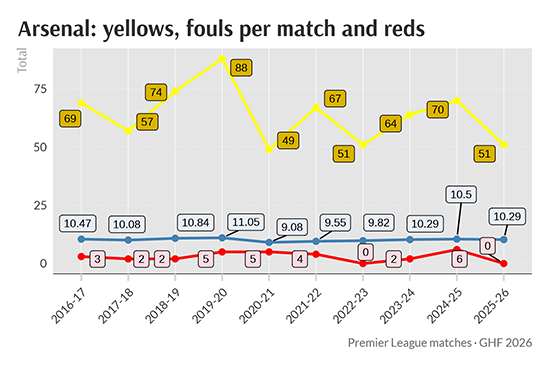
There was a foul roughly every four and a half minutes in the league last season, an average of 21 per game. Our average of 10.3 per game was slightly below our fair share. Wolves committed the most, at 13.0 per game, and City the fewest, at 9.7. Yet thirteen of the 20 PL clubs were roughly within half a foul per game of our figure.

The blue line in the chart below shows that our number last season was close to the midpoint of the narrow range of our foul rate over the past decade. Myth no. 1 to dispel: Arteta has got his team fouling less. He hasn’t. Where the fouls are conceded is a different matter, and that has affected our yellow-card count. More on that later.

Next, let’s consider red and yellow cards, represented in the chart by, er, the red and yellow lines. Last season’s yellow card count was relatively low, but not the lowest over the past 10 seasons. Nor has there been a steady decline during the Arteta years. This term was the first since 2022-23 when we received fewer yellow cards than the previous season.

In general, in the Premier League, the correlation between fouls committed and yellow cards issued is very strong, as one would expect. However, for Arsenal, considered in isolation, the correlation is weaker than in the league as a whole, though it remains reasonably strong.

That, I shall argue later, is not a coincidence.

The red line shows no correlation with either yellows or fouls conceded. We should not expect one. Red cards are relatively rare, and VAR puts its oar in, not always for the best. The Key Match Incidents panel reckoned we should have had four reds last season, not zero. The previous season, the panel had said we should not have had as many as we did.

However, the tally is what it is, making last season the second of the past four seasons without any red cards. For the record, the most red cards we’ve had in a season in the Premier League era is seven in 1998-99.

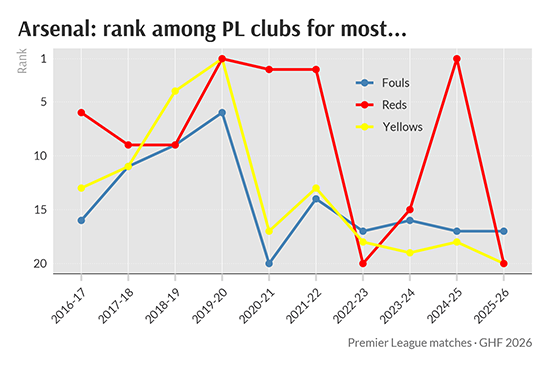
Where we ranked for fouls, yellow cards and red cards among the other PL clubs over the past ten seasons underlines the randomness of red cards.

Last season we ranked joint 18th for red cards (City and Brighton also had no red cards last season) but 16th for fouls. The previous season we were 17th for fouls but top for reds. In 2020-21, we were second for reds but 20th for fouls. Go figure.

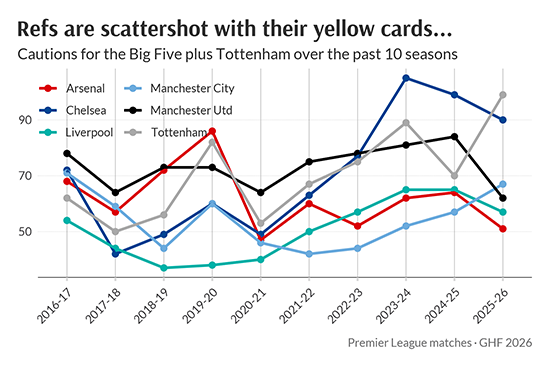
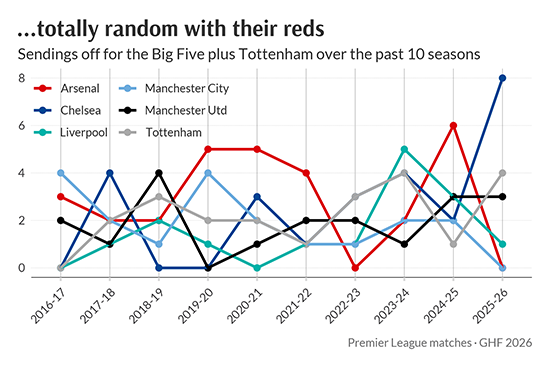
It would be easy to see a conspiracy afoot. Yet, as the next pair of charts show, the same erraticity in yellow and red card issuance applies to the other members of the Big Five and the neighbours, over the past ten seasons.

The only reasonable conclusion the man on the Clapham omnibus could draw is that there is no coherence or consistency among Premier League referees.

No surprises there, then.

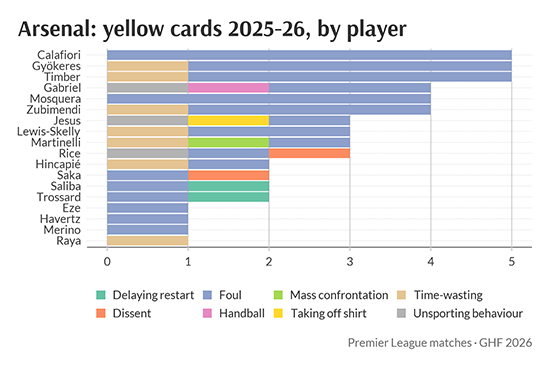
The final chart shows our yellow card count by player for last season. Two-thirds were for fouls, roughly one-sixth for time-wasting or delaying restarts, and the remainder for a miscellany of infractions.

I draw your attention to the numbers for Gabriel and Saliba, four and two, respectively, of which only half were for fouls.

I would suggest that these figures hold the key to why our yellow card count has been relatively low compared with other clubs in recent seasons, and that this season our red card count has evaporated, even though we are still fouling as much as ever.

Gabriel ranked 33rd and Saliba 62nd, respectively, for yellow cards last season, not among all PL players but among just PL centre-backs. The top 10 included Brighton’s Dunk and van Hecke, with 10 and nine yellows, respectively. Newcastle’s Burn had nine. Everton’s Tarkowski had eight, as did Bournemouth’s Senesi. Wolves’ Mosquera led the way with 11. There was a sprinkling of red cards among that cohort, too.

I would argue that those extraordinarily low figures for Gabriel and Saliba are a consequence of the discipline and organisation Arteta has instilled in the team, rather than the result of specific measures to reduce cards.

I will acknowledge that after Saliba was sent off at Bournemouth in October 2024, Arteta said, “we cannot continue to play with 10 men at this level”, and that the team needed to eliminate red cards. I will pair this with Arteta’s oft-stated maxim that one quality he values in a player is availability, which includes avoiding suspensions.

Yet, to my mind, it is the defensive organisation built on strict positioning principles and the discipline to hold that structure for long periods in games, allied to a game plan based on control and on making the opposition play where we want them to play, i.e., away from yellow and red card-prone areas in front of our goal, that has made the difference to the card counts.

Our defenders have fewer desperate last-ditch tackles to make — and in Saliba’s case, as I mentioned in a previous drinks, while his numbers for the dirty work of defending are anything but impressive, his positioning and anticipation stats are off the charts compared with any centre-back in Europe’s top five leagues, let alone the PL. He rarely needs to make last-ditch challenges, and when he does, he has the Rolls-Royce qualities to make them cleanly.

I would ask you to guess — without first looking at the answer in the next paragraph — how often Saliba and Gabriel foul on average.

The answer is 0.8 of a foul every 90 minutes. That is remarkable given the intensity and physicality of the Premier League. Even our most carded players, Jurrien Timber, Ricardo Calafiori and Viktor Gyökeres, all with five yellows last season, were committing only 1.4 fouls every 90 minutes on average.

That further suggests a systemic effect from team discipline and organisation. Control of the ball makes players less likely to commit fouls, and even less likely to commit the desperate fouls that result in cards. We got a yellow for every 7.66 fouls last season, down from every 5.7 fouls in 2024-25

There are second-order dimensions to this. Our out-of-possession 4-4-2 midblock rarely exposes individual players. A study of all 20 PL teams, conducted after 10 games last season and dividing the defensive third into ten zones, found that we were the only team to foul below the league average in all ten.

Another is our high defensive line when in possession. Most of our fouls are committed near the halfway line. In the Palace home game, all six of our fouls were committed in the Palace half. One benefit of fouling high up the pitch is that referees view such fouls as less serious offences and are less likely to reach for their cards. Another point is that free kicks conceded in the middle third are not in direct shooting range.

Paolo Maldini, who would feature in many all-time XIs at centre-back, once said that if he had to make a tackle, it was because he had already made a mistake. Artetaball is built on avoiding mistakes, in the sense of avoiding jeopardy.

We now have a mature, disciplined team that is confident in its tactical organisation. It no longer fouls in the most dangerous areas out of desperation, but rather where it is tactically most effective. The foul count hasn’t declined, but the card count has as a result.

The European Odyssey 2025-26

Having reached the semi-finals of the Champions League last season there were high hopes, indeed expectations, that Arsenal could  mount a serious challenge for the trophy this year. Arsenal had adjusted to the new league system very effectively last season and comfortably qualified in the top eight places in third place. In theory, the higher a team finished, future progress would be more facilitated in the draw but, last season, Liverpool were drawn against PSG in the last 16 after finishing first in the expanded league group so there was still a random element to the system!

Arsenal set out on their 2025-6 European journey with a visit to Athletic Bilbao, a testing start but one that we coped with comfortably. It took until the 72nd minute for Arsenal to break through. Gabriel Martinelli scored then Trossard secured victory with a few minutes to go. A shut-out with an excellent defensive performance illustrated how well-placed Arsenal were to go deep into the competition.

Our first home game was against Olympiacos and although an early Martinelli goal set Arsenal on their way a quite remarkable save by Raya from Podence was necessary to preserve the lead and the game was not wrapped up until Saka scored in injury time. 

One of the glamour games in the first eight matches in the expanded league was a home match against Atletico Madrid, a seasoned European campaigner, managed by the notorious Simeone and a side expected to pose significant problems for Arsenal. Apart from a spectacular effort by Alvarez early in the second half which rebounded off the woodwork, Arsenal picked off Atletico with ease after the interval. Gabriel headed in an excellent Rice free kick, a superb Lewis- Skelly run set up Martinelli for a second and Gyökeres then poached two close-range goals to complete an impressive victory. 

Arsenal then travelled to Prague to take on Slavia and benefited from a VAR intervention to give them a penalty which Saka converted. Merino carried on a very helpful club habit of scoring immediately after the interval with a slick finish and added a third goal, with a header, twenty minutes from time. 

Arsenal had a 100% record but faced their most significant challenge in the next game against Bayern Munich at home. Harry Kane returned to his usual warm welcome at the Emirates but this time was not awarded a penalty as he usually is when he visits. Hincapié was deputising for Gabriel at centre back, and he did so very capably, while the team carried enormous momentum into the game, having thrashed Tottenham a few days before. 

Timber gave Arsenal the lead from a corner but a superb and very direct counter from Bayern saw the young prodigy Karl equalise. Arsenal’s second half performance was even more impressive than we had seen against Tottenham. Calafiori produced a superb overlap and cross which substitute Madueke turned in for his first Arsenal goal and a great long pass from Eze drew Neuer from his goal only for Martinelli to race around him and turn the ball home. This was a real statement victory. On my way back to my hotel in Marylebone after the match, I hopped into a taxi. The driver noted my scarf and had also been at the game. “F***ing hell mate, I’m just starting to realise how good we are!” was his prescient comment. Ahead of the game, Bayern were reckoned to be the big threat to PSG but they were put firmly in their place by Arsenal that evening, and Kane spent the match firmly confined within Saliba’s pocket . 

Arsenal had soared into the  upper reaches of the Champions League table and were close to qualification for the last sixteen before they played FC Brugge in mid- December. Arteta rotated the team significantly but Arsenal still comfortably took care of the Belgians. The Gunners were set on their way by a spectacular effort from Madueke who then added a second just after the interval with a header. Martinelli, who was having a barren time in domestic football, continued his European scoring streak with a goal in the 56th minute for another solid 3-0 victory. 

The Inter Milan away game loomed as a serious challenge, especially as Arsenal had suffered their first defeat in the previous campaign in very unfortunate circumstances at the San Siro. Arsenal were able to rotate the side significantly but still won with a very professional performance. Jesùs opened the scoring but Sucic hit a spectacular equaliser only for those physical monsters Trossard and Jesùs to combine to give Arsenal the lead from a corner. Arsenal then coped comfortably with the Inter attack and substitute Gyökeres banged in a long distance effort to clinch a 3-1 victory.

Arsenal’s final game in the league phase was a home fixture against Kazakhstan’s finest, Kairat Almaty, who were lying at the bottom of the 32 team league. When Gyökeres scored early on, Arsenal fans expected a rout but we then conceded a penalty which Jorginho (no, not that one) converted. Havertz and Martinelli put us into a 3-1 lead but to their credit Kairat kept going to the end, and Ricardinho scored a goal in the last minute to suggest a game that was much closer than had actually been the case! 

We had qualified top in the league with a 100% record, had conceded only two goals and this proved very significant in helping us to navigate through the knockout stages. We entered the competition again at the last 16 stage and were able to play our home legs as the second match for the rest of the competition.

Our first opponents in the knockout phase were Bayer Leverkusen. There was no repeat of the 7-1 away victory we had achieved against PSV last season and we struggled in Germany lacking our normal control and fluency and conceding from a corner which Andrich headed in just after half-time. It was a goal from the Arsenal playbook and our response was a long time coming. Eventually an enterprising run from Madueke was met with a heavy challenge and the referee adjudged that it was a penalty. Later in the competition, a very similar situation did not have such a happy outcome. Havertz coolly slotted home the  penalty and we gained a rather fortuitous draw. 

In the home leg, we gave a controlled performance sparked by a quite superb strike by Eze midway through the first half. Rice clinched victory in the second half, with another fine finish following a corner. We then shut Leverkusen down very effectively and were able to move smoothly into the quarter finals . 

We met Sporting Lisbon whom we had thrashed last season when Viktor Gyökeres was their main striker. The away leg in Lisbon was cagey but a beautiful combination between Martinelli and Havertz enabled the German to finish elegantly to give us a priceless 1-0 lead. The second leg was closer than most Arsenal fans had anticipated. Sporting rarely threatened but neither did we and a fairly sterile game ended 0-0.

Our semi-final opponents were expected to be Barcelona, but they had been upset at home by Atletico Madrid, and Atletico prevailed after a tense second leg. Arsenal played a textbook European away leg in the first half in Madrid and were awarded a penalty which Gyökeres blasted home. In the second half, Atletico improved and White was penalised for the sort of handball that is punished in European games. Alvarez equalised but Arsenal’s defence held firm thereafter and it finished 1-1 .The second leg was tense and the highly charged atmosphere seemed to lift Arsenal who scored a precious goal just before the interval when Saka turned the ball home after Oblak had parried a Trossard effort. Arsenal showed all their European knowhow  to preserve their lead in a tense second half, Simeone came to blows on the touchline but what’s new?! When the final whistle blew we saw huge rejoicing around the Emirates. We were off to Budapest! 

Bayern and PSG had played a remarkable, high scoring semi-final first leg but PSG were  much more pragmatic in the second leg and advanced after a 1-1 draw.

Our final with PSG was played in Budapest and despite a huge exodus of Arsenal fans only 16,000 tickets were available through the club although it was estimated that we occupied three quarters of the stadium. Havertz gave Arsenal a dream start with a fine breakaway goal, after only six minutes with a shot that he rifled into the roof of the net at the keeper’s near post. Despite overwhelming PSG possession the French side made very few chances in the first half. 

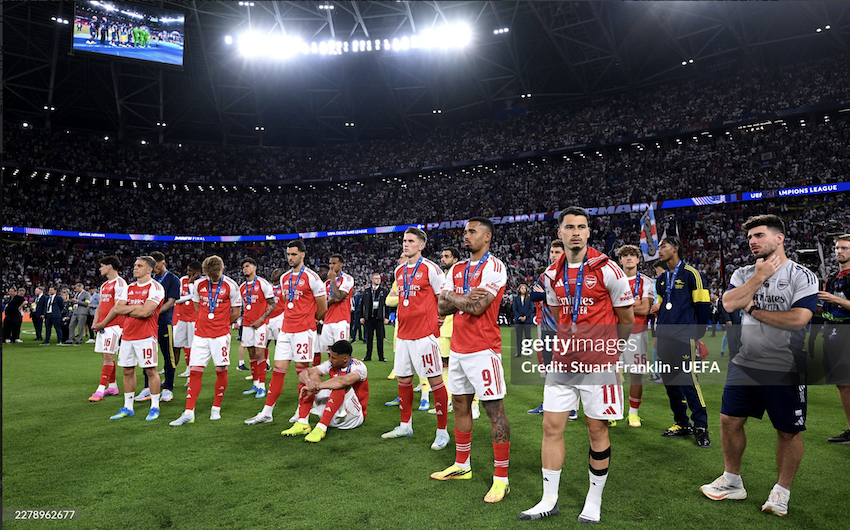
Kvaratskelia had been the player we most feared but he was generally beautifully played by Mosquera, starting in place of Timber ….. until the 63rd minute, when he mistimed a tackle in the box and Dembele despatched the penalty. An attritional  game moved into extra-time and Madueke was clumsily challenged by Mendes but the referee who had made few friends in North London, waved away Arsenal’s claims.  It looked every bit as much a penalty as the one we gained in Leverkusen. Barcola hit the post with virtually the last kick of the match but we moved on to penalties. Eze missed Arsenal’s second after Gyökeres had scored. Raya then saved from Mendes and Rice and Martinelli scored. However, Gabriel blazed Arsenal’s fifth penalty over and the Champions League  belonged to PSG for a second consecutive year. 

Football judgments are very binary and Arsenal have alarmed a lot of rival clubs and their fans this year. A lot of the negativity towards us  is borne of fear.  Arteta has turned them from a club with no worthwhile recent European pedigree to a serious challenger for the Champions League in three years. In those three years, Arsenal have narrowly lost to Bayern in the quarter final in 2024, made the semi finals against PSG in 2025 (having already beaten them in the league stage) and lost two tight games whilst recording a significantly higher xG than PSG. This year’s  version of Arsenal is a much more streetwise and resilient outfit. Ironically having not conceded a single penalty in 38 league matches, Arsenal gave away three (all scored) in the Champions League  in 15 matches ….. and their ultimate fate was decided by penalties in that fateful shootout . Two of those conceded would have been unlikely to have been given in the Premier League but the penalty at Leverkusen was debatable (I thought it was a penalty) and I believe Madueke was fouled in the box during extra time in the final.

To come so close to such a big prize and to see it slip away is very hard to take but this Arsenal side is made of very stern stuff and this type of experience may harden their resolve even more . We have come very close to the League title three times and eventually clinched that prize. Let that be the case with the Cup with Big Ears. As a very determined young man once said, “This is not done!” 

« Newer Posts - Older Posts »