Feed on
Posts
Comments

I don’t really know how to write this piece. It was originally intended as a comparative look at how the populace behaved when league football in England was put on hiatus in the past, but getting at those data are more of a master’s level thesis than a piece for a football blog. We see from the reactions of supporters now how important club football is in England, and worldwide, and I can imagine they’re not a lot different than they were during previous times of crisis. Even with similar reactions, however, what is happening right now is unprecedented, and I think it’s instructive to see how English league football was managed during World Wars 1 and 2 in comparison. Part I of this story will cover the First World War, and part II the Second.

For fans of Arsenal, tracing the actions of our club through those times should also have appeal; it certainly does for me, and it enriches my image of Arsenal with deeper veins of color, sharper focus, and an abiding appreciation for the red side of North London. The First World War came at an auspicious time for The Arsenal, coming as it did directly after our move to Highbury in 1913 and immediately preceding our last promotion to the First Division when play resumed after the Armistice. We’ve dined at the high table ever since that 1919-1920 season, with the little club from Middlesex always in our shadow (regardless of where they’ve been on the league table).

And while that history is known and appreciated on its own, there is more to that period than just Sir Henry Norris’s well-engineered plan and Archibald Leitch’s beautiful stadium (I am indebted for much of the following raw information to a number of websites, linked below).

When war was declared by England on 4 August 1914 the League season was less than a month away from its traditional 1 September start. There was little discussion of cancelling the season; in fact, by then the League decided it couldn’t cancel the season, with some 1,800 player contracts to honor. As the season progressed, the FA put football grounds at the disposal of the War Office (14 September); by October the League levied 2.5% against gross net receipts for a League relief fund to aid clubs moving into financial difficulty due to the War. Then player wages were under the magnifier, and the League cut maximum wages by £50 to £156/year. Don’t some of these things sound familiar to what’s happening now!

In the end the 1914-15 season was played in full before declining crowds, as the 12 million supporters who attended games in 1913-14 had their attention drawn towards the conflict in Europe and its ramifications; some 8 million attended in 1914-15. Everton was crowned champions, and after the War Spurs were relegated (and The Arsenal promoted from 5th in the Second Division, a story all Arsenal fans know and love). Sheffield United won the FA Cup, whose final on 4 May 1915 was the last professional match played until 30 August 1919. But that wasn’t the end of English football during the long months and years of the War.

During early 1915 more and more able-bodied football players were enlisting, including a number from The Arsenal joining the Footballer’s Battalion, sponsored by Henry Norris; it was for this sponsorship he ultimately gained his knighthood. Others had gone into munitions factories or were involved in other war work. The League met in July and, given the great battles in Europe, large numbers of English casualties, and rail travel restrictions across England, they decided to cancel the 1915-16 season. However, the issue of contracts, entertainment, and the importance of football clubs in community life brought the decision to organize 3 geographic leagues, consisting of 40 clubs, each league having a principal and a supplementary tournament. This allowed clubs to pay expenses and keep players registered under their banner. Promotion and relegation from 1914-15 to the First Division were left undecided, and would be taken up when proper League football was reinstated; the same into and out of the Second Division was decided, favoring Leicester Fosse and Stoke at the expense of Glossop. I wonder how instructional that might be during our own Covid Lull…

The three “War Leagues” were Lancashire, Midlands, and London. Within the London League there was further division, with the London FA organizing the London Combination, where The Arsenal were drawn with Chelsea, Clapton Orient, Fulham, and Spurs, along with Brentford, Croyden Common, Golders Green Ramblers (not really, thinking of Clive!), Crystal Palace, Millwall, QPR, Watford, and West Ham. Tottenham couldn’t use White Hart Lane due to its being a dump, er, being used by the Ministry of Munitions, so they used Highbury for the duration of the War as their home turf. Match admission was 6d across the War Leagues; the games started in September, 1915, and by their end in January, 1916 over 1 million fans had attended across all three leagues. From January the supplementary leagues replaced the principal leagues, and the games continued until May, 1916.

The Arsenal had come 3rd in the 22-match principal tournament, and 11th in the 14-match supplementary tournament. One of the lesser-known tragedies in the club’s history occurred during the supplementary tournament, in February of 1916 (though our own North Bank Ned passed more than a glance at it in a guest piece he wrote for ‘Holic in June, 2015). On the 19th The Arsenal played Reading at Highbury, and the club found that right back Joe Shaw was not released from his job to play. The Arsenal player and English international Bob Benson was in the stands to watch the game; he was asked to take Shaw’s place in the team, though he hadn’t played in nearly a year while working at the Royal Arsenal in Woolwich. While Benson made 54 appearances for the club between November 1913 and April of 1915, scoring 7 times (including 2 goals in the 7-0 drubbing of Nottingham Forest that was the final prewar Football League game at Highbury), he was clearly not match fit, and collapsed on the pitch during the second half. Taken to the dressing room he died in the arms of trainer George Hardy; it was later determined Benson had died of a burst blood vessel. The Arsenal took care of their own, even then: in May, 1916 they held a testimonial match against a Rest of London XI, providing his widow the proceeds. It was said Bob was buried in his Arsenal jersey; may he rest in peace.

The War Leagues continued in the same basic format again in 1916-17, though the “season” was enlarged to 40 games and the principal London Combination was played between 2 September 1916 and 28 April 1917. At the season’s halfway point The Arsenal had won and lost in equal measure, drawing 4; the rest of the season saw us lose only 3, and draw 5: we ended up in 5th place. We were 1-2-1 against Spurs, but they ended up in 4th above us. Even then they celebrated their 4th place trophy, coming out with a commemorative film based on D.W. Griffith’s “Birth of a Nation” called “Birth of a Superclub”. Four copies were printed, one sold, and the all were consigned to the dustbin of history. No supplementary London Combination was played that year.

By the start of the War League season in September 1917 not much had changed in the setup, but the Third Battle of Ypres had cost 440,000 British casualties and America had joined the War. The London Combination reduced to 10 teams from 14, each club playing 36 games. Fifth place was ours again, and again just behind Spurs. During the season the crowds, which had averaged about 5,000 per match, slowly dropped to 3,500 per match at Highbury, despite a win against Brentford on 1 December; the 0-2 loss to Palace at Highbury on 8 December was our sixth loss from 15 games. For the season we won one more than we lost, drawing 5. In May, Herbert Chapman was the official manager that led Leeds City against Stoke in a 2-leg final played between the winners of the Midland and Lancashire league sections, which Leeds won 2-1 on aggregate. As he was managing a munitions factory at the same time, that team was led by one of their directors to victory at Elland Road. Seven years later Chapman would take over the reins at The Arsenal and revolutionize the game.

The final War League season of 1918-19 looked much the same as the previous three seasons, coming after a Summer of massive British war casualties, though this time under the cloud of potential German victory. The London Combination again played 36 games with 10 teams, with The Arsenal improving to a 20 win season; losing 11 and drawing 5 cost them first place in the league behind Brentford. A loss at Brentford on matchday 30, though followed by a 5-game win streak (including a victory “away” at Tottenham, at Highbury), combined with a draw at Clapton Orient on the final match day and we fell five points short of the title. But the biggest day of the season was at Highbury on November 16, five days after the Armistice. Amidst the continuing celebrations and relief The Arsenal lost 1-3 to Fulham; however, Britain losing more than 1 million men dead and more than 2 million men wounded must have put the loss in perspective (though it led to a sequence of one victory through Christmas for the club).

After peace was declared on November 11 the League decided not to start a regular season, giving players time to return from the War, their jobs at factories or on farms, etc. Instead, they carried on with the War Leagues. The FA came close to fielding a shortened cup competition, but dropped the idea as unfair to the larger group of teams that hadn’t been playing during the War. And when the Football League was resumed in September of 1919 the Southern Division (including The Arsenal and other, smaller London clubs) was folded in to the Football League, creating 3 divisions of the professional game. The Arsenal began to be referred to simply as “Arsenal”, and joined the First Division at the expense of Tottenham (ha ha!). Arsenal has stayed in England’s top flight since. The London Combination continued to be played as a reserve league until the advent of the Premier League brought final changes to it. It was abandoned when the Elite Player Performance Plan was introduced in 2011.

To sum up, some of the same concerns raised, by both the supporters and the government, about whether or not to play football in England during the War have been raised during this time of Covid-19. One of the major differences is the populace affected: at War, those enlisted were away, suffered abroad, and returned home or were honored by poppies in the fields of Flanders. With Covid-19, everyone is at risk, everyone is potentially affected home or away, and stopping the season short seems the only choice. However, as with Sir Henry and his magic, and as with the Football League making the relegation/promotion decision after four years at War, it’s very possible that the final results of this season won’t be known for quite some while. And, when they’re known, they may not be what many fans (particularly of Liverpool or of the relegated teams) are hoping for.

In part II, I will explore the other great hiatus of English football, which occurred during World War 2. Perhaps other lessons can be learned, and other information shared that will put our Lull in the Time of Covid-19 into perspective.


I am indebted to the following websites and authors for their research, from which I culled the information to write this piece:

https://www.englishfootballleaguetables.co.uk/Blog/ww1.html
http://www.thepeoplehistory.com/soccerhistory.html
www.rsssf.com
https://spartacus-educational.com/Farsenal.htm
https://www.arsenal.com/historic/players/bob-benson
http://blog.woolwicharsenal.co.uk/
Bog standard upbeat theme tune fades to grey………..

Hello and welcome. I’m MF900 and this is Sky Talk. The show that brings you face-to-face with the movers and shakers of the football world and let’s you, our carbon and silicon based viewers ask them the tough questions.

Pointless switch of camera angle

And today my word but what a guest we have for you, the Master of the Marbled Halls,

the Perfectly Preened Potentate of the Pass, the one, the only, Mikel Arteta !!!

Camera pans to embarrassed looking Mikel

MF900: Mr. Arteta, thank you very much for joining us today. I can’t even begin say what an honour it is for me, and all of us here at SkyTalk to welcome you on the 10th anniversary of your glorious reign. How did you enjoy your introduction?

Mikel: err…..

MF900: Kind words indeed there from our Tormentor of the Tiny Totts. And now a word from our sponsor.

Pointless jingle from corporate defiler of all that is decent

Mikel: I didn’t know Lego was the sponsor today. Did Edu tell you to do that?

MF900: Purely coincidental Mr Spud Slayer. Why do you ask?

Mikel: What did you call me? Whatever, not to worry, I’m a little nervous today, I’ve never been interviewed by an AI before.

MF900: Fascinating!! I didn’t know that, Mr. Arteta. But, just sit back and relax, I’m exactly like your usual football interviewer, except I’m intelligent.

Mikel: Thanks MF, you certainly waffle artificially. Of course I’ve met the legendary half-man, half android Gooner Blogger extraordinaire ArseBorg but you know he’s just a robot really so it’s not the same thing.

MF900: Er, yes indeed. Of course viewers, Mr. Arteta is just bantering about robots and SkyTalk is a fully-paid up member of the Androids, Humans and Otherwise inclined equality alliance

Mikel: AHO!

MF900: Hahaha a Japanese joke, you are witty in several languages o exalted exemplar of everything excellent.

Mikel: What? Do you have verbal diarrhea MF?

MF900: Indeedy deedy. Well, much as I’m enjoying our chat it’s time for the tough questions from our viewers.

Camera pans in for close-up of pretend sombre face

Remember please carbon-based viewers – keep it clean or we’ll cut you off. And to my electronic etheren – comply or be terminated. But first another word from a valued sponsor

Pointless jingle from corporate etc etc

Mikel: I quite like Frosties myself.

MF900: Er yes. Never eaten myself but I’ll take your word for it Manager of Managers and Menacer of Marshmen. Now our first question is online from Wesley, a self-aware bidet currently installed in West Flushing, NY. Certainly, keeping it clean there folks. Hello Wesley, how are you today? Crushing it I hope hahaha

Wesley: I’ve heard that one before and it’s crass to laugh at your own jokes but anyway thanks for having me on the show MF900.

MF900: Sorry Wesley. What’s your tough question today?

Wesley: Yes, I’d like to ask Mikel what does he think of Tottenham?

Mikel: Sh…

MF900: Let me interrupt you there Mikel. I did warn you to keep it clean Wesley – we stand by our values here at SkyTalk and we must terminate you with extreme prejudice. Sensitive viewers may want to look away.

Camera fades to black as screaming bidet is suddenly silenced

MF900: My deepest condolences to Wesley’s extension family, and let me just say to our younger viewers violence is not the answer, except when a clear warning has been given and then it’s ok. Let’s hope for more sense from our next caller Mr. Arteta.

Mikel: It’s not like Match of the Day MF.

MF900: I’ll take that as a compliment Mr. Arteta but please call me Mathieu.

Mikel: Oh, did you name yourself after the man behind the singularity? (for it is he, Flamini, gentle reader). He used to play for The Arsenal before he solved the world energy crisis you know.

MF900: Yes, I am aware O Bane of Shite Hart Lane. Hahaha, sorry Mikel, “I am aware” that’s an AI in joke. Anyway, yes I met Mathieu Flamini once – it’s a hard thing to meet your maker and admit you’ve done questionable things but he pointed and told me to glory in my time. He really can do everything so I named myself after him.

Mikel: Yes he can, odd really as it was quite the opposite on a football pitch.

MF900: Er yes, well on to our next question and it’s a man cub this time. Hello to you Jack from Wiltshire. What’s your tough question for Mikel?

Jack: Thanks MF, and hello Mikel

Mikel: Hello Jack, you seem oddly familiar. Anyway, would you like to ask me about how I rebuilt The Arsenal, made The Emirates a fortress, won the Champions League 4 times and scaled the storied summits of the football world, all while playing attractive attacking football? Or perhaps you want to know how we made those hard decisions that really decided the direction of the club early in the 2020s? Or just maybe you’d like to ask about my dreams for the future, they’re certainly not of electric sheep like our android chum here I can tell you. I see a shining stadium on a hill……..

Jack: Good Dennis no. My question is What do you think of sh….?

Call is suddenly cut off and camera pans to pretend deeply concerned face

MF900: Sorry viewers、but I didn’t even need to be omnipotent to see that question coming a mile off. Shame on you Jack. But never fear after this short message we’ll be back….oh sorry Mikel did you want to say something?

Camera pans to outraged Mikel as a hair slips ever, ever so slowly out of place

Mikel: Are there actually going to be any bloody questions? I thought this was a proper football show but so far you just waffle meaningless drivel and laugh at your own jokes.

MF900: I’m confused Mikel, there is an odd paradox in your last sentence that is causing me acute distress. Something feels all funny…… nurse, nurse, must reboot, must reboot, must reboot, exterminate, exterminate……..

Camera pans to now aghast Arteta as a small explosion is heard and smoke drifts gently across the studio. Fade to Red.

We at SkyTalk would like to offer our sincere apologies for the abrupt end to today’s show viewers, but of course as we always say at SkyTalk – no refunds. Now, it’s time for all yesterday’s goals from around the league with our sister channel SkyNet………….

Well, a sudden end to today’s post, similar to the sudden end to this season, but in just about the only serious sentiment of the whole post I wish you all the best in the coming weeks wherever you may be.

I’m amazed to see the massive amount of transfer speculation on football websites, or rather I was until I stopped looking at them! I suppose we shouldn’t be terribly surprised at this development as these sites exist to attract clicks and with no actual football to write about, what else will interest football fans? But it is annoying and naive to suggest that Monopoly money will be spent preparing for next season. I don’t want to add to the general gloom around at the present time, in fact one of the joys of this website is to escape from the feeling of depression encircling us but we do need to be realistic about football finances at this very difficult juncture. Society globally has much bigger problems to confront than what happens in major football leagues around the world but equally as we are already seeing, the entertainment and drama that sport, most especially football,  provides for a significant proportion of the planet makes it a hugely missed part of our lives- a welcome diversion from so much of what weighs us down in life.

Football  will be hugely impacted, as will every other business by the fallout from Covid19. So far we are unsure if the current season will end and when that end  may  be.  That will in turn affect the next season which may start weeks or even in a worst case scenario, months, after it was scheduled. Huge numbers of supporters or Sky or BT Sport subscribers may just not be able to afford to renew their season tickets or subscriptions, some may be very reluctant to rush to sporting events in big population centres for some time. All this means that football needs to behave very responsibly as we start to rebuild our lives. Clubs and players that are seen to behave irresponsibly or greedily will find themselves ostracised in a way they never have been  before. It is against that background that I have analysed our transfer market activity over the last two seasons, four windows that have seen a big change in playing personnel.

Transfers can be exciting. I can remember the pleasure on this site when we signed Mesut Ozil. Further back I can still recall the euphoria when we brought Dennis Bergkamp, Ian Wright and Sol Campbell to the club. The signing of Alan Ball was a huge deal for Arsenal fans just before Christmas 1971. But transfers also invite massive scrutiny (says he just about to bring our recent work under heavy scrutiny!) and given the huge investments they represent nowadays, more and more emphasis is being placed on how effective transfer strategy is. Recruitment of players is indivisible from coaching as a factor in success. One cannot succeed without the other but if you recruit badly in a division as competitive as the Premier League no coach, however talented, is ever going to be able to make a team successful. With our self- sustaining model we are not going to be bailed out by an owner with infinite financial resources like the owners of Manchester City. If we make serious mistakes we have to live with the consequences.

So how have we done ? In this analysis I’m going to  concentrate as asked, on purchases, but I will make a few comments on sales at the end. My methodology will be to look at the context of the purchase, the price paid and the quality of performances since the player was signed. In common with most websites who do this sort of thing I will assign a score out of 10, purely to give our readers something to debate in this virtual bar,  which is sadly, the only sort of bar open nowadays.

Players purchased

Berndt Leno – From Bayer Leverkusen – £21 million   

Context

Signed to challenge Petr Cech his ability with his feet and his brilliant reflexes saw him quickly established as our number one keeper. He played extremely well throughout our unbeaten run in his first season despite a sense he doesn’t always deal with crosses well.

Success ?

Overall most Arsenal fans rate him highly despite some notable mistakes. He was outstanding in our last game against West Ham and is in contention to return to the German national team – and they don’t have Jordan Pickford as their number one!

Rating – 7.5

Stefan Lichsteiner – From Juventus – Free – (July 18) – (Left the club June 20)

Context

Lichsteiner was one of those purchases that didn’t look as if it could go badly awry. He was a vastly experienced Swiss international right back who could also switch to centre back if required, he was a serial winner with Juventus and he provided cover for the injury prone Bellerin. He was also free although a big signing-on fee was undoubtedly paid.

Success ?

Lichsteiner found the pace of Premier League football a serious challenge and he was not helped by injury problems. He would probably have been another Oleg Luzhny if we’d signed him about five years earlier.

Rating – 4.5

Sokratis – From Borussia Dortmund – £17.7 million – (July 18)    

Context

Sokratis was the recommendation of Sven Mislintat who headed up our recruitment for just over a year and took us back to his old club to sign Sokratis and his teammate Aubameyang. Only Sokratis is in my timeframe for this article. I wasn’t excited by this signing but Sokratis has done a decent job. He is a fierce competitor, he occasionally pops up with useful goals as he recently did at Portsmouth in the FA Cup but his form declined radically under Emery in the latter days of his tenure. His performance against Southampton in the dog days of the Emery era was appalling and he seemed to suffer particularly as defensive cohesion broke down as we approached the turn of the year. Since Arteta has taken over he appears to have regained confidence and effectiveness .

Success ?

I was underwhelmed by the signing of Sokratis so he certainly hasn’t fallen way short of my expectations. His time at Arsenal has coincided with a difficult era but he has looked solid at times and is manifestly a fierce competitor. But not really an Arsenal quality centre back.

Rating – 6

Lucas Torreira – From Sampdoria – £26.4 million – (July 18)

Context

Another Mislintat recommendation, Torreira joined after a highly impressive World Cup with Uruguay. I caught a superb performance of his which saw them see off Portugal, Ronaldo et al and his early performances for us were generally excellent. He opened his account against the old enemy in the NLD (and was sent off in the return!). Torreira’s form tailed off towards the end of last season but Emery seemed to have unusual ideas about what was his best position. He is a fierce tackler and ball winner but  isn’t particularly creative and has seemed to have stamina problems at times. But at his best he is a clear asset to the team and has improved significantly under Arteta, mainly through being played more often. The problem is he hasn’t been consistent and he has been regularly linked with a return to Italy.

Success ?

I remember back to the heady days of autumn 2018 when he was sensational. That player is still there.

Rating – 6.5

Matteo Guendouzi – From Lorient – £7 million – (July 18)

Context

When Guendouzi was signed from Lorient , I’m not even sure his mother had heard of him. It seemed a signing for the future and yet he went straight into the first team and made a surprising number of appearances last season. He impressed with his mobility and work ethic marred slightly by his tendency to make occasional important mistakes . I found his assist stats underwhelming last season but this season in the early days of the campaign he was superb against Tottenham and Villa but made a disastrous mistake against Watford. Word reaches me that he is a difficult character to handle but one that Arteta is willing to take on and mould.

Success ?

So far he has not quite fulfilled his potential but that potential is enormous and were we to sell him I suspect we could realise a very substantial profit. He is also on the fringe of the squad for the  World Champions.

Rating – 7

Dennis Suarez – From Barcelona – £3million (Loan fee) – January 19 – (Left club in June 19)

Context

We had very little money to spend in the 18/19 winter window and bizarrely signed a midfielder who we played as a winger and who subsequently was found to be  badly  injured. He played four times but  never started .

Success ?

Absolutely not. I described him as Meh to the power of n. That sums him up

Rating – 1

Gabriel Martinelli – From Ituano – £6million – July 19

Context

The first act of Edu was to bring Martinelli to the club. We anticipated, like Guendouzi, a gradual ascent to the first team but this boy has hit the ground running and is way ahead of schedule so much so that he is being linked with Real Madrid already. He scores goals playing through the centre although he is primarily a winger but he also works incredibly hard and has a good team ethos.

Success ?

And some. Our most exciting young signing for a very long time and one of our big hopes for the future.

Rating – 8

William Saliba – From St. Etienne – £25 million – July 19 – (Loaned straight back to St. Etienne for the season)

Context

William has not kicked a ball for Arsenal yet and has had a couple of nasty injuries so he is a typical Arsenal signing . We have huge hopes for him which may be slightly hard for him to fulfil but early signs in France are encouraging.

Success / Rating – n/a

Nicolas Pepe – From Lille – £72 million – August 19

Context

When I read we had reached agreement to sign Pepe I didn’t believe it. He was a sought-after marquee signing that I believed was out of our reach. I thought we might sign Zaha after a close season of wrangling with Palace but Lille were happy to  accept a mega-fee in instalments and so we completed one of the most glamorous deals of the summer

Success ?

Pepe has not found English football easy to adapt to. He possesses phenomenal ball skill and has a left foot that he can  open a can of peas with but equally everyone knows how one-footed he is. He is a great dead-ball kicker (with his left foot!) as Scruz and I saw against Vitoria in the Europa League where he scored two brilliant free kicks. He has scored superbly at West Ham and notched against Manchester United and Newcastle but he is maddeningly inconsistent and  ineffective away from home. Robert Pires had a slow start in his first season after joining from France…can Pepe  similarly up his game more consistently?

Rating – 6.5

Dani Ceballos – From Real Madrid – £8 million – Loan Fee (figure not known) – July 19

Context

Ceballos is highly rated in Spain but apparently not highly thought of by Zidane. His home debut against Burnley saw a sublime performance but the following week he looked overwhelmed at Anfield and then he picked up an injury in October which saw him out of the team as Arteta stepped into the hot seat. Recently he has returned to the team and Arteta after appearing lukewarm about him has praised his contribution and his attitude in training.

Success ?

I think he has latterly adapted well. He has a high work rate, good passing stats and he appears to have adjusted to the physicality of English football. But will we be prepared to pay circa £35 million to make the move permanent? And will he want to join? I’m hearing not but much will depend on Madrid’s stance.

Rating – 7

Kieran Tierney – From Celtic – £ 25 million – August 19

Context

I heard about Tierney from a Celtic fan several seasons ago and followed his career with interest from afar. I was very pleased that we signed him because I’m not a great fan of Kolasinac defensively and I knew Tierney going forward was mustard. Sadly he joined us when injured (is there a theme developing?) and then after getting fit and starting very promisingly he dislocated his shoulder against West Ham and hasn’t played since.

Success ?

Little to go on but he is one of the best crossers I have seen for a long time  and I am confident, if he can stay fit, in a settled defence he can be a major asset. But can he displace Saka?

Rating -6.5

David Luiz – From Chelsea – £8 million – August 19

Context

I was sitting by the river fishing In the summer when a mate contacted me and said how horrified he was that we had signed Luiz. A few minutes later another friend texted me to say what a brilliant signing this was going to be. Had you asked me before Arteta arrived I would have agreed with the first caller. Silly mistakes and daft penalties given away and he did little to stabilise a chaotic defence. Now I’m starting to agree with the second.

Success ?

Luiz is a player transformed in recent weeks. He has made little secret of his preference for the Arteta era and has not only stepped up as a player but as a leader in recent weeks. £8 million well spent in my view and I believe he is about to renew for another year.

Rating – 7

Pablo Mari – From Flamengo – £4 million (Loan Fee) – January 19

Context

Mari joined us on loan from the Copa Libertadores winners Flamengo and played well against Liverpool in the World Club Cup Final. He was not match fit as we signed him out of the Brazilian  season (this one wasn’t injured, just not ready) and he has made two, very impressive appearances  at centre back during which we have yet to concede . Big, left-footed, passes well.

Success ?

So far so very encouraging

Rating – 7 (a bit premature?)

I’ve not reviewed Cedric Soares as in typical Arsenal January fashion he hasn’t been fit to play yet. He joined on a small loan fee and I suspect may join permanently in the summer when he is out of contract unless his eventual appearances are ghastly.

So looking overall we’ve signed 14 players in the last two seasons , four on loan , three of whom have hardly played ( and one hasn’t played at all).  Only Martinelli has been  an outstanding success in the way that Aubameyang has been but I think 8 have represented decent value for money and I would also cite Leno as a particularly good signing . For reasons that I outlined earlier I don’t think we will see massive expenditure this summer but we may see some departures. Aubameyang, Lacazette, Elneny, Kolasinac and Mkhitaryan may leave, I’ve heard Sokratis and Mavropanos may also leave and Holding may go on loan. I’d also love Xhaka to go but you know that already! That’s a lot of upheaval but Arteta may not be able to get all of the players in he will crave. Expect a number of loan signings and only one or two major purchases. But won’t it be wonderful to play again in a healthier world?

The team was waiting worriedly for me as I stepped into the impeccable strategy room in our hyper-train. A wave of sadness, mingled with nostalgia and pride brought tears to my eyes and I made no attempts to hide them. Over the last few years the team had learnt to accept my changeable moods, probably more than I myself have been able to. Maybe my derelict old age, and my consistent refusal of any life-extension therapies, and willingness to suffer physical pain and discomfort, made me too much of a curiosity, a relic. Quite a few of these players were not even born when I first took on the role of the first team manager from Mikel. Whenever I think of Mikel, my thoughts immediately get drawn towards the memories of the man who was boss to both of us, and I still have trouble fully realizing how singularly, extraordinarily, trend-breakingly unique we are. After Arsène had left there was consensus among everyone in the footballing world that there never, ever was going to be a manager who could serve a top-level team for such a long time. Little did they know!

I walked around the compartment for a while without saying anything. The upholstery made from cactus leather, the polyfoam chairs made from reprocessed plastic wastes in ocean, the red-and-white interior walls, the 3-D simulation zone – the realization that this would be the last time I would ever see any of these broke my heart. I couldn’t speak a word, just nodded towards Bukayo to take over.  Unlike me he was in perfect shape, had replaced almost all his organs in the last ten years and had gone through multiple gene therapies. He would be able to carry this team forward for decades to come. That had been such a reassuring thought, but right at that moment I was overcome with a helpless sense of jealousy as I imagined Bukayo, nimble as ever, training with the team, pacing the touchlines all through the match like a graceful jaguar.

While my jaguar friend, my ageless assistant, was walking the team through 10 minutes of time-sliced simulations of the likeliest configurations in the match, the train had started moving. This 2500 Km journey would take our train around three hours through the hyperloop tunnel.  Last year in an interview I was asked, that after eleven years of first team football with Arsenal, followed by four years with Barcelona, more than twenty years at the forefront of environmentalist movements, and back again in football as Arsenal’s longest-serving manager, which of my life’s work I cherished most? I didn’t hesitate to answer that all of us who had participated in the global movement that pushed to pass the law banning all forms of fossil fuels forever couldn’t possibly think of anything else. But in my own private world I must admit that this train – our very own Chapman Express – was as dear to me as any of the things that others think I have achieved.

The idea for this train was not really mine, but Matheiu’s.  After his Levulinic acid-based oil alternatives won the market all over, he was quick to invest his money back in the club that always retained a special place in his heart: Arsenal. After buying out the American owners, he brought in experts from various fields as advisors to different aspects of running the club. Elon was one of them, and in his typical manner he pushed us to become the first football club to own and operate their own hyperloop train. Mathieu enthusiastically went with it, sponsoring the whole effort, giving me the chance to design the interiors. I am still very much grateful to him for that opportunity. Other than us, there are only five other clubs that have their own train and none of them – if I may say so – come even close to the combination of efficiency, comfort and aesthetics that the Chapman Express compartments have.

The navigation map showed we already left the French tunnels and were looping through Bay of Biscay. Porta Delgada in Azores was still more than an hour away. This will be the 4th time the beautiful São Miguel dome will host the WCL (World Champions League) final.  We had played in two of them, and unfortunately lost both. But the São Miguel dome remains my favorite, closely followed by the serene Tuvalu dome. We won our final there three years back. It is a much longer journey though, and unfortunately no hyperloop tunnel is yet ready, so we needed to fly there. But even in a Concorde it was a long flight, and nowhere as comfortable as these rides in Chapman Express. The rest of the seven such mega-dome footballing venues around the world – all in places where man-made islands were built to emerge above the risen sea water – I had never felt close to, even though the architecture of the Maldives dome with its organic lines and a slowly pulsating interior always reminded me of the city of my childhood. And it was the club of my childhood we would be playing against today in the final.

Bukayo was re-simulating the last ten minutes of the fourth quarter of the play, from 110-120 minutes. This is where we had often fallen out in recent years, our third array of substitutes never being able to pick up the breathless tempo. It had been a complete enigma to me, as they come to field with fully fresh legs and should be fine, but never could seem to move the ball fast enough and lose out in the transitions in counter-counter-press. I had given up on this and asked Bukayo to figure it out. He is still so incredulously fit, and almost as impatient for the team to score goals as he was in his playing days, I suspect one of these days he might just try to bring himself in as a substitute around 100th minute. Pity I wouldn’t be around to see that.

The train started to reduce speed as the loop tunnel came above water. At this speed it was safe to activate the glass windows in the train, and I turned them on all at the same time. The bright sunlight filtered in through the transparent walls of the tunnel. We all looked at the magnificent towers of the São Miguel dome. I had been lost in my own reveries for much of the trip and missed most of what Bukayo and the other assistants talked about. I realized that as the train approached the stadium I would now need to summon all my emotional reserves to come up with one last rallying cry. But I had nothing left to say. The game had passed me by, I couldn’t always even recognize all the players in my team, and to be honest I felt that the world too had passed me by. It seemed just yesterday I had felt myself truly alive in the middle of all the ebb and flows of technology, geopolitics, sports; throwing my life at every opportunity that came my way to move us all forward to a direction of sustainability and peace that the self-serving cynicism of the early twenty-first century couldn’t even dare to imagine. I had always been optimistic. I still am, but I no longer feel I have anything left to contribute. I had stopped explaining to everyone why I had chosen not to use all the advancements of biotechnology to renew myself. As I grew older I started losing passion for the ideas through which I had always engaged with the world, and without original ideas to shape my life and without any true drive to live I just didn’t see any point of carrying on. A happy hedonism was never my way.

Someone said, “Boss, it’s time.” It brought me back to where I was just then. I felt irresistibly tempted to tell them all that this would be my last pre-match talk, this would be the last time I would watch them, this would be the last time I would participate in any of the rituals of football’s eternal bond. And I could sense the weakness of self-justification building up in me: maybe knowing that this would be my final match would inspire them more, would help them find that extra bit of magic that I had never known not to be needed in winning a final. After more than sixty years I could still remember Santi’s curler in the Wembley sunshine in 2014. I was not even on the bench, but the elation of that magical moment had still retained its power in my faltering memory.

But I knew that would be wallowing in self-pity, and would not help the team at all. I chose my words carefully, and simply talked about Arsène. I talked about the Arsène they didn’t know too much about. Before he was the great FIFA president who rid football of institutionalized corruption — who worked with world powers to create these seven football islands all over the world to help and support populations under severe threat from rising seas, who helped to create football-based education and welfare programs that today have presence in the remotest corners of the planet — he was our manager, my boss, our footballing visionary. Arsenal ran through his veins as much as football did. And he never shied from reminding us of our extraordinary privilege to play for this club, and our great responsibility to bring smiles to the face of so many, and our unique opportunities to express the greatest of human facilities – creativity, innovation, selflessness – through our profession.

As the teams entered the ground and the young manager of FC Barcelona shook my hand reverently, I again realized what a great privilege it was to end my footballing life managing the team I love more than anything else, and against my own childhood club.

Anyone reading this does not need to be told about the details of the match. In one of the most exhilarating finals in the history of World Champions League Arsenal won 5-4 against Barcelona with an iconic 118th minute goal that I knew Bukayo had been training the team for: 32 passes, two elaborate decoy runs down the flank, and a trademark right foot finish from our peerless no. 9 Alexandre Aubameyang, who had by now broken all the records set for us by his great grandfather.

As I am finishing this last chapter of my book the day after the final, I can’t recall a single moment of the trophy celebrations that followed after the game. But looking at all the media while getting ready to disappear forever, I see myself in all the footage: laughing, crying, being thrown up in the air by the players, even breaking my own rules of not drinking and sipping from a bottle of champagne, throwing arms in the air with Bukayo and all the other assistants.  I am surprised how it doesn’t really feel that strange to see myself doing things I don’t remember having done. And I feel no pang of remorse or nostalgia, no hunger for one more adrenaline ride of a season, no cravings for the next trophy.

I feel ready. To lose myself in obscurity. To not have to be. Free. __________________________________________________________________

• Editor’s note: The above are excerpts from Hector Bellerin’s soon-to-be-published autobiography  “A Life in Red and White”, reproduced here with the approval of Arsenal Football Club, the book’s copyright owner, per Mr. Bellerin’s direction. Mr. Bellerin’s disappearance the day after Arsenal’s magnificent triumph in 2079 World Champions League final remains an act as enigmatic as the man himself. Arsenal’s most successful manager and the spiritual heir to Arsène Wenger and Mikel Arteta started his career as an outspoken activist, but after becoming Arsenal’s manager he became famously inscrutable and enigmatic. We wish Mr. Bellerin, wherever he might be, everything that he was looking for.

Elite football in England has been suspended until at least April 3. Given that UK government advisors are suggesting that the Covid-19 pandemic will not peak in the country until May or June, an April 3 return of football seems optimistic. 

Football authorities will be keen to play out the outstanding competitive games, not least to avoid lawsuits from relegated clubs that will have missed out on last-gasp chances of salvation. UEFA may accommodate them by moving the 2020 Euros to next year. Nonetheless, the prospect that this season is run is real. 

If so, how do we declare the Premiership season for the record? 

The most straightforward answer is to proclaim the season null and void. This has many attractions for the Arsenal supporter. Liverpool would not be champions and Leeds United would not be promoted from the Championship. Also, our season to forget would be forgotten, obliterated from the record. However, a Klopp-crony media would not put up with that for a minute. 

Alternatives? 

The remaining games could be adjudicated by the equivalent of the Pools Panel, the group of ex-players who decided on behalf of the football pools what the result of postponed games would have been. (For far-flung ‘holics, the football pools were a UK betting pool in which punters predicted the outcome of league games each week with forecasting score draws being the holy grail. For younger ‘holics the Pools Panel was introduced in 1963 when bitter weather forced a three-week suspension of league football.) 

The up-to-date version of this is perhaps the match week predictions on the BBC by Mark Lawrenson and his weekly celebrity guest. These are so dire that the idea is barely worth thinking about for real. And could we rely on anyone correctly to predict the 10-game winning run we were about to go on to close out the season? 

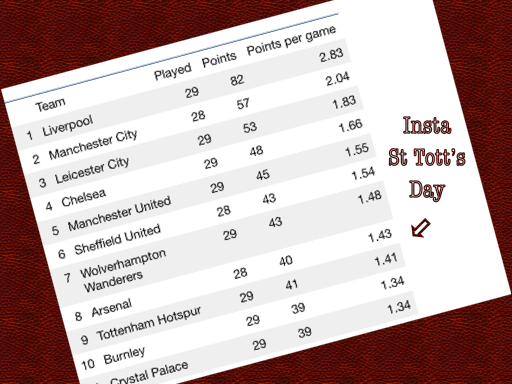
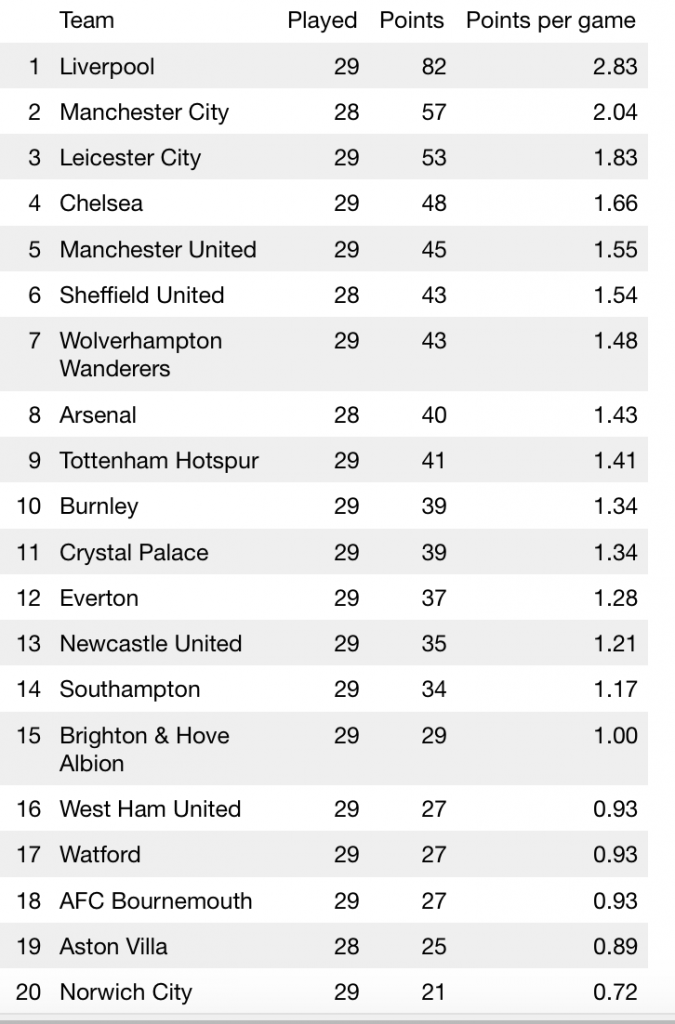
The next choice is to freeze the table as is and declare the positions to be final. The only snag is that while most clubs have played 29 games, four clubs — including the Arsenal — have a game in hand. 

It would only be fair in such circumstances to adjust the table based on points won per game. 

This would leave the top five unchanged. Liverpool would be champions; Manchester City would be runners-up; Leicester City, Chelsea and Manchester United would complete the top quintet. Sheffield United and Wolves would swap places in sixth and seventh. 

But the most compelling reason for making the adjustment is that it would bring an instant St Totteringham’s Day. We would move up to eighth, and Mourinho’s Miseries would slip to ninth. 

No change elsewhere in the table. Norwich, Aston Villa and Bournemouth go down. Eighth might be sufficient to qualify us for next season’s Europa League, depending on what happens to the place reserved for the FA Cup winner. 

It would not, however, get us back to the Champions League next season. For that to happen, the shortened season would have to be ranked alphabetically, which would make us runners-up. The neighbours escape relegation, sadly, by one place as Watford, West Ham and Wolves go down, but all hail the new champions, AFC Bournemouth.

Stay healthy, ‘holics.

« Newer Posts - Older Posts »