Feed on
Posts
Comments

Fairs Cup Final

Seventeen years without a trophy! How often have we heard a similar refrain? It is 1970; we last won the league in 1953 and we have been proven to be second best in two previous consecutive League Cup Finals. I don’t recall the 1968 final when we lost by a single controversial goal to Leeds United but I remember all too well the humiliating defeat in the 1969 final at the hands of Third Division Swindon Town when a certain Don Rogers was to become the hero of the day. Sad to say, there were no heroes that day wearing an Arsenal shirt.

This was my inaugural Highbury season. I had begged my brother to take me with him to a match against Nottingham Forest in the February to the absolute horror of my mother who would have preferred her ten year old daughter to show an interest in a more becoming and genteel sport such as tennis. My brother recalls his plan at the time for the indoctrination of his younger sister – it seems he was tired of suffering alone, attending a school less than fifteen minutes walk from the ground of the more popular North London side of the day whose fans were still lauding it having secured the  Double nine years previously. Despite him getting me a ticket for the 1969 League Cup Final, my mother forbade me to go – it felt cruel on the day. I had pulled out all the colour supplements in the local newspapers that suggested Arsenal only had to turn up on the day to lift the trophy. Perhaps my mother had known better, after all, protecting me from the misery and ignominy of losing to a third rate team from a place I’d never heard of.

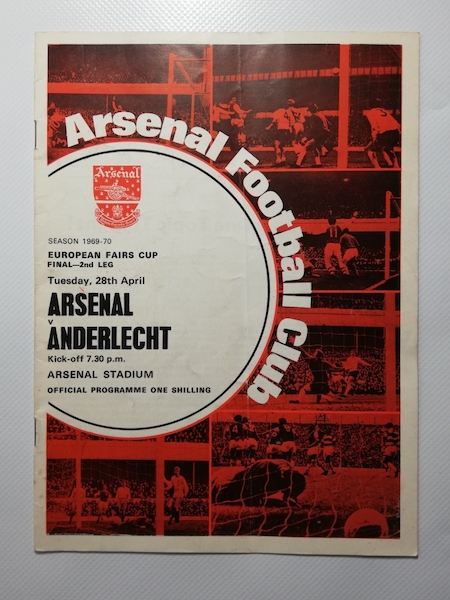
I lay on my bed with my cheap, small, tinny transistor radio pinned to my ear. We were losing 3-0 away to Anderlecht in the first leg of the 1970 Inter Cities Fairs Cup Final. A bit like Swindon, I had never heard of a place called Anderlecht but misery was becoming a familiar feeling and, with Arsenal’s help, I had apparently willed it onto my young self! Our Manager, Bertie Mee, gambled by throwing on a little known substitute and, a raw Ray Kennedy, grabbed a goal towards the end.  It took a while for it to dawn on me that the goal was beyond mere consolation and had given us a lifeline as I started to grapple with the meaning of a law that meant away goals counted double in the event of a draw. We now only had to beat a clearly superior Anderlecht team by two clear goals at Highbury in the second leg. Sounds familiar? There was hope! Arsenal fans seem to trade in hope rather a lot.

The second leg of the final was to be an all ticket affair and I recall the queue snaking along Avenell Road as we lined up for hours, past the large ‘Schoolboys Entrance’ sign to the left of the North Bank turnstiles. On this occasion, my first final, I was going to enter the ground with a proper, grown-up, paper ticket. Generally, I would enter through the Schoolboys Entrance for the reduced price of two shillings (ten pence) to then gain access into the North Bank via the large, imposing metal gates on the right hand side. I always felt indignant at the absence of a Schoolgirls Entrance even at such a young age. It seemed that Arsenal didn’t really want girls at football matches leaving me to ponder whether my mother had been correct about embracing tennis, after all!

And so I came to be present at what many people refer to as ‘The Greatest Night Highbury ever Witnessed’. By now, my brother and I had established a routine whereby he would go to the back of the North Bank and I would go to take my place, as did many children, down behind the goal where there was a chance of actually being able to see some of the action. This night, there was a palpable belief from the crowd that we could will the team on to victory. It was a crowd, that in common with the team, was weary and tired of disappointment and defeat; and desperate for a famous victory.

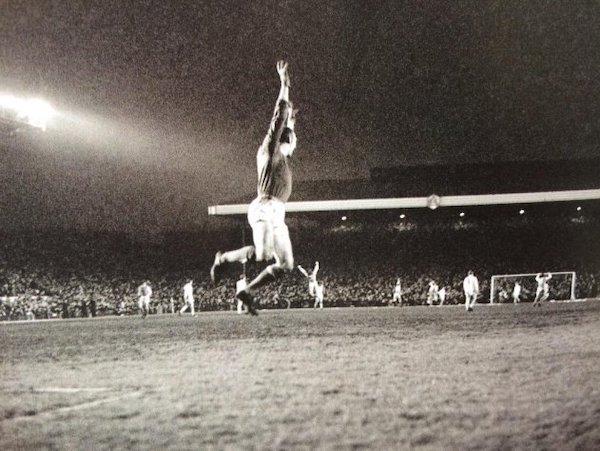
The breakthrough came on 25 minutes and I remember the exact moment Eddie Kelly’s shot flew past a static goalkeeper at the Clock End. I remember every goal that night with a degree of accuracy that is impossible for me these days when my memories of important matches tend to be an amalgam of what I actually saw, or what I think I saw after watching the extended highlights. I was not to see any footage of any of the goals until twenty three years later when the Arsenal Museum in the newly built all-seater North Bank aired some grainy black and white coverage of the final. Geordie Armstrong had taken a corner, Frank McLintock had intercepted the ball, sending a diagonal pass through to Eddie Kelly who steadied himself to make room for a shot that flew past Anderlecht’s static goalkeeper, Jean-Marie Trappeniers, comically referred to in Brian Moore’s commentary as ‘Trap ‘n’ Ears’.

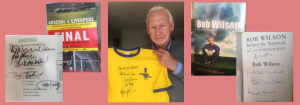
The first half ended one nil to the Arsenal and at the start of the second half, Frank McLintock entered the pitch early to further stoke the crowd of 51,600. That was the official count but in those days the actual attendance often comprised many thousands more as fans would gain entry to the terraces long after the gates had been slammed shut. Judging by how we were all crammed in with barely room to move I suspect that the official attendance was a conservative figure. Tonight was going to be as much about the crowd as the team. “Come on Arsenal, Come on Arsenal” encouraged the crowd; we were playing well but Anderlecht seemed resolute and even spurned an opportunity to kill the final off when Deverindt fired straight at our keeper, Bob Wilson.

Down behind the goal of the North Bank, I was struggling to see. On my tiptoes for most of the match I tried to find gaps between shoulders and heads as I struggled to follow the drama unfolding before me. A ball came flying over from a Bob McNab cross and I could just make out John Radford rising high above everyone else to head the ball into the net. Cue utter pandemonium; I was literally swept off my feet as the crowd moved as one mass carrying me with it in directions I had no control over ending up each time next to people unfamiliar from earlier on. I asked my brother for his recollection of the crowd at that moment, high up in the terracing of the North Bank:

“The crowd now went crazy, we were in the lead for the first time on the dreaded away goals rule.   This time I landed about fifteen feet from where I took off and although I was screaming with pure ecstasy no noise was coming out as I was totally hoarse by now. We were pounding the air and  hugging everyone including the police that mingled amongst us. And then, all of a sudden, the  sheer joy and elation was replaced by negative thoughts of  “No … not 2-0! We haven’t won it properly!”

Would we be able to hang on and win the Cup on the away goals rule, we all wondered? An expectant crowd gathered more belief just ninety seconds later, when a Charlie George pass found Jon Sammels, who on beating his marker, unleashed a fine diagonal shot past ‘Trap ‘n’ Ears’ into what was the bottom right corner of the goal from where I was watching. “Easy, easy” came the confident chant as toilet rolls reined down onto the muddy, furrowed pitch. While we now had more belief, there was still an unease that Anderlecht could force extra time if they were to get just one goal back. The crowd willed the team on through the final fifteen minutes. “We shall not, we shall not be moved” was the chant as John Radford almost added a fourth.

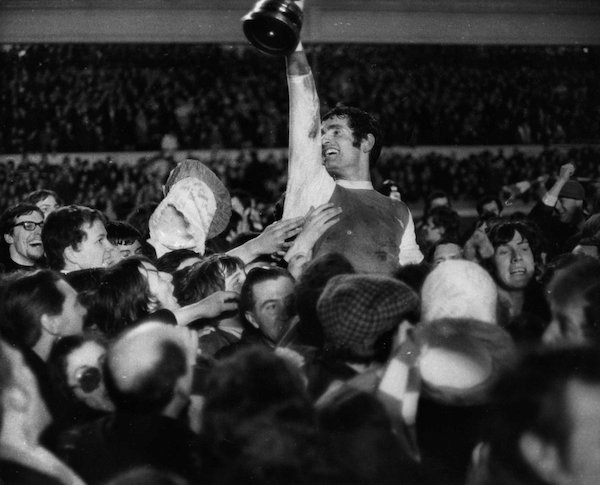
Highbury erupted on all sides when the whistle finally blew. As people poured on to the pitch to celebrate I was shoved to the ground by supporters pushing down from the back wanting to join in with the jubilation. The police were fighting a losing battle trying to prevent people from entering onto the pitch and I was getting trampled and unable to get to my feet. I think I learned in that moment what it might be like to drown as I was floundering in a sea of legs and boots and having difficulty drawing breath. I recall a calmness when I’d almost given up to resign myself to my fate at which moment I was hauled up by two men. My rescuers turned out to be a somewhat scary looking tattooed and bovver booted skinhead and a more reassuring looking helmeted policeman. By now, the police had made a wise decision to allow people onto the pitch and so the crush was alleviated. I recall Frank McLintock being hoisted above a joyous crowd keeping a firm grip of the trophy outstretched above his head. At last – a elusive trophy and he wasn’t letting go! Eventually, I was reunited with my older brother who escorted me home to a mother who appeared to be softening, realising that she was losing her battle just as Arsenal had started to win theirs. Little did we know that on that euphoric night, even better was to come the following season!

The Unforgiven

Hello again everyone, I hope the day finds you well and looking forward at least a tad more positively to the coming months. In May and June, society will dust itself down and emerge in whatever form is deemed safest in each country and that will include football. Welcome back to us all and fingers crossed for a successful re-launch of Project Humanity.

In the meantime we have today’s piece, the theme of which, as you may have guessed from the title, is forgiveness. In these difficult times it is more futile than ever to harbour old resentments. Wiser to let them go, though few people in my experience hold grudges better than your average football fan. This is of course an Arsenal blog, and therefore I shall endeavor to forgive those who have annoyed me by slighting our bold and pure Arsenal men down the years. A tenuous thread you may think, gossamer was to be honest my own thought, but a thread it is and that’s good enough for me.

The title, I should clarify, is a reference to the 1992 Oscar winning Western. A hugely enjoyable film, in which Clint faces many difficulties and solves them by killing most everyone who disagrees with him, it was honoured possibly for the extra time an unusually reflective Clint devoted to mulling things over. Not much forgiveness there I wean, but it also contained the usual quota of memorable lines, one of which “deserves got nothing to do with it” , as Clint kindly reassures Gene Hackman before he blows him away, is central to this post.  Although another memorable line “who’s the fella owns this shithole?” did strike me as very useful for the travelling faithful at the turnstiles on away days, but I digress.

The Unforgiven XI

Deserve often does have nothing to do with it in football, be that results on the field or recognition off it. As personally I have no wish to blow anyone away, or at home come to that, I would instead like to offer some absolution using the pen not the colt and an Arsenal XI made up of players who, in my personal opinion, have been unfairly served by supporters, managers or the media. For some, especially in the 70s and 80s that was reflected in a lack of international caps, for others it was events off the pitch or the unforgiveable sin of playing in an unsuccessful side.

The one clear criteria for selection in the Unforgiven XI is that I saw them play, which means post 1970 as the first game I remember is the 1971 Cup Final. To my Dad’s annoyance he couldn’t get a ticket for that final although he’d been a regular for many years by then, but to me it actually meant the purchase of our first colour TV. If I am honest it is probably my 6 year-old sense of wonder at the glorious colour rather than the football that has ensured the memory is still so strong after all these years. Whatever it was, we won the cup and I was hooked! The very next day my Mum delivered the first disappointment of my football life when she forbade a trip to SHL on the flimsy grounds of it being too dangerous for a 6 year old. Dad did have tickets for that one (I found his ticket stub amongst his prized possessions a couple of years ago when he passed and am looking at it as I write, it is an evocative aide memoire and if I may be permitted another digression, exactly the sort of memento I’d like to leave my own kids one day as it is priceless to me), and the double was duly delivered. We’d won 2 trophies in my first 3 days as a supporter. Talk about jumping on the bandwagon. To be fair to my Mum, she also stopped a trip with my Dad to Hillsborough for a cup semi-final two years later with the same ageist nonsense. That loss to Sunderland, was, in retrospect, a kind of ending for many of my first team of Arsenal heroes, but then again not going probably spared me a fair degree of trauma based on Dad’s choleric report of events. All this is not in fact completely off the point as the first love is the deepest and hopefully offers some clue as to why several of that team will feature in the XI. I’ve held some of these grudges for a long time.

Next year will be my golden anniversary as a Gooner (a league title would be a nice gift Mikel) and in all those long years the spuds haven’t won the league (see clock to the right) and I have watched some amazing players – George, Brady, Seaman, Adams, Wright, Bergkamp, Pires, Vieira, Henry to name a few – but the XI below will include none of them. In fact I have never tried to make a greatest Arsenal XI as I find it too difficult to compare players across eras and brilliant is brilliant as far I am concerned, I’m just happy to have watched any of them play for The Arsenal. 

Onward to the XI

I am sure many will disagree on many of the points and you are very welcome to your views, I honestly look forward to reading them all.  However, this is about releasing my own personal and sometimes I must admit petty resentments on a brief trip through the years so without further ado the side is named firstly in full below – for the benefit of those who want to skip straight to the selections they find most baffling!

Rimmer
Rice Simpson Vermaelen McNab
Robson Davis Talbot Armstrong
Stapleton Chapman

Jimmy Rimmer

Rimmer was well liked by supporters and Player of the Year in 1975. He played in a side that finished in 16th, 17th and 8th over his 3 seasons before being let go when we signed Pat Jennings. He moved to Villa where he won League and European Cup medals. A good career and so why is he in the team? I still think Rimmer saved us from relegation in his first two seasons, he was outstanding behind a creaky defence in a generally dire team and I loved watching him. He would I believe be rated far higher by supporters if he’d played in a better Arsenal side. Personally, I rate only Seamen as clearly better for Arsenal among all the keepers I’ve seen, but I finally accept that other supporters who think Lukic was better are not actually insane and forgive them all. 

Pat Rice

A shoo in for the Arsenal Hall of Fame if we had one. Rice won multiple honours as a player, captain and coach at Arsenal. What possible grudge could there be? In 1978 we played Ipswich in the FA Cup Final and lost 1-0, deservedly so to be honest. In the build-up to the game there had been much press attention given to Clive Woods as the Ipswich dangerman, To be fair Woods had been having a good season and was a tricky left winger. In the game itself I thought that Rice played him well, in general limiting his crosses and his threat. The commentator however kept right to the press narrative and endlessly referenced the torrid time Rice was having. Total nonsense and very annoying. Why do commentators do this? In this case, I understand now that many are simply jealous of The Arsenal because we are better than them. Therefore, I forgive the disrespect to the great Pat Rice and recognize it was just jealousy and littleness.

Peter Simpson

Simpson was another player widely appreciated at Arsenal and player of the year in1969.

My Dad’s strongly held, but possibly highly subjective, opinion that all Arsenal fans knew he was better than Bobby Moore around the seasons we won the double tells you I think that he was a classy, cultured centre-half. A great fit with McLintock, I saw him struggle at times in his later seasons with let’s say, less able CB partners, but he was still an Arsenal man and a class player for many seasons. He is in this team because he did not play for England and Jeff Blockley did. I think some of you will have seen both play for The Arsenal and I hope we can all agree that is an astonishing injustice. Talk about unforgiven, that is nigh on unforgivable.

Thomas Vermaelen

The Verminator made an instant impact in his first half-season after his transfer from Ajax and was widely seen as our next great centre-back. Things did not go to plan after that and we eventually sold him to Barcelona (for a profit, the mugs!). He is I believe not far down the road from me in Kobe right now. I liked watching his whole-hearted approach but he is in this team because at the end of a season when the Arsenal coaches sat down and looked at the goals we conceded over that season they concluded that Vermaelen was culpable for something like 60% of them. That is all fair and proper of course and we were woeful defensively at the time. Later that conclusion was leaked to the press to my huge annoyance. As an ex-HR guy, that is just unprofessional and unacceptable. However, 8 or 9 years later I will accept that these things happen and let it go. Actually, TV5 might not be a bad fit with Simpson at CB !

Bob McNab

Bob McNab was another important player in the first double side, good in the tackle, positionally clever and formed a strong left-hand side for us with Armstrong. He also, long before Charlie Nicholas, turned down Liverpool to join The Arsenal, so a man of impeccable judgment. If you ever stood on his wing at Highbury, you would have heard he was fairly vocal too. Another who was unfathomably unfashionable for England, 4 caps for a man whose only possible rival for a left back spot was Terry Cooper and yet he did not go to Mexico for the World Cup (actually I am cheating a bit here as that was 1970 and I only learned about it 2 or 3 years later). Ridiculous, but I will remember it wholesale later in this article.

Stewart Robson

In 1982 I went to watch us in an away game at Forest who still had a fair side at the time. In the first half we produced the worst 45 minutes I had seen us play at the time and were deservedly, if memory serves, 3-0 down by half time. An 18-year-old Stewart Robson was the single redeeming feature of that afternoon, he was everywhere that day and put many of our more seasoned players to shame (though some of them had none actually). I would have put good money on him being an Arsenal great and England stalwart for many years. Sadly injuries intervened and though he was Player of the Year in 1985, he was never fit for long enough. I have no idea of the rights and wrongs of his bitter relationship with the club since his time at Arsenal TV and actually don’t care, but I hope the future holds some mutual forgiveness and I can read about what a player he already was at 18 rather than his anger at the club and AW.

Paul Davis

In 1988 Paul Davis became the centre of a media storm when he broke the Southampton player Glenn Cockerill’s jaw with, I think, a well-measured right hook. He was caught on the tv replays and became the first player banned on video evidence. He also missed a place in the England team and was never selected again. Davis was not a ‘hard man’ as such but from the abuse heaped on him by the press you would have thought him on the Most Wanted list at that time. The hypocrisy of some of the criticism has always infuriated me but in the spirit of goodwill, I accept the assorted football and some non-football journalists in the press were just nicking a living and I forgive them. Just to add, Paul Davis was a pivotal member of the 90-91 side that only lost once and won many major medals.

Brian Talbot

Signed from Ipswich, he forms a midfield trio in our XI with Robson and Davis all of whom played for us in the 80’s, though Talbot signed in 1979 and famously at the time was I think the first player to win the cup with 2 different teams in consecutive seasons. He is also noted as the last Arsenal player I saw having a beer in the pub after a game (The Silver Bullet opposite Finsbury Park station). His place in the team is down to a mate of mine, Freddie, who for some odd reason took a particular dislike to Talbot or Ten-touch as he used to call him. Whenever we were at the game together there would always be some slight mistake sooner or later followed by a loud shout of “ffs ten-touch, play the ball”. Freddie, mate he wasn’t Liam Brady but he really wasn’t that bad, let it go. Anyway, I forgive you Freddie as we all have our little foibles after all, and years later I never warmed to Limpar, which many have found odd.

Frank Stapleton

Stapleton is the exception in this side as he is the only player to be forgiven for what he did rather than what was done to him. A fine player, though not a prolific goalscorer and by all accounts that I can find a nice fellow. Frank was a man ahead of his time in some ways as he went north for a bucketload of cash – or at least that was how it was perceived by all the Arsenal fans at the time. I went to the next few Arsenal vs Man Utd matches usually with a couple of Man U fans, we’d go our separate ways at the gate and then meet again afterwards. Each time they were amazed at the hatred for Stapleton as he was roundly abused for large parts of the game. To be honest I had happily joined in the chanting and told them we would never forgive Stapleton. Wrongly as it turned out, after all he played more games for us and scored more goals than he ever did for ManUre. Anyway, all is forgiven Frank and I hope you will forgive us the vitriol, which in hindsight was some way over the top.

Lee Chapman

So we come to Lee Chapman, and my own forgiveness. Chapman, who we had signed from Stoke, was a bad fit from the beginning and almost nothing went right. He didn’t actually suit our style of play and to this day I have no idea why we signed him although there are rumours that it was simply because of a 25-yard screamer he scored against us. Anyway, I was sitting in the West Stand for one game and watching us and Chapman in particular struggle in a scrappy game (apologies but I can’t remember who it was against) when we suddenly broke out of defence. The midfield was breaking at speed, the crowd sensed a chance, the noise level rose and then the ball was swiftly moved out to Chapman on the right, and right in front of me. Sadly, he completely missed the ball as tried to control it and then fell over. All around me in the West Stand the crowd didn’t groan or jeer, they just laughed, not a commiserating, empathic sort of laugh but simple contempt as if it was exactly what they’d expected. Chapman looked utterly dejected, like he would actually rather be in hell than on that pitch. Chapman’s look is the only thing I actually remember from that game and to my shame I had laughed too. Not a nice way to have treated a fellow human being and I am sorry Lee.

George Armstrong

There is really no need to write too much about Geordie Armstrong, he is a legend. Like Simpson and McNab he played very few games for England and like them it was scandalous. I have heard the suggestion that Alf Ramsey (an ex-spud) disliked Arsenal and was reluctant to select Arsenal players. I have no idea if that is true, to be honest it seems unlikely, but it is also difficult to see why so few were chosen even in hindsight. Perhaps less so in Armstrong’s case as England often played without recognized wingers at that time. As sadly Sir Alf has passed away he is in no need of my forgiveness and so I will finish by forgiving the FA for not stepping-in and having a word. The FA may feel they are innocent in the matter but as James Coburn told Anthony Quinn at the end of A High Wind in Jamaica “think of all the things you weren’t caught for’.

I haven’t chosen a manager but it would be Bertie Mee as the Arsenal board broke my 10-year-old heart when they fired him. Honourable mentions to Lichsteiner, Feo, Ozil, the great Tony Adams, in fact all of the famous five (where are the knighthoods?) and of course the incomparable Flamini, who have all suffered unjustly down the years but for various reasons could not be included.

And so there you have it, my journey of forgiveness is done. I hope if you have made it this far it provided some amusement, food for thought and reminders of times past. To err is human but to forgive is divine, and as we have seen it is certainly raining men to forgive. Let it go everyone, it’s easy and you’ll feel better.

Finally, it is possible we will have some real, actual football news to report early next week so please keep ‘em peeled on this site and best wishes to you all.

I think most readers of this blog will know that I prefer my football live. Yes the view is far worse than on a 50” TV, no matter where you sit, you usually don’t get the benefit of replays and you have to drag up and down motorways, sometimes in foul weather. But the special atmosphere you get by being in the middle of a group of likeminded people is, well just that, special. The humour of football terraces is different to any other sport I’ve attended live. That humour is best expressed in the songs. Yes the language is often ripe. When I took my son to Highbury for the first time, he turned to me on the way home and asked a simple question. “Daddy what’s a wanker?” I explained that it was a special term for referees. I also explained that things he heard at football were not to be repeated in front of his Mother, Grandmother or teacher, on pain of banishment. There was a period when Patrice Evra of Manchester United used to taunt us regularly (men vs boys etc). So the Arsenal faithful consulted the intellectual giants amongst them and came up with this witty response:

Evra, Evra
You’re a c**t,
You’re a c**t
You’re a c**t

My son, no mug, latched onto the fact that he could express his dissatisfaction in with somebody in front of his Mother by calling him a “right Evra”. Well it worked for a couple of weeks.

Football humour is cruel, but often at its funniest when it is cruel. The Rangers goalkeeper Andy Goram was diagnosed with schizophrenia. Their next game was against Celtic. With Goram at their mercy in the goals in front of them, they burst into

Two Andy Gorams!
There’s only two Andy Gorams!

Luis Suarez in his Liverpool years had two reputations. One of being a cheat and the other of being a racist. Hence this brilliant ditty:

He cheats
He dives
He hates the Jackson Five

How do you best help your star centre forward when he is going through a rough patch Fulham FC? By singing this every game at Craven Cottage

When you’re sat in row Z
And the ball hits your head
That’s Zamora

But this piece is about my favourite Arsenal chants. Easy I thought. Actually very much not easy because I have had to leave loads out! Still, that gives an interactive opportunity for you, gentle reader, to point out your favourites that I missed. So let’s begin. My rule is that to include it in this list I have to have been present at a game and sang that song.

The players

I began going to Highbury in the 70s. I’ll be honest that many of the songs we sang then about the players are lost in the mists of my memory and old age, but here are a couple.

We all agree
Rixy is better than Hoddle!

(Spoiler: he wasn’t)

I saw Liam Brady from when he broke through from the youth team to when he sadly left for Italy. By the end of that run, Chippy was the firm fan favourite, with that cultured left foot. But he was just a little arrogant. Once the Band of the Metropolitan Police had finished doing their thing, the players came out to warm up. The North Bank would serenade each player with their own song and the player would salute the crowd. Except for Brady. We would begin by singing:

One Liam Brady!
There’s only one Liam Brady!
One Liam Brady!
There’s only one Liam Brady!

Nothing. Zip. Nada. Not even a glance. He was waiting for

Brady, Brady
Brady, Brady
Born is the King of Highbury!

Only then would he turn around and salute the North Bank. Ah well. He was worth it. My favourite player until DB10 rocked up (of whom more later).

I want to pull out just two from the 80s. Both are still sung to this day, one far more than the other. The latter was the player of whom David Dein said “ we’ve a lad from Lewisham in our youth team who dribbles like a Brazilian”. David “Rocky” Rocastle. One of the banners at the Emirates bears his picture and the words “remember who you are, what you are and who you represent”.  The club’s values in just eleven words.

Oh Rocky Rocky!
Rocky, Rocky, Rocky Rocastle!

The former, seldom heard now, is about our cheeky Essex journeyman, Perry Groves

At number one, it’s Perry Groves
Number 2, it’s Perry Groves
Number 3, it’s Perry Groves
We all live in a Perry Groves world, a Perry Groves world, a Perry Groves world!
(repeat through to number 11)

Perry liked it so much he used it as the title of his autobiography!

And so to the Wenger years. A golden period of football, trophies and player chants. Who can forget…

Viera, woah woah woah
Viera, woah, woah ,woah woah
He comes from Senegal
He plays for Arsenal

He’s blond
He’s quick
His name’s a porno flick
Emmanuel, Emmanuel, Emmanuel!

We love you Freddie
Because you’ve got red hair
We love you Freddie
Because you’re everywhere
We love you Freddie
Because you’re Arsenal through and through

But most of all, the immortal Iceman

One Dennis Bergkamp
There’s only one Dennis Bergkamp
Walking along
Singing a song
Walking in a Bergkamp wonderland!

To show how it’s the away fans that develop the songs, on those long hours on trains and buses, here’s my final two player songs. Both from this season, both first heard at away games I was at, first Leicester and then Everton. Both songs are now sung loudly at the Emirates.

Dani Ceballos
Dani Ceballos
Drinks Estrella
Eats Paella
The boy is fucking magic

Gaby de de de de de de
Oh Martinelli
He comes from Sao Paolo
And he plays for Arsenal
One two three four
(and repeat)

Tottenham

Oh where to start? I’m only going to include three because this is getting to be a long piece and most of the Spu*s songs are sung repeatedly at every game. So first, the song that greets St Totteringhams day, once a seasonal event, now in a temporary lull.

It’s happened again
It’s happened again
Tottenham Hotspur
It’s happened again!

I said above that football humour is cruel. A song about Harry Redknapp being sung on a train by Gooners went viral and was soon being sung at games.

Harry Redknapp’s
Got a twitch
Harry Redknapp’s
Got a twitch
Where he got it we don’t know
How he got it we don’t care
All we know is he has got a twitch!

On the last game of the season, and the last game at Highbury, in 2006, Spurs were one point ahead of Arsenal and only needing to match Arsenal’s result against Wigan in their game against West Ham to finish above us for the first time in 20 years. From that game comes this song…

Lasagne whoah whoah
Lasagne whoah whoah whoah whoah
We laughed ourselves to bits
When Tottenham got the shits

And finally

Thank you for reading this far (if you still are). Two final songs sung at Arsenal to this day which are sung at no other club and much beloved by all, especially the former landlord of this bar.

What did she wear?
She wore, She wore
She wore a yellow ribbon
She wore a yellow ribbon in the merry month of May
And when
I asked
Her why she wore that ribbon
She said it’s for the Arsenal and we’re going to Wembley
Wembley, Wembley
We’re the famous Arsenal
And we’re going to Wembley

My last song – does anyone know the history of this? The full lyrics (I’ve never heard anything but the chorus being sung at a game) can be found here https://www.fanchants.com/football-songs/arsenal-chants/bjesus-said-paddy/

So Paddy got up and he sang it again
Over and over and over again
Bejaysus said Paddy I sung it so well
I think I’ll get up and I’ll sing it again
So Paddy got up and he sang it again
Over and over and over again

Repeat to fade. I’ve left out so many. What are your favourites?

Since writing the first part of this piece, two weeks ago, the numbers of Covid-19 cases worldwide have nearly doubled, and the deaths. Football has slowly receded into the background for those forced into isolation, and its importance has paled compared to the health and protection of loved ones, finding enough to do during the days so they don’t bleed together into a timeless morass, and making sure we have enough toilet paper (loo roll, etc.).

In that new order given unto us by “sheltering in place” we have time to understand our history. Lessons from then can be interlineated with those we’re setting forth in the face of the current pandemic. And, hopefully the results on the pitch over the next two decades will be as successful for Arsenal as they were in the two decades between the World Wars.

Between 1919 and 1939 there were 10 different winners of the First Division, including Liverpool and Sheffield Wednesday twice, Huddersfield Town three times, Everton 3 times, and Arsenal 5 times (in those glory years of Alex James, Ted Drake, Denis and Leslie Compton, and Cliff Bastin, from 1930-31 through 1937-38). Radio had been introduced so the masses could follow games announced from the stadia in the comfort of their homes; one wonders if broadcasters thought they’d stop fans from going to the games if they could just stay at home with a bottle and a smoke and hear the game called by professionals. If so, what naivete! Despite radio the crowds came in increasing numbers as World War 2 approached, averaging 23,468 per game in the First Division across those 20 years, an increase in nearly 10,000 per game from the years between 1900-1915.

And who was being watched the most? In addition to the five titles and 2 FA Cup victories between wars, Arsenal led the attendance league 10 of those 20 years, including 9 straight years between 1930-31 and 1938-39. Our highest average attendance at Highbury in those years was over 46,000, in 1935-36. This seems odd. We’d won the league in three straight years, but could only manage 6th that season (behind Sunderland, but 21 places above Spurs, languishing in 5th in the Second Division). Nonetheless, before the war came we’d win our fifth title in 1937-38, making the Bank of England club the most successful of any in the First Division by almost every measure. The numbered red shirt with the white sleeves became as famous as the Art Deco stands of Highbury and games under the floodlights.

The events from the German Anschluss of 1938 and the annexation of Czechoslovakia the following year brought the first response of Football League players and teams to the crisis: a number of players from West Ham, Liverpool, and Bolton joined the Territorial Army. Nonetheless, the 1939 season started in fine fettle on 26 August 1939, with 88 League teams scheduled to play 1848 games throughout the season. Arsenal opened with a 2-2 draw at Wolverhampton, then came home to Highbury; they squeaked past Rovers 1-0 on the 30th. Two days later Germany invaded Poland. Our game on 2 September went forward, and the Gunners smashed Sunderland in a 5-2 win. Contrary to Neville Chamberlain’s 1938 claim that he’d achieved “peace for our time”, he declared war against Germany on 3 September. The win against Sunderland was last League game played at Highbury until 7 years, 2 days later, when we lost to Rovers 1-3 on 4 September 1946. Yes, that’s giving a bit away, there was League football after the war!

As opposed to the dithering about continuing to play by the Football League in 1915 (and continue they did), the League decided that day to cancel the season in its entirety. The FA Cup, which started with preliminary rounds on 2 September, also cancelled the competition; it would not return until the Fall of 1945. Forty-two of Arsenal’s 44 professional footballers joined the Royal Air Force, serving as physical training instructors at home and in various capacities abroad; Tom Whittaker became an Air Raid Warden at the start of the war, was accepted by the RAF and promoted to Squadron Leader as a pilot, and was granted an MBE for his part in planning British operations of D-Day.

The immediate fear, across England, of attack by Germany’s Blitzkrieg brought the country to a standstill. Unlike the worries of the Great War, the threat of German bombs raining down on packed football matches was brought to mind by memories and images of destruction from aerial attacks in the Spanish Civil War; immediately, all places of public entertainment were closed, including football stadia. As September of 1939 drew towards its end and no bombs fell, and the authorities allowed some friendlies to be played between league clubs. However, even those games were subject to limits on attendance and ticketing, and could be cancelled by the local constabulary at the last moment.

When the Football League met at the end of September they discussed how to work with these restrictions, and others imposed by the Home Office (such as setting maximum capacities for stadia at 8,000; stadia with capacities of more than 60,000 could have crowds of 15,000, and in all cases fans must be evenly distributed in the stands and terraces…socially distant, as it were). The Home Office also dictated any season must end by the end of April in 1940, and banned travel of more than 50 miles within England. Out of the September meeting came League decisions (home/away club revenue sharing, player registrations remaining with their club but allowing for guest players when soldier-players were stationed near a club to which they were not registered) and restrictions, such as maximum per-match payments, limits to squad size, and minimum admissions charges.

The League was determined to create regional competitions as it had during World War I, and the scope of each region was set out by the Home Office’s travel limit. It was decided to create 8 divisions from the 88 League clubs: Western, North Western, North Eastern, East Midland, Midland, London and Home Counties (divided into 10-team A and B leagues), and South Western. Arsenal was joined in South A by Charlton, plus other, smaller teams such as Southend United, Clapton Orient, and Spurs. Stadia had been taken over by the Home Office for the war effort led to a variety or issues. Exeter City’s St. James Park was requisitioned, and with no ground sharing available they didn’t participate in the War Leagues. Highbury was also unavailable, having been turned into an Air Raid Precautions post, protected by a barrage balloon over the Clock End. In the reverse of World War I, Arsenal played its “home” matches at White Hart Lane; fair play to them, returning the favor. Football would begin on 28 October 1939, with the War Leagues scheduled to play a total of 1068 games.

In the 1939-40 London and Home Counties South A regional division, Arsenal reigned supreme. Despite an increase in players leaving for the armed services, Arsenal managed to win 13 and draw 4, losing only once, ending the season eight places and 12 points ahead of Spurs. The season progressed in all regions with no bombing raids; cold weather in January and February required the Home Office to extend the season, though it kept the games limited to Saturday (excepting the usual festive period gamedays). The London and Home Counties divisions were re-drawn to group First and Second Division teams into South C, and Everyone Else in South D. Arsenal came third to Spurs, just 3 points back. However, as the season progressed many teams had to forfeit games, or had difficulty getting players to fill out a first eleven, so change was to come in the 1940-41 season.

Shortly after the first War League season ended in May Hitler ordered his troops to step up their attack on Britain, Winston Churchill became Prime Minister, and the “Phony War” ended as the first phase of the Battle of Britain began. Combined with the logistical issues involved in supplying so many teams with players, and staging so many games at stadia that made perfect targets for German bombers, in July the Football League restructured the 10 divisions into two, the Northern and the Southern Regional Leagues. Seventy teams would play 848 games when it was all said and done. There was no way to have a symmetric season in either region, due to travel restrictions, games postponed or abandoned due to German bombardment, and the potential lack of players. As a result, it was decided that league positions would be based on goal average. Other, smaller leagues were established in the South Coast and the West.

The 1940-41 season opened on 31 August, in a quiet spot between aerial battles. However, the following weekend, on 7 September, Arsenal “hosted” Fulham at White Hart Lane. The game was called off with Arsenal leading 5-0 due to a massive, 350-plane German aerial assault that brought the Blitz to London. In 2010 the Guardian printed a diary entry from a young Londoner who was at the game:

“Saturday 7 September – This afternoon went to see Arsenal v Fulham on Spurs’ ground. It’s a lovely ground too. Arsenal played a magnificent first half, and all five of their goals were snorters. At 4:55 pm, 15 minutes from time, the air raid came and the game was called off. Five minutes later I watched a formation of Junker bombers, protected by fighters, attacked by two of our planes. There were at least 50 [German] planes and two came crashing down before they went out of sight. Boy, what a thrill it was.”

This match was one of six stopped before time due to that same raid. From that day forward, the East Stand at White Hart Lane was closed, being as it was needed to be a mortuary for North London’s bomb victims.

These air raids continued into October, forcing abandonment of the Arsenal derby with Spurs on the 19th. Soon after, in spite of its protective barrage balloon, the terraces of the Clock End were damaged when a German bomb blew up just outside the stadium, blowing tons of concrete from Arsenal’s half-sized training pitch onto the South Bank, requiring extensive repair. The Blitz continued to pummel London and England’s industrial heartland, killing thousands during 71 different raids, driving attendances to half of what they were in 1939-40. Later in the season, the roof over the North Bank was destroyed by an incendiary bomb, setting fire to the wartime goods stored there, bringing the shed to the ground. Festive-period fixtures were not allowed, excepting Christmas and Easter Monday. The number of abandoned games dropped after the New Year, and in spite of Highbury’s destruction Arsenal came in 4th in the South Regional Championship, behind Crystal Palace in first; Tottenham could barely manage 10th.

The end of the Blitz in May, 1941 brought an end to frequent German bombing raids and allowed more games to be played across Britain. As we’ve seen today with the proposals for a European Super League, for 1941-42 the Football League had to contend with a breakaway of the London clubs from the League’s Regional Championship format…but at that time it was successful. The London clubs that broke away had their League registrations cancelled; this could have had serious consequences for the London League teams, but the Football League would allow them to re-register later in the War. Nonetheless. the 16 clubs in the new London League played home and away from August 1941-May 1942. The London League was administered by the pre-war London Combination, and affiliated with the London FA; the League allowed guest players to move freely between the London League and the North and South Regional Championships. Through all of this attendance increased, nearly doubling compared with 1940-41, even as rationing of clothing, petrol, and other necessities caused hardship among the population. Arsenal played 30 matches in the London League, and ended the season in May, 1942 in first place, winning 23, drawing 2, and losing 5.

In June of 1942 the London clubs were brought back to the Football League fold, apologizing in writing and paying a £10 fine. They continued with the London League, which expanded to 18 teams (adding Southampton and Luton Town) for the 1942-43 season. Not all teams played both home and away; a total of 28 games were played between the teams. The 1942-43 season was played against a backdrop of reduced civilian casualties in Britain, against rising casualties on the continent and in Africa. Attendances rose again by nearly 1/3 when compared with 1941-42. Arsenal again finished the London League in first place, with 43 points from 28 games, in May of 1943. It would be the last of Arsenal’s London League titles; Highbury would not see another title until Arsenal’s First Division winners of 1948.

As the war stretched on through 1943, the Germans concentrated their efforts on the Eastern Front, England focused on Tunisia, and had a respite from the bombing and the battle for Europe. Arsenal played again in the London League in 1943-44, coming in 4th behind Spurs. Rationing, and the limits set by the Home Office, continued to make life difficult for the people of England, yet attendances grew again by nearly 1/2 compared with the previous season. On a personal note, US Army Air Force troops were stationed around Britain beginning in early 1943, increasing in number through the year. My mother’s uncle, 2nd Lieut. Alan S. Grant, a B-17 bombardier with the US 8th Army Air Force, was among them. He was stationed at RAF Station Horham, and participated in 25 daylight bombing raids into Germany between October and December, 1943. He left Horham on 29 December, bound for Chicago and his new wife Mary Lois. The B-17 ferry flight bringing him to his debarkation point at Woodvale, near Southport, crashed into Cwm Dyserth in Wales killing all aboard. Uncle Al is buried at the Cambridge Military Cemetery.

Just after the end of the 1943-44 season came Operation Overlord, the invasion of Europe from England by the Allies. The heavy fighting in France and Germany from Summer 1944 through spring of 1945 was the backdrop for yet another season organized by the Football League in the same manner as the previous 3 years. A major difference from the previous season were the attacks of the V1 and V2 flying bombs on London and its surrounding areas. The British Government blamed many of these bombings on “gas main explosions” to prevent panic; fortunately, none of these “flying gas mains” landed on a football pitch while a match was being played. Just as Hitler gave himself lead poisoning with his pistol in his Berlin bunker the London League season of 1944-45 ended, with Arsenal in 8th, having never getting on track, losing one less than they won and drawing 5 from 30 games.

Finally, after six long years, the War in Europe was over. It didn’t end in the Pacific Theater until September, and so the planning by the Football League for the 1945-46 season looked much the same as it did for the 1941-42 season. The London League was dissolved, and Arsenal played in the Football League South, coming in 11th behind Birmingham City; for the season, 86 teams played 1324 games in six leagues across 3 Divisions. Arsenal also played in various friendlies, providing an Arsenal XI that played Russian Champions Dynamo Moscow in November, only to lose 3-4 at White Hart Lane in front of nearly 55,000 fans. The FA Cup restarted in the Fall of 1945, with the early rounds seeded regionally to reduce traveling (though the rationing of petrol and the 50-mile travel limit were relaxed by the Home Office). Arsenal lost 0-6 in their first game, a Third Round tie against West Ham on 5 January of 1946; while they beat the Hammers 1-0 in the return leg on 9 January, they lost the tie on aggregate and were out of the cup. True League football would finally return in September of 1946, with the 1946-47 season playing the same teams and same slate of games as was cancelled in 1939.

In addition to the wartime regional leagues, the Football League created a War Cup competition with 5 rounds and a final at Wembley. This started in early 1940, with 137 games played over 9 weeks; West Ham won the cup on 8 June in front of more than 40,000 fans, including evacuees from Dunkirk’s beaches. The War Cup was played through the 1944-45 season, with Arsenal playing for the cup in the finals of 1940-41 and 1942-43, winning neither. The 1941 final against Preston North End was 2-legged; the first tie at Wembley ended in a draw. Leslie Compton missed a penalty in the opening stages of the game, and Preston scored shortly thereafter. But Denis Compton (the brothers Compton played cricket for Middlesex and football for Arsenal) leveled the tie just before the half with a fine strike from inside the box. The second leg was played at Ewood Park, where Arsenal couldn’t find the back of the net, losing 2-1 courtesy of a brace from Preston’s Bobbie Beattie, and an own goal from their Frank Gallimore.

The 1943 War Cup final was structured differently. In the South Region final Arsenal destroyed Charlton 7-1 at Wembley in front of 75,000 fans, a record score for the stadium at the time. Reg Lewis, foreshadowing his heroics in the 1950 FA Cup Final, scored the first. Denis Compton scored the 2nd before Charlton got one back with a penalty, then Lewis put in his second before Ted Drake, who continued to play occasionally for Arsenal on leave from the Royal Air Force, got the 4th for the team. Drake got the 5th just after halftime, then Lewis completed his Arshavin with two more goals past Charlton’s hapless Hobbins before the final whistle. The 1943 final was Drake’s last for Arsenal; he injured his spine in a regional match in 1945, ending his career as a player. In the North Region final Blackpool defeated Wednesday across two legs. The overall final was played at the Bus Stop in Fulham; 55,000 watched as Arsenal lost 2-4 to Blackpool. While we won neither, we were the only club in the League to reach two War Cup Finals.

World War 2 was a much more intense time for the people of Britain than was World War 1. The clubs of the Football League provided 780 players to the armed forces; of the 42 professionals on Arsenal’s books in 1939, 9 died in the War: Sid Pugh, Henry Cook, Will Parr, Leslie Martin, Bob Daniel, Hugh Glass, Cyril Tooze, Herbert Roberts, and Bill Dean. The oldest was Lieutenant Herbert Roberts; at 39 he was part of the great 1930s teams, starting 335 times for Arsenal over 11 years, winning 4 titles and an FA Cup medal as the club’s centre-half before retiring in 1937 to train Arsenal’s reserve side. He died in 1944 of erysipelas while on duty with the Royal Fusiliers’ City of London Regiment. As far as I can tell, no other club lost as many to the War as did Arsenal.

Relative to World War 1, British life in the Second World War was much more complicated. Germany’s aggression against Britain from the air created an environment where little was known, yet life had to go on as normally as possible. Restrictions of movement, restrictions of teams and how the leagues were formed made the Wartime leagues less than optimal for the fans and players alike. Does any of this sound at all familiar to what’s happening now, in this time of Covid?

As we saw in the part I some of the same concerns raised by the Football League in World War 1 were raised in World War 2, and have been raised again today. That the League restarted the 1946-47 season with the same teams and same schedule as they had at the start of 1939-40 leaves it a possibility that whenever League football resumes (after the current season that appears to be being abandoned) it will simply be started anew with no 2019-20 title winner. As well, depending on how points are counted some of the potentially odd results from the current season may echo the results from before and after the War to end all Wars (namely, that Arsenal might benefit at the expense of Tottenham, but FOYS, ha!). We are fortunate that the number of dead from Covid-19 has come nowhere close to either the dead under Flanders’ poppies, those taken by the so-called “Spanish Influenza” of 1918, or those lost to the specter of Nazi aggression in the fields of World War 2.

And yet, what can be said of the future, after football resumes, at least in England and the English leagues? One can only hope there’s an unbroken number of years with no pandemics, no Great Wars, and many Arsenal league and cup trophies, including old Big Ears itself…


I am indebted to the following websites, videos, and authors for their research, from which I culled the information to write this piece:

https://www.european-football-statistics.co.uk/attn/nav/attnengleague.htm
https://www.englishfootballleaguetables.co.uk/Blog/ww2.html (Dave Coalman’s blog)
www.rsssf.com
https://www.youtube.com/watch?v=Gm05ILo9g2I (1941 Cup Final)
https://youtu.be/4BApHjH9r7c?t=1 (1943 South Region Cup Final)
https://m.youtube.com/watch?v=tKXO75zNSlc# (Same video of 1941 Cup Final but different of 1943 South Region Cup Final)
https://londonist.com/london/history/football-wartime-blitz-1940s (Contains image of newspaper article for 1943 South Region Cup Final)
https://www.youtube.com/watch?v=Vw_Gy3ECmHI (North Bank destruction)
https://www.theguardian.com/sport/blog/2010/nov/10/blitz-football-grounds-bomb-damage (Arsenal-Fulham 7/9/40)
Gas Masks for Goal Posts: Football in Britain during the Second World War. Anton Rippon, 2005
Falling in love with Arsenal

I’ve found myself becoming increasingly nostalgic over the past few weeks. I imagine many of us have as we face this unprecedented and surreal situation. It has given us plenty of time to reflect. In such a previously busy world it seems strange that life has come seemingly to a full stop.

One of the areas I have reflected on is football. While we’d all agree that in the greater scheme of things football is not a matter of supreme importance, the long stretches of ennui in our daily lives bring home to us how much it enriches our daily experience and how much we miss the excitement of matches.

I thought I would share with you the early days of my Arsenal supporting life and one game which still today is etched in my memory as one of the most memorable I’ve ever seen. As many of you know I come from a line of Gooners although when the line began the term ‘Gooner’ was not remotely recognised .

My grandfather started following Arsenal as a teenager at Woolwich in the early years of the century. He was a soldier before the First World War began and when he left the Army and started a family he was very keen to take his young son (my father) from their home in Hoxton to the new ground at Highbury. He didn’t wait long!  My father recalled that his first visit to Highbury was in 1924 , at four years of age , and he remembers travelling from Hoxton to Highbury carried on his father’s shoulders .He told me that as they got closer to Highbury there was a crocodile of Dads and their sons  snaking down towards the ground . Arriving at the ground he like all the many small boys was passed down to the front where he watched the games through the railings although Dad remembers his father taking a box for him to stand on as he started to grow! He watched the team who lest we forget had never won a major trophy when he started watching them, gradually improve through the Charlie Buchan era and then he enjoyed fabulous entertainment in the thirties with Chapman’s highly successful  team highlighted by the individual brilliance of Hapgood, Bastin , Drake and my father’s favourite player Alex James. James, one of Arsenal’s favourite sons owned a tobacconist shop by the stadium for many years, an indication of how modest were the financial pickings for the superstars of the day in the nineteen thirties, forties and fifties.

My father had his own, very active, war to fight and returning from the conflict after six years , resumed his support for the Gunners. Financially, like many family men in the post-war period he struggled, but it remained a keen ambition to take his young son (me) to see his beloved Arsenal. I can remember starting to take an interest in the game and asked Dad to show me the positions on the pitch when I was about six years of age. I can still remember the delight with which Dad wrote out the 2-3-5 formation for me on a photo board with a mixture of elation and a relief only matched a few years later when he realised that I was developing a healthy interest in the opposite sex. I retain both of these interests to the present day! I remember him telling me ‘our club is the Arsenal‘. There was no room for argument!

I began properly supporting Arsenal at the start of the 1958/9 season but Dad did not consider me old enough to go to an Arsenal match until April 1961 when he took me to see Arsenal beat Blackpool 1-0 at Highbury , the last time that Sir Stanley Matthews played for Blackpool in London.

Watching Arsenal at that time and for many years afterwards, I am reminded of the different feel that Highbury had to other grounds. We of course had the Metropolitan Police Band with Constable Alex Morgan charming us with some wonderful vocals. They would sit at the front of the East Enclosure near the Clock End and each programme would show the musical menu for the day .  The band would march on the pitch for large parts of the season with the leader of the band throwing up his baton in front of the North Bank who all tried to make him drop it by raucously heckling him! On occasions he did but it was rare! We had the halftime updates which came on number boards which were put in place early in the second half. Later on fans would bring transistor radios to keep abreast of the results of our rivals. The mobile phone has seen that habit die out. We had the peanut sellers, we recalled recently in the drinks, and rudimentary bars. I enjoyed my first taste of rum and blackcurrant in the old rickety bar that lay behind the North Bank. I remember the huge and dangerous scrums as spectators tried to squeeze out of the North Bank on their way to Arsenal, or in our case, Finsbury Park, tube. Football could be a hazardous afternoon out especially when we moved into the hooligan era. Attendances varied enormously. The first game I saw had an attendance of 36,301 many of whom were there to see Stanley Matthews but crowds could be 60,000 for Manchester United and Spurs and not much over 20,000 for the less attractive games.

Many years after my first visit I took a girlfriend to Highbury for a night match. She asked where the ladies loos were and I had to confess I had no idea! We asked a steward who had to ask another steward before we identified the one area where they were housed!  Football was an almost exclusively male preserve and I remember the ambivalence of the supporters around me who were interested in the presence of a pretty girl next to them but a bit mystified about why you’d take a woman to a football match!

For that  Blackpool match we stood at the front of the West Enclosure , very close to the place where thirty years later I would have my first season ticket , and five minutes into the second half , Armfield block- tackling Alan Skirton,  knocked my father’s glasses off as the ball rebounded into the crowd.  Ever the gentleman Armfield enquired after my father’s welfare. My father was more concerned that Skirton had no clue how to get past the then England captain and right-back who had the Arsenal winger in his pocket. Arsenal won the game 1-0 with a fierce drive from David Herd that I didn’t see rip past the Blackpool keeper and Jack Kelsey ensured we held on to bag the two points.

But it is a game that took place a couple of years later that I remember particularly. Arsenal, under Billy Wright, were serial underachievers. From the conversations in the crowd at matches you sensed this was a group of supporters who were brought up on success and were less than impressed with the struggles that a side who did attract some very fine players, endured for many years in the sixties. I think the term ‘sleeping giants‘ would sum Arsenal up very well at that time.

In early September 1963 we found ourselves bottom of the league after four matches despite having invested a club record fee in the Scottish international centre half Ian Ure from Dundee. Our two previous games (both away) had seen us lose 7-2 to Leicester (after our goalie was taken off with a broken arm) and 4-0 to West Bromwich Albion. We welcomed Bolton Wanderers who sat, I believe, in mid-table. I remember Dad and I taking a place high on the North Bank in a modest crowd of just over 26,000 and watching aghast as Bolton took an early lead. They doubled it soon after in front of a horrified North Bank as Arsenal’s central defence of Neill and Laurie Brown (Ure played further forward that day) leaked like a colander. My father had something of a down on Skirton who he thought was far too lacking in guile for an Arsenal winger but he pulled a goal back only for Freddie Hill, the Bolton schemer (as playmakers were then known) to restore their two goal lead before half-time. 3-1 to Bolton at half-time and the pre-match gloom had deepened into a crisis.

I can still incredibly remember the despairing conversation between my father and a fellow supporter as we agonised about the very real threat of relegation. Overreacting after five games wasn’t confined to the modern game! Our new friend despaired of the defence but still held out hope for us in the match because of the potency of the Arsenal attack with the brilliant Joe Baker prompted by the creative George Eastham, he of the spindly legs and sinuous control. The second half was only a matter of minutes old when Baker thumped an incredibly powerful volley past Eddie Hopkinson the Bolton (and England) keeper to bring us back into the game. Cue wave after wave of Arsenal pressure, thrilling in its power and intensity but we were still unable to unlock the Bolton defence. Then with about seven minutes left Eastham whipped a free kick to the far post and a blond Arsenal head- that of Ure- sent it into the Bolton net. I remember huge waves of relief which were followed by a mini pitch- invasion. We had rescued a point…or had we?  Bolton switched the ball to the Clock End and Hill was brought down. That moment when you realise you’ve committed a clear foul and it was within the area is always an excruciating one and is even more excruciating when you’ve worked so hard to get back into the game. So Bolton had a penalty. Arsenal’s keeper was a Scotsman called Ian Mckechnie, later that season dropped for being overweight, and playing in one of his very first games. Hill stepped up ready to notch his hat-trick and duly drove the ball unerringly to the top left-hand corner but Mckechnie dived full-length to his right to turn the ball around the post. I can still remember the elation now.

With the game moving into injury time, that very moveable feast in those days which was never scrutinised , Arsenal broke incisively through the middle. The ball moved from Mcleod to Baker to Geoff Strong and he hit a bullet that Hopkinson saved brilliantly …but he only managed to parry it into the path of Skirton who turned it triumphantly home. You wouldn’t have thought 26,000 people could raise the roof on the North Bank but it felt like they did that day. 4-3 to the Arsenal and the start of an important winning run for what was a talented but defensively flawed team.

I’ve personally seen Arsenal win ten  FA Cups, clinch six titles , play in  and nearly win the Champions League Final and win the Fairs Cup at Highbury and they were all very, very  special  moments but nothing is seared in my memory like that extraordinary match in September 1963. Very little beats the adrenalin rush of your team winning a thrilling victory with you actually there in the ground. That was the moment in that wonderfully evocative stadium , next to my ecstatic father when I really fell in love with my team. I knew from that moment on that whatever I did in life, wherever I went, this club would always have a huge place in my heart.

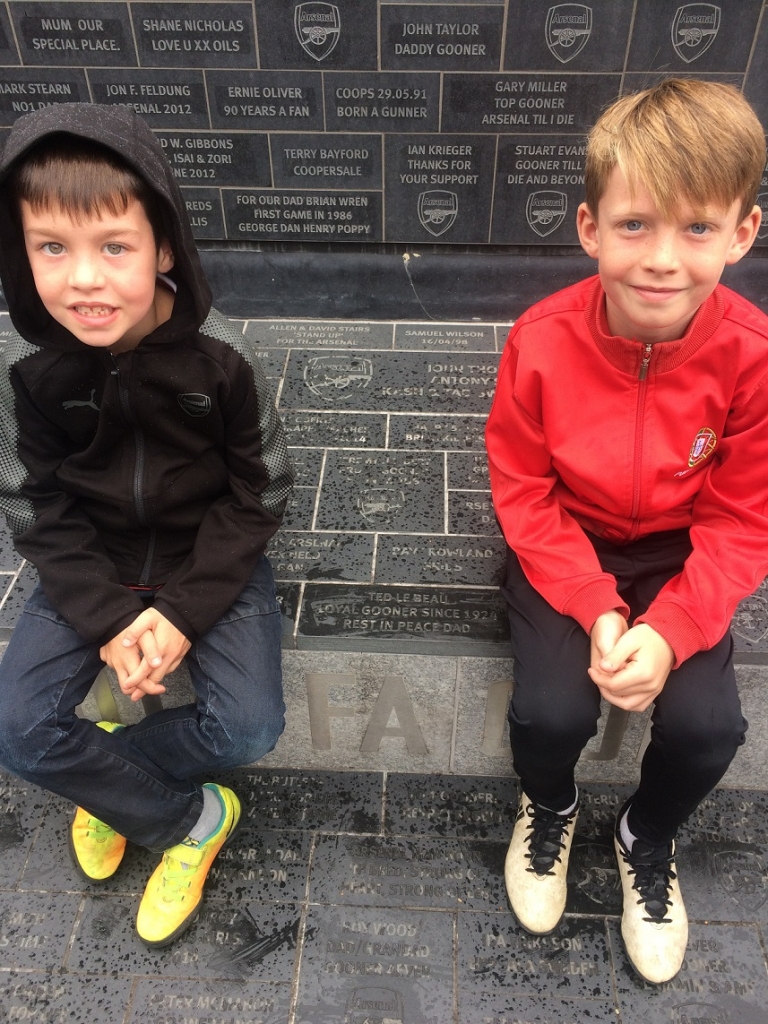
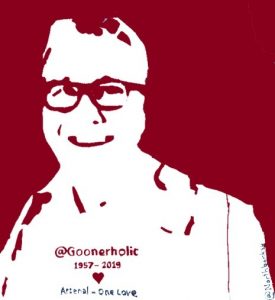
A few years ago I alluded to the game on Goonerholic and I believe Clive was there too and was similarly entranced. I’ve been hugely lucky to see live around 1500 Arsenal matches in my life (many of which I have forgotten) but that was an indelible memory. In the later years of my Dad’s life that glorious Arsenal side was a massive part of his world. He never made it to the Emirates as he was too frail to take on the journey but never was a Sky subscription used so avidly. After matches I would always phone him to discuss the match, take him the programme to read and discuss the players we had. He was enthralled by the flair of Henry, Bergkamp and Pires, amazed by the drive and power of Vieira and Petit, stirred by the stoicism and leadership of Adams and hugely grateful to Wenger for producing teams that illuminated the later years of his life with such stunning football. We calculated after his death that he had supported Arsenal for eighty-six years with no time off for good behaviour.  A tile, similar to the one we bought for Gooner Terry, commemorating his support, can be found as you walk down from the Ken Friar Bridge not far from the Tony Adams statue. The picture above shows his two great grandsons sitting by it on a visit to watch the Emirates Cup. One of them is continuing the Arsenal tradition in our family which stretches to well over a hundred years. Every so often as we discussed ‘the Arsenal‘ as he always called them, Dad would say to me, Do you remember that game we went to see when the Arsenal came back to beat Bolton 4-3?. That was a wonderful game wasn’t it?..Remember it….. that is a game I will never forget as long as I live.

« Newer Posts - Older Posts »