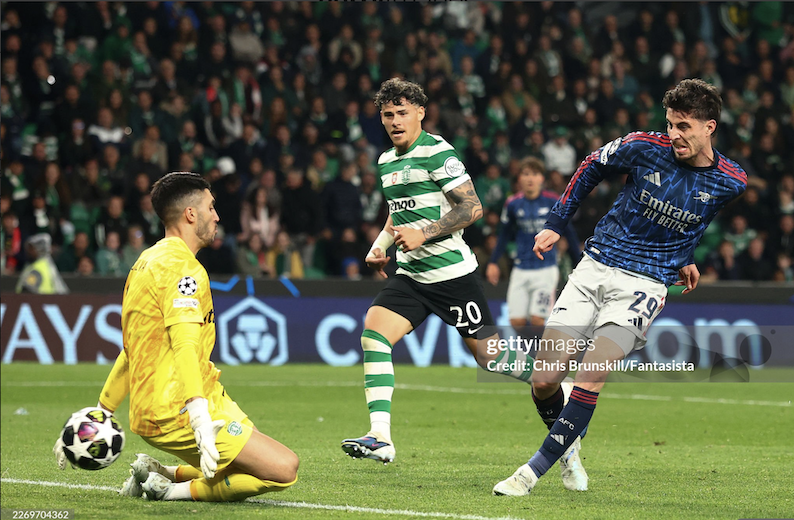
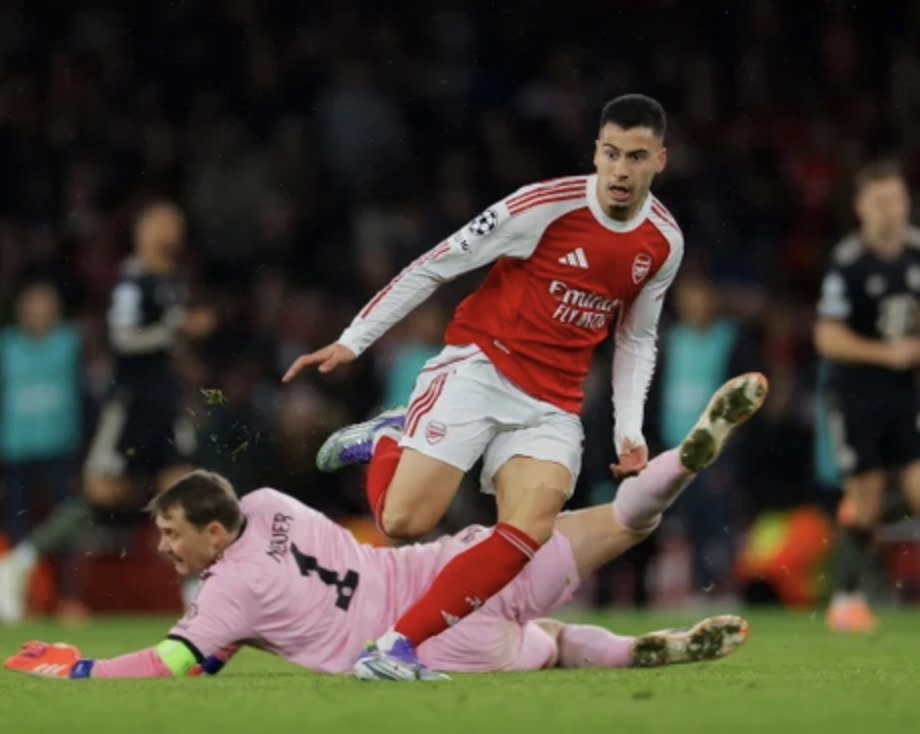
We got out of Lisbon with an extremely handy one-nil to the Arsenal thanks to a late bit of quality from Gabriel Martinelli and Kai Havertz, the substitutes combining to find us an injury time winner that we probably deserved on the balance of play but that did not look like coming right up until it did.
It was not a classic by any means, but we got the result we wanted and that was all that mattered ahead of a huge game in the PL on the weekend.
Our lineup looked good, and we began with some possession in defence, just to draw the sting from the early whistles of a crowd who were well up for this one. And well might they be. The match was barely five minutes old when Sporting’s Irish centre-back O’ Diomande played the best pass I have seen all season. With the outside of his right foot, he knocked it through our whole team, bending it between Saliba and White, with the perfect pace to slow up in time for the onrushing Araujo to take it on and smash a shot that looked to be heading in until a fingertip from Raya took it onto the bar. Great save, but the through ball was sensational. It was Sporting’s magic moment, but they failed to capitalise. When ours came at the other end of the ninety, we nailed it. Fine margins.
We slowly took control of the first half, having a lot of the ball, playing lots of passes in their half, but not creating a huge amount (I should have this sentence saved to speed-dial). Madueke hit the bar from a corner, but I think European VAR might have disallowed it for a slight push from Gabriel on their keeper.
As the game trundled on, I considered that I don’t much enjoy playing Portuguese teams because they whinge about everything. I don’t enjoy watching them foul our players and then make the diving gesture. I don’t much enjoy listening to their fans cry for a foul any time two players make any type of contact. There was plenty of that tonight, and I look forward to the return leg where our fans will be making the noise (although not complaining when the ref gives the opposition free kicks that we can all see are justified!)
We came closest in the thirteenth minute when an Odegaard free kick from wide looked to be on its way only for Diomande to get a head to it. The ball bounced down and out for a corner, but the big defender will have been relieved it didn’t hit the net. It could have gone anywhere.
Apropos of nothing much, although it was one of my standout first-half observations, Trincao has good hair and a dashing moustache. He looks like he’d make a fine swordsman as well as a tidy midfielder. Needless to say, the actual football was not thrilling. Unfortunately, this continued into the second half.
Ben ‘Jammin’ White gave us a mixed bag, mixing some good actions with some moments when he looked either off the pace or, at least, out of sync with his teammates. Still, I assume that he will get more match fit and then every little thing is gonna be alright. Similar from Odegaard, but the minutes will have done him some good, unless it turns out that he picked up an injury. He went down briefly and came off soon after but took his place on the bench and seemed okay. Fingers crossed, as we need him so much to knit our game together.
Trossard was rusty. Rice full of running and duel winning but not at his best going forward. Zubi looked like some rest has helped, but we need to keep him as fresh as possible as he’s so important. We had the ball in the net in the 64th minute after he crafted lovely finish, but it was ruled out because Gyokeres was clearly offside in the buildup on what was an underwhelming return to a ground where he has scored 4,139 goals.
Madueke had an interesting battle with Araujo, which probably ended about even. I don’t know how the defender avoided a yellow for a long series of fouls, but Sporting fans seemed to think Calafiori was given too much leeway, so maybe that ended up even. (Although the ref was good overall). Noni went on the outside too often, and his last action of the night was to finally cut inside and whip a dangerous ball past Trossard at the back post before they were both subbed with fifteen minutes remaining for Martinelli and Dowman.
We had spells where our press was effective, but we did not turn it into an advantage. We were the better side, but they were in the game and what actual chances there were fell pretty evenly. It looked like it was going to peter out goalless but Sporting wanted to find a winner. Luis Suarez showed some neat skill to get past Calafiori and put a good cross in, but Raya made an excellent save down low from Geny’s header. He made another double save when he blocked a low shot that squirmed out to the feet of some lad but our Spanish stopper made himself big, blocked the shot and gathered it in.
At that point, it did not look like we were the side more likely to get a winner, but that’s what happened and we will take it all day long. Martinelli dribbled around two players, chipped a curling cross into the box where the intelligent Havertz had ghosted into space, and the German took the ball down immaculately in front of him and finished exactly how we wish he’d finish all the time. It was easily our best piece of play all night and deserved to win us the game.
So… we kept a clean sheet, got the win to take back to the Emirates, and got a look at a side who we should be beating at home next week to go through to a second consecutive semifinal. All good.
After Consul Decimus Junius Brutus Callaicus obtained the alliance of Olisipo in his campaign to take control over the Iberian peninsula and Lusitania, integrated this ancient settlement into the westward expanding Roman empire, and granted the local populace a degree of self-governing rights and yet at the same time Roman citizenship, the ancient forefathers of the current Lisboans – sounds better than Lisbonians, though neither is used; rather the people of Lisbon tend to be known as Alfacinhas – then ended up playing a pivotal role in the prosperity of the empire, including being a key trading center for the flourishing business with another Roman province, Britannia. There must be at least one living authentic expert about the Londinium-Olisipo sea routes in the first century AD. If they happen to be a part of the Goonerholics family, I hope they would fill in the details of the rest of this imaginary journey in the comments. (I recommend not asking your favorite Language Model, ancient history is particularly prone to being hallucinated upon, given the diversity of opinions out there in what is called the corpus nowadays).
We leave such a journey from the fertile past to our imaginations, and focus mostly on the relatively prosaic future of Arsenal men’s team taking on one of the Três Grandes of Portuguese football. Unlike Max Ophüls’s all-knowing, all-ironic narrator in La Ronde – who prefers the past because the present is mostly unhappy and the future is uncertain, quoting from memory – we Arsenal supporters have all the reasons to look forward to the future. Well, at least one very specific football match in the very near future. Yes, it is good to be specific. The Future with the dreaded capital F is, indeed, uncertain.
But before we get into the familiar business of football, while reading the introductory paragraph above, dear reader, I hope your curiosity was piqued a little bit about the moniker Alfacinha, the one people of Lisbon are known by. Let me elaborate (if you already know, please feel free to jump over three paragraphs): the word alfacinhas (al-fa-seen-yahs) literally means “little lettuces”. It is a recent term. Well, a very, very recent term for the second oldest of all current cities in the western world, after Athens; likely a trading post of the Phoenicians. For those who like to imagine the past, think of a Phoenician merchant ship 1000 BC (give or take a few hundred years) leaving the port of Byblos, moving along the southern Mediterranean, passing through the Strait of Gibraltar, sailing gently on the Atlantic, hugging the Iberian coastline, then arriving at Olisipo through the Tagus estuary: what did they imagine/think/hope looking at the sun setting in the limitless body of water to their west? Maybe a respite from these ceaseless movements and the endless business assignments, these battles of wits and perseverance in a world full of fright, fight and splendor? Edge of the universe or a mythical paradise?
Apparently, the term alfacinhas gained popularity in the 19th century through a book by Almeida Garrett – “Viagens na Minha Terra” , i.e., “Travels in my Land” – where the author celebrates the verdant beauty of the city by naming its citizens thus. Supposedly. I haven’t read the book. But the above facts do withstand scrutiny, and in any case they are not obtained from Bayesian prediction machines. Neither Jose Saramago nor Fernando Pessoa (or his many heteronyms) I remember have ever used the term. My Portuguese literature exposure extends only to those two greats, so others with a keener knowledge of the language or the culture should correct me if I have inadvertently spent a few minutes of my time (and yours, if I may add, apologetically) on a completely unimportant word.
I must say I do like the knowing wink of the history – the history of longue durée, slow and permanent formation of mankind and societies – embedded in the etymology of alfacinhas, its Arabic roots. We have been formed, shaped, defined, sculpted, made worthy of ourselves by our movements, and the gifts of interchanges those movements have brought. From the dawn of prehistory to now.
Well, back to the present. Sporting Lisbon – or, as they are known in Portugal, Sporting CP for “Sporting Clube de Portugal” – stands between the mighty Gunners and our second consecutive semifinal appearance in the Champions League, this most prestigious of the European club competitions. Sporting – or as they are sometimes called Leões , or Verde e Brancos (looking at the Sporting crest or home jersey will solve the puzzle) – is one of the big three of Portuguese football, along with Benfica and Porto. In terms of trophy count, they are just behind the other two. And while they have been a consistent presence in European football – especially in UEFA Cup/Europa league, where they are the most participated team, though their only European trophy came in 1963/64 Cup Winners’ Cup — they have never won the Champions League (or its previous incarnations). Well, neither have we.
However, they are the reigning champions of the Liga Portugal, which they topped in the season before as well. The player who was instrumental in their domestic success exhibiting an extraordinary goalscoring prowess – 97 goals in 102 matches, and in the last season 54 goals in 52 matches – is, however, now in our ranks, and one hopes the familiar sights of the Estádio José Alvalade will inspire Viktor Gyökeres to emulate his efficacy in the penalty box in Arsenal red-and-white. Viktor’s absence may have not been felt too keenly by Sporting, who are chasing Porto in the league, 5 points behind with a game in hand. Their last five domestic matches are W, W, D, W, W. This is a team in form, with Viktor’s replacement the Colombian Luis Suárez –no relation to the Uruguayan Luis Suarez as far as I can tell, without doing any research in their genealogy whatsoever – scoring for fun with 24 goals in 25 matches.
The managerial architect of Sporting’s current resurgence is of course the familiar figure of Ruben Amorim. We will leave him respectfully be, especially given that he is no longer managing one of the arch-enemies.
Rui Borges took over the managerial reins in December 2024. His record at Sporting is a respectable 51-14-9, which is a 68% win ratio. Before Sporting, he managed a series of relatively smaller clubs in different divisions of the Portuguese domestic leagues. His playing career was mostly restricted to a respectable, but unspectacular, winger role in the second and third divisions of Portuguese football, with a year or two in between in the top division.
Leaving aside the Liga Portugal – while highly competitive between the top three clubs, there is a wide gulf of quality especially in comparison with the clubs in the bottom half, and hence not easy to transpose the form or tactics in the context of a Champions League match – Sporting this season has played 10 matches in the CL, won 6, lost three, draw 1. In the group stage they performed well enough to finish in the top eight – they had finished 7th with a 5-1-2 record – and so have qualified for the second round directly. After losing away at Bodø/Glimt 3-0, they famously defeated the Norwegian team 5-0 at home. Their home form in Europe has been impressive this season, reverse chronologically: 5-0 against Bodø/Glimt, 2-1 against PSG, 3-0 against Club Brugge, 2-1 against Marseille, and 4-1 against Kairat.
As the blogger mentions succinctly, “alvalade (the Sporting stadium) has been our fortress.”
Across the two European competitions, we have faced Sporting five times: twice in double-headers in the Europa league in 2018-19 and 2022-23, and of course in last season’s group stage away at Sporting where we put on a fine all-round display to win 5-1. Interestingly, both of our wins against Sporting – the other three are draws – came away at their ground, the previous one in October 2018.
So, while we must absolutely respect the opposition, the impact of the home atmosphere and the crowd etc., we should also be confident to play to our strengths, with cool heads, tactical discipline and complete commitment to controlling possession and space. Given the traveling squad, my preferred starting eleven would be:
Raya
White – Saliba – Gabriel – Calafiori
Ødegaard – Zubimendi – Rice
Madueke – Gyökeres – Martinelli
There would be temptations to start Max Dowman after his eye-catching performance last weekend, but I feel it would best serve our cause to bring him in with thirty minutes left on the clock and let him simply play his natural game, covering for his obvious immaturity around defensive workrate etc. Sporting will sense an opportunity to impose themselves early – especially given what is widely being advertised as an Arsenal squad under pressure, though I don’t really buy at all into any psychological problems with the team – and if they throw themselves into the attack, Martinelli can then become the trigger to launch rapid counter-attacks. However, I suspect Arteta may prefer Leo to impose more control. I like the Calafiori-Martinelli combination, and would hope to see that working fluently. This would also be a good match for Madueke to bring back the scintillating performance against Brugge, a team of just a little less quality but similarly front-footed attitude in front of their home crowd.
Let us start strong, quieten the crowd, control the tempo and possession and we should create enough chances to score a couple of goals towards a 2-0 away win.
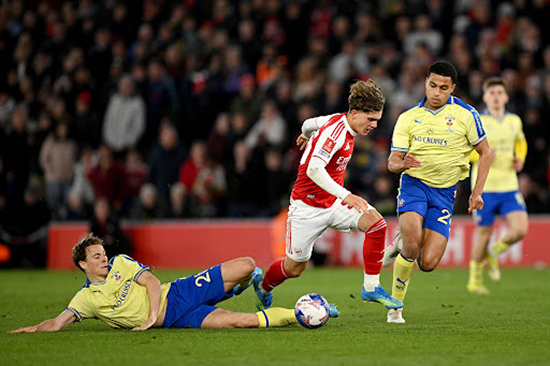
SOUTHAMPTON, ENGLAND – APRIL 04: Max Dowman of Arsenal is fouled by Caspar Jander of Southampton during the Emirates FA Cup Quarter Final match between Southampton and Arsenal at St Mary’s Stadium on April 04, 2026 in Southampton, England. (Photo by Mike Hewitt/Getty Images)
As the subject of this match review, it was tempting to choose from so many proverbs and witticisms around the failure and its, often paradoxical, implications. “There is no success like failure, but failure is no success at all.” “Success has a thousand parents, but failure is an orphan”. “Failure is success in progress.” “Failure is the condiment that gives success its flavor”. Etc.
But I don’t think we need to reach for too much of an insight from a loss in a football match. It’s a charmingly/bewilderingly/notoriously unpredictable sport, and this was neither the first time nor would it be the last time that Arsenal would lose an FA cup match against a lower league opposition. Cliched as it may sound, the “magic of the FA cup” has always been an endearing footballing reality, and once we can shake off the initial disappointment of the result (and the sub-par performance), it is best to simply congratulate Southampton and acknowledge that they were more efficient in both penalty boxes, and beyond all the analysis, statistics, theorizing – all of which have their rightful place, naturally – the fate of a match is often decided by this very simple fact.
I have chosen to put together some impressionistic thoughts – and not terribly structured or even thematically consistent – about Arsenal’s quarter final loss to Southampton F.C. away at the English seaside, avoiding the annoyance of recalling the performance and the manner of loss, and hopefully saving you from the displeasure of reliving what couldn’t have been a particularly enjoyable couple of hours.
This was the first time in the season we lost in two consecutive matches. The fact that they were both cup matches, and punctuated by a two week long international break in between, doesn’t make us realize how singularly good we have become in overcoming disappointments and bouncing back quickly from losses. It is a trait worth remembering, by players and supporters alike.
I don’t follow much of the incessant conversations about football in general and Arsenal in particular in the media outlets – including in the social media “discussions” – and as a result, I am (thankfully) spared much of the noise that some of the contributors in this blog (rightly) lament about. Football and Arsenal are important to me, but I try my best to refuse to let the inevitable ups and downs of the team’s fortunes dictate the tone of my relationship with my own self and the world. And understanding rather too well how the content machine works, profiting at the expense of others’ valuable time and invaluable emotional wellbeing, I try my best to not fall into the traps. It is not easy, but it has become easier over the years as one learns more about oneself and others.
So, I have been able to avoid most of the discussions about quadruples and trebles etc. And whenever I have heard those mentioned – typically in the commentary while watching the matches – I felt that anyone who brings that up doesn’t have Arsenal’s best interest in mind. Even when we were playing very well in the late summer and early Autumn, it seemed to me that we are well set-up to really fight for PL and CL, and hopefully win at least one of them to build the habit and confidence in this squad, but we should rotate more and give academy players more chance in the domestic cup competitions. To have started following Arsenal since the early Wenger days, I could never really take the League cup seriously – the League cup may turn around and say that she/he/they/it also never takes Arsenal seriously – and while our unique history of success in the FA cup and the romance associated with this oldest football competition in the world means that I always enjoy a long run in this competition, I didn’t think that we are a squad that can seriously fight for all three competitions until the very end. We need to get a PL and/or a CL trophy over the line first, and subsequently make some more fine tuning to both our personnel and playing styles, before we can become the kind of all-conquering team that can go on and win the three most important trophies in the season.
Our league position this season has been built on the basis of defensive solidity, a methodical control of games, greater efficiency in both boxes, tactical and psychological dominance in key passages of play, and a rugged willingness to leave no stones unturned in search of a result. And I loved it. It has been instructive, and despite the many nerve-wracking days, enjoyable in its own strange ways – demonstrating the values of those innate human qualities that never fail to inspire.
That said, we also must not delude ourselves into thinking that we have shown the kind of inventiveness, insouciance, originality, sharpness in our attacking play that can see out bad days in office against well-drilled oppositions by the sheer verve of football. This is not a criticism of the players or the manager or the coaching team, but just a simple observation. There may be many reasons for that – a lot of new players settling in, injuries to many key players, individual losses of form, opposition teams mostly choosing to defend deep – but I have no problem accepting the reality that this season we haven’t really sparkled in attack. The fact that we still have scored so many goals in PL and CL, and topped the group in CL, speaks eloquently about how extraordinarily good we have been in all other areas of the game.
But there would be days when not all of these other qualities of the team would shine, not all the moving pieces that work meticulously together will connect, the defense will make the kind of mistakes on long balls over the top that have become extinct from the Arsenal form book and hence all the more jarring when they reappear, and that missing sparkle in the attack will mean we will find it very difficult to simply overpower the opposition and score more goals that they do. Keeping those days to a very minimum should give us an excellent chance of winning the league, but the very possibility of those days mean that our cup runs would require us to be more or less flawless in exhibiting the core strengths of the team in every single match.
Today was not one such day. That really I think is all there is to say about it. Hopefully we will avoid a relapse in CL, and I continue to retain my optimism for our CL run. I have my reasons, but all of those center around the hope that we would be able to play the game we want to play in each of our remaining CL matches, starting with Sporting Lisbon away in a few days, and put on the kind of flawless efficiency that I think is the defining character of this team of their best days.
The PL would obviously be a mighty grind. We Arsenal fans will all probably go through quite a few days where the gap between catharsis and despair would hinge on a VAR call, a last-ditch tackle, a sublime finish out of nowhere, a last minute corner kick that would concentrate all of our breaths into one single hopeful outcome. I have no illusion that the next couple of months would be a challenge to our nerves. But if we are to simply rationally look at the possibilities, and expect that the team would continue to do very well the things that they have mostly been excellent at, we would still be able to remember all these frantic days with a fondness and joy that binds us all together for life. Millions of people world over – across all the divides this divisive species of ours had dreamt of in its short sojourn on this planet – would feel connected over a shared experience of achievement, maybe for a short moment most of us would be reminded that we are all so very similar.
Maybe it would be a Max Dowman goal that would confirm the league win for us? If there was one player today who deserved to win, it was him. He was the best player, by far, across both the teams. His technical skills have already been noticed by all, but his strength and conviction today were impressive. No one can know what the future will bring for him, but we as Arsenal fans should feel privileged to witness the emergence of a special talent through our ranks.
Southampton 2 (Stewart 35’, Charles 85’) – Arsenal 1 (Gyökeres 68’)
In Arsenal’s first post-Interlull outing since losing the League Cup final on March 22nd, a stretch of 12 match-free days, on Saturday the Gunners travel to Championship side Southampton in the FA Cup quarterfinals. It is an important occasion for Arsenal in several ways, firstly to regain positive momentum to erase any doubts that may have arisen from Arsenal’s first loss since their home defeat to Manchester United in late January. Secondly, advancing in this competition is likely to be an essential aspect of Arsenal’s bid to make their season as successful as it has looked for months like it could be, with the prospect of multiple trophies looming at the end of our long exertions.
In his pre-match comments Mikel Arteta addressed the need for the team to get back to winning ways, saying: “When (we) didn’t manage to win that final…what you have to take on board is how this is going to make us stronger for the final push of the season.” With Arsenal now still competing in only three competitions, Arteta must balance his priorities just right in all team selection decisions in order to get the most out of his injury-strapped squad, and Saturday’s match provides the first of many interesting tests for him in that regard between now and the end of the season.
The opposition
As of March 22nd, the Saints were in sixth place in the Championship table after going unbeaten in their last 12 league games, qualifying them for the ultimate spot in the promotion play-offs, level on points with Wrexham but ahead of the Welsh side on goal difference. Southampton travel to Wrexham next Tuesday in what must surely be a massive league fixture in their minds, to be played the same afternoon Arsenal face Sporting Lisbon in the away leg of their Champions League quarterfinal.
Earlier this season Southampton’s board appointed manager Tonda Eckert after he performed well in an interim role, and few second tier clubs have been in better form since that time. It may be too late for Saints to earn an automatic return to the Premier League, but they have moved into the top six places in the Championship and their positive momentum will be difficult to contain. Saints have beaten Doncaster, Leicester and Fulham to reach this quarterfinal, and they are enjoying their best FA Cup run since reaching this stage in 2022. The Saints are currently unbeaten in 14 games in all competitions, having won 10 of those matches.
Arsenal team news
Our long-missing and long-missed captain Martin Odegaard is said to be targeting this tie for a return from a knee injury after laboring to get back to full fitness, but Arteta will be closely monitoring his minutes so he may or may not be in the starting XI.
Arsenal had 15 first-team players involved in international matches, with Calafiori, Gyokeres and Norgaard in World Cup play-offs. All three of them played a significant number of minutes during their respective qualifiers. Saka, Rice, Madueke and White were originally all in the senior England squad, which faced Uruguay and Japan at Wembley, but only White featured much as the others thankfully dropped out early. Lewis-Skelly and Setford had England Under-21 Euro qualifiers away to Andorra and home in Norwich. Dowman played England under-19s Euro qualifiers in Portugal.
Martinelli traveled to North America for Brazil’s two friendlies. Raya, Zubimendi and Mosquera joined Spain for two home matches, while Havertz’s Germany played away and home. Hincapie joined Ecuador for two matches played in Europe. Eze (calf), Saliba (ankle), Gabriel (knee), Timber (groin) and Trossard (hip) missed their respective internationals due to injury, but the latter four could be in line for a return.
Madueke (knee) and Hincapie (hamstring) both limped out of their friendlies on the first Friday so both of them will miss this tie. In his pre-match presser Arteta said Madueke could be back in the squad within a few days: “Noni was really worried after he was (recently) out for six weeks. But no, he’s nowhere near that injury, so that was really good news.” But Arteta’s assessment of Hincapie’s injury was not so positive, confirming that it will keep the defender out for an indefinite period of time.
Arsenal XI
Largely by process of elimination, selecting players who are healthy and capable of winning the tie but who have travelled minimally during the break, Arteta seems to have little choice but to pick a side like this one:
Kepa
White Mosquera Gabriel Lewis-Skelly
Dowman Rice Havertz
Saka Jesus Trossard
Even if Arteta were to play a significantly weakened lineup, by bringing in Salmon at right back for instance, the Gunners should still have enough to win but must be ready for a proper battle because Saints will certainly offer significant resistance and threat in front of their own fans. Arsenal’s Tuesday Champions League quarterfinal at Sporting Lisbon must be an important consideration in Arteta’s planning, and he may not risk a number of top players or minimize the number of minutes they play. On Friday, el jefe described his thought process like this: “We are going to make the strongest line-ups and decisions that we possibly can to win every competition. We are two or three games away in the FA Cup and we know how important that competition is for us.”
Taking Arteta at his word, I expect Arsenal to come out with a spring in their step and to blow away a determined Saints side with a touch of quality here and a staunch determination all around to finish the season strongly. 3-0 to the away side.
After Wenger had led us to a Double in his first full season, expectation was high in N5. One problem – we had an implacable opponent in Manchester United whose treble in 1999 could so, so easily have been another Arsenal double. Further frustration in Copenhagen and in the FA Cup against Liverpool led to scurrilous suggestions that Wenger wasn’t a winner. As a result, Arsenal spent heavily in 2001-2 to remodel their side in an effort to clinch another title.
Ned tells us how that adventure played out, though primarily based in New York, the centre of the worst terrorist outrage in history, just as the 2001-2 season began.
TTG
2001-2: A Double Double
North Bank Ned
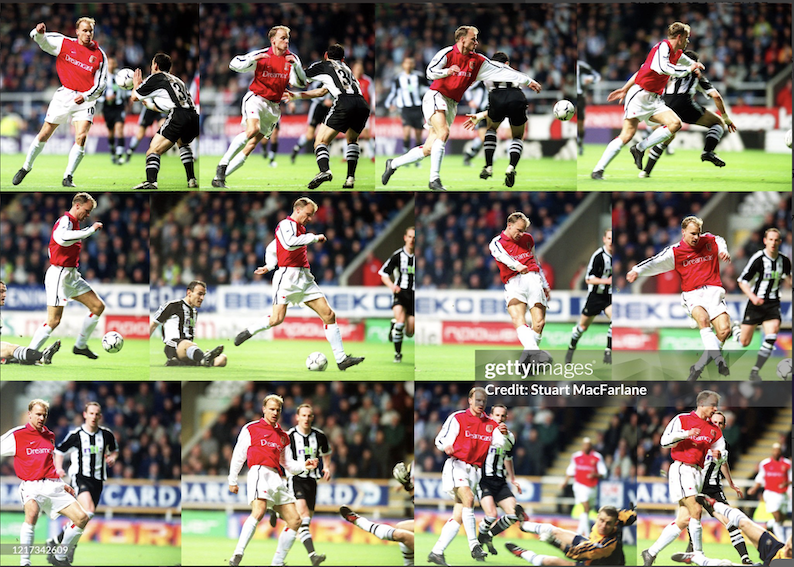
A composite image of Dennis Bergkamp’s goal for Arsenal during the League match at St James’ Park, Newcastle United on March 2, 2002.
What do you remember of that season and where were you mainly watching it?
I was mostly in New York. However, the 9/11 attacks occurred shortly after the season started. I had clear sight lines to the World Trade Center and saw both towers fall. Football took a back seat for quite a while.
It was a strangely detached season for an Englishman in New York, for other reasons, too. At that time, there was little coverage of English football in US newspapers. No inescapable social media. No blogsphere to talk about; Arseblog started in the second half of the season. Only occasional live games and highlights were available on a couple of cable channels. You had to find a dodgy internet stream or go to a sports bar that subscribed to the very expensive multi-sport cable service exclusively for sports bars, and was (a) open in the morning as some kick-offs were at 7 am, (b) showed English football, and (c) had our game on.
I didn’t discover Nevada Smith’s, the soccer pub in Greenwich Village, until quite late in the season. It is now sadly long-gone, a victim of the developer’s wrecking ball. It was many a New York Gooner’s matchday venue of choice, despite being a Man U bar. Geordies and Scousers congregated there, but followers of many clubs showed up as it showed so many games. I remember Roma fans there, sipping espresso. Heaven knows where they got it at that hour. Guinness was the breakfast of champions in Nevada Smith’s.
We had finished second for several seasons and fallen short in the UEFA Cup in 2000 and the FA Cup where we were unluckily beaten by Liverpool in 2001. Discontent with Wenger was growing among some Gooners. Do you see parallels with Arteta’s position now?
History can repeat itself, but never does so exactly. There wasn’t the toxicity of social media then. Abramovich and his £50-note-firing tanks were still a couple of seasons away. Another difference was that Wenger had already put serious silverware in the trophy room with the 1997-98 double.
The footballing competition with Fergie’s Man U was the dominant narrative —and the 6-1 defeat at the OT the previous season still stung. They had, after all, won seven of the previous nine Premiership titles. You saw Man U shirts all over NYC then, just as you see Barca and Real Madrid shirts today.
My recollection is that the Arsenal board, not Wenger, faced more criticism for failing to match United’s big-name signings due to the strict wage structure. But the FA Cup loss to Liverpool prompted the need for a rebuild. Still, I was a long way away, so it all might have looked very different from the other side of the pond.
Thierry Henry suggested we needed ‘a fox in the box’ before the season started, notwithstanding that we already had him. It’s interesting, isn’t it, that criticism of Arsenal as a goalscoring force is nothing new!
AW had bought a ‘fox-in-the-box’ before the start of the season: Francis Jeffers from Everton. Perhaps ‘cub-in-the-box’ would be more accurate, as Jeffers was 20. But he couldn’t stay fit, and when he was, he couldn’t displace TH14 or Sylvain Wiltord from the side. He was shipped back to Everton after playing fewer than two dozen games over two seasons. Checking the records, I see we still scored more goals in 2001-02 than every other team except Man U. They had van Nistelrooy, Solskjaer, and Cole up front. TH14 was the league’s leading scorer. It wasn’t as if Freddie Ljungberg, Bobby Pires, and Dennis Bergkamp couldn’t put the ball in the net.
Returning to your initial point, the club has a tradition of iconic, goal-scoring, big No 9s, and as fans, we feel somewhat bereft without one. That might explain the high expectations and disappointment surrounding Gyökeres.
We had been very active in the transfer market before the season. Which buys did you think worked particularly well?
It’s hard to think of anything that tops getting Sol Campbell on a Bosman. Beyond Jeffers, Giovanni van Bronckhorst, from Rangers, was the big-money arrival — when £8 million was big money. An OK buy, but had he not torn his knee ligaments early, we wouldn’t have gone out and bought Gilberto. Richard Wright arrived from Ipswich to be David Seaman’s long-term replacement, but that man would ultimately prove to be Mad Jens.
The best acquisition after Campbell was arguably Kolo Toure in the January window for £150,000, although he didn’t make his debut until the following season. Almost imperceptibly, the Invincibles were falling into place.
The sensation in the close season had been the acquisition of Sol Campbell. Can you remember the impact of that signing and how important a signing did you consider he was?
It was a stunning surprise, especially as he was coming down the Seven Sisters Road. You will remember the papers called it ‘a coup’. Wenger got kudos for talking Sol into signing for us rather than going to Barca or Inter, both top European clubs then and both of whom had offered him much better money. I seem to remember Denis Bergkamp presciently saying Sol was the missing piece of the jigsaw that would let the team break Fergie’s grip on the title.
Who do you think were our key players in our league title success that year?
The first choice team was probably: Seaman, Lauren, Campbell, Keown, Cole, Ljungberg, Vieira, Parlour, Pires, Bergkamp, Wiltord, Henry. I know that is twelve, but they were the most used players. We wouldn’t have won the double without one of them. If I had the invidious task of choosing just one, I would go for Denis Bergkamp for (i) being the bridge between the 1997-98 double side and what would become the Invincibles and (ii) his pirouette at St James’s Park—when he flipped the ball past the defender’s right side, spun past him on his left, and slotted home. That goal is up there with my all-time greatest Arsenal goals.
Can you remember when you began to believe we could win the league that season?
Looking back over the season’s records, I was surprised to see that we didn’t lose a game from Christmas on. I remember the title race being wide open well into April, with Man U and Liverpool on unbeaten runs. Liverpool weren’t mathematically out of contention until they lost at White Hart Lane with three games to go, their first loss since January, and Man U had only lost once over the same period. We still needed at least a draw at Old Trafford in the penultimate game. Having won the Cup the previous weekend, that was never in doubt!
We clinched the league at Old Trafford . Do you remember that night and how did you celebrate it?
It wasn’t a night for me, but a working Wednesday afternoon. So like, many of the games that season, I didn’t see it. I don’t think I was able to check the score until the game was over. So there was no real celebration until going to watch the last game of the season against Everton.
What other thoughts do you have about that season?
I can’t emphasise enough how monumental it felt to break Fergie’s three-year grip on the title after being runners-up each time — and having had to put up with the insufferable smugness of Man U fans for the duration. It was also pleasing to leave them without any silverware for the first time in what seemed like forever. However, in many ways, it proved to be a false dawn, and we had hit peak Wenger with this double team. The Invincibles were its Indian Summer, but they didn’t win as much as they should have and were quickly broken up. The move to the Emirates would soon have to be paid for and the slow slide into ‘fourth-place-is-a trophy’ territory started, Wenger said at the end of the 2001-02 season there had been a shift of power, which perhaps was true in relation to Man U, but he missed the shifting of the tectonic plates under both clubs that the money that was about to come into the game would cause.
Another Double was the outcome of a season that began with global turmoil. Wenger’s claims that Arsenal could go unbeaten all season were mocked after Rooney’s super strike but the team was growing into a very special force . Gunnersaurus Stunt Double takes up the story in 2003 and describes the most important season in Arsenal history.
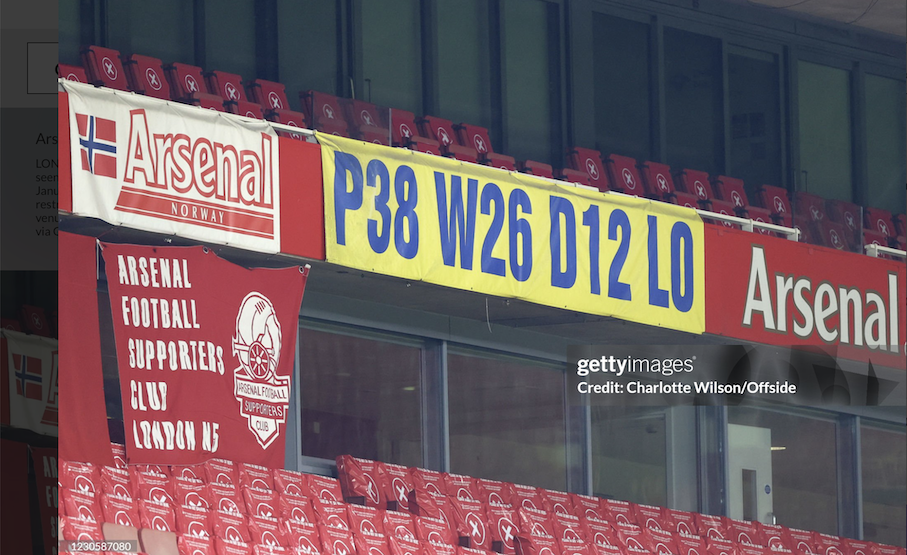
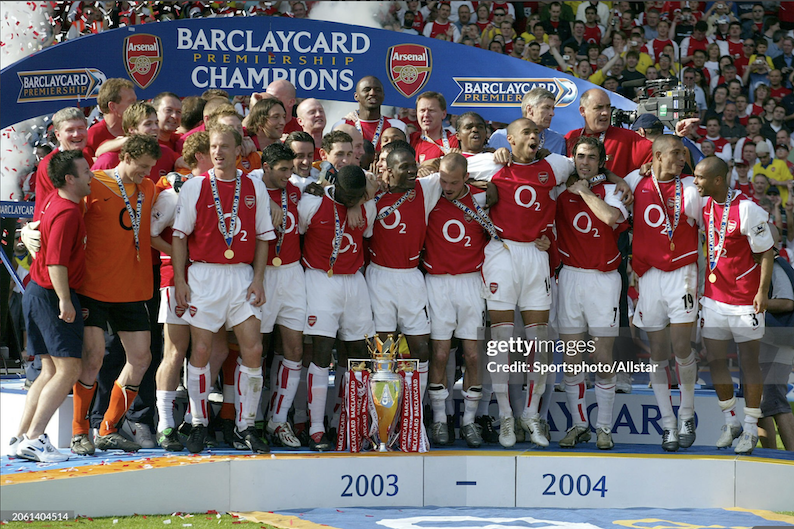
As we strive to clinch this year’s title we are besieged with jibes and barbs from the media that Arsenal have not won the title for 22 years . But that last title win was VERY special because during that season Arsenal were unbeaten. As Thierry Henry paraded around Highbury, he made the point that no team had ever achieved anything like Arsenal did that season. Gunnersaurus Stunt Double takes us back to that wonderful campaign and relives his memories of the Invincibles.
TTG
The Invincible Season
Gunnersaurus Stunt Double
The 2003/4 season was a particularly special season which saw Arsenal claim the title of ‘The Invincibles’. Did you ever anticipate that such an achievement was really possible at the start of the season?
A couple of years before the Invincibles season, Arsene Wenger had publicly stated that he thought it possible for a team to go unbeaten through an entire league season. For this hubris/idiocy, he was lambasted in the media. The British press at the time were, at best, xenophobic. They much preferred Sir Alex Ferguson, who they saw as one of their own, to the upstart Frenchman. Sure, they knew he was good, but they never resisted a chance to stick the boot in. Stop me if this sounds familiar.
Back then the media could get away with stuff that they can’t anymore. They regularly complained that Arsenal did not have enough English players and fumed over our starting lineups. We were ruining the English game. (Just like we are today).
Every year we would go to Old Trafford where thousands of their fans would chant that our manager was a paedophile. Just let that sink in; it is beyond disgraceful. But the fact that it was accepted by the media is even worse. It was not called out. We, and he in particular, just had to get on with it, amidst vile treatment. So, like most Arsenal fans, I was bullish about our team and our manager as the season approached. Everyone was out to get us. Bring it on.
In truth, I thought the inexcusable media were probably right that going an entire season unbeaten was a pipe dream. It seemed too big an ask, and as the season began it was not on my mind. I was optimistic about our title chances, but that was at least partly because I always am. I’ve squinted at plenty of worse opening day team-sheets and convinced myself we could win a title if things went our way. What usually happened was Wenger took us to a fourth-place finish that, judging by the calibre of our squad, looked like a bloody miracle, but in 2003, that was still years down the line. We were still at our peak.
Did you get a chance to see many games that season?
I was a teenager during this season, and so the journey our team went on meant a huge amount to me because, well, everything did. I did not get to a game at Highbury that year, and this was before the various online ways of watching a match that exist now, so I was limited to watching the matches on Sky, listening on the radio, watching highlights on MotD, and (if younger readers can imagine such a thing) reading the newspapers. I suppose I was reading Arseblog by then, but I don’t remember for sure.
At what stage did you realise that we were seeing something special? Were you firstly interested in winning the title or did you always believe that we could go unbeaten throughout the season?
It’s funny to look back given the stature the Invincibles now have, but during that season I felt we drew too many games. We were hard to beat, and tough enough to stand up to some rugged outfits, which I loved. But there were games where I’d watch Bergkamp, Henry, Pires and the rest, and think to myself, how are you lot drawing with Portsmouth? Not in a modern, ‘lose my shit and spray anger all over social’ media kind of way. More in a, ‘this is a top team and you are capable of better’ kind of way. And, of course, I was as scarred as we all were from United teams winning league titles that we should have got over the line. Our failure to win back-to-back league titles during this period still rankles. So, early in the season, every draw felt like it could come back to bite us. No matter how good we ended up being, as it was unfolding it felt like winning the league would be tough enough without saddling the added burden Arsene had willingly drawn down on us with his comments. Sometimes, it felt like he wanted the pressure. Personally, I could have done without it!
We had a wobbly moment when we went out of the Champions League to Chelsea (ouch!) after losing in the Cup to Manchester United. Did you have a temporary loss of faith then? Could we have avoided that Chelsea defeat given we had beaten them three times already that season (sound familiar?).
I don’t want to think about that Wayne Bridge goal. Ever! I still remember feeling sick when it went in. Genuinely nauseous. That is the year we were the best team in the world and other big-name clubs fell away in the CL too. It was there on a plate. The final was Porto v Monaco (hardly a clash of titans) and it spawned the uprising of one Jose Mourinho. Proper sliding doors moment.
For what it is worth, yeah, we could have avoided defeat. The goal that sunk us was the kind of naïve concession that was to become a hallmark of later Wenger teams and that fortunately we don’t see often from Arteta teams. But, ultimately, it’s all a bit ‘if my auntie had balls’. And it all worked out in the end.
The FA Cup loss sucked. By that point, I’d be lying if I said thoughts of the treble were not on my mind. After our ’98 double, I cannot express how pissed off I was that United bettered it a year later. We could all see how good our team was in 03/04, and I dearly wanted to match their achievement. Instead, we went out of both cups in a week and I was gutted. Back then it was hard to imagine us not challenging for top honours every year, but even so, there was the sense of a glorious chance wasted. Getting done by a Man Utd side who were by then miles below us in the league made it no better.
However, it was over that period that we drew at home with Manchester United in the league and then beat Liverpool with that Henry hat-trick to stop our season from falling apart – at least if you believed the hype. So, even though it was a time of tremendous disappointment, it was also the first time that I started to believe we could really go unbeaten. I had hoped that for a while, but by that point there were less than ten games to go, and we had gotten through our toughest tests. Make no mistake, Man Utd could see that we were gunning for something truly special and they wanted to stop us in our tracks. Getting past them without loss felt big. We still had to play Spurs, who would obviously be well up for it, and go to St James’s Park to play a good Newcastle outfit, but it was getting close enough to believe.
Truth be told, it suddenly meant more after the two cup exits. We were strong favourites to win the league, but that team were so good it would have been somehow underwhelming if all they got to show for it was a league title win.
I was also incredibly protective of our club and our manager. The media have never liked Arsenal, and that is just fine. I don’t like them. But I wanted to rub their noses in it after Arsene earned his vindication, did what most people thought was impossible and upset all of the received wisdom about English football. Every one of those nasty, agenda driven journos who piled in on Arsene were close to getting the largest slice of humble pie they’d ever seen (even if, when it did eventually come, many of them lacked the good grace to eat it). Yet, the flipside was clear. If we lost to Leeds, or Birmingham, or whoever, then the entire establishment could breathe a sigh of relief and get on with the happy job of ridiculing us (for getting so close to achieving something they said could not be done). It felt like we were against the world. By that point, I did not care about the draws. 1-1 against Portsmouth was not, in isolation, a brilliant result. But it left us with only two more games to get through, and not losing had become far more important than winning. I was thrilled to get out of Fratton Park with a point!
Every game was stressful. The enormity of the achievement was clear, the simplicity of messing it up equally so. All it took was one bad day, one dodgy penalty and red card (which we were no stranger to!) and it could have all gone wrong. To fall in that final run would have been heart-breaking. We had the league sewn up, but this felt much bigger than a mere league. This was immortality, up for grabs.
When we did it, I was on cloud nine. With hindsight, I suspect that if we had gone on in the cups, we would not have gone unbeaten in the league. I have always rued not winning the CL that year, but in truth, would I have swapped it for the unbeaten season? The answer is no. One team wins the CL every year. It is less of an achievement than what we did in the PL that year. It was also the most Arsene Wenger thing ever; an achievement born out of the twin abilities to dream bigger than anyone else, and to dig his heels in with an almost pathological stubbornness. It was so very Arsenal.
Do you believe any team will ever repeat the feat of going unbeaten all season in the league again?
I cannot see how it will ever be matched. In the last couple of months this season, every time I watch Wolves, I think they are a decent outfit, and they are bottom of the league! The PL has too much strength in depth and is too physically challenging. It took over a hundred years for anyone to do it (since Preston in what we can reasonably say was a very different football landscape) and I don’t think we will see it again.
Do you remember when it became obvious we were going to win the League? Do you remember clinching it at Tottenham and how that felt?
I honestly have no idea exactly when the league felt inevitable and all eyes switched to the unbeaten season. It was a while ago and I tend to remember how I felt much more than I remember individual results, even goals. I am amazed on those occasions when one of our number (often the inimitable Doc Faustus) references some specific Rosicky goal from a group stage game that I cannot recall for love nor money. I never know how other fans do that. Thank God for Youtube.
I do remember feeling incredibly proud of what we had done so far, a sense that it was job done. But also, a strange sense that our brilliance had created a new opportunity that was unlikely to come around again. Winning the league was weird in a way. Until that point, all talk of the unbeaten season could be batted away with ‘we haven’t even won the league yet’. So, after that was done, there was nowhere to hide. It felt like the pressure grew when we won the league, instead of fading away. I don’t think any other team has ever had to face that.
Winning the league at Tottenham was hilarious and brilliant. So, so good. I would have preferred to actually win the match, but watching them celebrate the annoying last-minute equaliser when the result was still enough for us to win the league at their place said everything about the relative aspirations of the two clubs. Always in our shadow.
Who stood out in what was a wonderful team?
It is not possible to pick out one player. That was such a good team, and they carried no-one. But, as I’ve just been thinking about winning the league in the enemy heartland… I love Sol Campbell. I just love him. For him to win the league for Arsenal at WHL was epic. And a sickener for them. Beautiful.
What other reflections do you have on that season?
I was talking a few days ago with a younger Gooner who does not remember any of this. He has never seen us win a league. I could not explain to him what it was like that year. We did not just win it, we managed what may be most remarkable achievement in modern football. It was stunning. And it felt like sticking two fingers up at the world, at all who doubted us. Everything was perfect. Just walking to the shops felt better than it usually would. Arsenal were champions. Arsenal were unbeatable. It was pure magic!
What was best about that team?
Well, there are too many right answers here. It was so strong. But I’ll pick something. I loved how directly we broke. Seeing five, six, seven red shirts just bombing forward in unison, it was like watching the Red Arrows. Backtracking defenders did not know what to do. We were devastating. And such athletes too. Fast, strong, determined, ruthless. But also skilful, with a clarity of thought matched by the ability to execute at breakneck speed. We were a multicultural, multiracial, all-singing, all-dancing, all-fucking behemoth. We tore up the rulebook and did things our way, inspiring a new generation whilst enthralling the longstanding faithful. That team had an impact on football, even society, that few can match. Thierry Henry is still a global icon. Sol Campbell still takes the piss out of Spurs whilst selling phones in big money campaigns. Dennis Bergkamp is known to all Gooners simply as ‘God’.
They were, and are, iconic.
Final thoughts?
For me, it all comes back to the visionary who imagined it all. Even when that team was defending, we always felt that in ten seconds we could have the ball in the back of the opposition’s net. They worked things out for themselves, Le Boss never being too prescriptive in how they played. That team and that achievement itself were the dream of one man, the almost perfect realisation of his football philosophy – right down to not winning any other tournaments in an effort to win the league perfectly. He was always, for better or worse, the most stubborn idealist you will ever encounter. As much as I love everyone associated with that triumph, it can be truly laid at the door of one man, and one man only.
He took more shit than anyone. But now, he gets the glory.
Arsene Wenger, Invincible.
We now hope against hope that Mikel Arteta will lead Arsenal to their fourteenth title , one that will be part of a very special season . Come on you Gunners!