We begin the second part of our look back at Arsenal’s league titles by examining the very controversial 1990-91 season. Trev was kind enough to supply his recollections of what was a momentous season.
TTG
1990-91 – A Controversial Title
Trev
What were you doing when the 90/91 season began? Were you a regular attender at Highbury and did you get to any away games at that time?
When the 1990/91 season began, I was getting settled into the second year of my Sports Physiotherapy practice. Ironically, I was probably one of my most important patients, having just undergone another couple of knee surgeries as a result of which I had reluctantly decided to give up my North Bank season ticket. So, no, I was not a regular attender at Highbury and away games had sadly become a thing of the past.
We had won the league in 1989 but the following season was rather flat. Were you optimistic when the new season began?
Despite the refreshing of the squad and the eventual success of the new recruits, I can’t say I started the season with great optimism due to the predicament that Tony Adams had got himself into. He was Mr Arsenal and integral to the defence, the team and the spirit of the team.
We’d had a bit of a splurge in the transfer market in the close season, particularly bringing in Seaman in goal and Limpar on the wing. What did you think of the new signings as the season unfolded?
During the summer of 1990, George Graham had decided to update the squad. David Seaman arrived from QPR for a fee of around £4 million as the replacement for John Lukic who headed to Dirty Leeds; Anders Limpar arrived from Cremonese and Andy Linighan was bought from Norwich City as cover for Tony Adams and Steve Bould. Brian Marwood and Martin Hayes left for Sheffield United and Celtic respectively.
David Seaman’s record needs no repeating by me. Andy Linighan proved to be a very able deputy and played a lot more than he would probably have expected – 156 games for Arsenal over 8 seasons and, of course, he scored the winner in the 1993 FA Cup Final – as he had to cover for Tony Adams when he was forced to take a break at Her Majesty’s pleasure. More on that later. Anders Limpar was a big success, scoring 13 goals in his first and title winning season. He was with the club until 1994 and only left when he mysteriously wasn’t offered a new deal by George Graham.
The season featured a points deduction after the ‘brawl’ at Old Trafford. How did you feel about the way that incident was viewed and dealt with?
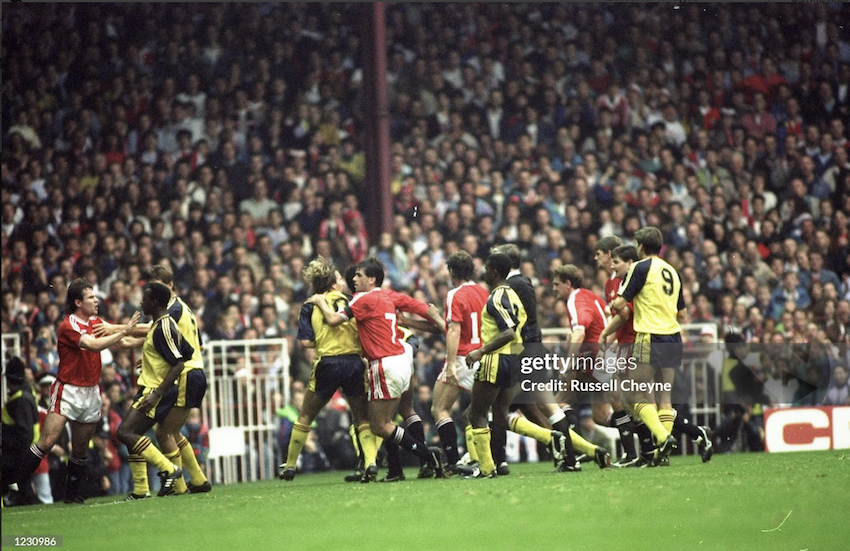
The “brawl’ at Old Trafford blew up after a bit of a running battle between Nigel Winterburn, Denis Irwin and Brian McClair. Irwin started the trouble with a nasty tackle aimed at Anders Limpar’s ankles. Winterburn, sticking up for his teammate, repaid the favour to Irwin. McClair, who I remember as a persistently nasty piece of work, then took the opportunity to give Nutty’s back a good kicking – payback presumably for Nige taking the piss out of him for missing a penalty.
McClair’s thuggery provided the starting shot for 21 players to rush into the ensuing “brawl”. In truth, most of them were trying to pull the main protagonists apart amidst the flurry of handbags being flung in all directions.
Both clubs admitted their indiscretions and fined some of their own players in a failed attempt to avoid further sanction from the FA. Both teams were fined £50,000 for misconduct and disrepute charges, and both teams were punished with a points deduction. Manchester United were deducted one point while Arsenal – who had been involved in on-field trouble during their home match with Norwich the season before – were handed a two-point deduction.
My memory is that the media, as we’ve grown accustomed to experience, presented Arsenal as the villains of the piece while the fact that Man Utd started the whole thing was barely mentioned. It’s over 30 years ago now. I’ve detested Man Utd ever since and we’ve suffered unfairly at their hands more than enough.
Tony Adams went to prison in December for drink driving. Was he victimised in your view and how did you think the team would respond?
First, some context:
On 6th May 1990 Tony was expected at Heathrow to join his teammates for the end-of-season tour of Singapore. He unfortunately decided to have a couple of beers with some mates before leaving for the airport. A couple turned into far too many at a boozy barbecue in the garden of friends in Essex. He eventually reluctantly accepted he needed to pack and head for Heathrow.
As he wrote in his autobiography, ‘Addicted’: “I did not want to go to Singapore and was beginning to think I might not have left enough time to do what I needed to at home then drive the 60 or so miles to the airport. In fact, I barely got 60 yards.”
While doing almost 80mph in a residential street, he lost control of the car, clipped a telegraph pole, span onto the other side of the road, and head-first into the brick wall of the garden in front of a resident’s house. Thankfully and miraculously neither he nor any other people were harmed.
A breathalyser revealed him to be four times over the legal limit. He was charged with reckless driving and driving with excess alcohol, but was nevertheless released to await trial in court at a later date. In the meantime, Arsenal were able to start the season with Tony Adams still available.
Given the circumstances, I don’t think you could say Tony was victimised by the various public or sporting authorities as his indiscretions could have had catastrophic outcomes. The press, of course, were not slow to make hay but this was serious and bound to attract enormous attention. In December 1990 he was sentenced to four months imprisonment, of which he served two months before his release.
He did recognise his problems with alcohol addiction, as detailed in his book ‘Addicted’, and transformed his life. Ten years later, still trying to atone for his troubles and establish the kind of support he could have done with himself, his charity Sporting Chance was founded in 2000, providing a service for athletes with emotional and mental health problems including various types of addiction.
So, no, he wasn’t really victimised in terms of the punishment he received. However, the media certainly made the most of his situation which was, after all, an illness. As an Arsenal fan though, I can’t talk about this without also mentioning that he went on to play 674 games for the club over 22 years, retiring in August 2002 as the Premier League and FA Cup Double winning captain and, as we knew him, “Mr Arsenal”. To this day I still can’t talk about him without getting a major lump in the throat.
The team in 1990 responded to all this as I knew they would and always did in times of adversity. They fought back and won the league.
What do you remember of the title run-in? Were you always confident we would win the title?
What with getting my practice running and undergoing more knee surgeries, I don’t remember much of individual matches, and neither can I say I was especially confident that we would win the title. What I remember was that we had an almost impenetrable defence, relentlessly drilled by George Graham, that conceded only 18 goals across the season as we became the ‘Almost Invincibles’ losing only once. Despite all that, I do remember being constantly worried that the title would somehow be kept from us by the FA. Our discipline was not good and everyone except Arsenal fans wanted us to lose because they hated our direct style, our hard, mean defence, and our success.
When we won it we were at home to Manchester United that evening. Were you there and do you remember how you celebrated?
No, I wasn’t there due to the recent knee surgery. I do remember the voice of Brian Moore on TV commentary and feeling relieved, smug, proud and elated by myself at home.
That team only lost once all season. Do you think it got the credit it deserved?
It definitely did not get the credit it deserved due, as previously stated, to our direct, uncompromising style of play and admittedly poor disciplinary record which was widely criticised by all around. To lose only once and concede just 18 goals across 38 matches was a tremendous achievement. We had a goal difference of +56 (almost 20 better than Liverpool in second place with +37), and were also the division’s second highest scorers with 74 goals, just 3 behind Liverpool.
It was certainly odd that our mean, direct playing style was the work of George Graham, known during his playing days as Stroller, for his relaxed, elegant skills.
Who, in your view, were the outstanding players that season?
I would nominate two players for that award. Anders Limpar, for his goals and the speed at which he integrated into the team, and Andy Linighan who arrived expecting in all honesty to be a reserve and finished up filling in for months for Tony Adams during his absence, a massive task for a new recruit.
Looking back, how do you reflect on that season?
If I had to do a “What 3 Words” for that season, they would be:
- Worry – over what would become of Tony Adams and, therefore, Arsenal.
- Defiance – over continuing to love the club everyone else hated.
- Pride – that despite everything and everyone, we’d won the league again.
It really was a time of “no-one likes us and we don’t care!”
So what’s new?!
Trev captures the essence of that controversial season superbly. I remember a pivotal game at Anfield round about this time of year. It was effectively a title decider and in the first half they battered us only to find Seaman unbeatable in goal. That season, particularly, he was a cheat code and he operated behind a superb defence. George Graham had created a siege mentality that saw us win the league comfortably that season. Two titles in three years was highly impressive.
Bathgooner takes up the story seven years later. The Graham era has ended ignominiously, Bruce Rioch has come and gone and in his place we have a new coach who assumed control after the start of the 1996-97 season, Arsene Wenger, a Frenchman who arrived from Japan. Arsene Wenger did not waste time in propelling us forward as bathgooner relates.
1997-98 – Arsene Wenger’s First League Title
bathgooner
When the season began Arsene Wenger had been at the club for just over half a season. What impression had he created in those first few months?
In his first year as the Arsenal coach, Arsene Wenger had quickly established a cerebral, almost ‘professorial’ image and had brought transformative players to the club in Vieira and Petit but also, then, he also seemed to have a Zen-like quality on the touchline which over the years, he subsequently lost! Leaks from the dressing room suggested that he quickly revolutionised the lifestyles of the first team players’, not all of whom were happy with the new dietary regimen!
We had been very active in the transfer market in the close season. Did any signings particularly excite you?
I had already been extremely impressed with Arsene’s eye for a player when I saw Vieira come on as a sub against Wednesday the previous season and beat a midfield opponent by chipping the ball over him and then later that season when Anelka joined the forward line. Our style of play was far silkier with his additions and the team certainly looked better prepared to compete than they had looked at the beginning of 96-97. The purchase of Marc Overmars in the 1997 close season was a very exciting prospect and he proved to be even more influential than we had hoped but the player I quickly came to love in 97-98 was Manu Petit who solidified the midfield, covered every blade of grass, complemented Patrick Vieira perfectly and frequently played a sumptuous chip over the opposition defence for Overmars or Anelka to run onto. Alex Manninger was also an excellent signing as back-up keeper while Boa Morte and Wreh were important additions as squad players especially as Merson was allowed to leave, I suspect due to his resistance to changing his lifestyle. All three of those back-up signings would play key parts as the season progressed.
Did you anticipate how successful the season could become? If so, what produced this optimism?
I was optimistic at the start of the season, iprincipally because of the radical change in playing style that Arsene had introduced the previous season. The team was now building from the back with Seaman passing the ball to either Dixon or Winterburn and the attack being built through an elegant midfield containing Vieira, Platt and Bergkamp rather than the previous formula of missing out the midfield by the keeper simply pumping the ball down a channel for Ian Wright to chase.
There was an infamous meltdown among supporters and some players after we lost to Blackburn at Highbury before Christmas. Do you remember that moment and how did Wenger arrest the slide?
I do. The team produced a shocking performance in that game against Blackburn and the mood in the ground was as bad as I’d experienced until encountering the vitriol of the late Wenger years. Wrighty was booed off by a section of the crowd when he was substituted because he was having an absolute ‘mare’. He later leaned out of the East Stand dressing room window to give back some of the abuse! I subsequently learnt from Kenny Sansom on a tour of Highbury Stadium, before we left that lovely old ground, that this episode led to those windows being screwed shut!
After that game there was a famous first team meeting where it was said that Tony Adams rather than Arsene led the postmortem and bashed some heads off the wall with some home truths. Some years later, I did the Legends Tour of the Emirates with Lee Dixon soon after it opened (whom I recommend strongly as a guide) and he said that Arsene virtually never lost his temper in the dressing room. He recalled only one occasion (probably not this one) where he had done so when he gave the team a proper tongue lashing which absolutely shocked them. When he’d finished, he angrily crumpled the plastic cup in his hand and threw it emphatically at a bin sitting in the corner of the dressing room, turning to leave the room. But the cup missed the bin. Lee said that at that point he thought, “Don’t do it, Arsene. Don’t pick that cup up. Leave the room in high dudgeon!”. But Arsene turned, went over, picked up the cup and placed it carefully in the bin before leaving the room. Lee said, “The contrite and mortified mood of the room was immediately broken!”
The highlight of a long winning run was the 1-0 win at Old Trafford. Did you see this as a turning point in the season?
At the time, I did see that game as a turning point as the win blew the title race wide open and left us feeling that we had a great chance of winning the title but now it feels more like the culmination of a redemption arc that began at the turn of the year. Our trajectory in the first half of the season had been somewhat tortuous. We started the season slowly but playing very nice football and three consecutive wins in September (including Wrighty’s record-breaking 179th goal against Bolton and Nutty’s late rocket to win at the Bus Stop) took us to the top of the table one point ahead of Man U. However by the end of October a series of draws had left us one point behind them. A stirring 3-2 home win over Man U in early October (with Platty’s superb header providing the winner) was needed to keep us one point behind them but a series of defeats, culminating in that one against Blackburn, left us in 6th place, 12 points behind the leaders as December 1997 ended.
From the beginning of 1998, a run of 5 wins and 2 draws changed the dynamic completely. By the end of February we had clawed the gap back to 9 points and moved up to second place with 2 games in hand. As a result, there was a growing sense of momentum amid the tantalising possibility of catching the league leaders. However, by the time that match at Old Trafford came round in mid March, a Manchester bookie had already paid winnings out to punters who had backed Man U to be champions despite the fact that we had clawed our way back to second place, still 9 points behind, but now with 3 games in hand. Arsenal’s dogged pursuit had rattled Man U who, like that bookie, had clearly thought the league was in the bag. I thought we were the better side from the off at Old Trafford and we knocked repeatedly at the door of a clearly nervous Man U before Marc Overmars ran onto an Anelka nod-on and stroked the ball calmly past Schmeichel. My memory of that game is capped by a Rasputin look-alike animatedly celebrating our victory in the away end (or was that the later title winning victory at Old Trafford – mists of time and all that!).
That victory was a massive achievement but the title could clearly still have eluded us during the remainder of the season had we not gone on to win the next 8 consecutive games, culminating in that title winning victory against Everton setting a then record of ten consecutive victories.
Who were the outstanding players for us that season?
I find it difficult to pick out individuals in what was a superb squad performance throughout a season in which so many players contributed to the final outcome. Although our top goal scorers in the league were DB10 with 16 goals (including that famous hat-trick in the draw at Leicester), MO11 with 12 goals, IW8 with 10 goals (in only 22 starts), and NA9 with 6 goals, crucial winners were scored by several others: Nutty at the Bus Stop, David Platt at home against Man U after the visitors had pulled level from 0–2 down, Gilles Grimandi with the only goal at home against Palace, Christopher Wray with the only goal in the rescheduled match at Wimbledon (remember that suspect floodlight failure?) plus another critical winner at Bolton and Manu Petit with the only goal against Derby at home. Ray Parlour provided a crucial equaliser at Tottnumb. Stephen Hughes contributed 3 league goals in 7 starts.
David Seaman was terrific in goal all season long and Manninger proved an extremely able substitute when he was unavailable – I have a vague memory of a crucial penalty save but can’t confirm it was that season. However this was definitely an iconic season for Gorgeous George’s original back four: Dixon, Bould, Adams and Winterburn with 108 league starts between them with Martin Keown contributing 18 league starts. Wenger’s dietary revolution had given them a new lease of life – the end of the ‘Tuesday Club may also have been a factor! That defence seemed more secure than ever except for that day against Blackburn. The midfield of Vieira and Petit was imperious and has only been matched as a combo since by Gilberto and Vieira and by Rice and Zubimendi. Grimandi added some Gallic sangfroid and venom when required, as did the rarely seen Remi Garde. Player of the Season for me was undoubtedly the unparalleled Dennis Bergkamp.
Were you able to watch us win the League at home to Everton? How did you celebrate that moment?
I was, but tickets had sold out when I got through by phone to the ticket office on the day they went on sale. However, I was so confident that we were going to win the league that day with the way we were playing that the kids and I, resplendent in red and white went to the ground to soak up the atmosphere. We bumped into a gentleman who had spare tickets and I bought three from him. Although he assured me that these tickets were close together in the North Bank, the seats turned out to be widely separated in the away end! The teller on the turnstile at the Clock End instructed us to take off our scarves and reverse our Arsenal jackets – he seemed familiar with the phenomenon of home fans coming in through his turnstile. I ended up in the West Stand while the kids were far apart from each other in the Clock End. It took me several years to confess to my wife that her 14 year old daughter had been sitting alone in the Clock End surrounded by Evertonians – though Miss B did tell me that they were very nice to her. I would have been far less comfortable with the situation had it been certain other groups of fans! I’ve never bought tickets in that way since.
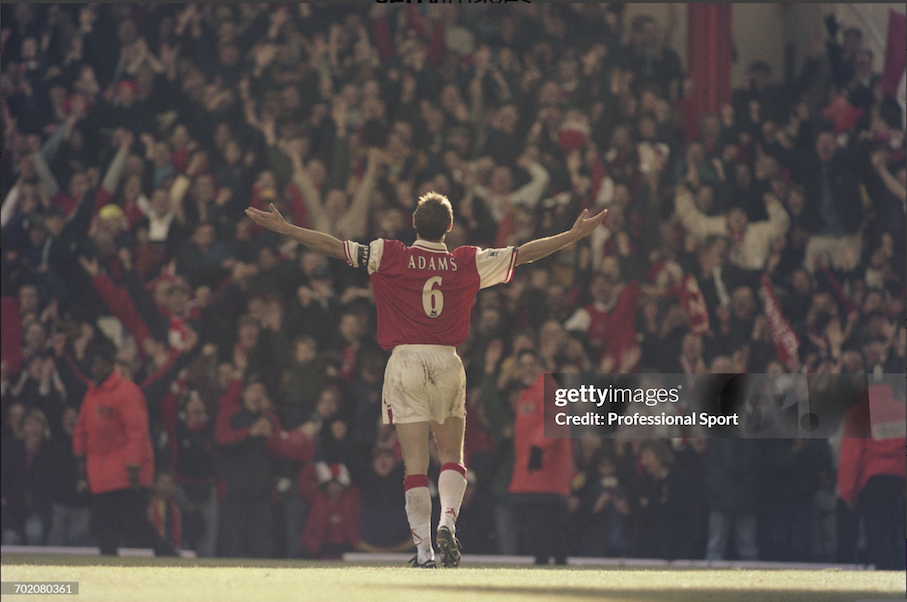
In the West Stand, I had a superb view of Bouldy breaking out of defence and lofting a superb ball to TA6 to race onto and blast into the Everton net for our fourth goal. When the final whistle went, dozens of Gooners emerged from camouflage in the West Stand and Clock End. I will never forget going eyeball to eyeball with Martin Keown who came running straight over towards the little knot of Gooners congregated in the now otherwise empty away section of the West Stand. We had 4 goals and a league title while Everton had 5 yellow cards! After the game, we met up with my wife in central London and had a celebratory meal in a nice restaurant off Knightsbridge before driving home for just a few more celebratory beverages.
What other reflections do you have on that season?
That was the season that I realised that Arsene Wenger was a coaching genius and what a huge privilege it was as an Arsenal fan to be able to watch his teams on a regular basis. Little did I know that this team would go from strength to strength and provide me with over a decade of pleasure, thrills and spills. That season was also a lesson in how tortuous the journey to a league title can be and how much mental fortitude contributes to a successful challenge. It was the first time that I had been in the ground when the Gunners had won a trophy and while I had loudly celebrated Anfield ’89, the domestic cup double in 1993 and the Cup Winners Cup Final in Copenhagen in 1994 in front of my TV, that first live experience of seeing us lift a trophy will stay with me forever.
It was a season that also saw us complete our second Double and put to bed (for a while) with vibrant football, the popular image of ‘boring, boring Arsenal’ despite retaining our superb defence. It ushered in a very exciting new era which we will explore in the next instalment.