Feed on
Posts
Comments

Expectations Rising

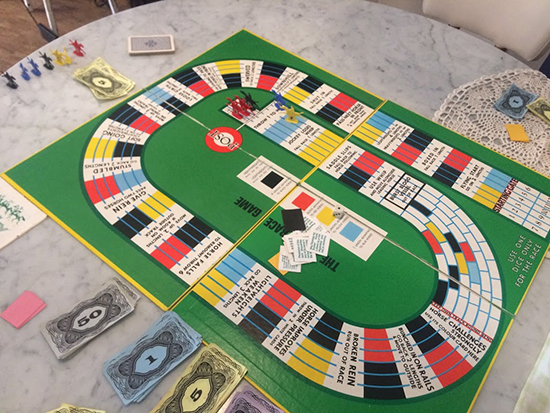
When I was a young boy (around the time Hannibal crossed the Alps on an elephant) our Christmas present choices were more limited. XBoxes and PlayStations had not been remotely thought of, so at Christmas I used to love to be bought, and to play, Waddington’s finest board games like Monopoly, Cluedo, and a horse-racing game called Totopoly. If you agreed to play Totopoly with a lot of people you might have to devote four hours to it. The reason was that there were two boards — the exciting bit, the race, but before that, if you played it properly, you had to go through training. That took forever but it was the key to winning the ultimate race. It helped if you had a strategy that you could stick to as the intensity of competition got tighter. Often you’d do everything right and your horse would burst a blood vessel in the final furlong. It was a lesson for life — and the Premier League. How often have Arsenal players been found to have gone in the fetlock at a crucial time?

That is a laboured analogy but it illustrates very well how success is obtained in modern football. You have to get the preparation right before you can enjoy the end-product and you need a modicum of luck. If there is one lesson from 22-23 so far it is that the better quality your preparation…and the more intelligent your strategy, the greater the dividends you can reap.
By Jcmagot – Own work, CC BY-SA 4.0, https://commons.wikimedia.org/w/index.php?curid=64792781

We are among friends so we can be honest. There is scarcely an Arsenal fan alive who expected the club to do this well so far this season. The reality is that a straw poll of Gooners would have been mightily pleased with fourth place and maybe winning the Europa League (another route into the Champions League) at the end of this season. Some tell me they still would be — see later!

The frustrating part is that all we have so far experienced is the foreplay. We‘ve played fourteen games and have to play another twenty four.  Two of those are against our greatest rivals, Manchester City. We play Newcastle twice, an away North London Derby, and a game at Anfield. Last season in those games we took a total of three points.

Ok, I’ve pissed on your chips, so lets find something a bit more optimistic to ruminate on. How close are we to the Champions League? Automatic qualification to the Champions League for fourth was introduced to the Premier League in 2012/13 but the number of points needed to secure that spot was on the rise well before then.

Here I quote from Planet Football: “In the first ten seasons from 1995/96 the average number of points needed to grab fourth spot was 65.5. For the following 16 seasons that number has risen to 70.8.

That number has been bolstered by Arsenal’s 79 in 2014/15 and Liverpool’s 76 in both 2007/08 and 2016/17. Interestingly, all three seasons’ points totals would have been enough to win the Premier League in 1996/97 when Manchester U, took the crown with just 75 points.”

Arsenal have already amassed 37 points from 14 games . They have 24 games left to get another 35 to almost certainly qualify for the Champions League. We are 11 points ahead of the fifth-place team, Manchester United, with a vastly superior goal difference (22 goals better). Liverpool, in 6th, are 15 points behind us.

So short of a major collapse we have undertaken a lot of the groundwork necessary to put us back in the Champions League. We are very well on course. I have an image of many denizens of this bar becoming very uncomfortable at this sort of talk. We are tempting fate in a very big way if we start talking about being champions after fourteen games.

But football fans are also greedy as well as pessimistic. Suppose we continue with excellent results and start to isolate ourselves with Citeh (if that hasn’t already happened). Would we be pleased with fourth place if we are top of the table with ten games to go? Expectations get ramped up spectacularly when you are playing well. You can feel inside Ashburton Grove an atmosphere that we’ve not experienced at that ground before. The place is rocking, it’s positive, and it’s been marvellous fun . Whisper it quietly but we do have a chance of the title. 

What are the main reasons? Well we’ve really thought out how to succeed. We have an intelligent template for identifying and signing talent and a sparkling academy that regularly produces stars. Look at our last one and a half seasons and compare them with Manchester United’s. How much of a demand was there to take up Piers Morgan’s puerile suggestion to sign Ronaldo on loan to cover the absence of Jesus? Answer: virtually none. Our coach may well be rated the hottest young property in Europe at the end of this season, and his relationship with a cabal of Edu, Lewis, Mertesacker, Garlick, Josh Kroenke, and a set of very innovative coaches generates terrific excitement for the future.

Last season there were several awful moments – Brentford away, Palace away, and the games at the Spuds and Geordies. Outclassed at Anfield and at Citeh. This season we played really well at Palace, and murdered Brentford where they had murdered us a year before. We’ve seen fine away performances at Chelsea and Bournemouth, and resilient efforts at Leeds and Wolves.

At home we’ve been sensational in the League, efficient in the Europa League, and although we went out to Brighton in the Carabao Cup I believe that has to be a blessing in disguise. The Brighton defeat coupled with the Eindhoven capitulation away illustrates that while our first eleven is a match for anyone we lack the depth to fill in for long if we lose key players. The loss of Jesus is a much bigger challenge than the need to buy another winger in my view. Up front we have Nketiah who is still relatively unproven and now faces a lot of games with no obvious cover. Martinelli can definitely do a good job of replicating Jesus, but that affects the balance of the side. On the wing, however, we have Saka and Martinelli and could use Smith Rowe, Vieira and Marquinhos. And we saw in his cameo against Forest that Reiss Nelson is not a spent force.

Our one league defeat at United was deeply frustrating as a Salford-domiciled referee chalked off a perfectly valid goal, and Sambi Lokonga failed to get anywhere near to the level of Partey in playing the holding role in midfield. We looked naive in conceding on the break but we wouldn’t have done so if Partey had played in place of Lokonga. Elneny wasn’t available but there’s also a big gap in quality between him and Partey.

We have an excellent defence. White, Tomayisu, and Saliba alongside the underrated Gabriel provide a strong barrier in front of the revitalised Ramsdale. In my opinion, Partey and the transformed Xhaka have dovetailed beautifully with the woefully underrated Ødegaard to provide a midfield that enables us to control matches against almost anybody.

On the wings we have two of the most sought after players in world football in Saka and Martinelli. Both lads bleed red and white, and we must confirm their new contracts soon. I am confident we will. Hopefully we will complete a hat-trick with the signing of Saliba. Our two signings from the Etihad have adjusted brilliantly, although we will lose Jesus for around three months after an injury sustained in the World Cup. What other impacts that ghastly, mistimed tournament will have on league football will become evident as the season unwinds.

This is where we get to the complicated Totopoly effect. We have prepared superbly for the first third of the season. Now we have to decide what we need to take us forward…and maybe decide how far forward that can be. It is hard not to feel we are seriously in the title race as I write, especially if we take up where we left off and Citeh falter at all, or Haaland or De Bruyne picks up a serious injury. Pressure builds though when expectations grow. We haven’t had those expectations…until now.

If we do sign Mudryk it is not because we need another winger but because we believe that he has a huge ceiling. We must, in my opinion, be able to mitigate the potential loss of Partey, and reduce the strain on a player whose injury record suggests he won’t come unscathed through the rest of the season. If we could also find a high-quality loan striker from a cash-strapped major club like Juve, or Barcelona, or Atletico, we could see if he was able to fit into the structure, give rest and rotation to Jesus and Nketiah and find out  whether PL football suited our temporary import. Options MIGHT be loans for one of Griezmann, Vlahovic, Felix, Torres, Taremi, Giroud (!), or Morata. All have big plusses and some have obvious minuses. We lost Champions League last season because we stayed with Lacazette who gave us very little towards the end of the season. If we are determined to sign Mudryk for say £40-45 m it will be because we expect him to be worth double that at least before too long. Midfield is more difficult and again a loan gives us options but McAllister at Brighton and Caicedo for that matter are fine players, and if we did get Griezmann his versatility in midfield could be a huge asset. Tielemans is a good player but isn’t a priority at this stage in my opinion.

Typical wish-list stuff which I believe indicates we need a holding midfielder and an attacking player who can be the focal point of attack. But one or both could be loan signings if Bloody Edu can do his stuff. So I might have concocted a wish list but it is based on an assumption and belief that the foundations of this club are exceptionally strong, KSE have a willingness to help the club financially in intelligent ways (they won’t be pumping huge amounts in but they understand sport finance and how to juggle balance sheets), and that this is a golden moment we didn’t expect but one we’d love to see the club seize with vigour and ambition.

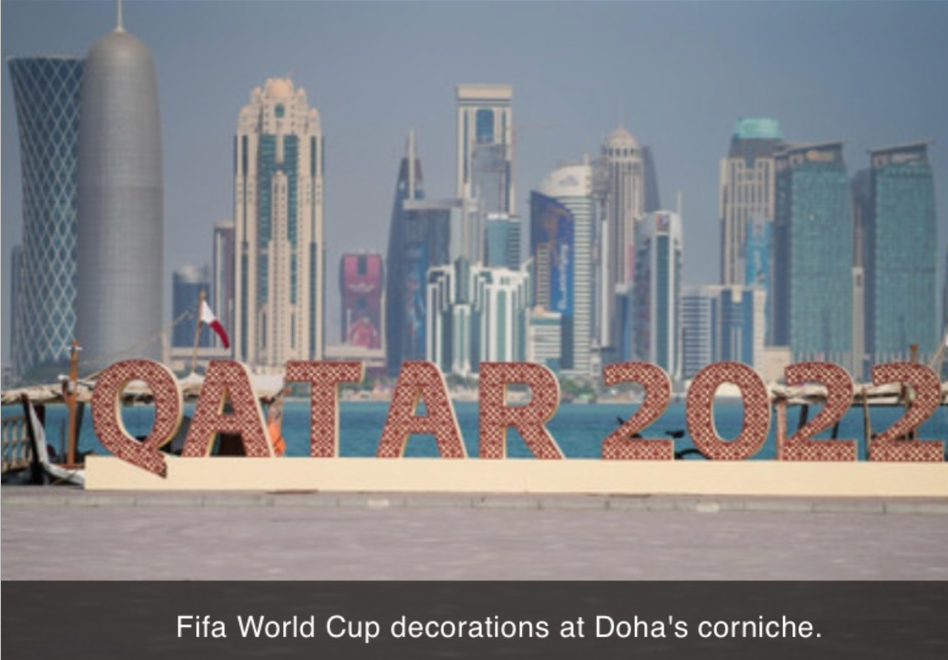
This is a season like no other. The impact of a huge disruption in the middle of a winter programme which will stretch out interminably until June will not only stretch our resources, it will stretch everyone’s. Many fine players will suffer injury and burnout but that happens when FIFA accept bribes from Qatar. We must hope and pray that our plans and our obvious quality continue this glorious domestic season, and that something special is about to occur in N5. I really believe it is. Who shares my view?

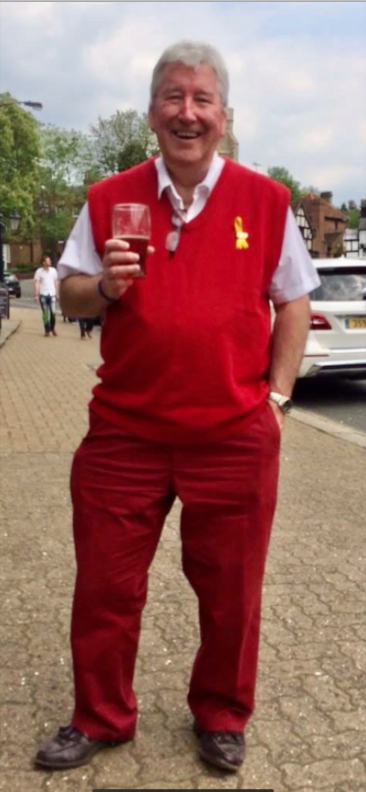
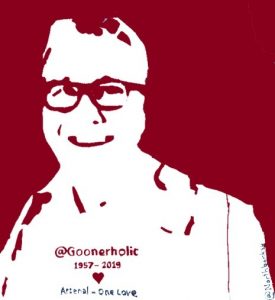
In two weeks it will be Christmas Day. It will already also be the third anniversary of the passing of a great man, and a great friend of Gooners from around the world, who passed away in the early hours of Christmas Day 2019.I have struggled to know what to write about this World Cup, but I wouldn’t have been considering that at all had the Guvnor not inspired a group of us to try to continue his amazing work. Here’s to you, Dave!

It hasn’t been at all easy to write this piece. I had originally intended to reinforce our banner question of “ Why ?? “ with some facts and figures to illustrate what a corrupt bidding process and bizarre final decision it had been. In the meantime, hardly a word has been left unsaid about the fate of thousands of migrant workers who built the stadia, the lack of human rights and the extraordinary statements made by Gianni Infantino and, sadly, even our own Arsene Wenger, in an attempt to hush political discussion of the venue and make everyone “concentrate on the football”. 

After all, FIFA goes to great lengths to ensure that sport and politics are not allowed to mix ! Woe betide the player who lifts his shirt during a Champions League game, to display a message condemning war in his own country, or the unjust fate of a relative or loved one. FIFA could never countenance such unchallenged proclamations unless, presumably, it was paid to do so ?

I then thought I would take one aspect of the “Why ??” and spent some time digging for more information on the bribery involved in the bidding process. I found a very good piece in the New York Times which dealt with the US investigations, the culprits and some of the sums involved. Those who might be interested can find the article by Googling – “New York Times FIFA bribery Qatar” – but be sparing with your searches – the second time I had to prove I was not a robot, due to my “unusual internet traffic”, and the third time I was hit with a paywall.

I decided not to reproduce that large amount of information here as it may already be familiar to some, but thought it might be more interesting to ask our banner question from the other side of the coin, so to speak.

“Why did Qatar want the World Cup?”

The general response to that question is that the Qatar World Cup is a sportswashing project, but that reasoning doesn’t fully explain why the country has spent an estimated £220 billion on a month-long football tournament that has invited international scorn.

Sportswashing is roughly defined as the practice of a controversial company or country using sports sponsorship to improve its reputation. But can Qatar really have said to have improved its reputation by hosting the World Cup? If anything it has amplified the country’s medieval set of rights for women and the LGBTQ community, and their now theoretically reformed kafala system of work sponsorship and its associated atrocious human rights violations. Solely on that basis, it has failed.

But sportswashing is not the only, or even the biggest reason that Qatar was prepared to throw such vast sums at hosting the tournament.

Simon Chadwick is Global Professor of Sport at Emlyon Business School in France. He claims, “It was never all about sportswashing. The term serves a purpose but it oversimplifies a complex debate.” He is keen to stress that sport does bring benefits in terms of reputation and does not dispute the accuracy of the phrase “sportswashing’, but he says it is only part of the reason Qatar wanted the World Cup. Qatar’s hosting of the World Cup is also about power and weakness. “Fundamentally the World Cup is about Qatar’s strategic vulnerability”, he says. Qatar is a tiny country – its area is less than that of Cork and Kerry combined – and it is surrounded by larger, powerful neighbours. It shares a land border with Saudi Arabia and maritime borders with UAE, Bahrain, and Iran. It is also sitting on the modern equivalent of a gold mine, with vast natural gas reserves, which they have efficiently exploited to make themselves the richest country in the world. But with great wealth comes great vulnerability.

Qatar was a British protectorate until 1971, with the British offering support and protection in return for access to oil and gas.”It was the British at work again in their colonial-era, imperialist way”, explains Professor Chadwick, “But when the British pulled out in 1971, Qatar was vulnerable again. Rather than be dictated to by the British as to how to use their resources, all of a sudden Qatar was on its own. It had to make its own decisions. Fundamentally, Qatar wants to protect itself and has done that by “hedging”, which is geo-political speak for trying not to annoy anyone. So while Qatar has a strong relationship with Iran and housed the exiled Taliban, it is also home to the US Army’s biggest air force base in the Gulf. Sport is part of that process.

The World Cup is undoubtedly Qatar’s biggest project, but it also hosted the FIFA Club World Cup and the World Athletics Championships in 2019, along with the 2016 UCI Road World Championships and the 2015 World Handball Championships. It has also been added to the F1 Grand Prix roster and may yet bid for the Olympics in 2036. “They are so small and so vulnerable, they can’t afford to antagonise anyone”, says Professor Chadwick. “So they have to remain visible and present, and appear constructive, trustworthy and legitimate. The World Cup is part of that narrative to allow them to be seen as legitimate and trusted members of the international community.

“If you can demonstrate to the world that you can deliver on a plan, keep your promises, and have the resources to invest in important projects, it sends a signal to the global community.” Sport is also used by Qatar as basic nation-branding, a vehicle to advertise around the world the essential fact that Qatar is its own nation state.

Only 15 years ago Qatar was little known. Now, people certainly know the country’s name. Defining national borders and entrenching them in people’s minds has its own defensive purpose. In his book ‘Inside Qatar: Hidden Stories from One of the Richest Nations on Earth’, John McManus writes that there was concern in Qatar that Saudi Arabia might invade during the Gulf crisis of 2017. “There is a defensiveness underpinning Qatar which a lot of people have not picked up on,” says Professor Chadwick. “Putin deliberately used sport for offensive rather than defensive purposes. Without doubt, sport for Putin was of a malign nature. It wasn’t intended to pacify or placate, but to divide and conquer – a totally different strategy.”

But while the World Cup has betrayed Qatar’s vulnerability it has also projected its power. That power has increased since Russia invaded Ukraine. Qatar’s gas exports for April this year were more than double what they were in the same month a year earlier, as Western leaders descended on Qatar to strike deals. The West’s reliance on Qatari gas has been articulated through criticism – or rather the lack of it – of the nation’s hosting of the World Cup. Western governments have rarely spoken as one on the matter, and often tempered whatever criticism they have mentioned.

To give an example, Germany’s Interior Minister, Nancy Faeser said in October that “it would be better if the World Cup wasn’t awarded to countries with a human rights record like Qatar,” which earned her a swift rebuke from the Gulf State. She clarified her comments a week later, saying they were “misinterpreted” and Qatar had, in fact, introduced “very good laws” in improving the living and working conditions of migrant labourers.

German Chancellor Olaf Scholz has also praised Qatar’s “progress” on improving labour rights in the country while speaking on a visit to Qatar during which he signed gas deals with Qatar and the UAE. Amnesty International have acknowledged those same laws and improvements, but warned that there remained a gap between the writing of the laws and their implementation across all infrastructure, not just the projects directly related to the World Cup. “What we have here is a very small country with outsized power, and that outsized power is a consequence of their resources and the interdependence that allows them to exert control over countries like Britain, Germany and many others across Europe”, says Professor Chadwick.

Only this week French president Emmanuel Macron wheeled out the tired old line that sport and politics shouldn’t mix. “We must not politicise sport”, he said, surely in hope rather than expectation. In awarding the World Cup to Qatar, FIFA have allowed the competition and the sport to be used as a political tool – to become one plank of a nation-building strategy. The politics will never consciously leave the World Cup – it will always be of use to someone, somewhere. It is FIFA’s job to ward off those politics. In that respect, they have distinctly failed.*

A whistleblower who was jailed in Qatar after raising concerns about the mistreatment of migrant workers at World Cup stadium sites, was tortured on the eve of the tournament, his family has claimed. The human rights organisation FairSquare also released a letter from the family of Abdullah Ibhais, a former media manager in Qatar’s Supreme Committee, which accused FIFA of “callous indifference” for ignoring his case. FairSquare is now calling for the United Nations working group on arbitrary detention to intervene in the hope that Ibhais will be released from his three-year jail sentence.


In the letter Ibhais’s family claims he spent four days “in complete darkness in solitary confinement after being physically assaulted” – as punishment for contributing to last month’s ITV documentary Qatar: State of Fear? – with the air conditioning at full blast and used as a torture device. “He was in a cell of two metres by one metre, with a hole in the ground as a bathroom and with temperatures near freezing,” the letter adds. “I was already suffering from several bruises after the prison guards’ assault and I was shivering all the time, as the cold air directed to me never stopped. I hardly slept during those four days,” Ibhais said.

Ibhais says he was jailed after raising concerns that the Supreme Committee planned to deny that World Cup workers were involved in a strike of between 4,000 and 6,000 people in Doha. He says he found 200 workers in Education City Stadium and Al Bayt Stadium that had no drinking water and had not been paid for four months. However, Qatar’s authorities insist that Ibhais, who was removed from his role in 2019, was sentenced on fraud charges relating to a contract to produce social media content for the World Cup. But that is disputed by Fair Square, which says he was coerced into a confession and denied a fair trial.

Nicholas McGeehan of FairSquare said Ibhais had gone to FIFA before his arrest. “He was messaging directly members of FIFA’s human rights team,” said McGeehan. “At some point, however, they just disappeared. They essentially ghosted him – for want of a better word – and he had no further communication from them after that.”

And Finally, A Bit Of Fun

So, after all that seriousness, it must be time for something a bit more lighthearted. It’s really isn’t my style to do a solely serious piece …..

As we all know, Russia and Qatar were each awarded a World Cup at the same ceremony in 2010. In 2022 those two countries are probably the most featured in international news – Qatar for their football tournament and appalling human rights record, and Russia for their own form of inhuman behaviour in Ukraine.

The Arabic names constantly in the news reminded me of a very old poem, more recently (1974) recorded as a song by Peter Skellern. The poem, by a strange quirk of circumstance, deals with a skirmish that happens accidentally, in a market place, between an Arab Emir (actually Turkish but we can surely suspend disbelief for the sake of a bit of fun) and a Russian Tzar. It’s interesting that way back in the 1800s when the poem was written, the intolerance of both parties led to ….. well, give it a listen. It is fun!
https://www.youtube.com/watch?v=f7GgmOdHDog

Stop press: (for me anyway!)
Baddiel and Skinner have released a revamped version of Football’s Coming Home in an attempt to achieve a Christmas No. 1, says Frank Skinner – “it’s finally come down to a shoot out between Mariah Carey and me as to who’s got the best voice!” Great video – enjoy!

Oh, and a Very Merry Christmas !

*From an article by Sean Ingle of The Guardian, 7th Dec 2022.

The last time we were top of the league at Christmas and went on to win the title was in 1947. 

Few, if any, in this bar, save Dr F.’s interlocutor in the previous, most excellent post, will remember that Christmas. American crooner Buddy Clark topped the UK pop charts with An Apple Blossom Wedding, Cambridge University has just admitted women into full membership and Princess Elizabeth had married her Greek prince just a month before.

Life was drab, austere and wearing. Rationing was still in effect, and London was bombed out and exhausted. The devastating V-1 rocket hit in 1944 at Highbury Corner was a fresh memory. (It is why the Corner isn’t a corner anymore.) At the stadium, the North Bank terracing and South Stand were newly repaired from bomb damage during the Blitz.

When league football had resumed after the war, we were a shadow of our great pre-war sides. We flirted with relegation for most of the 1946-47 season; the 13th-place finish flattered.

Refresh, revive

Yet manager George Allison was putting elements for a revival into place, buying Welsh left-back Walley Barnes, veteran England wing-half Joe Mercer and the mercurial Scottish winger Ian McPherson from Southampton, Everton and Notts County, respectively. 

Jimmy Logie, a Scottish inside right of the small and skilful ilk who had signed for the club in the summer of 1939 (timing is everything!), had made his league debut, playing ahead of right-half Paddy Sloan, newly acquired from Tranmere Rovers. Laurie Scott, signed before the war but unable to get a first-team game, also made his debut. George Swindin, later to manage the club, became the undisputed first-choice keeper.

Ronnie Rooke joined mid-season from Fulham, an unlikely recruit, 35 years old and a lower-league journeyman centre-forward. Yet he blossomed in red and white. A relegation-averting 21 goals in 24 league games in 1946-47 would be followed by 33 in 42 in 1947-48, the only 30+ goal haul between Ted Drake in 1934-35 and TH14 in 2004-05. 

Rooke formed a prolific striking partnership with another centre-forward, Reg Lewis, who like Swindin and the Compton brothers had played a handful of games for the 1937-38 title-winning side.

Time was also wearing away the remaining older heroes of the 1930s. Cliff ‘Boy’ Bastin, the Robert Pires of his day, and Bernard Joy would retire in the close season. Bryn Jones, bought in 1938 to replace the incomparable Alex James, but another who lost their best years to the war, started to be phased out; so, too, George Male, the greatest full-back of 1930s, although there would be a twist to his tale.

Whittaker’s world

Allison, too, retired at the end of the 1946-47 season. Adding the final touches would fall to his successor, Tom Whittaker, the third manager of the Herbert Chapman dynasty. Whittaker had qualified as a physio after injury cut short his Arsenal playing career in 1925 when he was 27 years old. His innovations in Arsenal’s conditioning of players and rehabilitation of the injured as first-team trainer were critical to Chapman and Allison’s success in the 1930s. 

As the new manager, he replaced Sloan, later the first Irishman to play in Serie A, with a less attacking wing-half, West Ham’s Archie Macaulay. That let him deploy Mercer, now captain, even deeper, to orchestrate the team Partey-like from in front of a defence of Swindin, Scott, now England’s right-back, and Barnes, shortly to be Wales’s left-back, with Les Compton between them. 

Allison had converted Compton from a middling right-back in the reserves into the reserve first-team centre-half. With Joy’s retirement, the position became his own. Thirty-five and the club’s longest-serving player, Compton was about to embark on the Indian summer of his career, including in 1950 becoming the oldest player to win a first England cap. 

Whittaker’s adjustments were transformative. A defence that had leaked 70 goals the previous season conceded just 32 on its way to the title, keeping 21 clean sheets in 42 games.

Whitaker’s other signing was a young, two-footed winger, Don Roper, from Southampton. Like McPherson, Roper could play on either wing. The pair provided flexible cover for Les Compton’s younger brother Denis, first-choice on the left wing but frequently unavailable because of cricket or a dodgy right knee injured in a collision with Charlton’s goalkeeper in 1938.

Flying start

The 1947-48 season got off to a perfect start, with six straight wins, opening with a 3-1 win at Highbury over Sunderland (highlights https://www.britishpathe.com/video/arsenal-3-sunderland-1-soccer-seasonss-flying-star/query/arsenal ). Six more wins and five draws extended the unbeaten run to 17 games. 

It ended on November 29 at the Baseball Ground. That Derby County won with the game’s only goal was down to Swindin’s keeping. The Pathe newsreel of the game doesn’t show a single Arsenal attack.

Yuletide arrived without further mishap and was celebrated with a 3-1 Christmas morning win at Anfield. We were top of the table, three points clear of Burnley after 22 games and seven ahead of Preston North End, who had played one game more.

Two days later, ‘Scouthland’, as the match programme described our visitors (the people take their name from a sailors’ stew that is a contraction of lobscouse since you ask), won the return fixture 2-1 on a wet Saturday that turned Highbury into a quagmire, our first home defeat. Whittaker was still playing Chapman’s pass-and-run game using his modified WM formation. Lesson one for Arsenal is that ‘they cannot tip-tap their way to success through heavy going’, opined the Daily Herald.

Cup shock

Another unexpected home loss came on January 10, in the FA Cup 3rd Round against Second Division Bradford Park Avenue (highlights https://www.britishpathe.com/video/VLVA2B58EHMHBXFRX3N5K5PF1F4CT-ARSENAL-VS-BRADFORD-IN-THE-THIRD-ROUND-OF-THE-FA-CUP/query/arsenal ). However, the league points continued to accumulate. Defeat would not strike again until the end of February, a 4-2 reverse at Villa Park.

Three more defeats would await before the end of the season, two at Highbury, including against Chelsea in mid-March that started a stuttering run-in. A side with an average age of 30 was running out of steam. We won just three of our final ten games but had a nine-point cushion to fall back on.

The first of these three wins was a 7-0 thumping of Middlesborough at Highbury on Good Friday, with Rooke getting a hat-trick and Denis Compton a brace. 

The next day, we played Blackpool — in Blackpool — fielding nine of the team that had played 24 hours earlier, and lost 3-0. On Easter Monday, we were at Middlesborough, where the identical team that had won 7-0 three days previously drew 1-1. 

Three games in four days over the Easter holiday involving just 13 players. Rotation? Bah! We used only 19 players all season, with seven playing at least 40 games and another three more than 30.

Title secured

Two weeks after Easter, it was off to Leeds Road, Huddersfield. A 1-1 draw earned the point that secured a sixth title with four games to spare. However, the team did not know it until they saw the newspapers at Doncaster Station on the way home. Second- and third-placed Manchester United and Burnley had lost and could no longer close the gap.

The season wound down with another loss to Derby and scoreless draws at Portsmouth and Manchester City but ended with a spectacular May Day thrashing of relegated Grimsby, 8-0 at Highbury.

George Male, who had played three games for the club’s first side to win the First Division in 1931 and was an ever-present in the 1933, 1934, 1935, and 1938 Championship sides, was given a valedictory game against Grimsby. Though deep into his thirties, he played eight times in the 1947-48 season when Barnes or Scott was injured, making him the first person to play in six title-winning seasons. After hanging up his boots, he had a long career as an Arsenal coach and scout, discovering Charlie George. 

We had led the league for all but three days in September when we were second on goal average. We ended seven points clear of the Mancs and Burnley: P42 W23 D13 L6. GF 81 GA 32. At home, W15, D3, L3; away: W8, D10: L3.

Lessons from three-quarters of a century ago? Avoid lengthy injuries to key players, and don’t lose away games you can’t win.

-0-

Outside the train window I could see a vast expanse of olive groves interspersed with stretches of gently undulating pastures, deserted but not desolate. I had fallen asleep with my head leaning back towards the empty aisle seat next to mine, and as I opened my eyes the landscape outside was the first thing I noticed. Still, it took me a few seconds to realize that the train was not moving, and the air inside felt much warmer compared to the artificial chill that had accompanied me all the way until Córdoba. And that made me realize that I must had fallen asleep shortly after the train left the Córdoba station. As the fog of sleep started to lift, I realized that the idea for the blog that came to me just before I closed my eyes was starting to slip away. Panicking, I reached for my MacBook inside the bag that I had left lying next to me, placed it on the small table in front of me, opened and typed my password, opened my favorite writing app, and started to type. It couldn’t have been more than a minute from the moment of panicky realization to opening the writing app, but by that time the idea I was so desperately trying to capture in concrete words and sentences had already evaporated, along with the somewhat dreamlike state of mind I woke up to.

Frustrated and angry at myself, I simply started to write “All or Nothing” repeatedly on my screen. I was supposed to have finished a review piece for the blog by the day before, hoping to enjoy the rest of my Andalusian week without a sense of failing in my responsibilities to constantly gnaw at my heart, but I hadn’t written a single line and still had no idea how to start.

I was startled by a booming voice coming from the seat next to me, “All or Nothing sounds like a good name for a screenplay. Do you write for the movies?” The accent was unplaceable, the articulation too gave nothing away. What came through clearly was a sense of bemused irony expressing itself as a good-natured bonhomie. Even though I always had an immense dislike for next seat neighbors looking at my laptop over my shoulder – whether stealing a glance or shamelessly staring at the screen – the disarming humor in that voice I found rather charming.   

I clearly remembered that this aisle seat remained empty even after the train had left the Córdoba station, as it was all the way from Seville, as were the two seats just opposite mine across the table. Maybe he had boarded the train in Córdoba and strolled around for a while in the mostly empty compartments before setting on a seat. I turned my face around to take a good look at him: a tall gentleman, impeccably dressed in a finely tailored three-piece dark blue linen suite, wearing a black beret that added a hint of flamboyance to what otherwise seemed to be a deeply serious man. Even though he must have been at least in his seventies he exuded a sense of considerable physical strength. His eyes – the right eye looked slightly larger than the left one – had that glint of amused expectations that betray all incorrigible conversationalists. 

I answered, “Not at all, it is meant to be a review for a television series about a football club. Well, technically speaking they call it a docuseries nowadays.”

“Not very imaginative, is it?”, he smiled.        

“You mean docuseries, the neologism?”

“That too, but I was thinking about ‘All or Nothing’.”

“Well, the idea is in elite sports you must give everything, all of yourself. Anything less than that would get you nowhere. There is no middle ground, no room for mediocrity.” I tried my best.

“Oh, there is always room for mediocrity. We are a very mediocre species.”

“Not my club. Arsenal always strives for excellence in everything. This documentary really shows that. How in every aspect of running the club we are continuously trying to get better.”

“Better at what?”

“Everything. Football.”

“I see. My impressions were a bit different – it seemed to me that Arsenal was presenting a narrative that that they are trying to completely revamp their organizational culture.”

“Oh, so you watched the whole series too?” I could barely contain my surprise.

He smiled and told me that though he did not follow football that closely, he was curious about developments in Arsenal. He was initially reluctant to explain why but I persisted. The train was still standing, and I didn’t feel like reading or going back to sleep, and the idea of a somewhat enigmatic old man talking about Arsenal I felt would be a pleasing enough diversion.

“Okay, but first me let me get my afternoon drink.” He said with a hint of exasperation. He raised his left hand with a gesture that seemed to be ushering in someone from the back of the compartment. And a few seconds later I saw a dining car attendant appearing pushing a trolley. Both the attendant and the trolley were a throwback to some unknown past, as unplaceable in time as were my companion’s accent and gestures. I had already drunk one of those mini bottles of tolerable red wines that were served in the train along with the meal, and so felt no desire to inquire about the options. My co-passenger on the other hand was busy in an animated conversation with the attendant who had started to mix well-measured liquors that he poured into a cocktail mixer from multiple bottles. He swiftly poured the resulting mix right into two martini glasses in front of my thirsty companion and vanished equally swiftly.

“Try this, it’s my invention. Well, rather a variation of mine on a popular theme in the key of Gin.” He offered me a glass with a flourish of his hands.

We clicked our glasses, and I took a sip. “It’s delicious. What is it called?”

“I haven’t named it yet. My friend Jean-Claude mockingly calls it Bunueloni.”

“Strange name that.”

He seemed mildly offended.  “Strange would have been good. I like strange. But it’s rather banal if you ask me. Just like All or Nothing.”

“You mean the name of the series? Or the full documentary across all the eight episodes.”

“Both.”

“It is definitely not banal to us Arsenal fans.”, I protested.

“Your generation is very easily impressed. Herbert would have been aghast at this mania for vicarious proximity.”

“You mean Herbert…Chapman?”

“Oh yes, I met him first in Paris and then in Brussels in the late twenties, a few years before he passed away. So early…” he said rather ruefully.  

It started to dawn on me that I might be drinking cocktail offered by a complete stranger who at the least was benignly eccentric but could also be not entirely harmless.

“Must be a very interesting story. I mean how you met him. Must have been quite a coincidence.”

“Not exactly. But I cannot really take any credit for that. You see Herbert was a man with rather progressive and dare I say modern ideas, especially for an English football manager of his time. He used to come to the continent now and then, and he was a close friend with this Austrian called Hugo Meisl. Hugo was a football manager too, and his brother Willy was a sport journalist. Willy knew Jean Epstein, and I met Herbert with the Meisl brothers in one of Epstein’s parties.”

“And you two immediately hit off talking Arsenal.” I made no effort to hide my incredulity. I didn’t know anything about any of these people he was talking about, and I had a vague suspicion that those names were as made up as his story.

“Not at all. He was interested in learning about the mechanics of shooting films, and that was all I mostly used to think about in those days. My English was non-existent, but Herbert spoke workable French, and even a few words of Spanish. So, we ended up talking a lot about cinema, eventually moving on to football and Arsenal. He was almost in his fifties, but he had as much spark in his ideas as any of us. Quite the character… ”

“Exactly! See, he was a man ahead of his times…bringing in so many innovative ideas into the game…white footballs, floodlights, numbered shirts…I am sure he would have appreciated that the Arsenal he had helped to build remained so … inventive.”

“You think All or Nothing was inventive? The whole thing was a cliché…full of platitudes masquerading as insights.”

I was offended. Yes, over the span of eight episodes there were quite a few cringeworthy moments, but there were also enough scenes where the way Mikel and his coaching team interacted with the players, tuning their approach, demonstrating empathy while demanding the absolute best made watching the series worth the time. It was also reassuring to see that the club seems to be in just the right hands after years of chaos and rumors about lack of discipline at every level.

I told him that. I also told him that to many of us Arsenal fans the series was inspirational, especially the young fans who are in difficult circumstances in their lives. For them to learn about the challenges overcome by their heroes in such a direct and accessible manner was something to cherish.

The bemused smile was back on his face. “Do you know about Gerard Keizer?” He suddenly changed the course of our argument. 

“No, another of your friends? I know there is no Gerard Keizer anywhere in Arsenal…”. Eccentric and annoying, I thought to myself. Maybe I ought to stop this conversation.

“And you call yourself an Arsenal fan! He was one of Herbert’s discoveries. He was Arsenal’s goalkeeper in their first league winning season, and later he became a legendary figure in Dutch football. And I think then a smuggler for a short while after the war…how amusing!”

“What has that got to do with All or Nothing? Look, Mr..Mr..” I realized that none of us had introduced each other to begin with.

He spared me any further embarrassment. “You can call me Luis. Some even say Don Luis, but that’s not necessary. ”

“Thank you Luis!. You can call me…”.

“Faustus. Yes, I know.” I dared not ask how. And then continued, “After the war Gerard once borrowed kits from Arsenal for the Ajax team who had no money at that time and so they played a few matches in Arsenal colors.”

“Luis, if I may, that is completely irrelevant to a contemporary TV series about the inner workings of Arsenal.”

“I thought that was a crucial flaw with All or Nothing, Faustus. The desire to present Arsenal’s inner workings as completely disconnected from their past. As my friend Carlos used to say, ‘Novelty for its own sake is an anachronism.’.”

“Carlos the jackal? You sure had some interesting friends.”

“Carlos Fuentes. It’s a pity you haven’t read him.”

“Luis, let us stick to the topic, please. Well yes, the documentary shows how Arsenal is trying to completely revamp and rebuild the club in a comprehensive and holistic way, at every level. So, it is hardly surprising that they would focus more on the present evolution, the process of changes, and less on their past.”

“You misunderstand me. I am sure the club leadership and hierarchy are doing the right things. At least trying to, but their efforts can be discussed meaningfully only through the prism of the outcome. They should not need a documentary full of curated feel-good moments as an eight-hour long apologia. And if they were to make a documentary it should at least have the merit of making the audience see things that they would not otherwise have.”

“If you really disliked it so, why did you watch it all the way through? In memory of your friend?”

“I didn’t say I disliked it. It might have been irrelevant and a bit fake, and not even a good fake, but it was fun in a gossipy kind of way. Also, the editing was excellent.”

“The editing?!” Exasperated, I felt it increasingly difficult to keep up with this stream of ideas and observations. A second glass of bunuelino had magically appeared in front of both of us, the silent car attendant with his retro uniform had served those when I was busy arguing. We cheered silently, and this time I took a long sip. The train still hadn’t moved, the air inside though was starting to get colder and fresher again, and the drinks made me drowsy too.

“Yes! Did you realize how it must have been impossible for some of those players who are so obviously vocal leaders on the field to be completely silent in the dressing room in the break or after poor performances? The players could not have been acting to a script, they are not trained actors and if anything, at least their reactions come out as direct and authentic. And yet, at the same time it is fake because evidently a lot of the in-between interactions are edited out. Smoothly and seamlessly, and I must say those must have been some expert editing.”

“Like Ødegaard, you mean? Yes, he was very surprisingly silent throughout the series. I thought he was just camera shy. But even if what you said was correct that doesn’t really devalue the series. Obviously, the club is not going to give away all its secrets in a documentary. It will present an edited version of itself, naturally! Like we all do to the outside world.”

“Answer me this Faustus, why make this documentary at all? Beyond reassuring the Arsenal fans what purpose does it serve?”

“Luis, it is also about the attitude of excellence. It shows how a group can evolve together towards a collective greatness. Or at least strive to.”

“Now we are back to clichés … how is that different than hundreds of other such sanctified documentaries purportedly about the inner workings of big organizations? What was unique about All or Nothing: Arsenal? Why would anyone watch it say a couple of years from now?”

“Why does everything have to be unique? We are enjoying this cocktail that you claim to have invented, but to me it tastes like just a sweeter version of Negroni, delicious but nothing original.”

“I did say it was a variation on a theme in the key of Gin!” He broke out in a smile.

“Well, that documentary too was a variation on a theme in the key of pleasant and harmless entertainment.”

“As long as you recognize that. You know, there was one episode where I thought there was potential material to make it truly original. I think it was called ‘The Exit.’”

“Original? How?” I started to guess he would suggest that the whole episode could have been narrated purely from the perspective of Aubameyang and those close to him to kind of a fugal counterpoint to the consistent Arteta-centric tune of the rest of the series. But Luis had other ideas in mind.  

“I would have directed it as a sequence of chamber pieces where the manager and the captain both try genuinely and honest to meet with each other and sit down to discuss and clear the air, but there was always one unforeseen distraction or challenge after another stopping them from ever actually meeting.”

“Sudden distraction? Like illness in the family or traffic delays.”

“May be. Or an unannounced military exercise in the practice ground. Or a revolution on the London streets. Or uninvited guests in Arteta household. Or… ”

And he kept on reciting one implausible scenario after another in a tone that took on a rhythmic cadence. I started to drift off to sleep as his voice took on a faintly metallic quality and I could no longer understand the individual words. Suddenly I heard a piercing sound and woke up startled.

The train was moving in full speed through a tunnel. The aisle seat next to mine was empty again. There were an elderly couple now on the seats opposite mine talking to each other animatedly. My MacBook was not on the table, but I was assured to find it still lying inside my bag. With the aftertaste of sleep in my mouth I slowly stood up, disappointed that the dream didn’t go on just when it was starting to get interesting.

That’s when I noticed the empty martini glasses, lying on the corner of the table, rolling precariously to the edge. I reached out my hand to stop them from falling on the floor.

I don’t read many autobiographies, especially sporting autobiographies which are inevitably ghost written (this one enlisted help from Amy Lawrence and Henry Winter) and often lack intellectual challenge. There are exceptions but that’s not what I’m here to write about.

A few weeks ago our own Clock End Rider was kind enough to supply me with a ticket for the game with Forest. On my way into the ground snaking past the Armoury and up the staircase leading to the outside concourse I saw a familiar figure making his way to the match. I had to blink because I had only ever seen him immaculately attired in a (very expensive) suit. It was David Dein and he was dressed as casually as I was although without the nod to scruffiness that I managed to affect. I’d met David a few times many years ago and felt obliged to waylay him, if only to wind up my good friend Countryman100 who accuses me of flagrant namedropping! I ask you, how unfair can you be? Just as I was saying to Rishi Sunak the other day…

My encounters with David were not, in truth, etched deeply in his mind, but he was courtesy itself. We talked about Highbury, his book and the return of Arsene to the ground. I was just going to delve into our mutual interest in the resettlement of prisoners (of which more later) when he was hijacked by a number of young lads wanting selfies with a man that they must have been told about by their Dads.

‘See that man there son? He used to run Arsenal. He brought Arsène Wenger to the club.’

My task in this article at its most basic level is to review David’s book, ‘Calling the Shots’, but I’d like to do a little more and frame a debate about what Arsenal, and indeed English football, owes to a man who has been described to me as ‘the best networker in world football’.

Let me begin with a brief précis of David’s life. David was born in North London in 1943 to a Jewish family. His beginnings were modest and he developed a business trading sugar, which became very successful but then saw him him heavily defrauded by a business partner. He built strong links with Africa. His love for Arsenal began through being taken to games by his uncle. Like so many of us the spark which his uncle ignited burst into flame and in 1983 he was successful enough to buy 16.6% of the club. Famously, Peter Hill-Wood described his investment as ‘dead money’. How ill-judged was that comment!?

Dein eventually built up his shareholding to over 40% but had to reduce it because of the aforementioned business problems he encountered. He sold his shares to Danny Fiszman, a diamond merchant and (then) friend, another member of the wealthy North London Jewish community who have strong links with both North London clubs.

It didn’t take long for Dein’s influence to be felt within the club although when he joined the board he was rather different to his fellow directors. Arsenal had always been a patrician club with an innate class and dignity and what Dein came to feel was a lack of ambition. His involvement at the club began in a flat period, and there was clearly a culture clash behind the scenes as Dein tried to produce a more successful club. He was heavily involved in the decision to bring in George Graham as manager in 1986 and enjoyed a very warm relationship with him.

I was privy [Name drop alert] to see them both together when I did a bit of work with Dein in 1993 and there was a nice, easy rapport which suggested informality and ambition to me. Dein was masterminding the Bond scheme which met huge supporter opposition when it was first mooted. When I first met Dein, I mentioned my work on the Gooner. The temperature dropped several degrees, but I asked him if he had engaged with the fanzines, who were generally crusading organisations then, trying to press for better conditions and fairer prices. Ultimately he reached out to supporter forums much more and in turn those forums came to realise what incredible value the Bond scheme represented. Arsenal were starting to achieve great success and to pull significantly away from their great North London rivals down the Seven Sisters Road. Dein always speaks warmly of Tottnumb and enjoyed a close relationship with Irving Scholar, but as an Arsenal man our success gave him huge satisfaction.

It is interesting that Arsenal at that time were an amalgam of an evolving and increasingly ambitious football club mixed with a fairly stuffy institution. The driving force was the VICE chairman. PHW was a figurehead, affectionately thought of but not a power broker in the world of football. While the book begins with the end of Dein’s involvement with the club (to be dealt with later in this post), the most interesting part to me was his relationship with Arsène Wenger. The story of their first meeting, Charades at Dein’s house, and the burgeoning relationship is lovingly described. Dein describes friendships with all sorts of people, inside and outside football, yet he claims unequivocally that Arsène is his best friend. He drove Arsenal to recruit someone who was largely unknown and facilitated Wenger’s complete overhaul of the club. Sometimes in autobiographies one gets a sense that the writer praises a collaborator and in so doing bathes in strong reflected glory. This book doesn’t do this. Dein gives a paean of praise to Arsène, his only criticism being that he is miserable company after Arsenal had lost!  The reality, I think, is that they were an incredibly well-matched partnership. Wenger brought a stream of incredible players to the club, sometimes at ridiculously low prices, when he was working hand-in-glove with Dein.  Contrast this with the situation post-Dein. After 2007, Arsenal made fewer outstanding purchases and over time paid more money for less gifted players. Of course, the impact of the debt taken on to build the new stadium at Ashburton Grove had a big influence on our transfer horizons, but as time went on I believe Arsène became less and less confident about purchasing players. He badly missed Dein’s influence and faith in his ability to recognise a player.

The closure of Highbury and move to the new stadium with its consequent financial pressures created big tensions in the Arsenal boardroom. Legend has it that Dein favoured hiring Wembley (I’m so glad we didn’t!) and he began to feel that Arsenal required an overseas investor to provide the firepower in financial terms that we needed to compete with Chelsea, United, and Manchester City. He met Stan Kroenke, but that relationship seemed to sour and Kroenke was not bothered about buying Dein’s shares. He sold them eventually to Alisher Usmanov, who Dein saw as more ambitious and a better communicator of the ambition Dein wanted us to show – and an Arsenal supporter! Relations with Fiszman, Arsenal CEO Keith Edelman, and the Kroenkes deteriorated, and Dein left the board in 2007. He couldn’t face going back to the club for months until Karen Brady’s dad insisted he return with him a few months after his departure. He has been a regular ever since.

He recounts the conversation where he implored Wenger to stay with the club when the Frenchman wanted to resign. Say what you like about David Dein, but his primary desire has always been to see Arsenal become a very successful football club. He has 10 seats and six Club level memberships and gives match tickets to people he meets through the Twinning Project he has created with UK prisons. The head of maths education at the prison where I chair the Monitoring Board tells me Dein offered him a seat when he heard he was an Arsenal fan.

The other theme of the book is Dein’s work in helping to devise and create the Premier League and his work with the FA, where he was hugely influential on the International Committee. Without being indiscreet he does suggest that Sven Goran Eriksson’s reputation as a ladies man was well deserved! The trauma of Hillsborough affected him significantly and persuaded him that the game needed to move rapidly into the 21st century. He can fairly be described as one of the architects of professional football in England.

It must be said that in discussing the book with [Name drop alert] Bob Wilson, who likes and admires Dein, he did tell me that opinions at Arsenal are very divided on the truth of Dein’s assertions, particularly those relating to why and how he left in 2007. But perhaps that’s to be expected, as Mandy Rice Davies once implied at the Old Bailey!

Whatever the exact truth, there is no doubt in my mind that David Dein is one of the most influential figures in the history of Arsenal Football Club alongside Herbert Chapman, Tom Whittaker, Sir Denis Hill-Wood, Ken Friar, George Graham and, of course, Arsène Wenger. Without him it is possible that so much of the success we enjoyed between 1987 and 2006 would never have happened.

Dein is supposed to have made £75 million from the sale of his shares to Usmanov, having already made a substantial sum from the earlier sale to Fiszman. Not bad from an initial investment of £292,000, that dead money that PHW felt had been wasted while a vain man pursued an ego trip. When I saw him walking quietly across to Club Level before the Forest game, I saw an Arsenal fan off to see his team, not a brash entrepreneur sweeping into the club. I wanted to ask him about his prison work which is appreciated enormously by the prison authorities in the UK and by the prisoners themselves. He has visited 167 prisons in the UK and regularly spends time with Lifers and those on the longest sentences. It’s not a glamorous way for a multi-millionaire to spend his time but it means a great deal to David and he creates really positive feelings among a group that don’t receive much positive public attention for fairly obvious reasons, particularly in the Daily Mail!

Dein will always divide opinion. Many people see a man who has made a fortune out of Arsenal and doesn’t deserve any sympathy for his effective dismissal from the club feeling that he was undermining the board. Others, and I am firmly in that camp, might remember someone who came to sit with bond holders as they selected their seats in the new North Bank, or who took huge interest in improving facilities (he has a thing about better quality toilets!) or who spent half an hour talking with me about how we could upgrade the match day experience at Arsenal. He might have completely ignored my suggestions but at least he listened!

I’ve touched on the direction of the book and the key themes. Given the journalistic expertise that was harnessed to produce it, I found the style a little too conversational. When you are as well-connected and such a good networker as Dein, there is inevitably a progression from famous person to famous person that were and are still in David’s orbit. That can get a little tedious [unlike name-dropping in a Goonerholicsforever article — Eds.] but it also does explain how he gets things done so effectively. It is significantly more interesting than Arsène’s autobiography, and is quite revelatory about the backstabbing that seemed to take place in the Arsenal boardroom. It’s nowhere near a classic sporting autobiography but it will interest most Arsenal fans, those over the age of 35 particularly.

Dein will be remembered above all as a huge influence on the game of football, a man who rose from humble beginnings in North London to shape the whole structure of club and of international football. Ultimately he was an Arsenal fan who through his own talent and hard work lived his dream. And so many of us have been much richer for it.

« Newer Posts - Older Posts »