This is what we do when we score, in case you’d forgotten.
Remember, Remember the 5th of November? A few short weeks
ago on that very day we welcomed Molde FK to The Arsenal on the back of an
enjoyable victory at Man United. You might even say a roseate glow gleamed
across the golden Goonerverse as we sailed serenely through seas of sunken Solskjaers.
How I miss those days. Now, on the back of some woeful finishing, we haven’t
scored since and choppy waters threaten to engulf us in another season of
mediocrity. A short jaunt across the water to take the spoils in Norway may be
just the order in the circumstances. On that halcyon bonfire night when we last
bothered the scorer, we knocked in four with OG chipping in two plus one apiece
from Pepe and Joe Willock to round off what was in the end a comfortable enough
4-1 win after conceding a slapdash goal for the Norwegians opener. What to make
of the return leg?
Molde FK
Though Molde FK may possibly be a different matter at home and will no
doubt strive vikingly to provide a wholehearted test on a chilly November night
in Norway there is no reason I can see that the game should not be won. Well,
no reason other than the aforementioned inability to stick the ball in the net
of course. Most of you will have seen the first leg, and my commiserations if
you didn’t as it was a veritable bonanza of goals in these net-straitened
times, and so will know that Molde are what they are – not a bad side, but not
at a PL Level. They will be without their first choice striker, Ohi Omoijuanfo,
who is apparently unwell – Leke James will attempt to plug the gap. Apart from
that I think we can expect a similar line-up and approach to the first match.
The Arsenal
A twenty strong squad has travelled to Norway with the usual mix of
youngsters and first team squad members to the fore. I believe our starting XI
will fairly similar too though Runarsson may start this time – I hope so to be
honest as the more games we can give him the readier he may be if shove comes
to injury for Leno again. I expect we will continue with a four-man defence as
I do not see Mikel abandoning the switch after one game and will suggest this
XI accordingly. I believe Cedric must be fit and ready to start by now, if not
then questions really must be asked as to why we gave him a contract. I also
assume AMN will fill-in as left back given that Kola is hors de combat, Saka
nursing a knock and KT due a rest. The new father of a bouncing baby girl David
Luiz (congrats David) will I think form the CB partnership with Mus. I don’t to
be honest know if Calum has travelled but it would be nice to see him get a few
minutes at some point if he is indeed in-country. There are three youngsters
ready to join the party, Folarin Balogun who has already played a few minutes
in this competition plus two midfielders Ben Cottrell and Miguel Azeez. With
Elneny and Partey both out and Xhaka and Dani having a tough game at Leeds we
may well see a youngster as we are certainly short in midfield. In the
circumstances AMN is a little unlucky really that a left-back shortage should
have arisen at exactly the same time. It seems likeliest though that Joe
Willock will partner one of Dani or Xhaka. Joe was excellent in the last tie
against Molde, his performance enough I think to earn him a starting spot at
Leeds after our Villa woes and Thomas Partey’s injury. Encouragement perhaps
for other members of the Europa gang – perform well and you can get a chance in
the PL. Apart from the obviously absent Elneny and Kola it is reported that
Saka, Willian and Partey have also been left at home to nurse any knocks,
tweaks, twinges, pulls or strains. The good news to leaven those losses is that
Saka is expected fit for the weekend, which is a welcome smidgen of good
fortune. With Willian and Saka out and Joe W required elsewhere I have some
real hope that ESR will start for the first time in a wee while.
Up front, Pepe is available to start after making a fulsome apology as
below
“ Yesterday I have let my team down at a crucial time of the game and there are no excuses for my behavior” and going on to say “I am deeply sorry and would like to apologise to the fans, my team-mates, my coach and everybody at the club”
Well said sir, that’s enough for me and other than making a mental note
of the name of the second-rate ham from Leeds the matter is now forgotten. The
other starting forwards are a little trickier – in general I would think Laca
starts with Nelson out wide. However, that means no place for Eddie, who also
had a good first leg against Molde. I hope MA will not solve the problem by
starting Eddie wide as having seen him play out wide twice now I think the
middle to be place for him. Mikel may well choose to shoehorn both Eddie and
Laca into the side; regardless, I would make a tentative stab at the starting
XI below
Runarsson
Soares, Mus, Luiz, AMN
Joe W, Xhaka
Pepe, ESR, Nelson
Lacazette
The Holic Pound
I do not see how we can fail to score again! Unduly optimistic given
some of our league performances this season but we have scored nine in three
games so far in the Europa and so the Holic Pound is pinned firmly on 2-0 to
The Arsenal. Available at around 9 or 10-1 it represents fair value for a game
in which I expect it to be fairly tight until around the hour mark after which
I think our class should start to show. Early redemption for Pepe perhaps as
well, he should certainly be motivated for this game. Unless of course Mikel
decides further punishment in order I would expect Pepe to be looking for a
goal to brighten his days. Let’s hope he gets one or even two to brighten our
days too.
The best of luck to Gooners everywhere and I hope we all enjoy the game!!
After a fortnight of international football where most Arsenal players needed to travel around the world while a pandemic is raging, the team regrouped only a few days back to prepare for what was expected to be a particularly difficult away trip against the newly promoted Leeds, managed by the managers’ manager, Marcelo Bielsa. The Argentinian enjoys a nearly universal respect among the football management fraternity for his tactical acumen and the ability to build teams that irrespective of their playing personnel play in a trademark fluid style with relentless intensity, first brought to world’s attention as he built a formidable Chilean national team which was the basis for their subsequent success in Copa America.
We were coming into this match on the back of a less than mediocre run of forms in the Premier League. The rare (and well-deserved) away win at Manchester United – courtesy a penalty by Aubameyang, our captain too has been in an uncharacteristically poor run of form in front of the goal, only two PL goals in this campaign including the – may have made us all not as alarmed as we would otherwise have been by our two consecutive home defeats: 0-1 to Leicester and an embarrassing 0-3 to Aston Villa. If we include the other away trip to Manchester City which we had lost 0-1 we had three points from our last four premier league matches, 5 goals conceded, 1 goal scored and that too from a penalty. It is no longer just a blip but a noticeable stagnation, especially so in the attacking department where we had looked predictable and pedestrian.
However, there have been other reasons for optimism. Our newly acquired midfield stalwart Thomas Partey looked exactly the player we had hoped for, and more. And next to the new Ghanaian, the returning (from loan) Egyptian Mohamed Elneny finally looked to have found a system and a manager who can best optimize his specific skillsets and positive energy.
But Partey was yet to recover from the injury he had suffered against Villa before the break, and Elneny unfortunately is in self-quarantine for a fortnight more after being positively diagnosed with Covid-19. Thankfully there are no such interlull before March. Hence a forced and unfortunate change was expected in the engine room of the team.
Aubameyang-Lacazette-Willian have been Mikel’s go-to choice for the forward line before the break, and given the paucity of goals and shots that department too was expected to be revamped.
The line-up looked aggressive and assertive, with a clear 4-3-3 and our captain returning to a central position where his movements, instincts and finishing abilities were surely expected to give us an edge we have been missing.
Leno
Bellerin-Holding-Gabriel-Tierney
Xhaka-Ceballos-Willock
Pépé-Aubameyang-Willian
Willock earned his first start of the PL this season on the basis of a series of effervescent and energetic performances in the Europa. Xhaka and Ceballos resumed their old partnership from towards the second half of the last season where they provided a basis of solidity and consistency on which we had built a clever counter-attacking game.
The omission of Saka was most definitely due to his prolonged involvement with the England senior squad. Keeping Saka company on the bench were our Icelandic goalkeeper, Mustafi and Maitland-Niles as defensive options, Lacazette, Nketiah and Nelson as firepower up the field.
We started brightly enough. Willian – hopefully rejuvenated after a memorable meal of the golden Tomahawk at Nusr-Et Dubai – moved through the gears effortlessly (reminding us all that we were supposed to have brought in a world class performer) and charging into the Leeds penalty box but his cutback was cleared out. Around 6th minute Pépé ran at speed with the ball past the defenders but the ball was expertly taken off his feet before he could set it up for a curler. A few minutes later a bright move saw Dani moving up the pitch and from outside the box powered through a shot that hit the side-netting. Leeds didn’t look particularly perturbed by this flurry of activities in front of their goal. Around 12th minute they put together a typically rapid and fluent counter-attacking move which drew a good save from Leno.
At this early stage the possession was evenly split, but Leeds looked to have more variations and ideas than us. Watching an Arsenal team play without any neat triangle of passes around opposition or a defense-splitting pass from an advanced midfield position is something that I have not yet become used to, despite our frighteningly rapid slide down the attractive football ladder in the last couple of years. And hopefully Mikel Arteta will soon find a way – and the requisite players – to remind us of why Arsenal for the last two decades has been synonymous with inventive, attacking football.
Around 15th minute Ceballos was hacked down which earned Leeds a yellow card. Pépé delivered a decent enough free-kick in the box which was cleared for a corner. Pépé took the corner, Auba found himself offside.
Willian was dropping in deep and adding an extra body in the midfield. I think the idea was for that to be a signal for Joe to join in Auba centrally while Tierney takes over an effective left-winger role in attack. While Tierney was doing his part, Joe looked tactically lost in his positioning and movement. Evidently this is a system not all of these players have had much time to work with and/or has past experience of.
Pépé switched flank momentarily and around 21st minute drove past defenders near the left by-line and miscued a cross (or was that an intentional shot? Surely not…) that hit the cross-bar. We were building a bit of attacking momentum. Around 24th minute Bellerin set up Auba with a crisp pass. Auba had two options: either to shoot from a tight angle or try to set up Pépé who ghosted a run behind the central defense. Aubameyang did what was expected of him but his shot instead of rippling the opposition net flew harmlessly wide. The commentators didn’t think much of that chance but watching Auba all these years that is exactly the kind of “in the penalty box but not quite there to score” chances that he excels at. In my book it was a miss.
After the first 20-odd minutes Leeds started to exert more influence on the game. It was noticeable how little we were trying to play out from the back in this game — well aware of the collective high-press of Leeds and the slow turning radius of Holding and Xhaka – but Leno kicking it up field. Neither Auba nor Pépé are quite the target man so our goal-kicks will often find their way back to Leeds players. One such well-orchestrated Leeds move drew another good save by Leno around 30th minute. In the next 10-odd minutes Leeds saw most of the ball and created couple of good chances but in both cases shot over the bar. As the half-time approached Pépé found just enough space to cut in from the right to bend in a left-foot curler that went just wide. Neither him nor Willian were having particularly memorable game, but at least there were some attempts to make something happen from Pépé.
At the interval Willian was replaced by Reiss Nelson who too – like his mate Joe – has been impressive in his appearances (if not as impressive as Willock) this season despite a few niggling injuries that kept him away in a few matches. We started energetically with Reiss and Pépé switching flanks as well as moving inside to create positional uncertainties for Leeds to be able to defend space. While trying to influence the game from one-such inside-drawn position Pépé committed an absolutely irresponsible offense that earned him a red card. It was his first red card in senior football.
Pépé was being hounded by a Leeds defender both on and off the ball with some niggly kicks and pushes. This was as per the course in modern football though some teams apply this tactic more than others. After a while Pépé reacted by head-butting – well, technically speaking it was indeed a head-butting but was not a dangerous play; let us just say he fell for one of the oldest tricks in the footballers’ manuals in getting opposition players carded – and deservedly received the marching order albeit after a consultation with the VAR. I think Pépé the player has a very high ceiling and sooner than later things will work better for him, and I hope this was a significant learning experience towards that direction.
It was now only 52 minutes on the clock and we were down to ten men. That definitely forced a tactical change for Mikel who brought in Saka to provide both more technical security in defense while allowing for incisive counter-attack down the left: Tierney-Saka-Auba have traditionally been the best attacking avenue for Arteta. Saka replaced Willock around 56th minute. It was a learning experience for Joe as well, who couldn’t quite impose himself in the game the way we had all hoped he would. Playing against a midfield that rotates positions so cleverly and presses so relentlessly he will need to find a better tactical awareness about what is happening all around in the pitch to complement his technical abilities.
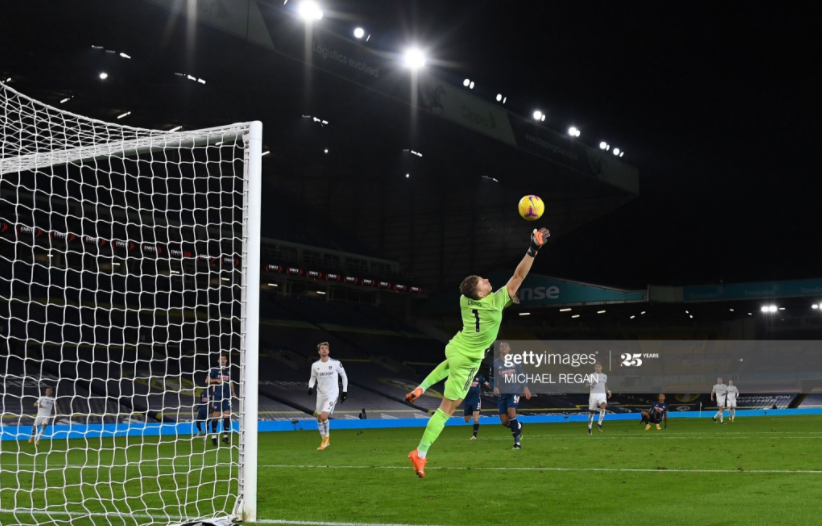
Immediately afterwards Saka-Tierney-Aubameyang put together a crisp passing counter-attacking move that ended up with a tame shot from our captain. But Leeds was now dominating possession much more and overloading both flanks. Leno produced a superlative save around 63rd minute, punching away a fierce shot headed towards his top right corner. We managed another promising counter-attack when Saka’s cross was headed clear. On 75th minute Xhaka stepped up to take a free-kick from outside the penalty box and his effort didn’t dip and bend enough to trouble the keeper. In between Leeds continue to pour forward, and hit the post once, but other than that didn’t trouble our defense too much as Gabriel, Holding and Xhaka dropping deep stood firm. There were stretches of the game when we were playing two defensive lines of 5-and-3 with just a few meters between them, only Auba somewhat listlessly floating around and hoping for a counter-attack.
Maybe I was just imagining it but it felt like the team is more comfortable defending deep and in numbers and then launching rapid counter-attacks than when they need to take the initiative and force the issue. After going down to ten men and having to reshape the formation and the positioning, the team played with a greater tactical assurance.
We did put together a couple of more sharp counter-attacks and on another day either of those could have ended with a goal. First, the Saka-Auba combination down the left led to Auba’s shot hitting the arms of a Leeds defender who was already on the floor. The VAR decided not a penalty. But isn’t the letter of the law now that any handball in the penalty box is a penalty? Maybe there is a fine print in the complex and everchanging legalities of handball rules that I have missed.
And then the best move of the match came on 80th minute when Bellerin made a wonderful through-pass bypassing all of Leeds midfield to set Saka up 1-on-1 with the Leeds keeper. Instead of taking a first time shot on either side of the keeper or loft it over his head Saka tried to move around the keeper to find him with an empty net but the keeper recovered swiftly and made an excellent save. It was a movement of pure brilliance, all the more memorable as our current Arsenal incarnation has been so bereft of moments like that.
A few minutes later Leno made yet another good save. Around 86th minute Bamford’s header after beating Leno found the post. As the game approached the 90th minute five extra minutes were added. Within that injury time Saka suffered a knock and was replaced by Maitland-Niles. Leeds again hit the bar around 94th minute, but the game then ended as they were getting ready to take another corner.
A clean sheet, and an away draw at Leeds with playing nearly half of the match with ten men is not the worst result. We do have Bernd Leno to thank, and also his best friend the goalpost. But while the result was acceptable the first half performance with eleven players on the field was not entirely so. The team is missing both cohesiveness and inspiration in attack, though the defense has come in leaps and bounds since the troubled days last year (around this time last season our defense had more or less disintegrated). We all have our theories about how best to revive our attacking verve, but at this time of his tenure and at such a crucial juncture of Arsenal’s season, our young manager needs all our support and maybe also a bit of patience. I myself am convinced that he will turn this around, will do so sooner than later, but he and the entire team are now under a bit of pressure – as they should be — to start moving up the league table.
And so, our weary warriors trudge from a massacre at the hands of the Villans to the site of epic battles in our distant past. Can our leader revive their tattered morale? Can he restore the vestigial signs of defensive organisation and midfield drive that we saw at the Old Toilet and raised our hopes only for them to be cruelly dashed by a Villa team playing with verve, drive and style? Can he find a creative spark and a fox in the box within the depleted squad?
We carry many scars from previous meetings with Leeds United that didn’t make the cut in TTG’s excellent last post. We need not go back to the battles with Revie’s Dirty Leeds whose players could have served as models for Tolkein’s orcs. The sharp practices of Bremner, Giles, Charlton, Hunter et al achieved such depths of infamy that they permanently colour any view of the Yorkshire team. However, we have more recent scars from encounters with this opponent.
In May 1999 we looked a good bet to retain our Premier League Title but our hopes were cruelly obliterated at Elland Road by David O’Leary’s Leeds. A familiar story unfolded as the champions squandered many chances (‘twould actually be a fine thing to make many chances again, methinks!) only to be suckered by a Hasselbaink goal 5 minutes from time, losing 0-1 to allow Manure to win their ‘famous treble’. That scar has never healed.
In May 2003, dreaming of creating history by retaining the Double, we hosted Peter Reid’s struggling Leeds team at Highbury with three games to play. All season long we had looked odds-on to retain the Premiership trophy, standing 8 points clear on 2 March. A hapless defence missing Lauren and Campbell conspired to dash our ambitions and an 88thminute goal from Viduka consigned us to a 2-3 defeat, ended all hope of a back-to-back double and preserved Leeds’ Premiership status. Another deep unhealed scar.
In 2003-4 we took revenge at Elland Road winning 4-1 in both League and FA Cup and 5-0 at Highbury to condemn them to the relegation from which they have only now emerged. The latter was a masterful display with 4 goals from Thierry Henry after a Robert Pires opener. I well remember after the Highbury game meeting an extremely disconsolate Leeds fan on the platform at Arsenal Tube Station. He was beside himself with grief and observed that as Leeds were relegated his hopes that Manure would never win the Premiership again rested with the Arsenal. I reassured him that our lads would do their level best but I wish Hasselbaink and Viduka had shared his sentiments in previous years.
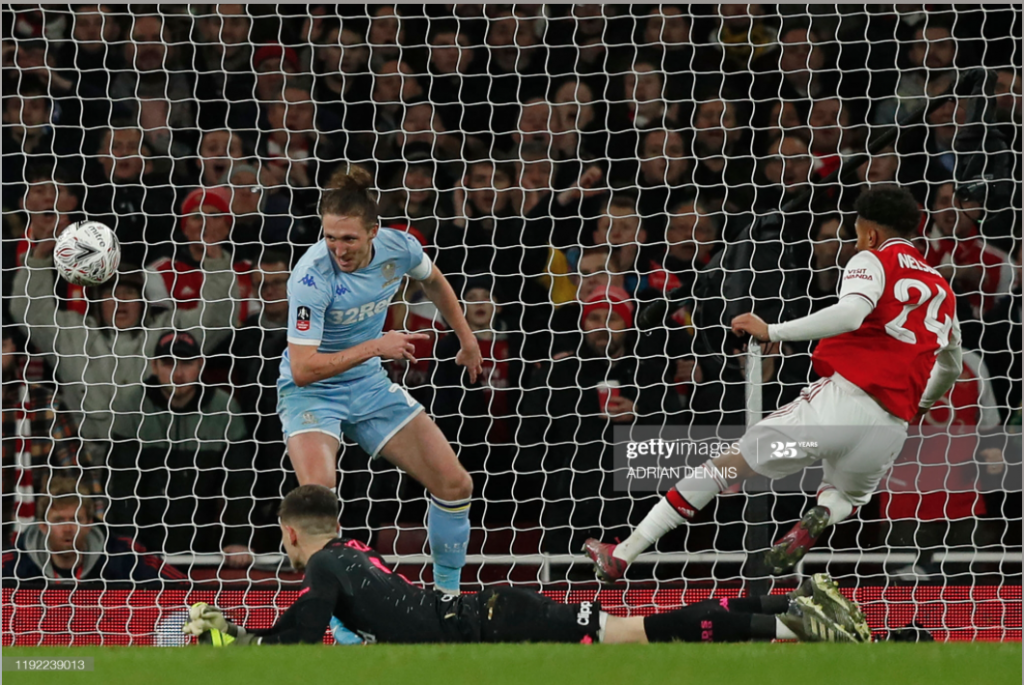
In the intervening period we have met Leeds three times in the FA Cup Third Round, beating them 3-1 at Elland Road after a 1-1 draw at the Emirates in 2011 and winning 1-0 at the Emirates in 2012 with a goal from a New York Red Bulls loan player who seemed very familiar. In our most recent meeting in January we beat them 1-0 at our place through a second half Reiss Nelson goal. However, in the first half Leeds ran rings round us with their high intensity, aggressively pressing game. They had 63% possession and 15 attempts on goal in that first half but fortunately lacked a cutting edge. We could easily have been 0-2 down at half time but MA8 read the riot act in the dressing room and a reorganised and refocused Arsenal team carried the day. Mikel said later that he had warned the players what to expect but post-match Nelson admitted that Leeds’ intensity surprised them! Forewarned is forearmed this time, I hope.
The enigmatic, highly regarded Marcelo Bielsa swiftly revived Leeds’ fortunes on his arrival as head coach in 2018. In his first season Leeds remained in the Championship’s top two until running out of steam late on, losing in the play-off semi-final. In his second season they again stayed in the top two for most of the season and finished 10 points clear to gain promotion as Champions. In the Premiership Leeds have been exhilarating to watch with several high scoring games. On the opening day of the season they lost 4-3 with a brave display at Anfield, reversing that score-line with a home win against Fulham before a 1-0 away win at Sheffield United and a 1-1 home draw against Shitteh. Then a narrow 1-0 home defeat by Wolves preceded a striking 3-0 away win at Villa. However, Leeds come into our game on the back of a pair of 4-1 defeats, at home to Lesta and undeservedly away at Palace.
Without the ball, Bielsa’s Leeds teams line up in a 4-1-4-1 formation with an aggressive press as their key tactic. On losing possession every Leeds outfielder presses aggressively aiming for one of two outcomes: (1) to regain possession within seconds and mount a high-paced counter-attack using swift interplay or (2) to force opponents to play a long ball upfield to be hoovered up by their big centre-backs because the effective midfield press blocks all other out-ball options. In possession, Leeds players transition to a 3-3-1-3 with the full-backs bombing forward to provide width in midfield with Phillips dropping back centrally to form a secure back three. Meanwhile one of the two central midfielders moves forward between the lines to create scoring opportunities while the other drops back to provide cover between the full backs. As the attack moves forward the two wingers move inside to add to the creative midfielder’s options. Their build-up is based on short passes between players progressing through diamonds up the pitch ending in the opposition penalty area with the advanced midfielder, the ‘wingers’ and Bamford. This summarises an excellent and more detailed analysis of Bielsa’s 2019/20 Championship tactics by Sachin Prabhu Ram (https://eflanalysis.com/analysis/marcelo-bielsa-at-leeds-united-201920-tactical-analysis-tactics).
The Leeds team we face on Sunday will largely be the one that ran us ragged for 45 minutes in January. Their key deep-lying midfielder Phillips, now an England international, has been out for several weeks with a shoulder injury but is returning earlier than expected. Left winger/wing back Alioski is a doubt having returned early with a tight hamstring following exertions for North Macedonia but I expect him to be fit. Bamford is their main goal threat with 7 Premiership goals in 8 PL games this season, a significant improvement on his respectable career average of a goal every other game. He will probably be flanked by Costa (2 goals, 2 assists) and Harrison (1 goal, 2 assists) as wide attackers. Leeds’ captain is Luke Ayling, formerly a youth team captain of this parish and a dynamic right back whose play epitomises the Bielsa project. Luke will certainly be up for this match! He is matched on the left flank by Dallas (1 Goal). Their high energy roles and augmentation of the midfield and attack are key to Bielsa’s strategy. As are the roles of the mobile and intelligent central midfielders, usually Klich (2 goals, 3 assists) and Hernandez though the latter is apparently a doubt and will probably be replaced by Roberts or perhaps Raphina.
The Arsenal
The Arsenal come into this game without scoring a goal from open play for over six hours and despite a handful of missed chances, we display an abiding lethargy and creative drought. Despite an encouraging first half against Lesta and a rare display of midfield drive and domination against Manure, we produced the most lacklustre display of the Arteta era against Villa. In 8 PL games, we have averaged just 1.12 goals per game so it’s no surprise that we are in the bottom half of the table. The reason for this is not rocket-science. Last season’s top scorer has taken just 10 PL shots and is playing further left than Magic Grandpa while last season’s second top scorer has made only a single PL start. Meanwhile, our new playmaker/winger who has started ahead of him has taken as many shots as our new centre half.
Our team selection will certainly be affected by Interlull events. Two players are certainly out of contention. Elneny has had two positive tests for coronavirus and is quarantined in Cairo. Less damagingly, Kolasinac tested positive with the Bosnian team and has also entered quarantine. Willian has been gadding about in Dubai, and was barred from training, subject to the result of a coronavirus test which I presume was negative. KT3 has played 3 full games plus an extra 30 minutes in 7 days and Saka has played 2 and a half games over the same period. Meanwhile, Auba merely played twice but spent an overnight on the floor of an airport in Gabon. Gabriel and Pepe played virtually two full games and Xhaka played a game and a half. At the time of writing, I have seen no reports of further coronavirus tests or injuries but there are certainly going to be weary limbs and tired minds down our left flank! Much more seriously, Thomas Partey’s thigh strain sustained in the Villa match, has not recovered sufficiently for involvement in this match. That is a major blow.
I had hoped that MA8 had seen enough creative malaise and had resolved to amend it by changing the pattern of play going forward. There is little doubt, despite the three goals shipped against Villa, that he has improved our defensive organisation and individual performances. Gabriel has further stiffened the defence. I hoped it was time to shake-up the midfield and attack. In his pre-match presser, MA8 observed that although the Villa game “left a really bad taste”, he added that “after a bad result to change everything you do” is “a really bad temptation because a lot of things are working and it’s really clear the things we want to improve on and how we’re going to”. That sounds more like a tweak than a shake-up.
The possibility that the focus on improving the defence has contributed to the decline in our attacking potency has been debated at length in other fora. The third centre back stiffens the back line at the cost of a third midfielder. Unless you ask your centre forward to drift so far back that he is effectively the third midfielder meaning he is rarely in the box to finish an attack (!). Ultimately, we need two trustworthy centre backs screened by an energetic, defensively smart, deep lying midfielder to allow the other two midfielders freedom to join the attack. I think we should give Aubameyang the central attacker role rather than confine him to the left-wing pinging in crosses which he himself should be finishing. I would advance Saka to the left attacking position and start our ‘wild-card’ Pepe, (and give him the ball) because of the threat he poses when he gets an opportunity. Had we had Partey available, I would have started Joe Willock as the third midfielder because of his ability to get between the lines, join the attack and score goals but in Partey’s absence, I think we should add Luiz’s defensive nous and creative passing range as a deep-lying third midfielder between Ceballos and Xhaka. We need a third midfielder against Bielsa’s Leeds and Luiz can drop back into a back three as necessary. Hence my selection plays 4-3-3:
Leno
Bellerin, Holding, Gabriel, Tierney
Ceballos, Luiz, Xhaka
Pepe, Aubameyang, Saka
I am certain that this is not the team that MA8 will start as I expect him to stick with 3-4-3. Of course, he can do that with the above selection simply by dropping Saka back to left wing back and replacing Luiz with Nelson in the left attacking slot but I think MA8 will keep Auba wide left and start Laca centrally. He will also almost certainly choose Willian over Pepe. An absence of major changes is understandable as his key players left after the Villa game and only returned on Thursday, allowing him just three training sessions with his full squad. I suspect tired legs and the absence of the successful OT midfield pairing of Partey and Elneny will see him be very conservative. Willock, Nelson, AMN and Nketiah will start on the bench to provide energy in the second half. I expect MA8 to approach this game the way he approached Manure at OT though we will have to work harder to deal with the intensity of the Leeds press and I fear for the inevitable midfield pair of Xhaka and Ceballos against Leeds’ mobile midfield and attack. Despite the time pressures, I hope MA8 does manage to make clear to his players the improvements that he says he knows are required and that he can transform Arsenal into an effective attacking force again.
The Holic Pound
The value bet is 20/1 on a 3-2 victory for the Arsenal. However, our recent inability to create scoring chances or even take shots, let alone score goals, leads me to believe that such an outcome is unlikely. I really cannot see us scoring three goals even though Villa and even lowly Fulham managed to do just that at Elland Road. Despite improved defensive performances this season the Arsenal still don’t keep clean sheets very often, otherwise I would have plumped for a good old 1-0 to the Arsenal at 17/2. Thus, I’m going to have to push the boat out on us scoring twice (!) with 2-1 to the Arsenal at the shorter odds of 15/2.
Fingers and everything else crossed. We need a win. However, I think a point from Elland Road would be a good outcome given the circumstances. The first goal is going to be vital.
Defeats that struck deep at our hearts …but were far from terminal
The desperate feeling that we all felt as we were taken apart in the second half against Aston Villa is a relatively rare feeling for an Arsenal fan but from time to time we experience a defeat that is so important or profound that at the time it feels like the world is caving in. This has happened to Arsenal teams down the ages, some of them extremely good teams and when the defeats occur it is easy to feel a season is likely to end in massive disappointment.
Some defeats are epically disappointing. The two most cataclysmic for me, in emotional terms were the 1969 League Cup Final against Swindon Town and the 2006 Champions League Final v Barcelona. That they occurred in finals accentuated the pain. At the closing whistle the contrast between the rejoicing opposition fans and us was stark and painful. A long journey home is always far more daunting with a massive defeat to contemplate.
But
defeats can also be watersheds and can provoke responses that
transform a seemingly hopeless situation and underline the character
of a side. I shall touch on three such moments that prove there truly
is darkness before the dawn.
First let us flip back to May 1989. There are three matches to go in our season and after enjoying a massive lead in the title race, the Hillsborough tragedy caused a delay in the season. We watched as agonisingly Liverpool clawed back our lead. At kick off time we were two points ahead of Liverpool with a marginally better goal difference? Our opponents were Derby and we were confidently expected to beat them. I remember a girl in our office asking if she could attend the game with me because her new boyfriend was a Gooner and she wanted to surprise him with her knowledge of the team. The real reason was that I was clearly irresistible to women but I remember being deeply irritated by her constant questioning as Arsenal stuttered unconvincingly and missed a slew of easy chances. Never mind – news came through that Liverpool were losing at Wimbledon. Midway through the half, against the run of play, Dean Saunders lashed a half-volley past Seaman and in off the bar. Liverpool turned the score around against the Crazy Gang and as the second half wore on a clumsy challenge on Saunders by Tony Adams in a Derby breakaway resulted in a clear penalty which Saunders dispatched comfortably. A very late Alan Smith goal was not enough to bring us back meaningfully into the game. A few days later we entertained the Crazy Gang. Despite leading twice through a Winterburn right-footed screamer (honestly!) and a Merson close-range effort we were pegged back twice . Liverpool’s five goal victory against the spineless Hammers left us needing to win by two goals at Anfield. A completely impossible task… the rest is history!
Moving on eight years we had entered the Wenger era. The 1997-8 season had begun very promisingly but two recent defeats had seen us slip seriously behind Manchester United. We welcomed Blackburn Rovers to Highbury and the game began well with Overmars seizing on a long lobbed pass and dinking it past Flowers in the Blackburn goal. It is salutary to think that we fielded our legendary back four but in the second half we fell apart as we allowed Blackburn back into the match. Firstly Wilcox volleyed the equaliser and then Kevin Gallacher swept a bouncing ball past Seaman into the top corner. As we pushed up for an equaliser the loathsome Tim Sherwood (looking several yards offside) found himself clear of the Arsenal defence and beat Seaman at the second attempt. The reaction from the Arsenal fans was vitriolic. Several around me talked of another season written off (in November) and outside the main entrance in Avenell Road a distressed Ian Wright berated the critical fans.
The defeat prompted a heated team meeting in which Tony Adams (who had a very flawed game rather like the Derby performance) called out his two French midfielders for not protecting the defence more. It is interesting that we tend to think of those players as infallible but there were periods in their Arsenal careers where the wheels seemingly came off. Arsenal did not lose another game in the League that season until the title was secured and for good measure completed the League and Cup double. Might a defeat that comprehensive have been a blessing in disguise? On Easter Monday in the return fixture, (played in snow for long periods!) we were 4-0 up at half-time and ran out 4-1 winners.
Defeats can definitely represent watersheds in a season.
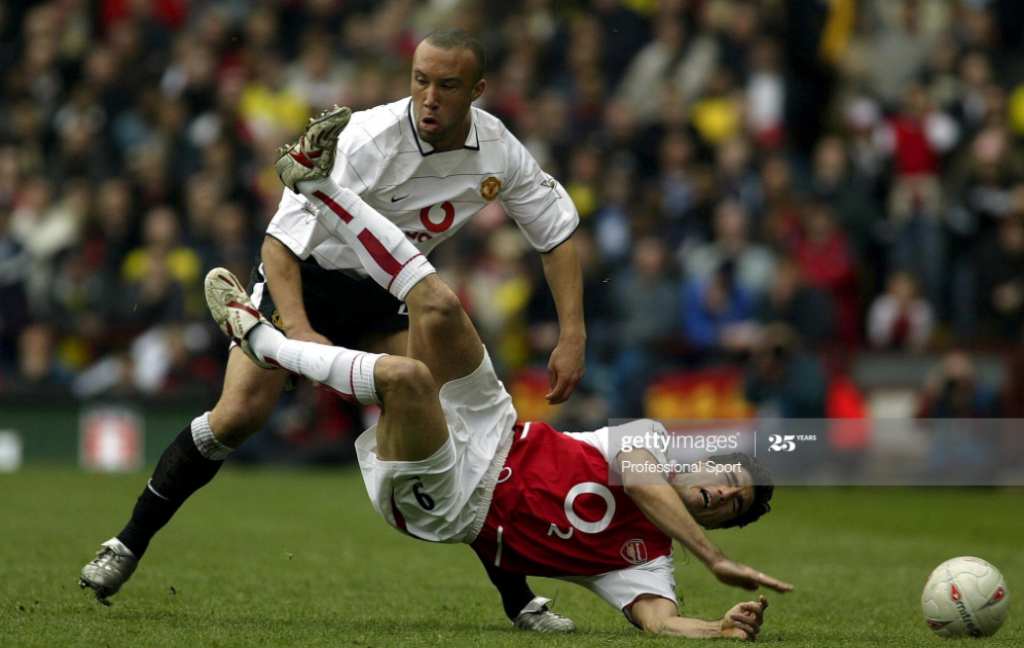
Just to prove that even the best teams can slip to defeat my final example is in the marvellous Invincible season. We sailed on serenely until March in all three competitions. Chelsea were still within reach of us in the League but we had already prevailed over them three times that season. Fate decreed that we should play them again in the Champions League, four days after an FA Cup semi-Final against United. Arsene has subsequently said that he needed to rotate more given the size of the stakes facing us in that week. A traditional Nemesis, Paul Scholes, scored the only goal of a semi-final in which United employed the tactics that they employed to combat us during that period by trying to kick us off the pitch. We didn’t bring Henry on until late in the second half but on a frustrating afternoon, the chance of a domestic double had gone.
Credit: Professional Sport / Contributor
But we still had the Champions League. As we prepared for the second leg we were drawing 1-1 after the game at Stamford Bridge where a rare Pires header had given us the crucial advantage of an away goal. After a first half in which we were well on top, Reyes scored just before half-time to put us ahead on aggregate. Surely this was to be our year? We reckoned without a rare handling error by Mad Jens who palmed a Makalele shot (as unlikely as a Pires header!) to Fat Frank Lampard who tied the score up. Anxiety grew as even the Invincibles failed to take control of the game and then with about ten minutes left Wayne Bridge proving a cruel and unlikely assassin, latched onto a pass in the inside left channel and slotted home. I think that was one of the cruellest goals I have ever seen Arsenal concede as that team would have faced a very beatable Monaco and then Mourinho’s Porto in the final, if we had prevailed over a team we used to beat for fun at that time. That team carry one wonderful title as ‘the Invincibles’ but nothing will persuade me that we weren’t the best team in Europe that season and that was our time.
Three days later, on Good Friday, we met Liverpool in the Premier League at Highbury. We trailed twice and were losing at the interval but a fine second-half rally illuminated by one of Henry’s finest ever individual goals saw us run out convincing 4-2 winners. That win assured us of a title which we clinched, to our delight, at the Swamp a couple of weeks later.
Is there a moral in this story? I think there is. Even fine sides – and these three sides were among the finest Arsenal have ever had, are human. Great defenders make mistakes and fans lose heart and belief. But fine sides and talented managers react in the right way and we need to have faith that while we may not see league titles from this current Arsenal side they will improve and be ready to challenge in the future. The darkest time really often is before the dawn.
A guilty secret – I have to start by owning up to watching the whole of the Amazon Prime series, All or Nothing, about Tottenham Hotspur. I was, of course, expecting it to be a whole load of Nothing, and given the subject matter and the terms of the series title, it was.
Like everything to do with Jose Mourinho, who was about to enter the fray at the dark end of the Seven Sisters Road, the series was really All about Mourinho. In reality, what else was there to talk about at a club that has a Cheese Room instead of a Trophy Room and whose main current boast seems to be the longest catering counter in the world, next to its own brewery? Mourinho proved himself, once again, to be a miserable, four letter word spewing, dinosaur of a coach, whose most urgent instruction to his players was, when on the pitch, to “be nasty C u next Tuesdays”, (just in case any minors are reading).
Anyway, we all know more than enough about Jose Mourinho. The point is, I had enjoyed a lot of pleasure from watching more acrimony, chucking under the bus and ultimate failure at the Totts, and was drawn to another Amazon football series, this time featuring Borussia Dortmund, which I began watching straight away.
The difference was immediate and stark. The Head Coach of Borussia Dortmund is a man called Lucien Favre – an apparently quietly spoken, intelligent man who seems to foster a trusting relationship with his players, rather than the snide suspicion engendered by Mourinho. The atmosphere in the changing room seemed to be one of friendliness, the players looked relaxed and smiled and laughed a lot amongst one another and the staff.
In contrast, the Tottenham dressing room was quiet, glances were cast sideways, blame was directed from one to another, just as it is always Mourinho’s way to point the finger at someone for every failing. Mourinho demands from individuals, then threatens, omits and ignores players who can’t deliver what he wants. There always seemed to be a player in the manager’s office demanding to know why he wasn’t in the team, or being dressed down for his latest shortcomings. His way is to buy big and his teams seem to be collections of individuals.
Favre has a different way. For him the team is vital, at the heart of everything. Then comes “running”. He says that before you worry about the mental fitness to play at the highest level, you must first have one other thing – running. If you can’t run and don’t have physical fitness, mental fitness is useless, if not impossible. He also says that it doesn’t matter how gifted players are if there is no “team – you have to really build a team”. That will come as no surprise to us, after 22 years of Arsene Wenger and now the similarly inspired Mikel Arteta.
These comparisons led me to wonder how football compared in wider terms between England and Germany. If these two randomly chosen clubs appeared so different in the way they operated, were there other cultural or organisational differences between the two leagues?
I may be only just in time, as there are now moves afoot to either radically change the organisation of the top European Leagues, or add a Super League to what we already have, possibly in place of the Champions League.
THE CLUB OWNERS
It’s not really a surprise that multi-billionaire owners from America, Russia, Arab states and the Far East are now looking to take their product of European football to their own huge home audiences at far more conducive kick off times than European countries currently offer. They will also be able to offer glamorous top-quality opposition for their clubs every week, rather than the harder sell of Burnley or Sheffield United on the infamous wet, freezing Tuesday night in November. Clubs would presumably either leave their domestic leagues or expand their squads as they prioritise the big money on offer in the Super League and still try to operate a team in their home competition.
In either case it’s hard to imagine that the quality of the domestic leagues will not be seriously diluted unless someone comes to their senses, as far as most fans are concerned, and throws the idea out. It does, however, bring us to the subject of club ownership, for which purpose let’s return to the comparisons between England and Germany.
In Germany, in order to obtain a license to compete in the Bundesliga, a club must abide by the 50+1 rule. The 50+1 Regel is an informal term used to refer to a clause in the regulations of the Deutsche Fussball-Liga which states that a club must hold a majority of its own voting rights.
For example, who owns Bayern Munich? The club is majorly run by spin-off company FC Bayern München AG which accounts for a 75% stake in the club. There are then three other companies who share the remaining 25% stake equally. Sports manufacturer Adidas, car company Audi and the Allianz insurance group each own an 8.33% stake in Bayern Munich. Day to day operations and workings of the club are controlled by the football club board directors. Interestingly, in November 2019 the legendary Uli Hoeness was replaced as club chairman by Herbert Hainer who until then had been CEO of club sponsor Adidas Group. It’s almost like there was a succession plan!
The chairman of the football club at Bayern, however, represents the club members, of which there are some 293,000, who all pay an annual membership of between €60.00 for a full adult member, to €30.00 for children u17, senior citizens and disabled members, while young adults aged 18-25 pay €40.00. Assuming equal proportions at each level that would raise €13,000,000 per season in fees before match tickets are taken into account. In addition, the club runs its own subscription TV channel, FC Bayern TV Plus for €4.00 per month or €36.00 per 12 months.
Their commercial department is clearly knocking spots off our own. In terms of revenue, Bayern is the largest sports club in Germany and the fourth highest earning football club in the world, generating an estimated €660.1 million in 2020. In the 2018-19 season they reported revenue of €750.4 million and an operating profit of €146.1 million. That was Bayern’s 27th consecutive year in profit. The club runs other departments for a variety of sports including handball, basketball, gymnastics, bowling, table tennis and a senior football section with over 1,100 members. At the end of the 2019-20 season, Bayern was ranked 1st in the UEFA club coefficient rankings.
This is not supposed to be a Bayern Munich love in, but compare and contrast with what has happened at the Arsenal since moving to the Emirates Stadium in 2006, which was supposed to propel us into the top five or six clubs in Europe. Our current UEFA ranking puts us in 10th place, due mainly to our record of continuous involvement and points accrued in the Champions League with Arsene Wenger – I don’t even want to think about where we would be if it was recalculated every year.
Bayern have achieved all this without an Arab sheikh, a Russian oligarch or a state financed investment company and with a fan base of comparable size to our own. When we moved to the new stadium there were reckoned to be 200,000+ fans with an interest in attending matches, including season ticket holders, silver and red members, people on waiting lists estimated to run for ten years, and would be “casuals” who would wait for general sale.
Our ownership, as we know, is now in the hands of a single shareholder and our executive management has lurched from Gazidis to Sanllehi and the influence of a couple of “super agents”. Between them, they have allowed our contract management to become a disaster, our squad to become badly unbalanced, ticket waiting lists have dwindled and our accounts have slid worryingly into the red. In fairness there have been recent signs of a determination not to let us continue the slide, with the signings of Tierney, Gabriel and Thomas Partey, and the re-signing of Aubameyang and Bukayo Saka. Overall, I have to say it makes me personally gaze with envy at the German model.
WHERE DOES THE MONEY GO?
One obvious place is to PLAYER SALARIES. In the current times of Covid-19 pandemic some players are lucky to get paid at all as clubs battle to stay afloat, while elite players are extremely lucky, as they continue to be paid sums that most of us can only dream of.
In Germany, in the 2019/20 season, Bayern were the highest payers with an average annual player salary of US$ 8.12 million, while Paderborn were the lowest paying Bundesliga club at US$ 0.42 million.
In England, Manchester City were the highest payers with an average annual salary of £6.99 million ($ 9.08m @1.30/£) and Newcastle were the lowest payers at £2.09 million ($ 2.72). Arsenal are fourth highest in the Premier League at £4.79million ($6.22m) average annual salary.
In terms of individuals, we have:
Bayern
Manuel Neuer (GK) $10m, Robert Lewandowski $20m, Coutinho $24m(!!)
Man City
Ederson (GK) $5.3m, Sergio Aguero $15.47m, de Bruyne $23.66m
Another area of obvious importance is TRANSFER INCOME AND EXPENDITURE.
Here the Premier League really flexes its muscles* / threatens to go bust* (*delete as appropriate) against its German counterpart.
The summer 2020 window went as follows:
Bundesliga
Departures 232 Total Income £292.7m Income Per Club £16.3m
Premier League
Departures 260 Total Income £399.2m Income Per Club £19.9m
Bundesliga
Arrivals 237 Total Spend £292.2m Spend Per Club £16.2m
PremierLeague
Arrivals 293 Total Spend £1,329.3m Spend Per Club £66.5m
Bundesliga
Total Balance £468,000 Balance Per Club £26,000
Premier League
Total Balance -£930,200,000 Balance Per Club -£46,500,000
This suggests either amazing coincidence or extremely tight collective management of funds in the German league and, to a financial incompetent like myself, the eventual suicide of many clubs in England. But we all want or need nice shiny new players, so how did Arsenal fare against the big spenders of the two countries?
(Last set of figures, I promise.)
Bayern Munich
Total Income £19.8m Total Exp £55.8m Total Balance -£36m
Arsenal FC
Total Income £16.8m Total Exp £77.4m Total Balance -£60.6m
Man City
Total Income £55.5m Total Exp £154.6m Total Balance -£99.1m
So, Arsenal sits right in the middle of the biggest German and English spenders, but it seems that at the top of the game in both countries, we’re all still in business at the whim of the banks and extremely rich individuals.
These levels of spending do of course have an effect on probably the most important issue of all to match going fans – the cost of attending matches, buying the latest shirts and TV subscriptions. Because of the ownership and control model of clubs in Germany, at least the cost of attending matches in the Bundesliga is much cheaper than attending matches in the English Premier League.
COST OF ATTENDING MATCHES
In Germany, SC Paderborn have taken the opportunity to cash in on their promotion to the top flight and, despite being the lowest payers in the Bundesliga, have the most expensive Standing Season Ticket at €225 / £202 (no, that is not a typo!) while Bayern Munich charge €219 / £197 per season.
All season tickets in the Bundesliga are cheaper than their English counterparts but getting your name on one can consequently be difficult. Last season, Bayern again sold out of their €145 / £130 season tickets and shifted every single ticket for their 17 away league fixtures.
Ok, swallow hard now folks. Arsenal have the most expensive season tickets in the Premier League, despite freezing prices for five seasons in a row, and actually reducing them when we dropped from the Champions League to the Europa League. The cheapest adult season ticket at the Emirates is £891 – £96 more expensive than the next highest price which is at Tottenham.
My own season ticket at the Emirates was in centre block, half way up the upper tier, right over the half way line where the players run out. A superb view but which cost a shade over £2,000 per season before reducing to around £1,750 when we dropped to the Europa. To take my daughter to one of our Barcelona CL home games, including a hot dog and a cup of tea, cost a combined £250+. Club Level at the Emirates is about twice as much.
England’s lowest payers, Newcastle United (our own SC Paderborn), charge £658 for their cheapest season ticket, while a season in East Stand, Category One will set you back £811. At Liverpool, the cheapest ticket is in the Kop at £685 and the dearest is in the Main Stand at £869.
It’s therefore much more affordable for families and younger fans to attend Bundesliga matches than the Premier League, which results in younger, noisier crowds and atmospheres than many matches here. Those atmospheres are also improved by the competitiveness of the league and the fact that standing is allowed in German stadia.
THE COMPETITION
The Bundesliga is made up of 18 teams, each therefore playing 34 matches per season. Their boast is that the league remains competitive throughout, maintaining fans’ excitement to the end. Bayern Munich are clearly the dominant side but what changes on a regular basis is the composition of their “top four”. Borussia Dortmund are always there or thereabouts and have been joined in recent seasons by RB Leipzig, fuelled by cash injections from Red Bull and driven by their highly rated head coach Julian Nagelsmann. Schalke and Bayer Leverkusen are regular challengers, with Freiburg and Hertha Berlin making advances and Borussia Monchengladbach improving under Marco Rose. Wolfsburg and Eintracht Frankfurt make up the top ten and they are quite capable as we found to our cost last season in the Europe League, losing 1-2 to them at home, having beaten them 3-0 on their own ground.
In England it is still rare for a new team to break into the top four or five positions in the league, which generally reflect the teams’ budgets. Perhaps the increased competitiveness across the German league is the result of their more controlled and similar spending patterns.
THE MANAGERS
Of the 18 managers in the Bundesliga, 14 are German.
Niko Kovac, the Croat who was in charge of Bayern until the end of last year, has now been replaced by Hansi Flick (yep ok, ‘Allo, ‘Allo fans!).
Lucien Favre at Dortmund is Swiss, Oliver Glasner at Wolfsburg is Austrian, Ante Covic at Hertha Berlin is Croatian, and Urs Fischer at Union Berlin is a Swiss who has taken the lesser known Berlin team into the top flight for the first time in their history.
That is clearly a very high proportion of indigenous managers, with no superstar names among the “imports”, and those brought in tend to come from the German speaking countries, Austria and Switzerland, although Lucien Favre is from the French speaking Saint-Barthèlemy area of Switzerland. This policy presumably helps with the development and integration of German youth players on which their teams rely so heavily.
I was slightly shocked to discover that in the Premier League, traditionally infamous for not giving British managers a chance, there are no less than 10 “home-grown” managers currently operating – at Villa, Brighton, Burnley, Chelsea, Palace, Fulham, Leicester, Newcastle, Sheffield United and West Ham. Only Chelsea amongst the usual top six – if you include Tottenham – employ a British manager – a count which improves by one if you replace the LWCs with Leicester and Brendan Rodgers.
WHAT REALLY MATTERS
When all the facts and figures are done though, the most important things in football to fans are not matters of the head, but most definitely of the heart – the emotions tied to your team, the rivalries, the memories – often from early childhood, glory days, suffering, the friendships cemented over years of supporting your club whether in England, Germany or from afar, as many of the readers here have proved.
As Super Leagues and the resulting travel, time and ticket costs threaten to soar for fans across Europe, there is a lesson to be learned which has been rammed home in no uncertain terms by the curse of the Covid-19 pandemic. It doesn’t matter how many hundreds of millions of pounds, euros, or dollars owners spend on trying to buy glory, security or even bigger broadcasting profits for themselves, without fans in the ground, elite football matches become mundane, echoey, uninspiring, glorified park kickabouts.
For the sake of their own investments, the game and especially the fans who have made it what it is, let’s hope the owners recognise that fact before they destroy the thing we all love so much.