Feed on
Posts
Comments
Credit: Professional Sport / Contributor

I’m sorry that this review comes so long after the publication of Arsene Wenger’s autobiography, not least because it has given time for some apparently genuine anticipation to build up. With matches coming twice a week, each calling for a preview and review, it has had to wait for an international break. It only occurred to me a day or two before the book came out, that I might conceivably have been able to get hold of an advance copy against a promise of a website review. Fortunately, by that time it would clearly have been pointless even to have made the attempt, so I was spared the embarrassment of a refusal. With luck, when Mikel comes to retire and publish his autobiography, this bar will be so well established that the publishers will approach us. We have, of course, already published extracts from the autobiography of Mikel’s successor.

Arsene’s autobiography starts with an account of the young Arsene Wenger growing up in Duttlenheim, a small village near Strasbourg. We learn a little of his early life, of his family and his early education in people skills as he watched the behaviour of men of the village in his parents’ bistro – “I listened to their conversations, I noticed which man talked loudest, which one lied, who was the conceited one and who the retiring one…”

The next chapter deals with Wenger’s playing career. Having been spotted by Max Hild, the opposing coach, Wenger joined Mutzig and then followed Hild first to Vauban and then to Strasbourg. Hild also noticed the latent coach in Wenger and offered him the position of Training Academy coach while he continued to play in the first team. Wenger’s playing career came to a sudden end when, aged around 30, the club president told him he was getting too old. This was as great a surprise to the rest of the team as it was to Wenger himself who watched in the next match as his erstwhile teammates outdid themselves, leading him to resolve to concentrate his full efforts to coaching.

Chapter 3 covers Wenger’s first couple of coaching jobs – a year at Cannes, then in Ligue 2, and three years at Nancy in Ligue 1. His job in Cannes was the first time that Wenger had left Alsace – there’s a nice story that he made his first signing en route to the South, when after arranging to meet the player in a motorway services, they played four-on-four and one-on-one games of football by way of audition. Life in Cannes was very different to north-eastern France and Wenger gained an insight into the feelings of a newly-transferred player struggling to come to terms with new team-mates not knowing anyone, in a new town. We also learn a little of Wenger’s beliefs regarding player development – learn technique between the ages of 7 and 12; develop physically from 12-16; mentally from 17-19 and gain intelligence and motivation between the ages of 19 and 22. He tells us that football “depends on three criteria: ball control, decision making and the quality of execution”. An illustration of Wenger’s understanding of finance (some might call it parsimony) comes in the shape of another story of him making the 1000 mile round-trip alone to a trade fair in Munich where he negotiated a good deal on 100 footballs for the club.

After Nancy, Wenger moved back to the south coast, this time to Monaco. Perhaps a description from chapter 4 of his relationship with the Monaco players tells us a little about what Wenger misses most from the old days: “It was possible for us to talk. They were not yet surrounded by lawyers, agents, advisors who are really family members, all those middlemen who would gradually get between a player and his coach”. There’s a nice story about George Weah, who was recommended to Wenger while he was playing in Cameroon. Wenger brought him to Monaco, where he was initially thought “hopeless” and “clumsy”. After a great deal of work and encouragement Weah went on to win the Balon d’Or in 1995. By now managing in Japan, Wenger happened to be in Milan for the ceremony and when he found out about this, Weah insisted he come along, vouching for him to the security staff when he arrived and tried to gain entry without a ticket. At the presentation, Weah had dragged his former manager on stage and given him his prize. Wenger says that he still speculates on what the security men must have thought as he left the building at the end of the night carrying the trophy.

Chapter 5 tells of Wenger’s time in Nagoya, where he came across players with a completely different cultural background. He tells us of their extraordinary commitment and how their trust in a manager’s infallibility would lead them to follow his instructions without question and to rely upon him to make all their decisions (even those in the middle of matches) for them. Wenger tried to re-educate the team to believe that his job was to train them to be able to take decisions for themselves – something he achieved fairly successfully to judge by the team’s rise from being the laughing stock of the J League (17 consecutive defeats) the season before he joined to finishing second in his second and last season. It was in Nagoya that Weneger and Boro Primorac (whom he had met at Cannes) formed their coaching partnership. They also shared living accommodation and the book includes a curious story (of which Wenger is apparently very fond) of a social evening the Primorac and Wenger families had enjoyed together, when Boro and Alphonse (Arsene’s father) spent most of the time deep in conversation. Afterwards, Wenger asked his father what they’d been talking about and received the reply, in effect, “No idea, I could hardly understand a word he was saying”. There’s a lot of interesting stuff in this chapter about Japanese culture – I liked the story about how Wenger saved his interpreter’s job – but this review is getting far too long.
Credit: Clive Mason / Staff

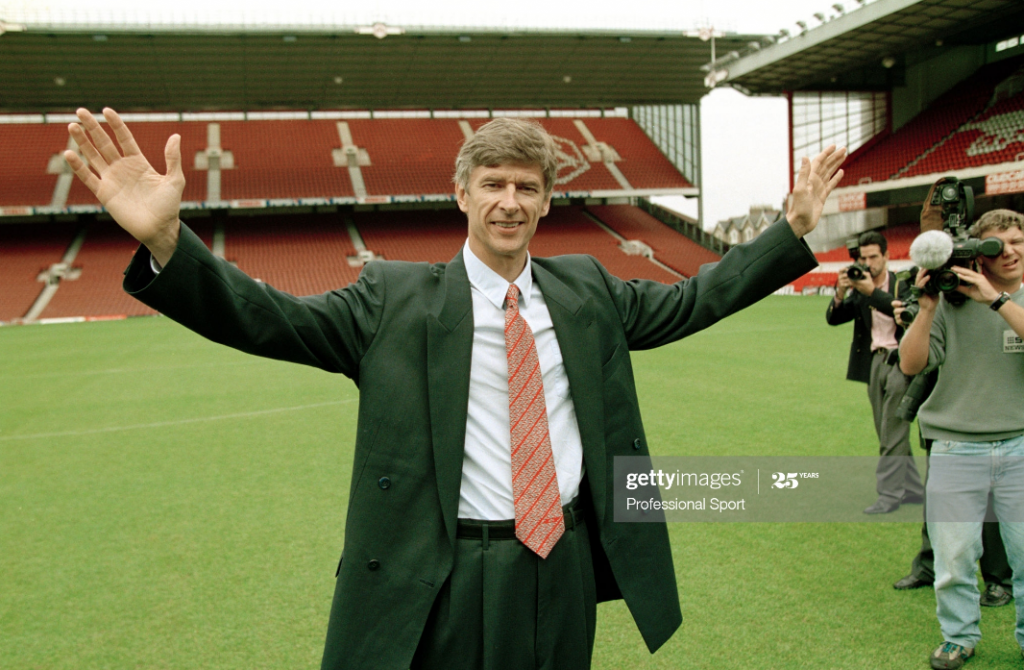
Chapter 6 marks the main event – Arsene Wenger’s arrival at Arsenal. There is a description of how the young Arsene had watched FA Cup Finals on a black-and-white TV growing up and had conceived an ambition to step onto the perfectly prepared Wembley pitch; of how he had flown to England one summer in his playing days to learn the language and had wandered around Cambridge knocking on doors in search of rooms to rent. By sheer luck, he ended up with a landlady who taught at a language school and got him enrolled on her course. After a description of Arsenal’s history and culture – well known to drinkers at this establishment – there’s a paragraph each on many of the players Wenger found at the club – Adams, Seaman, Berkamp, Wright and Keown – and descriptions of his first few acquisitions – Vieira, Petit and Garde. He follows up with a list of notable players that he brought in over the years – Ljungberg, Gilberto, Arshavin, Ramsey, Gallas, Sagna, Vermaelen, Walcott, Mertesacker, Fabianski, Clichy, Gibbs, Coquelin, Szczesny, Cygan, Senderos and Kanu. After an account of his first few, eventful and successful, seasons – the double in 97-98, the disappointment of 98-99 and that goal by Ryan Giggs, Wenger tells the story of the replayed FA Cup tie against Sheffield United in 1999 and the purchases of Henry, Wiltord and Pires. The chapter ends with the 2001-2 season, when Arsenal won the title without losing away, and the start of the quest to go one better by going through a season without losing at home either.

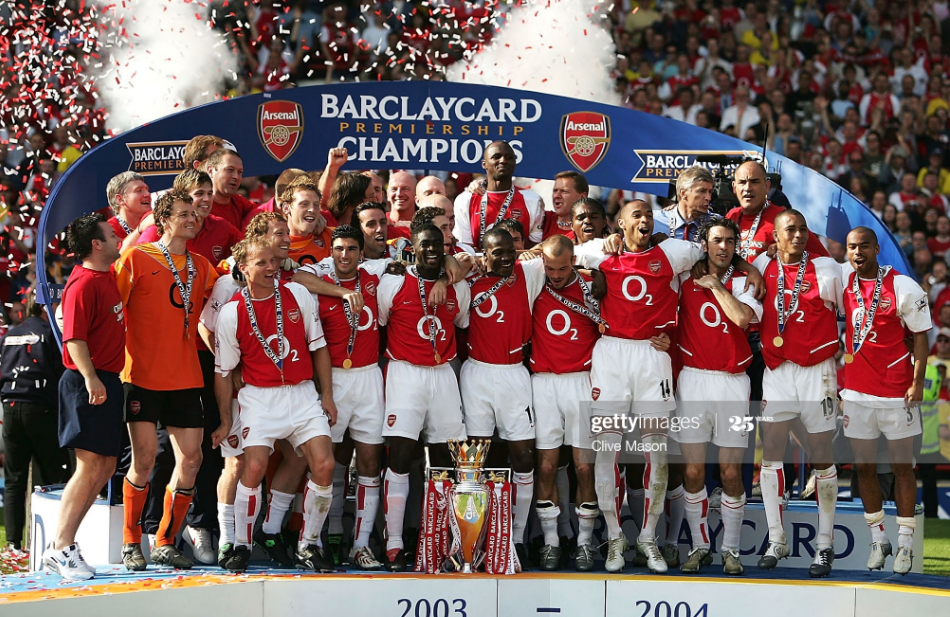
The achievement of that ambition is covered in chapter 7, which starts with brief appraisals of Campbell, Toure, Lauren, Cole and Lehmann. (The paragraph on Cole includes the sentence “It is one of the great regrets of my life that I lost him to Chelsea, thanks to a misunderstanding in the negotiations with his agent”.) There are no descriptions of any of the 49 matches which include the Invincible season – no comments on the circumstances surrounding Arsenal’s equalising penalty in the home match against Portsmouth, nothing about Thiery Henry’s individual excellence at home against Liverpool (just two of my own memories of 2003-4) – but there is much about the spirit of the team, how they “were solely focussed on the objective of playing very well during every match, swiftly correcting any individual faults, maintaining the level of our ambition”. There is a brief description of the away match against Manchester United that brought the run to an end before the chapter turns to an account of the press reaction to Arsenal’s team for the home match against Crystal Palace in February 2005 in which there were no English-born players, and a discussion of the role of foreign-born players in improving (or otherwise) the quality of English players in the years since then. The chapter ends with Arsenal’s FA Cup win in 2005, courtesy of Patrick Vieira’s last kick of a ball for the club.

Chapter 8 covers Arsenal’s move from Highbury to the new stadium finishing with a brief description of the 2006 Champions League final. Wenger describes how he always lost in “unbelievable circumstances” in the Champions League and says that the 2006 final hurts the most and he has never been able to watch it again.

Chapter 9 deals with a period when the organisation of the club and the game itself was changing and becoming more complex. Arsenal’s staff grew from 70-80 when Wenger arrived in 1996 to over 700 by the time he left in 2018. Television revenues increased from around £20 million to £180 million in the same period. Much of the chapter is devoted to a description of these changes and their effects of day-to-day life at the club. Hanging over everything were the loans that had been taken out in order to build the stadium. Among the conditions of these loans was an agreement that Arsenal would spend no more than half of their income on player salaries. With a hard limit in place on the wage bill, it became harder to compete when other clubs came knocking on the door trying to recruit our best players and so, with regret, Wenger had to part company with a number of well-known names, who left with more or less dignity, leaving corresponding good or bad memories behind them. While he was hugely disappointed to see young players leave – Wenger says it was as if “we were being cut down before the harvest” – he understood their desire to win trophies and how Arsenal’s lack of players with more ”maturity, experience and clear-headedness” was making it appear unlikely that they would be able to do so without moving on. (Perhaps Alan Hansen had a point after all?)

The final chapter is about Wenger’s life since leaving Arsenal and deals mainly with his new job as Head of Global Football Development at FIFA. He tells us that he sees FIFA’s roles as: organising competitions; being custodian the Laws of the game; and education, and that he sees his role principally as educational. He speaks briefly about his ambition to set up a research centre to develop teaching methods and ways to measure performance and his desire to focus on the development of young players.
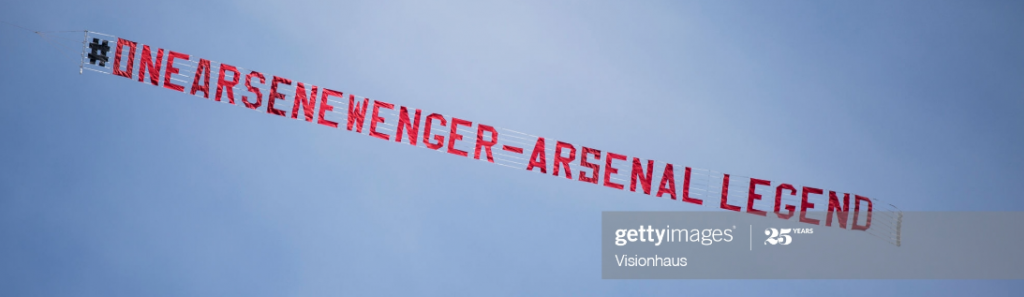
Credit: Visionhaus / Contributor

As a card-carrying fan of Arsene Wenger, I was surprised to discover after reading the book, that I had found it somewhat disappointing. I rather enjoyed the first few chapters as I knew little about his early years, but the chapters about his time at Arsenal contained little that was new to me. There’s a lot of interesting stuff about man-management and team building, but to be honest, nothing particularly new or startling. I hadn’t realised how much of a family man Arsene Wenger is – there’s a couple of pages of quite moving tribute to his daughter Lea in the middle of chapter 6.

I guess my disappointment should be directed as much toward myself as toward the book. Although it was silly to think that Wenger would be indiscreet, I had hoped to get some insight into some of the more controversial transfers of the post-Invincible era (think Gilberto, van Persie, Fabregas) but the only hint I spotted was the remark about Cole in chapter 7 that I mention above.

I would have been interested to know how things might have been organised differently in Wenger’s latter years to avoid some of the problems that became evident – maybe the lengthy description in chapter 9 of the way the game has changed might be an oblique admission that he had too much influence in the club, but there are many other statements of the importance Wenger attaches to a manager being involved in everything about a club.

I was reduced to trawling the book to find something that might have been emphasised more than I expected, or an omission that surprised me in search of enlightenment. I’m not the only one, I’ve read reports that the current Tottenham manager is devastated that he doesn’t get a mention. Never mind Jose, one day perhaps.

Perhaps the explanation of the unrest that marked the end of Wenger’s time at Arsenal is simply that as in politics, all football managers’ careers eventually end in failure. In a career as long as his, perhaps the sheer number of players you have disappointed, fans you have upset by selling their idols, journalists to whom you haven’t given decent quotes and opponents that you’ve beaten once too often just becomes too long.
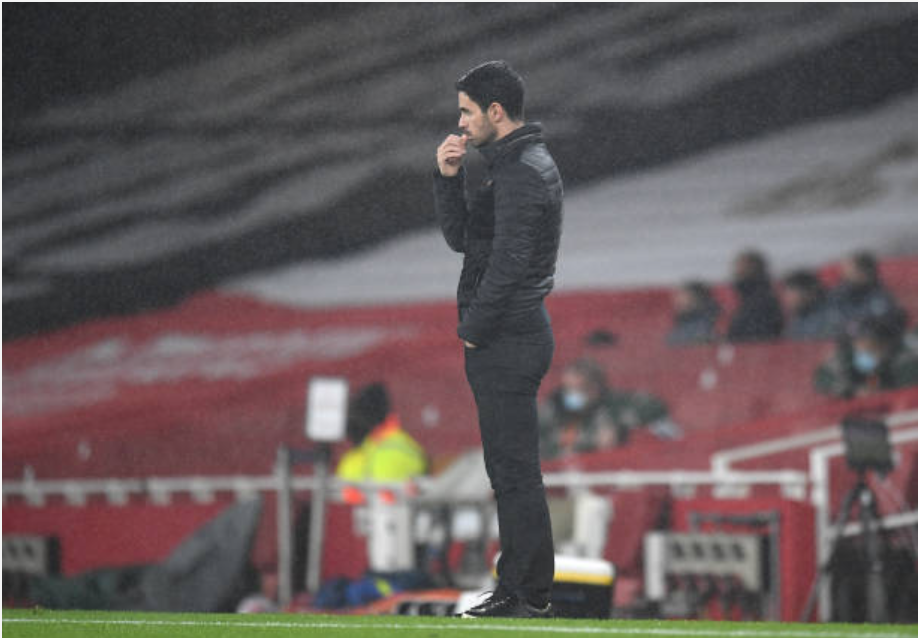
Food for thought? (c) Getty Images.

Last week we spent Sunday evening with a spring in our step after a gutsy, organised win at Old Trafford. Today would tell if we could maintain this momentum.

In the weird world we inhabit now with no fans, eccentric VAR decisions and a much less physical game which if today’s Sunday Times is to be believed, may see heading outlawed by 2040, it was a concern to learn that Villa had not conceded away from Villa Park this year. 

Arsenal went with a predictable team. Holding, Gabriel and Tierney were at the back, Elneny and Partey in midfield and two rather fortunate individuals, Willian and Lacazette joined Aubameyang upfront 

As I looked up at the start of the game, McGinn scored a cracker from a Grealish pullback within the first minute. It was then referred to VAR because Barkley was in Leno’s eyeline and leapt into the air in front of the goalkeeper. To our massive relief the goal was chalked off. Shades of Leicester??

Tierney then slipped to let in Watkins but his cross was overhit. In the early minutes I couldn’t help feeling that we were starting too slowly again. On 9 minutes, an under-hit pass by McGinn almost let in Partey who just failed to reach the ball before Emi Martinez. The greasy surface was tricky, holding the ball up at times and occasionally causing passes to skid on uncontrollably. But pitches in November when I started watching Arsenal were much trickier than this. 

Thirteen minutes in Partey won the ball in midfield and sent Aubameyang clear but Willian completely skied a presentable chance. Then on 17 minutes nice play down our left put in Saka but he mullered the cross. 

Grealish playing wide left was a real handful for Bellerin. What a signing he would have been for us! Aubameyang accelerated past three Villa players on the left and was brought down near the byline. The free kick was well-worked but Tierney scuffed his shot.

After 23 minutes the increasingly infuriating Willian gave a ball away in midfield sloppily and Villa worked it patiently around before cutting us apart with a through ball and cross from Targett which Saka turned in at the far post under pressure from Trezeguet. 

Arsenal 0 Villa 1 (Saka og, 25) 

Villa were good value for their lead. I would already have been inclined to remove Willian but Arteta has greater belief in him than me. Towards the half hour we finally got behind Villa twice and a great block by Konsa denied Tierney’s driven cross. That was better and importantly quicker but when Villa moved forward they looked much more dangerous. A fizzed corner screwed behind off an Arsenal foot. Our midfield, so impressive last week and good here sometimes in possession, was struggling to win enough ball to influence the game. Partey lost possession and Trezeguet’s shot was blocked by Bellerin. Then a great ball by McGinn found Grealish and Gabriel blocked the shot. 

Bellerin moved menacingly onto a Holding chip, rode two tackles but rather than pull the trigger he laid the ball back and the attack fizzled out. Willian clipped in a fine cross that wasn’t converted and then a fine build up with Saka and Aubameyang saw Emi frustrate us with a block and as the ball ran loose Partey hammered wide. Better and importantly, quicker. 

On 40 minutes a wonderful Tierney cross was disappointingly headed over by Lacazette. A huge chance and indicative of the poor form of the Frenchman at present. 

Watkins was impressing with his strength, control and movement and he engineered a situation that saw a desperate block by Elneny after McGinn turned dangerously. A graphic appeared before half time showing Lacazette had only 8 touches in the first half. It was little surprise!

The half ended in the same pouring rain in which it had begun and Arteta faced his fourth home game where we were not leading at half-time. 

Half – time Arsenal 0 Villa 1

Mrs TTG emerged during the interval to inform me the name of the departure from Strictly Come Dancing and commented that I had been quiet! She appreciates that this is not a good sign but neither does she like me yelling at the TV. She then commented that losing to Aston Villa was not impressive. That was a little unfair to a very well-drilled Villa side that Smith has improved significantly in the transfer window. 

Our first decision of the second half was to add Danny Ceballos to the mix. He replaced Partey who surely must have been injured during the first half. That didn’t appear a good omen or a productive substitution. 

Elneny lost an early ball to Grealish and Trezeguet fired in a shot which Leno touched wide. Willian then screwed hopelessly wide after Lacazette couldn’t gather an Aubameyang cross. The game was starting to  cry out for Willock. Then Willian wasted another cross-field ball, something Don Howe used to call, ‘a Hollywood ball’! There was little glitz about the performance so far. Saka was fouled on the edge of the box on 54 minutes. They worked the free-kick to Ceballos who curled wide. 

At the other end an impressive move down the Villa left between Barkley and Grealish saw Grealish force a terrific save from Leno. Grealish then had a volley blocked by Tierney but we were being outplayed. Arsenal’s ball movement was cautious and slow and invited pressure. This was an obvious indication that Arsenal lack leaders on the pitch and we also seemed to lack an effective right side defensively as Villa played through us at will. 

We had the respite of a corner on the hour and Gabriel played in Holding who fired wide. Heads were dropping on the Arsenal side, especially Saka and Lacazette. Substitutes were clearly required and Nketiah and Pepe arrived to replace Willian and Lacazette. Not before time! 

Immediately Elneny hit a Tierney cross straight at Nketiah. It was wide of the target though and this was becoming a major mental as well as tactical test for Arsenal. It looked like we were now playing a front two. On 68 minutes Pepe fizzed a shot just wide but his aggression was heartening. We were playing a bit more direct football and Nketiah was creating more problems than Lacazette had been.

But then Villa got their second with a fine move – a cross-field pass was turned across goal by Barkley for Watkins to head home from close range. 

Arsenal 0 Villa 2 (Watkins, 72)

Immediately after this Ceballos blocked a Grealish shot on the line. However, their third was not long delayed as Grealish played in Watkins on the right of our box and he finished clinically.

Arsenal 0 Villa 3 (Watkins, 75) 

It was becoming a complete humiliation, the sort of defeat that provokes a massive reaction from the people you only hear on the blog when things are going wrong. All the benefit of last week’s win at Old Trafford had evaporated. The defence was torn asunder but largely because Grealish and Barkley were running through them almost unimpeded in midfield.

Saka was brought down in the last minute but it scarcely occurred to anyone to appeal. 

Defeat of this sort is hard to take but it is part of the life of a supporter. Sadly, this will increase pressure on Arteta from a fan base that are becoming increasingly fickle. Villa are a substantial side but lost recently 3-0 to Leeds. Arsenal’s next opponents are … Leeds! 

We must retain faith in Arteta who has done much more right than wrong since he took over the club but the nature of this defeat and the reaction it will provoke will set him unenviable problems. Certainly, we are largely toothless despite fielding one of the best strikers in European football. Willian is currently not worthy of a place in the side and it is surely time for us to find a role for Joe Willock. Bellerin had an alarmingly bad evening defensively and few players could hold their heads high although Tierney, Ceballos and Gabriel were among our better performers albeit at a disappointingly low level.

Arteta’s first crisis arrives as we go into yet another Interlull. When he needs time to work with the players he will be denied it. Let us remember he is a fine and resilient coach but he has much to digest tonight 

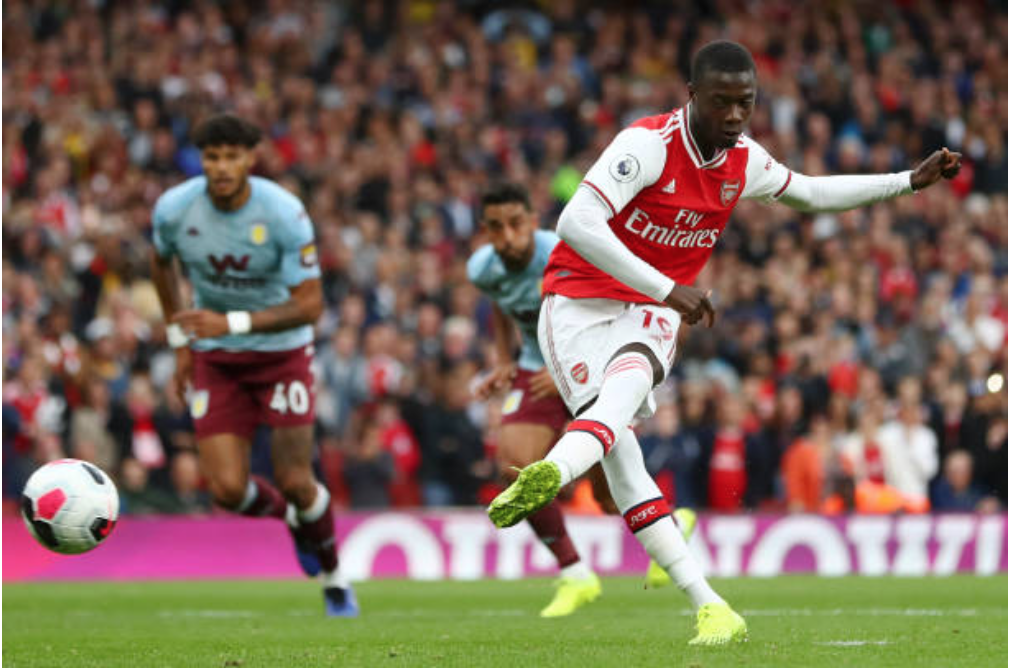
Nicolas Pepe converting his penalty against Aston Villa at the Grove, September 22, 2019 
©Michael Steele / Getty Images

The relentless cycle of Thursday/Sunday matches continues this Sunday evening as Arsenal host Aston Villa, a club that has made strides toward solidifying their Premier League status after they were almost relegated in July.  Coming into this game Villa are eighth in the table having played one fewer match than the ninth-placed Gunners, who trail them on goal difference.  The Birmingham side have scored 15 goals and conceded nine, nosing them ahead of Arsenal who have scored nine but boast a league low of seven goals conceded.

Arsenal approach the match looking to build on last week’s victory at Manchester United.  After four wins and three losses in their first seven league games, including a disappointing loss to Leicester in their last home fixture that featured Lacazette’s undeservedly disallowed first half goal, Arsenal need to grab the points from Villa to push the club into a more distinctly upward trajectory ahead of next week’s tough away fixture at Wolves, to be followed a week later by the season’s first North London Derby.  In other words, this match would be a good time to sharpen up whatever needs sharpening.

Opposition

Villa epitomise the craziness of this young Premier League season.  To say they have ridden a roller coaster would just about cover it.  They got off to a very fast start, winning their first four games including clean sheets against Sheffield United, Fulham and Leicester and a 7-2 drubbing of Liverpool; but their performances tailed off in the last two weeks in losses to Leeds and Southampton.  After using up a month’s worth of goals against Liverpool, Villa failed to score against Leeds and last week trailed 0-4 to Southampton before fighting back with three late goals only to lose by 3-4.  They have scaled the heights and sunk to the depths so it is a bit of a mystery which direction they may be headed this week, but at times they have looked like one of the better clubs in the league, so Mikel Arteta and his men had best pay close attention. The Villans made several significant acquisitions in the offseason.  The three highest impact signings have been ex-Arsenal goalkeeper Emiliano Martinez, who has kept three clean sheets and helped calmed the defence; ex-Nottingham Forest right-back Matty Cash who has started six games, and added mobility and another attacking option on that side; and ex-Brentford striker Ollie Watkins, a danger man who has contributed four goals and one assist in six outings.    

Arsenal XI

Arsenal are on a decent run of results, especially considering their undefeated record in Carabao Cup and Europa League games, but having lost three of seven league matches already they really need a result this week.  There are very few reasons not to expect Mikel Arteta to pick the same team that did the business last Sunday but I have a feeling he might start Pepe in place of Willian, who otherwise would be making his third start in seven days.  Arteta’s formation may be otherwise at the start, and it may change several times during the game, but here’s one way we could line up:

Leno

Bellerin, Holding, Gabriel, Tierney

Elneny, Partey, Saka

Pepe, Lacazette, Aubameyang

Goonerholics Pound

Seeing as the Villans are among the most prolific scoring clubs in the Premier League at the moment, it could be a stretch to predict another clean sheet despite Arsenal’s league best defensive record.  But a 2-1 score strikes me as a reasonable forecast considering the close proximity of the sides in the table, and 19/2 were the best odds I spotted for that score.  The best odds I found on Pierre Emerick Aubameyang to be the first scorer were 3/1, but (assuming he plays), Nicolas Pepe could be a decent punt at 7/1 if you are looking for more lucrative payoff potential.  Not that I put my own money on those or any other unsure bets, of course.

Enjoy the game wherever you are watching, ‘holics.  If Arsenal can score a couple of early goals it would be healthful not to have to watch from behind the sofa, so Come on You Gunners, we could use a sustained 90-minute performance to remember.  

Joe WIllock scores Arsenal's fourth
(c) Getty Images

Mikel Arteta made 9 changes from the team that triumphed at Old Trafford on Sunday. Only Bernd Leno and Willian survived as the Boss rotated his squad for a home Europa League game. The full team was:

Leno, Maitland-Niles, Mustafi, Luiz, Kolasinic, Willian, Xhaka, Ceballos, Pepe, Willock, Nketiah

Subs: Runarsson, Macey, Bellerin, Tierney, Gabriel, Saka, Lacazette, Aubamayang, Holding, Partey, Cedric, Elneny

Keen eyed Gooners immediately noted the lack of Reiss Nelson (to the chagrin of BtM) and Emile Smith-Rowe, who both proved to be injured and also the highly rated Balogun who made his debut last week against Dundalk in the same competition. No explanation was given for his absence. The team looked like a 3-4-3 with Xhaka at centre back and with wing backs, although as always we expected a fluid shift of formation through the game.

Arsenal started brightly in the first 10. The shape became apparent, with Pepe on the right, Willian on the left, Ceballos sitting in front of the back three and Willock buzzing around as a Ramseyesque 8/10 with licence to make runs into the box. During those first 10, Joe had fizzed across a wicked ball which Eddie just failed to connect with. A few minutes later Pepe put Eddie in with a good ball, but it was just cleared for a corner.

The game settled down. Molde looked accomplished in midfield and organised at the back. Arsenal were moving the ball a little slowly. Then on 21 minutes, for the second week running, a Leno clearance put us in trouble. This time it wasn’t “pissing about at the back” (©Bathgooner) but rather a long clearance downfield. Eddie was the target but he was comfortably outjumped by Molde’s giant centre half and the ball came back at us, seemingly much to our surprise. The Norwegians moved the ball quickly and found Ellingsen in acres of space on the right just outside our area. He hit it well and beat Leno on his right hand post. Leno looked slightly out of position and maybe could have done better.

21 mins Arsenal 0-1 Molde (Ellingsen)

We fought back well and attacked hard. Willian and Pepe swapped wings. Willian was getting in some crosses, unfortunately all too long. On 33 minutes Willock, comfortably our best player, ran into the box, beat his man and just failed with a cutback to Eddie. We were pressing much higher and the spaces were appearing. On 42 minutes, a lovely move saw Pepe jink twice before passing the ball to Eddie who put the ball in the net. Willock was side by side with him and the Linesman’s flag went up for offside. I can understand why the flag went up. Willock was offside, Eddie wasn’t, but the two players were very close and it wasn’t apparent who had actually scored. Slow motion replays showed that Willock wasn’t interfering with play and Eddie was onside but VAR is not being used in the EL Group stages. A shame because I think VAR would have given the goal.

As we went into added time at the half, we broke rapidly from a Molde corner. Xhaka slipped in Eddie on the right. He crossed to Willock, in the box again, and his pressure forced Haugen to put through his own net.

46 mins Arsenal 1-1 Molde (Haugen OG)

HT Arsenal 1-1 Molde

In the first half we were losing the ball more than the first team do and our final ball was not precise enough. We gave away a sloppy goal (albeit finished well) but after that we picked up our game, pressed higher and got a deserved equaliser.

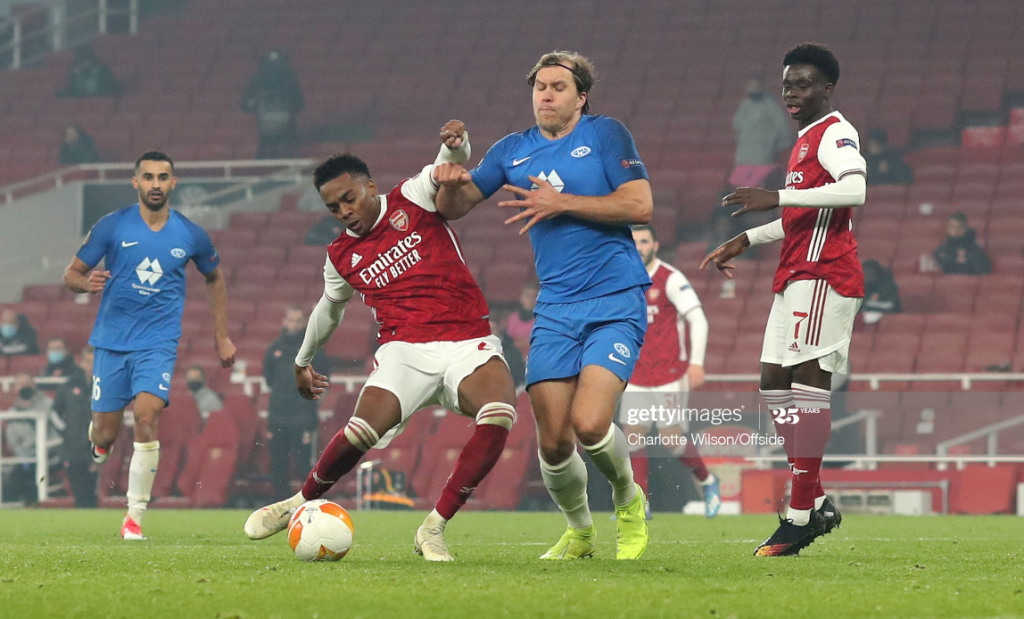
Arsenal made no changes at halftime but Molde changed their tactics and started pressing high and hard. A lovely ball from Xhaka (whose passing range was very much on show) put Kola in but he took a touch and got robbed. Another classy ball from Willian put Willock in but Luiz clumsily got in the way and it came to naught. On the side-line, Auba, Saka and Partey were warming up in the chilly North London air. Willock was put through wide on the right. His cross caused the goalkeeper to flap and the ball fell to Kola, four feet out with the goal at his mercy for a tap in. But he swung with his right foot and spooned the ball well over. Holy cow. Millions of Gooners all over the world were thinking “I could have scored that” – and they were right. An utterly shocking miss.

But we were dominating and making chances. David Luiz eased his man off the ball and, slightly harshly, was booked. Ceballos found Pepe on the edge of the area in space. Yet again he paused to try and switch to his left foot, allowing the defender to get a foot in. Am I becoming a cracked record on this?

On 62 minutes Willock played a one two with Xhaka who was now consistently playing further forward. Joe got to the by-line and stood it up for the three Gooners waiting for the ball, but the wonderfully named Sherrif Sinyan got there first for Molde’s second own goal.

62 mins Arsenal 2-1 Molde (Sinyan OG).

Straight after the goal, we made two subs, Cedric and Saka coming on for AMN and Willian. On 65 minutes Kola crossed to Pepe who volleyed straight at the keeper. But we were knocking on the door and playing really well. On 69 minutes, a lovely goal. A run through midfield by Willock (I love it when he does that) found Eddie who slipped in Saka. He cut the ball back to Pepe, in the centre of goal just inside the area. He rifled it in with his wand of a left foot. Great goal. Pace, precision and clinical finishing.

69 mins Arsenal 3-1 Molde (Pepe)

On 74 minutes Luiz again played a fantastic ball over the top into the path of Willock. His first touch was brilliant, but the keeper saved well. Willock’s appetite for goal was becoming more and more apparent. Saka hauled his man down and was correctly booked. On 79 minutes Elneny and Tierney came on for Xhaka and Ceballos. Saka was looking incredibly lively and twice was in on goal, but both times he had just strayed offside.

Finally on 87 minutes, Willock administered the coup de grace with the goal he so deserved. Elneny won the ball after a clearance, passed to Pepe who slid in Willock. He held off the defender with strength and finished clinically. Another quality goal.

87 mins Arsenal 4-1 Molde (Willock)

FT Arsenal 4 -1 Molde.

Willock was the clear MOTM and is pushing hard for a PL place. He looks more and more like Aaron Ramsey and has clearly kicked on from last year, adding strength on the ball to his other skills. Good problems for Arteta. Saka was different class when he came on. Luiz’s range of passing can be different level if given the time. The defence looked solid after a slightly sloppy goal was conceded. Eddie worked hard and had a valid goal chalked off for offside. He will face more competition when Gabby returns after Christmas. Pepe and Willian were in and out. Kola was terrible and missed a sitter.

Three games, 9 points and a group totally under control. On to Villa at the weekend.

The Vikings are coming. A shout to strike fear into the hearts of some of the older denizens of this bar, however, fortunately, rampaging Vikings have not posed a threat for several centuries now and were after all among my forebears so I will malign them no more. The current bunch are a far more peaceable lot, known these days more for Nobel prizes, mice-made fjords, the finest salmon in the world, and their very own pièce de résistance, the invention of the paper-clip. 

Molde itself is a small town on the west coast of Norway with a football team that has been relatively successful over the last few decades despite being subject to a double helping of Ole’s hobbitine leadership. Molde’s best-known  son in the wider world is probably Jo Nesbo, an ex-Molde FK player and a writer of fairly stylish, if a tad repetitive, Scandinavian noir, who has sold a ton of books to those that enjoy that type of thing, which I do myself – for the main character think Rebus a bit farther north – though I may have to rethink any future purchases now that I have learned Nesbo’s dream was to play for the spuds. Never mind, those that think small are people too. Of course, Molde FK’s best-known son in the Goonerverse is Pal Lydersen, once, somewhat murkily perhaps, of this parish. Pal finished his career at Molde FK after a stint in Austria, annoyingly un-coincidentally with Sturm Graz and not Rapid Vienna but there you go – into each life a little rain must fall as my Dad used to say. Of course an actual coincidence is we just stuffed a team managed by Molde’s ex-manager.    

A Bit About Football

Anyway, to the match, and Molde FK arrive sharing leadership atop our group after victories at home to Rapid Vienna and away to Dundalk. They sit 2nd in the Norwegian league 23 games into the season and have won their last four games. They have set up in a 4-3-3 formation in their two Europa League ties so far though they have also used other formations in the Norwegian league this season. That I am afraid is about the limit of my knowledge on Molde though I believe it is probably fair to assume they are around the same level as Rapid Vienna. In other words, we should treat them with respect but it is a game that we should win. I would say a win would go a long way to ensuring qualification from the group but actually qualification was pretty much assured from a very easy group once we won in Vienna. 

Team News & Line-up

To the Arsenal then, fresh from our fully deserved 3 points at Old Toilet there appear to be no new injuries for Mikel to consider. On the return front it appears that David Luiz will be available but though Calum Chambers is now training again it is likely to be soon for his comeback. ESR has not featured in any U23 games of late, which leaves me to surmise that he will be short for this one too. Pablo Mari is back in light training though his comeback has again been delayed and Martinelli’s return is still scheduled for the end of the year.

It was not an easy game physically last weekend and I trust MA will continue his policy of resting most if not all of his expected starting XI for this weekend’s visit of Aston Villa.  If so, the team seems to pick itself and I am fairly sure we will see Runarsson, Soares, Kola, Mustafi, Joe W., Dani, Xhaka, AMN, Nelson, Eddie and Pepe in the starting line-up. Happily, that only leaves one place for me to ponder and I believe MA will start Luiz if fit. The other options seems to be another start for Rob with the obvious risks that entails or the possibility of some tinkering with Granit slotting into a back three with Mus and Kola. I am all for adventure but personally that back three is not the type of wild camel ride down the foamy rapids I would have in mind. Therefore, I will go with the below XI and hope that Luiz’ powers of recovery remain undimmed by the fading of the football light. Go not gingerly, David. 

                           Runarsson

                         Mus, Luiz, Kola

                    Soares, Dani, Xhaka, AMN,

                        Pepe, Eddie, Nelson

The Holic Pound

The irony of hoping the often admirable David Luiz will bring stability to your back line is not lost on me but he is capable of the odd goal and some excellent passing which may come in handy on the night as the starting XI above though certainly solid does not in all honesty look like an XI with an avalanche of goals in it. In the circumstances I think a conservative 3-0 to the Arsenal is the way to go for a punt this time round at odds of around 9 or 10/1. If we do go with Mus, Xhaka, Kola then a 3-1 at 11/1 would start to look a little more attractive. Mostly I would like us to get through with a minimum of fuss, no injuries and a cheery wave for Molde FK as they set off home in the club longboat with a hearty so long and thanks for all the points ringing in their ears. 

That’s about it for now other than to say that any historical or factual inaccuracies in today’s piece are all my own responsibility and were entirely intentional. 

COYGS!!! 

« Newer Posts - Older Posts »