Feed on
Posts
Comments

And so to the Stadium of Stone for the second leg of our Carabao Cup semi-final against Chelsea on Tuesday evening. 

We are one game away from a Wembley final, the winning of which could do so much to kickstart the accumulation of several pieces of silverware.

We shall be defending a one-goal lead from the first leg at the Bus Stop. Two well-taken goals by substitute Alejandro Garnacho turned the Blues’ xG of 0.75 into a final and, for them, flattering scoreline of 2-3, breathing life and West London hope into a tie that should have been dead and buried.

Not for the last time, the new head coach at the Bus Stop, Liam Rosenior, resurrected his expensively if seemingly randomly assembled show ponies, as I read them described, rather amusingly and accurately, I thought, with some deft in-game adjustments to a starting XI that had undewhelmed. 

It was substitutes to the rescue a week ago, too, against Napoli in the Champions League in the form of two assists from Cole Palmer, brought on at half-time. And again last Saturday, to turn around a two-goal deficit against West Ham in the league, although it meant bringing on four regular starters and a fifth who had replaced the hamstrung Jamie Gittens in the first half, all of whom were intended to be rested for Tuesday evening.

Please curb you sympathy.

We have a mixed record in the League Cup against Chelsea: in terms of games, we have won four, lost four and drawn one; in terms of ties, we have won two and lost four, including the 2007 final in Cardiff, where we ended up with nine players after Emmanuel Adebayor and Kolo Touré got reds right at the end. In semi-finals, we lost in 1998, when the competition was the Coca-Cola Cup, and won in 2018, the debut season of Carabao’s sponsorship. 

In the games we won, we have never done so by more than one goal. The January 14 first leg was the first time we scored more than twice against them in any League Cup game.

Liam Rosenior

I understand that the old door to the manager’s office at Stamford Bridge was removed from its hinges some years back and replaced with a revolving one. Rosenior, the latest incumbent to pass through it, was brought in from the other club in Chelsea owner BlueCo’s stable, Racing Club de Strasbourg Alsace, after Enzo Maresca marked New Year’s Day by getting the old heave-ho from BlueCo’s owners, Clearlake Capital and Todd Boehly. As head coach at the Ligue Un club and bearing the same title in SW6, Rosenior can, at least, have no illusions about the job spec.

He has, however, made a strong start to the other part of his job, getting results on the pitch. The first leg is the only one of his seven games that he has not won.

The Opposition

At Strasbourg, Rosenior mostly, but not invariably, played a 3-4-2-1, but at the new gig, he has stuck with his predecessor’s back four. Wesley Fofana and Trevor Chalobah are the most likely starting centre-backs, with Benoit Badiashile staying on the bench, to which he was banished at half-time on Saturday. 

Levi Colwill, arguably the pick of Chelsea’s central defenders, is a long-term absentee having torn his ACL. Tosin Adarabioyo is also out injured. The AFCON-winning Senegal international (have to put that in for BtM) Mamadou Sarr, has been suddenly recalled from his loan in Strasbourg, but is unlikely to be back in London in time to feature.

Club captain Reece James, who missed the first leg because of injury, and the irksome Marc Cucarella are likely to start either side of them. Both are inverting full-backs in the modern fashion. They will spend a lot of the game higher up the pitch if allowed to. James’s elite passing will be a threat. Malo Gusto and Josh Acheampong are alternatives on the right if Rosenior reprises playing James alongside Fofana in the middle of the back four, as he did against Napoli. Jorrel Hato is the cover for the mat of hair that could start an argument with an empty field.

Robert Sánchez, who belied his inconsistency by pulling off some good saves in the first leg, should be in goal.

The engine room might comprise Moisés Caicedo and Andrey Santos, the latter of whom has been manning the ship pending the return from injury of both Romeo Lavia and his cover Dario Essugo. 

However, against West Ham, Rosenior started with Caicedo as the sole pivot in a 4-1-4-1, which allowed him to play four attacking midfielders. A rehearsal for Tuesday evening, perhaps, when Chelsea will need both to attack and counter our capacity to impose smothering control in midfield. 

The attack at Rosenior’s disposal is undoubtedly potent. Palmer missed the first leg but returned for a half against Napoli and the full game against West Ham. He and fellow 10, the often gravity-challenged Enzo Fernández, would be among the first names to be inked onto the team sheet.

The youthful and dangerous winger, Estevao, missed Saturday’s game because he is on compassionate leave. He returned home to Brazil, and it is unclear when he will return. Even if he is back in time, the bench would seem the right place to be after such a long flight.

That would leave Liam Delap, Pedro Neto, Joao Pedro, Garancho, Marc Guiu and Tyrique George vying for the remaining two starting places. Pedro Neto’s ability to play on either wing would likely put him at the head of that pecking order, followed by Joao Pedro, who has the most goals and assists for the club this season and is developing a partnership with Palmer.

The Arsenal

The performance and goals at Leeds will have eased the nervousness of the team and fans that manifested in the preceding few games — or at least, if the crowd at the Ems can not get behind the team for a semi-final after the showing at Elland Road, I don’t know what can gee them up.

I will rehearse my habitual expectation that Arteta will play his strongest available side, except for sticking with Kepa as his cup keeper.

Mikel Merino has joined Max Dowman off games. For all of Arteta’s artful ambiguity in his pre-match press conference, Bukayo Saka ain’t startin’, and nor should he be if there is any peril to his participation later in the season.

I also favour the physicality of Kai Havertz and Viktor Gyökeres from the off for what is likely to be a fast and furious start to the game. Thus:

Arrizabalaga
Timber, Saliba, Gabriel, Calafiori
Havertz, Zubimendi, Rice
Madueke, Gyökeres, Trossard

Even though we are at home, one goal is a slender advantage against a team that has quality goals in it from multiple players and more than its fair share of practitioners of the dark arts. A tight and freisty game is in prospect as the Blues look to add to their record of winning three of their past four Carabao Cup ties in which they have trailed after the first leg. 

Weathering the early stages without conceding an equaliser will be essential, but I suspect the final half hour will be key, turning on which coach makes the right subs, whose side keeps the leveller head, and perhaps even which team can keep 11 players on the pitch.

As a quick reminder, unlike earlier rounds, second legs of Carabao Cup semi-finals do not go straight to penalties if the score is level at full time, but have 30 minutes of extra time, and then penalties if necessary. 

Let’s get the job done in the 90, or rather the 96 as Arteta always now refers to the length of games. I will hazard 2-1 on the night to give us a 5-3 win on aggregate. 

Enjoy the game, ‘holics, near and far.
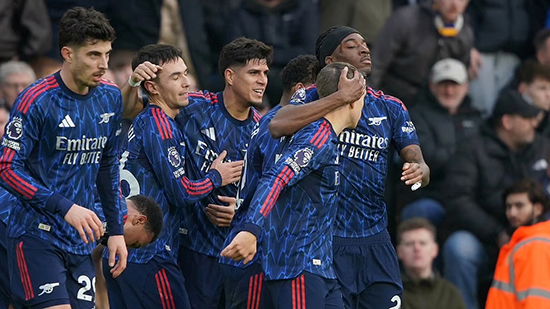
After the disappointing result and performance last weekend, at home, against a relatively mediocre Manchester United side, Mikel Arteta had said that maybe the players need to be reminded of how good they actually are. The fact that he said it openly may also have been a gentle corrective to what he must have perceived a current of negativity among Arsenal fanbase, on the matchday audience and otherwise. The last few years had naturally preconditioned some in the Arsenal fanbase to anticipate a collapse of the title challenge whenever there is even a hint of failing becomes apparent. Do we dare to believe, consistently and unshakeably? Or do we try to protect ourselves from the eventual heartbreak by assuming the worst? Or, do we simply just enjoy the ride, with all its terror and exaltation, anxiety and release, the uncertainty adding to the joy of the achievements when they arrive?

We each have our own ways of being in the world. I belong to the third group, surfing the waves as they come. But I fully respect others who perceive the ups and downs in our performances differently. I respect, as long as I am not forced to have to defend what at the end is a purely aesthetic choice. The events within every match as well as the statistics gathered at the end can always be interpreted in many different ways, through different lenses, and even though sometimes educated guesses can be made about the outcome of the season, most of the times the patterns unfolding aren’t very clear until the season ends and we have the privilege of looking at it as a whole.

An away match against an in-form Leeds, playing in front of their raucous home supporters, seemed a stern enough test for Arsenal following two draws and a rather unpleasant home loss. The performances in PL in that period, or even a few matches before that when we had to dig deep to overcome inconsistency and sloppiness that seemed to have lately crept into our game, had begun to raise concerns about different facets of our game, but mostly in the goalscoring department. On the other hand, the fact that we had topped the CL league stage with a perfect eight wins out of eight and goal difference of +19, and were still topping the PL table with a goal difference of +25 (only one less than City in the second place, four points behind) offered assurances – especially to most here in the ‘Holicverse – that that dip in performances and results were merely temporary, likely caused more by fatigue following a busy and difficult winter schedule, and didn’t point to anything fundamentally amiss with the squad or the tactics.

The midweek CL match against the Kazakh champions saw Kai Havertz starting for the first time since his return from a long injury, and he played a different version of the left-sided number eight role, working almost as a partnership with Gyökeres, setting up a goal for him with a delightful through ball, and scoring a goal himself with Viktor blocking defenders to make space for Kai to finish sumptuously. As we wondered in the preview, the combination and how they operated looked so clearly intentional that it was likely to be tried again very soon. It turned out to be as soon as this next match after that. Arteta sometimes gets criticized for tactical predictability and even conservatism. While he has a bias towards consistent modalities of operation – which has served us magnificently, lest anyone needs a reminder – he has never lacked courage to move pieces around as and when needed. Resting Ødegaard for such a pivotal match, and trusting the Kai-Viktor partnership to work out was a courageous decision. In hindsight it looks to have been a perfect decision, but that doesn’t take anything away from the willingness and courage to change. It is possible it was also prompted by the physicality of the Leeds midfield and defense, and in that case too the decision turned out to be a finely judged one.

The rest of the team looked as expected. However, Bukayo Saka felt some niggles in the warm-up and was replaced by Noni Madueke. The fact that such a forced substitution just before the match eventually worked out so well is not an accident, it is a testament to the preparedness of the player himself, the coaches, the manager, and the other players, to be able to adapt to changing situations and rise up to any challenge. That adaptability, when complemented by quality, is the key to consistency and eventual success.                  

Raya
Timber-Saliba-Gabriel-Hincapié
Havertz-Zubimendi-Rice
Madueke-Gyökeres-Trossard

Leeds lined up in the 3-4-2-1 formation, with Ethan Ampadu at the heart of the midfield and Calvert-Lewin as the lone striker. Farke had mostly been setting up his team in 3-5-2, but the slightly altered variation one suspects was meant to offer a staggered layer of defensive screen to protect against transitions if the attack minded wingbacks lose possession.

Leeds started with intent and energy, full of pressing from the front and running off the ball. Saliba-Gabriel were back to their serene best, and despite the intensity Leeds didn’t find their way through to our box.

Arsenal had the first sight of the goal. There was one more tactical tweak in this match. Zubimendi started a little bit higher up and Rice stayed back on the left side instead of his recent roaming left sided eight role. Kai was playing more centrally and often moving across the field, and in combination with Rice’s slightly more defensive positioning that allowed Zubimendi to break through the lines vertically and use his uncanny ability to find pockets of space to contribute more in the attack. From one fluid passing movement he made space to shoot at the goal, but the finish lacked power or conviction.

Madueke, with his directness and his ability to go outside and inside with equal ease on either feet, started to create considerable uncertainty in the left side of the Leeds defense. Gyökeres occupying the central positions and Havertz moving intently in and around the final third, the central midfield and defenders couldn’t really get out to help Justin and Gudmundsson. That uncertainty allowed Madueke to deliver a wonderfully precise cross for Zubimendi to head home for the first goal. Darlow, the Leeds keeper, almost pulled off a superb reflex save but there was too much power. This was Martin’s fourth PL goal of the season, all of them are finishes that showcase the versatility of talent and his extraordinary ability to find space and read the situations. Just like his Sociedad and Spanish team mate Mikel Merino, his game is going to evolve to even greater heights in the red-and-white.

Leeds 0 – Arsenal 1 (Zubimendi 27’)

Not only Madueke was giving the defense a torrid time with his dribbles and runs – Gudmundsson saw an early yellow – his delivery from corner-kicks were excellent too. He has become remarkably good in his deliveries over the last couple of months and even when he is playing in place of Saka, we no longer miss Saka’s pinpoint corners that much anymore. From one such delivery – a curling, fast, looping inswinger straight in front of the goalkeeper heading towards goal, needing just any touch – that bamboozled both Darlow and Calvert-Lewin enough for the goalkeeper to bundle the ball into his own net. I didn’t quite understand the logic behind awarding this as an own goal, surely the ball was heading straight to the goal? Hopefully the dubious goals panel or however they are called nowadays will rectify this later and deservedly award Noni his first PL goal in Arsenal colors.

Leeds 0 – Arsenal 2 (Zubimendi 27’, OG (Darlow) 38’)

Arsenal played out the rest of the second half with confidence and composure, quieted the crowd and asserted their control over the match. I felt it was important to not give away any opportunities with mistakes.

Farke introduced a couple of changes at the beginning of the second half, bringing Longstaff and Okafor to offer what I suspect more directness. They started brightly, the crowd was behind them, and for the first ten-odd minutes we were defending deep. Leeds were putting more men forward, and Trossard used that opportunity to put Gyökeres through with a lovely one-touch pass. Viktor’s run from the deep was good, but he took too long to finish and Rodon ran back fast to block his goalbound shot. The fact that he finished well from a very similar movement following an excellent outside-of-the-boot Martinelli pass in the Inter match underlines a crucial point about the main challenge Gyökeres is currently facing: his lack of acclimatisation to the new reality that compared to the rest of Europe, PL defenders are stronger, faster and for the most part technically superior. Whether that lack is due to any innate limitations or simply a matter of readjustments, only time will tell. I have my own opinions, and they tend to be positive ones.

Around the 60th minute, Arteta made his first changes: Ødegaard came in for Havertz who continued his much awaited and encouraging return, Martinelli replaced Madueke who had played one of his best matches for Arsenal. Gabi went to the right flank while Leo stayed back on the left.

Gabriel Martinelli is a wonderful footballer. Yes, he is not technically the most sophisticated – especially in a team that has players like Saka, Ødegaard, Zubimendi or even Trossard sometimes his lack of nuance becomes too obvious – and neither is he consistently threatening with the ball on his feet. But he has a lot of great qualities – physical, psychological and also technical. I am probably in a minority, but I think he offers a combination of abilities that is genuinely unique and something that is a big plus for this squad.

There was a great bit of play from Martinelli who ran onto a pass from Ødegaard ahead of Struijk, made space for himself, and delivered a wonderful cross into the box with his left-foot – worth noting how much more two-footed he has become lately, it is an obvious but underappreciated fact, very good players continue to evolve their game in all directions even when they are established professionals – which Gyökeres scored from with a typical center-forward finishing, holding off the physical challenge from his marker. It was also worth noting that in recent matches the team has started to find him with a bit more frequency in the box, and while his finishing still leaves room for improvement, maybe the goals too will start to come with a greater frequency.

Leeds 0 – Arsenal 3 (Zubimendi 27’, OG (Darlow) 38’, Gyökeres 69’)

If we watch the goal again, it is worth noting Ødegaard’s role in it. Zubimendi, staying deep between the two central defenders, starts the move with a pass to his right to Saliba. Saliba waits for a passing lane to open up; watch Ødegaard swiftly moving horizontally through the middle on the wrong side of the midfielders, ghosting in to receive the ball from Saliba in a congested midfield, and within a few seconds move forward and finds Martinelli in exactly the kind of open space that Gabi thrives in. That I thought was a masterful demonstration of understated brilliance. Whatever has been ailing him nowadays, it is worth remembering the old adage: form is temporary, class is permanent. He has always been, is, and will always be a magnificent footballer. He looked sharp and fresh coming on as a sub. Maybe a bit of rest and recovery will do him good. He is the connective tissue of the team, and when he is at his best he is one of the best creators in the league.

Gyökeres and Hincapié were soon substituted by Jesus and Calafiori. Jesus had two good chances almost immediately – he missed a one-on-one with the keeper after Rice found him, and his header from a Timber cross was straight to the keeper – and his sharp movements troubled what was now a tiring Leeds defense. Arteta made his final sub, bringing Eze in for Trossard. His early season efficacy in the final third has dropped off a bit, but today he was very good in keeping control of possession, helping to defend, and circulating.

Then the sumptuous fourth goal came. From a Timber throw-in on the right side, the ball arrived to Calafiori via Ødegaard and Rice, Ricky went on one of his puzzling in-out-in runs that tends offer some much in terms of unpredictability to our attack, he passed the ball Ødegaard, who found Jesus through a crowded defense. The hold-up play, the dragback to make space for himself, and the curling finish using the defender as his shield was world-class. He has always been capable of those moments, and has produced many of those over the years. Maybe just not consistently enough to be thought of as in the same class as all the great Brazilian strikers, but at his best he is a genuine match-winner.

Leeds 0 – Arsenal 4 (Zubimendi 27’, OG (Darlow) 38’, Gyökeres 69’, Jesus 86’)

This was a performance of high quality, great control and composure on and off the ball, and demonstrating an ability to move through different phases of the game with exactly the right set of ideas, executed expertly.

As Rice mentioned in the post-match interview, if we can continue to play each game as a cup final as we did today, the squad has a great opportunity to create their own Arsenal legacy.

I started writing this preview with what I thought was a very clever construct: it started with the Lydian chromatic tonal organization concept in Jazz to Lydian mode to the ancient kingdom of Lydia (in modern Anatolia) to Leeds, but there was no way I could squeeze in even the wildest linguistic theory connecting the etymology of Lydia (apparently named after Ledus the king, as per Herodotus) to Leeds, which derives its name from the old Brittonic Lātēnses, meaning “violent”, most likely in reference to the river Aire. So, rest assured, this preview will not contain the annoying preambles about non-footballing esoterica.

I have never been to Leeds, or anywhere really in west Yorkshire, and so have never noticed whether their rivers are violent or not. And given that I am not remotely English, it would be unfair of me to comment/joke on the modern relevance of the city’s ancient name. But thanks to more experienced ‘Holics in this forum, I do know about the violent history of the “Dirty Leeds” and an old enmity with the Gunners which probably still flows in the waters of Aire and Thames.

But these are different times, Daniel Farke is as far from Don Revie as is Rhine-Westphalia from Yorkshire. He had spent a few up and down years with his previous club Norwich City before going back home, and then after being sacked by Mönchengladbach, he returned back to England in 2023 to join the then newly relegated Leeds United.

Following last year’s title winning run in the Championship, Leeds are back in the PL. And after a tumultuous start to the season, they are lately doing remarkably well and notwithstanding their current league position, they are one of the in-form teams. You don’t believe me? These are their last few league results: 1-1(A) v Everton, 1-0 (H) v Fulham, 3-4 (A) v Newcastle, 1-1 (H) v Man United, 0-0 (A) v Liverpool, 1-1 (A) v Sunderland, 4-1 (A) v Crystal Palace.

I haven’t seen them play since our home match against them earlier in the summer, when we had put in a cheerfully dominating performance (I remember the players smiling a lot) to continue our flawless start with a 5-0 victory. Timber and Gyökeres both scored a brace, Saka one, and the talented highschooler Max Dowman got his league debut. A 5-0 this weekend would do nicely, pleasantly surprised though I think we all Arsenal fans would be.

Leeds were away from the PL limelights for a considerable time, before the mad (arguably) genius (and ever quotable) Marcelo Bielsa had brought his feverish press-and-pass-and-move-and-press football to England and got Leeds promoted. English is not quite his language, so quoting some of his wisdoms/absurdities – for they tend to be indistinguishable – translated from his native tongue:

“A person is a madman until his ideas triumph.”
“I know that support is only given by triumph. Almost all coaches are losers, and that’s why we are so lonely.”

And, to sum his footballing philosophy up, “The only way I understand football is constant pressure, playing in the opponent’s half, and ball possession. I am obsessed with attacking. I watch videos to attack, not to defend. Do you know what my defensive job is? We all run.”

The laid back and not entirely unlikeable (especially given that unlikeable is the middle name of all opposition managers, at least to me) Farke may not be quite so dogmatically offensive-minded, but his teams tend to try to play more creative football than any attritional approach even against oppositions superior on paper. A deep and low block of defenders covering every passing route and marking every runner off the ball is not something Arsenal would likely face. Without implying any criticism of the team or the manager, but simply as an observation I think it is fair to say we don’t quite flourish against such attritional tactics. Even then, earlier in the first half of the season, we had typically managed to find some kind of tactical-technical solution to the most obdurate of opposition defenses. The solutions haven’t always been aesthetically the most elegant, but they have been mightily effective. Until very recently.

Our last few PL results: 2-3 (H) v Man United, 0-0 (A) v Nottingham Forest, 0-0 (H) v Liverpool, 3-2 (A) v Bournemouth, 4-1 (H) v Aston Villa, 2-1 (H) v Brighton.

That dip in PL form just around the start of the year – in the three cup competitions we played in that time we have maintained our winning run, though at times exhibiting a similar dip in performances or consistency – has manifested in both ends of the pitch: failing to create enough goalscoring opportunities, and giving away goals through defensive sloppiness.

While the drop in creativity is not entirely unexpected, it is the unlikely loss of defensive solidity that has equally hurt our point tallies. Fatigue – physical and psychological, especially after a strenuous winter schedule – is a likely cause for both. At least much more likelier in my opinion than any intrinsic glitches in our tactical approach.

But let us not overemphasize on the recent results and the dip in form, which is but inevitable. We have a (fingers crossed) mostly healthy squad, both deep and diverse, and with players of different profiles complementing each other, and all driven by uncompromising work ethic and desire for personal & collective excellence. A lot has already been written about the manager Mike Arteta and his team of superlative coaches, their attention to details, their unwavering commitment to prepare the teams for all tactical and technical tools, and bringing the team’s level back up-to where they were before the holidays, and then improving further from there would now be the focus.

Leeds had started the season with a structured 4-3-3 or 4-3-2-1 formation that was meant to rely on structured build-up through the middle. However, following the troubled start to the season, Farke has shifted to a more robust and yet attack-minded 3-5-2 or 3-4-2-1 formation which has offered greater positional stability and a more pronounced directness in attack. The positional stability also enabled Leeds to employ more aggressive pressing, likely an inheritance from the Bielsa days, and aggressive pressing done right is often the surest way to earn defensive stability. However, for their last away game they played in 3-5-2 formation, with the impressive Ethan Ampadu controlling the proceedings at the heart of the midfield. Calvert Lewin and Aaronson played the two strikers. Ao Tanaka came on later in the match as a substitute, we might see him start next to Ampadu.

This would be a test for Arsenal, and anything less than our best would very likely see us lose points away, especially given the recent form Leeds are enjoying. On the other hand, if we can regain our defensive solidity, confidence on the ball, the sharpness from the dead-ball situations, we should be able to assert our overall technical and physical superiority and dominate the game effectively enough for a difficult, but ultimately well-earned win.

The starting eleven is not as easily predictable as it was earlier in the season, thanks to a healthier state of affairs in the squad (fingers crossed, once again). Raya, Saliba, Gabriel, Timber, Zubimendi, Rice and Saka are the likeliest to return to the starting eleven. From the rest, Ødegaard too is likely to start. However, I wonder if Mikel will be tempted to start with either Kai or Merino on the right sided number eight role as a more physical presence in the midfield and in the opposition box arriving just behind the front three. Neither of them may be as press-resistant as the captain, but they are both capable of scoring goals and providing through balls. Martin is yet to hit his peak form this season, and it may not be a bad idea to allow him a breathing space to regain it.

I would like to see Nørgaard on the bench, who I think brings in stability, composure and PL know-how and can be used more and not have Zubimendi play every minute of every league match. We have missed Calafiori in the left back role, especially his contributions in the opposing half. He did look a bit rusty in the midweek CL match, and if he isn’t fully fit yet I would start with MLS. Hincapié is definitely a better defender, and not a slouch on the ball either, but he is yet to fully come to terms with the roaming left back role which is a key piece of our tactical flexibility.

My preferred starting line-up:
Raya
Timber – Saliba – Gabriel – Calafiori
Ødegaard – Zubimendi – Rice
Saka – Jesus – Trossard

Later in the second half, we may see the Kai-Gyökeres combination used again to replace Martin and Jesus. Yes, it was merely Kairat Almaty, but the way they were used in the midweek and how they played close to each other looked to be a very intentional approach, and something the manager feels offers us another variation in attack. Let us start strong, quieten the crowd, control the tempo and possession, be composed on the ball, win the 50-50s and we should create enough chances to score a couple of goals towards a 2-0 away win.

Come on Arsenal!

Arsenal became the first team to win all of their group games since UEFA revamped the group stage of the Champions League, with a 3-2 win over Kairat Almaty who are the best team from Kazakhstan that I’ve seen.

 I must crave your indulgence with this report as a change to our train timetable meant that, had I stayed to the final whistle, I would have been an hour and a half later home than if I’d missed the last ten minutes. I’ve managed to catch the highlights of that period on the train, so you’ve missed none of the action but as the last ten minutes featured a disallowed goal for Gabriel Jesùs and a headed goal for Kairat by Ricardinho I think my early exit was a portentous move.

 Pre-match I had the privilege of a drink with BtM and Bath although Bath was partaking of Bovril, not a bad choice on a January night! 

Arteta picked almost a complete second string to face Kairat with Havertz returning to start a game for the first time in many months. Calafiori also started – at centre back – and Eze and Nørgaard joined Havertz in midfield – or was that Havertz’s position? See later!

 The game began at a frantic pace and we were ahead after just over a minute. Kai showing Kairat that his long lay- off had not left any signs of Kai rot, threaded a ball through to Gyökeres who ran onto it, moved it to the right and bent it past the Kairat keeper who was irate at the lack of cover (couldn’t find a K for that one).

 Arsenal 1 Kairat 0 – Gyokeres, 1 min

No sooner were we toasting (metaphorically) this breakthrough when a nasty VAR notice appeared on the screen for a penalty review against Arsenal. After a visit to the screen the ref awarded the penalty which Jorginho despatched past Kepa. Jorginho looked very different from when he played for us but that’s life in Kazakhstan for you!

 Arsenal 1 Kairat 1 – Jorginho, penalty, 6 mins

We are making a habit of letting sides with an xG of not very much score against us but the game had an open feel to it and we were soon ahead again.

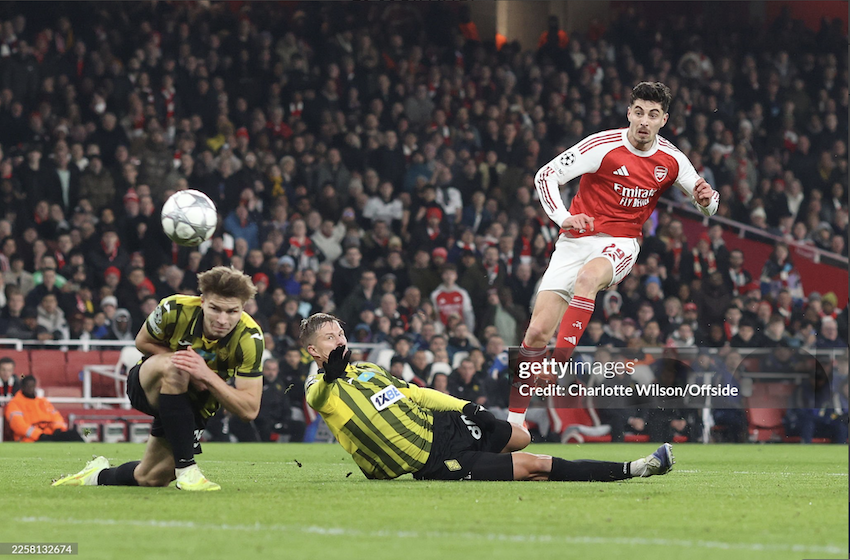
Havertz was playing in an advanced role which seemed to increase the threat from both him and Gyökeres and he showed pace, control and a fierce left-foot finish to restore our lead after he and Gyökeres chased a ball threaded forward by captain for the night, Ben White.

Arsenal 2 Kairat 1 – Havertz, 16 mins

 We were notably more dangerous albeit that Kairat were playing a high line that verged on the disastrous. Eze, Madueke and Martinelli caught the eye, Gyökeres missed some presentable chances and MLS combined with Martinelli in an incisive left wing move.

Our third goal came when Havertz turned the ball across and Martinelli
made a better job of finishing the pass than Gyökeres. It was immediately disallowed for offside call on Havertz but you can’t trust these identical twins on the line and after another thrilling VAR review the goal was given.

 Arsenal 3 Kairat 1 – Martinelli, 36 mins

 Arsenal’s fluidity was pleasing but they were wasteful in finishing and the overall impression at the end of the first half was that we hadn’t fully emphasised our superiority.

 Half Time – Arsenal 3 Kairat 1

Havertz and Calafiori were withdrawn at halftime for Ødegaard and Hincapié. Ødegaard was diligent but failed to finish a couple of very basic headed chances and Kairat who defended notably deeper found it easier to repel us, although we created plenty of chances. Martinelli and Madueke had their fullbacks on a piece of string but we couldn’t capitalise. Jesùs replaced Havertz and Brandon Bailey-Joseph made his first team debut to relieve Martinelli.  Later, Ife Ibrahim also made a late debut. Jesus had a late effort disallowed for offside and then Ricardinho nodded home from close range to create a very misleading scoreline.

Arsenal 3 Kairat 2 – Ricardinho 90+2 mins

Full time – Arsenal 3 Kairat 2

Arsenal fans should be very proud of our achievement of gaining a 100% record from a schedule that included four tricky away games and two home games against European giants in Bayern Munich and Atletico Madrid
But not the two entitled idiots I met on the tube before the match who described our form as ‘terrible’. Plastic fans like those two are intensely irritating and help to create what can be an underwhelming atmosphere in the ground. 

Tonight was a strange game with zero jeopardy but some exciting football. I was impressed with Mosquera and Eze. Madueke combines brilliance with a regularly errant final ball, Gyökeres showed us what he is capable of with a fine finish and a number of misses from straightforward opportunities but the big dividend from the night was the return of Havertz who brought real quality to our attacking play. At the moment, I’d choose a fully fit Havertz above Ødegaard in the ‘right eight’ position.

So, our next European involvement will come in March when we will find out just how good we are. The presence of five English clubs in the top eight underlines the strength of the Premier League and that is where we must now turn our attention.

Kairat Almaty

A 24 Kairat Gold Performance Please, Reds!

On Wednesday evening, in what seems this busiest of seasons, we welcome Kairat Almaty to the Emirates for the final round of Champions League league-phase matches. The Arsenal stand proudly at the pinnacle of the league table and, barring a mathematical catastrophe, are guaranteed to finish there with a perfect record. Kairat, on the other hand, sit rooted to the bottom of the table, although curiously only separated from a team like Villarreal by a four goals inferior goal difference. This must be due to the vagaries of the “new” draw. Perhaps it says something about the new format being less predictable – or maybe Villarreal are just having a very poor season?

As I’m sure we’re all now well aware, a major benefit of finishing in one of the top two positions is that we will play at home in the 2nd leg of every knockout round right up to the final – or as far as we might have the good fortune to go. In any event this match appears to be the very definition of a dead rubber. It will be interesting to see how close to capacity the ground looks but it could well be a quiet night for Kairat’s own version of a ticket super tout, Kazakh Stan. 

Thankfully, from a travel point of view, the game is at home and will save our fans an arduous trip to Kazakhstan. It should also leave them less exposed to the attentions of the Almaty Ultras – or the Kairat Crunchers as they are known – albeit mostly to themselves.

I will be forever grateful to my dad for taking me to my very first Arsenal game and making me a Gooner. He knew I was consumed by football but had only a passing interest in it himself. As a result our trip to Highbury turned out to be a one off but I was hooked – amazed by the lights, the size and the magic of the occasion. So I was even more amazed to discover that, even all those years ago, as far as his “fandom” went, my dad was a Kairat Almaty supporter. He was an extremely keen gardener but had neither the inclination nor the skills required for DIY. But on several of those occasions when forced into a bit of repair work, I heard him yelling “Kairat Almaty!” from the shed as another misdirected hammer blow found the end of his thumb.

The Opposition
Kairat Almaty was founded in 1954 under the name Lokomotiv Alma-Aty as a works team representing the local railway company. After a series of mergers dictated variously by politics and the agricultural employment sphere to which its expanding membership belonged, the club adopted the name Kairat Almaty in 1956. Kairat is a Kazakh word with Arab roots meaning “strength, courage, vitality and fighting spirit”, and is the romanised version of the name of its owner, Qairat Boranbayev, a Kazakh businessman.

The club is comfortably the most successful in Kazakhstan, having won four league titles, eight Kazakhstan Cups and two Kazakhstan Super Cups in what is described as its modern history. During the Soviet era, Kairat Almaty became a symbol of Kazakh football at national level.

The club has undergone several phases of development in its time but, while I always enjoy and admire North Bank Ned’s superb histories of our upcoming opponents, I have neither the time nor desire to impose similar detail on you about Kairat Almaty. The following excerpt from their particular history will hopefully explain why and has been lifted from Wikipedia if you really can’t resist: “The 1971 season was highly successful for the club. Under Viktor Korolkov’s rule, Kairat finished 8th in the Top League, a significant increase compared to previous seasons. On 12 November 1971, Kairat won the European Railworks Cup, defeating Rapid Bucharest 2–1 in the final.” That’s quite enough of that!

During the break up of the Soviet Union they reportedly appointed Mikhail Gorbachev as Director of Football. He achieved little, in truth, but did at least manage to find them a perestroikas.

The three most famous players who played for Kairat – and in all probability the only ones anyone here will ever have heard of – are our very own erstwhile winger Andrey Arshavin, former Bayern Munich midfielder Anatoliy Tymoshchuk and Brazilian striker Vagner Love. They do currently have a 28 year old No 7 called Jorginho but he is nothing to do with any of the similarly named players that might just spring to mind. Neither is he Brazilian – being in fact a Bissau-Guinean.

The club is actually quite stable with almost all of the coaching staff having been in place since around 2019. The exception to the rule is their manager, Rafael Urazbakhtin, who was appointed more recently, in September 2024, and is apparently well known for his cairat and stick coaching methods.

For the technically inclined, according to the club’s website, Kairat play in a 4-4-2 or a 4-3-3, or a 4-2-3-1 “for defensive stability and attacking creativity”. It seems pretty rudimentary information, should cover all bases, and whichever one they choose will hopefully prove utterly futile against our table topping superstars.

The Arsenal
On the injury front we have to wait and see whether Ricardo Calafiori is deemed fit enough to make the squad. He’s been out since pulling up in the warm-up before the win against Brighton just after Christmas. That must have been some warm up as he’s now missed nine games across all competitions with the resulting muscle injury. He was spotted in training ahead of the Manchester United game and Arteta said he could be available for selection. He wasn’t selected in the event so eyes will now be on Wednesday evening.

Kai Havertz also failed to make the matchday squad on Sunday. There were suggestions on social media that there are concerns over the German, but Arteta has reassured Arsenal supporters that he is “very close” to full fitness.

He said: “Obviously, he has been out for a long time, almost a year, for different reasons, and now we have to be very smart in the manner that we manage that load, the minutes.

“I am sure in the next few weeks he is going to play minutes. I cannot tell you which competition because that will depend as well on the game context, and it is a context that is positive to throw him in or not, with his qualities.

“It is great that we have him. We can use him in different positions. We will see him in different positions, and we are really happy to have him.”

Personally, I would love to see him in positions other than supine or prone on the treatment table. Fingers crossed.

Max Dowman has been out since suffering an ankle ligament injury in a behind-closed-doors game against Manchester United before Christmas. The 16-year-old was ruled out for two months and has consequently been removed from Arsenal’s Champions League squad. Arteta confirmed recently that Dowman was still “a few weeks away”.

Ethan Nwaneri has now completed his loan to Marseille and scored on his debut with a trademark Nwaneri goal – a run through the right side of midfield, turning inside to curl a left footer from distance inside the far post. If it works well for him, I do wonder if he might spend next season there too. He appears a different, less extroverted character than Miles Lewis-Skelly and this loan is probably as much about his personal development as it is about football. In 18 months he can grow physically and mentally, and the overcrowded pathway into our midfield might be starting to thin out a bit by then. He’ll be joining Jurrien Timber’s twin brother, Quentin, there too. Maybe, one day, they will return to Arsenal together.

Last week Gabriel Jesùs spoke of his own pride at scoring twice in the San Siro but also took a moment to acknowledge his striking comrades: “I was so happy that Vik came on and scored a goal because a striker without a goal is always difficult. I have been fighting with this all my career, but still, I’m so happy that I scored, Vik scored, and then I’m 100% sure when Kai has the chance, he will score and help us as well.” 

Nice touch. We all hope so. Very much.

That brings us to the question of team selection. There has to be a mixture of rest, rotation and a chance of playing time and confidence restoration for some of our squad members. Declan Rice and Mikel Merino are suspended so my guess / preference would be:

Kepa;

White, Mosquera, Hincapié, MLS;

Nørgaard, Eze, Jesùs;

Madueke, Gyökeres, Martinelli.

  • with hopefully some playing time for at least Calafiori and Havertz as subs on 60-70 minutes. 

Whoever plays, this has been a tremendous Champions League campaign with brilliant wins against Bayern Munich, Atletico Madrid and Inter Milan. This team deserves everyone’s support despite whatever frustrations and anxieties we might currently be experiencing. Sticking together is the only way we can help.

And finally, at this time of year, a note to particularly any Scottish, or Chinese, Holics – a couple of my mates were throwing a joint Chinese New Year and Burns Night party on Sunday. It was called Chinese Burns night. I didn’t want to go but they twisted my arm 😉
Enjoy the game, all !

« Newer Posts - Older Posts »