And so to the Stadium of Stone, where we entertain the SW6 Spendalots on Sunday afternoon in the last game of the Premier League’s Matchweek 28. Yes, just ten must-wins to go.
Barnum and Boehly’s Circus last visited just shy of a month ago for the second leg of the Carabao Cup semi-final. They arrived needing to overturn a first-leg deficit. Their still-new head coach, Liam Rosenior, was praised for his tactical acumen in hunkering down, with the acclaim in the popular prints not diminished one iota by our progression to the final, having won both legs. Funny old game, football.
That said, Chelsea has thrived under Rosenior, establishing a level of consistency in securing results that they struggled to achieve under Enzo Maresca. Aside from the League Cup matches, they have won eight and drawn two of Rosenior’s other ten games.
As a result, at time of writing, they are sixth in the Premier League, three points behind the defending champions, who have played a game more, and Michael Carrick’s resurgent Red Mancs, who occupy the coveted fourth spot that will secure qualification for next season’s Champions League, bringing spondulix much-needed in the heavily indebted parts of London SW6 and Manchester M16.
Not Maresca’s 4-2-3-1
On the surface, Rosenior’s Chelsea team plays a 4-2-3-1 as they did under Enzo Maresca. However, there are key differences in how the two versions try to play through the opposition’s press, in their pace of attack, and in how Rosenior deals with what doctors call Amorin syndrome, where a star is forced into the team out of position because the system is sacrosanct, yet the star cannot be dropped.
As Carrick has done with Bruno Fernandes at the Old Toilet, Rosenior has done with Enzo Fernández: remove him from the double pivot, where his skills are not ideally suited, although he is a good enough footballer to do a decent job, and push him further up the pitch to where his abilities are a better fit and where the player prefers to operate.
Fernández now starts on the left side of the three attacking midfielders. At times, he fulfils the role of a winger; at others, he comes inside, a junior 10 to the roaming Cole Palmer’s lead. With one of the first-choice wing/full-backs, Reece James or Marc Cucurella, overlapping and underlapping on the wings depending on where Palmer and Fernández have moved, this allows Chelsea to attack with a front line of five or six.
It also lets Rosenior deploy a player who is considerably more press-resistant than Fernández alongside Moises Caiceido in the double pivot. For now, that is Andrey Santos. He undertakes the unglamorous but indispensable role in the system Rosenior evolved at Strasbourg of playing third-man and one-touch bounce passes to keep possession while waiting to break the opposition’s press and get the ball quickly up the pitch to attackers waiting in space between the lines.
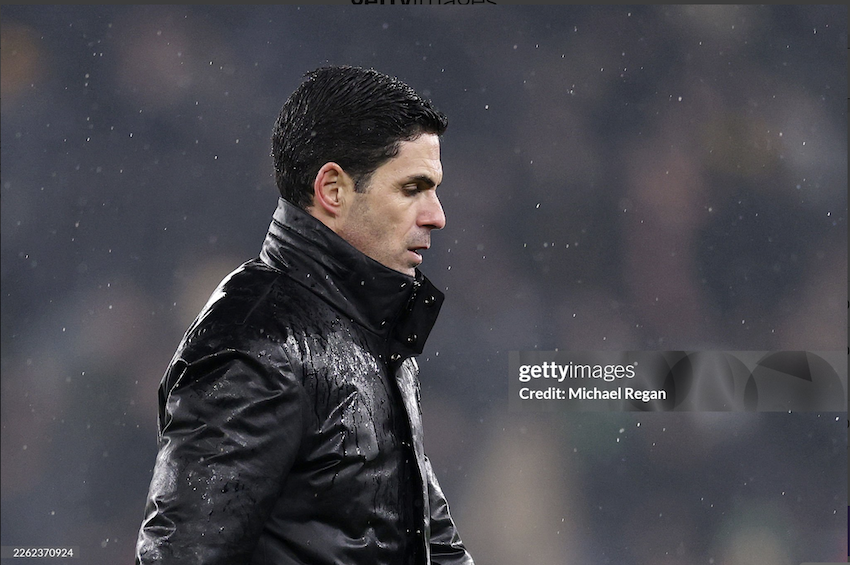
What? I hear you say; not much of that in the Premier League, where teams squeeze up with high lines, press man-to-man relentlessly and space between the lines is rarer than a hair out of place on Arteta’s head? This isn’t Ligue Un!
And, gentle reader (gentle reader!), not only are you correct, but I can see that you are ahead of me.
Wait and bait
Rosenior’s cunning plan is to stretch the gap between the opposition’s back line and its second bank of pressers to the maximum extent by using a wait-and-bait strategy.
At Strasbourg, his defenders patiently circulated the ball around the edge of their penalty area during the build-up, trying to lure the opposition’s press as close to their goal as they could, to open up space in midfield. As soon as the opposition had taken the bait, Strasbourg launched the ball into the newly created gaps into which its attackers had dropped, and they were off to the races.
This high-risk tactic depended on Strasbourg not losing possession while they waited and baited. Reliable, press-resistant DMs were essential. Rosenior also made the keeper an active part of the back line to create a numerical overload.
In Ligue 1, the tactic largely succeeded, at least until this season when teams learned how to counter it. Nonetheless, Rosenior has carried the concept with him across the Channel. Santos in the double pivot is one indication. Fernández on the left, rather than an out-and-out winger like Alejandro Garnacho or Jamie Gittens, is another.
A third is some hairy moments when Chelsea gets turned over with Robert Sánchez far from his net. Sánchez, though more skilled with his feet than many give him credit for, is not as good as Djordje Petrovic or Mike Penders, the two keepers Rosenior had at Strasbourg, both on loan from Chelsea, as it happens. Rosenior has been flexible enough to adapt.
Rosenior has also been fortunate in having had a benign run of fixtures to implement his tactics. Brentford is the only top-half team Chelsea has faced in the league, while Charlton and Hull were their FA Cup opponents, and they played Pafos and a struggling Napoli in the Champions League. We are the only top side Rosenior has faced, and he lost both times.
It remains uncertain how effective Rosenior’s wait-and-bait strategy will prove against elite pressing teams and those capable of pinning back Chelsea’s full/wing-backs and cutting off the supply lines to Palmer, Fernández, Pedro Neto and Joao Pedro, thereby negating the greater speed and directness in Chelsea’s attack. After Sunday, they face away games at Villa Park and Anfield, and host Newcastle and both sets of Mancs. Proof of the pudding, and all that.
The opposition
Most of Rosenior’s likely selection for Sunday will be familiar enough that reciting an inventory of Boehly’s extensive, expensive, and seemingly haphazardly assembled squad is unnecessary. For some reason, Beachcomber’s Anthology of Huntingdonshire Cabmen comes to mind: ‘Acheampong, JK; Adarabioyo, Abdul-Nasir; Badiashile, B…’
The preview of the League Cup second leg https://www.goonerholicsforever.com/?p=12772 can serve as a reminder, if needed.
I will therefore only relay the injury and suspension updates. Levi Colwill, Jamie Gittens, Marc Cucurella, Filip Jorgensen, Dário Essugo, and Estevao are all gone in the fetlock. Wesley Fofana is suspended after receiving two yellow cards during the draw with Burnley last weekend. Mykhaylo Mudryk remains on the long-term suspension list (What a dope, I would say, if I had Trev’s humorous touch). Reece James will return from injury, and Romeo Lavia, who rejoined the matchday squad for the Burnley game for the first time since last November, may get some minutes.
The Arsenal
Arteta was his usual obscurantist self about our walking wounded. Mikel Merino is definitely out. Ben White and Kai Havertz are almost certainly and probably unavailable, respectively, I would venture. Max Dowman played a half for the U-21s on Friday. He is en route to rejoining the first-team matchday squad, but not there yet. Bukayo Saka trained this week after twisting his ankle against the neighbours last weekend, so one assumes he is available.
Martin Ødegaard or Eberechi Eze is the big question. Playing both if Saka is not 100% to start is not inconceivable.
Raya
Timber, Saliba, Gabriel, Hincapié
Zubimendi, Rice, Eze
Saka, Gyökeres, Trossard
City has cut our lead to two points, so yet again, this is a must-win. Chelsea possesses a potent attack with players able to conjure up goals, but is vulnerable defensively. Rosenior says his job is to identify our weaknesses. I think we will be better at exploiting theirs. I’ll go for 3-1.
And did I mention that we could be celebrating St Totteringham’s Day on Sunday, possibly even before we kick off, if the old boys do their job at the Cottage? If so, it will be the earliest St Tott’s Day on record, beating 2008’s March 9.
Enjoy the game, ‘holics, near and far.