Feed on
Posts
Comments

Our debut in this season’s Carabao Cup involved a trip to the Potteries to play the ‘other team’, Port Vale, whom we haven’t played for 27 years. Then we struggled through a goalless home draw, a replay (remember those?) at Vale Park, extra time and a close-run penalty shoot out in the 1997-8 FA Cup third round and went on to win Arsene Wenger’s first Double. In the days before match day there was much speculation in the Goonersphere as to the team Mikel Arteta would pick for this match. Sunday’s match against the Creative Accountants had delivered yet another injury with Madueke sustaining a knee injury that forced his replacement at half time and his further absence for tonight and a couple more months. As if this wasn’t enough, we also learnt this week that Hincapié, who has played a mere 5 minutes for Arsenal since his late signing, has a groin strain that will keep him out tonight and for a few weeks longer.

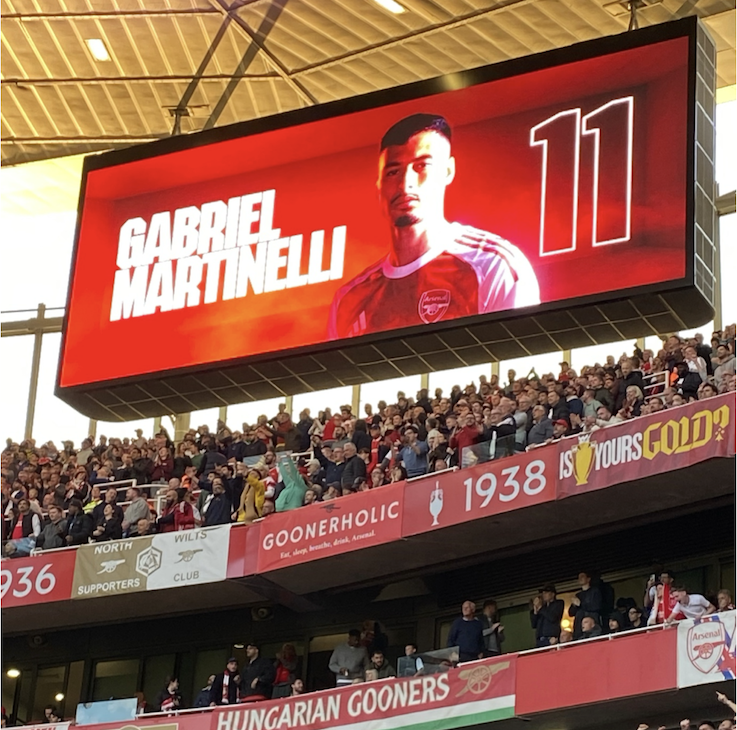
Many have suggested that this match is an opportunity for Martinelli to start down the middle hoping he could reprise his epic bursts behind defences and goals against Athletic Bilbao and the Creative Accountants. However, that was not how the coach saw it, but Eze got a chance to play in his favoured ‘ten position’ with Nwaneri at his favoured ‘eight’:

Kepa

White Saliba Mosquera MLS

Nwaneri Nørgaard Eze

Saka Merino Martinelli

Unsurprisingly, Sky couldn’t find a Gooner for the panel and burdened us with ex-Spud Jaimee Redknapp and ex-Spud & ex-Vale Michael Brown. Plus c’est la même chose!

The third tier outfit started with energy and directness as did the travelling Gooners who were in good voice while the locals betrayed their kinship with Stoke-ites by booing Saka whenever he was on the ball. The flurry of local activity lasted 5 minutes after which we established dominance of both possession and territory. 

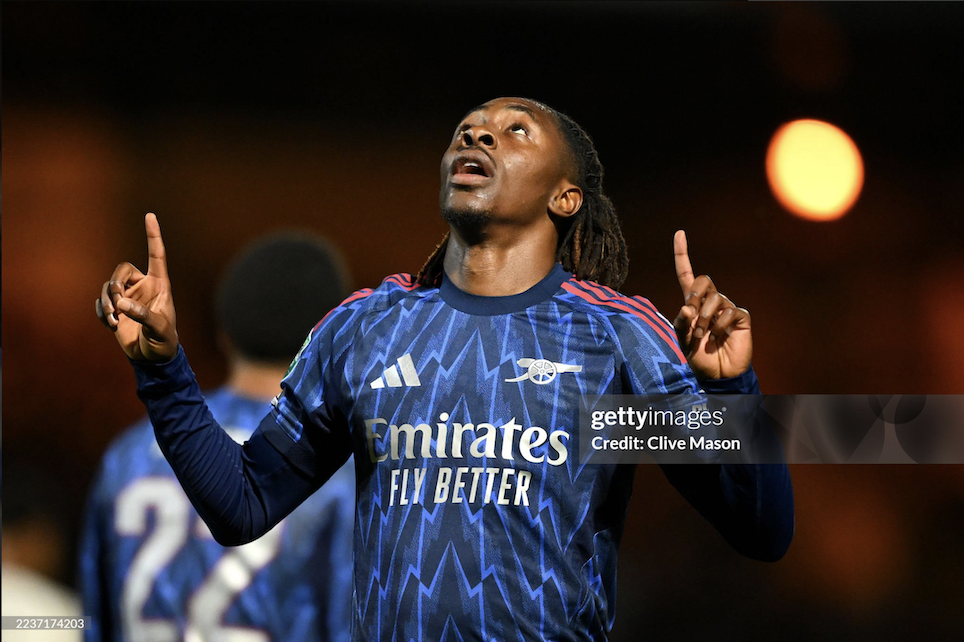
On 7 minutes, Martinelli, at the left edge of the Vale box, found MLS inside the box and the youngster’s back-heel to Eze left our new man the simple task of passing the ball into the bottom corner for his first Arsenal goal. Four minutes later, Nwaneri’s curler from the right edge of the box was deflected past the post.

A pattern of persistent interchange emerged with Saka and Nwaneri swapping roles on the right  supported by White’s overlaps and Martinelli and Eze doing likewise on the left supported by MLS’s underlaps. Meanwhile, Merino mainly patrolled the centre though occasionally appearing on the right, showing delicate footwork while making probing passes into the box for darting runs in behind while Nørgaard provided an outlet when necessary and recycled the ball well. After 20 minutes Arsenal had made 211 passes versus 21 by Vale but had not come close to extending their lead.

Vale had an exciting moment when their ‘Gabriel’ darted behind our defence to receive a lofted ball and bear down on Kepa who anticipated the pass and cleared it before the linesman raised his flag for a questionable offside.

A very crisp series of passes between Saliba, White and Nwaneri that took the ball from box to box came to naught but a sweet pass from Merino from the edge of the box to Eze eight yards from goal was met with a firm shot that drew a good save from the keeper on 35 minutes.

Port Vale persisted with the occasional flurry and won their first corner on 39 minutes. There was a free header misdirected downwards then a brief melee in our box before it was cleared but the crowd was lifted and there were a couple of minutes of pressure which called for our defenders to show their mettle.

HT: Port Vale 0 – 1 Arsenal

Our first half was professionally executed with 78% possession but all that ball yielded only five shots at goal and a mere two on target. Despite Arsenal’s dominance and occasional slick moves, the game felt somewhat underproductive and short on goalmouth action and excitement. We could certainly have moved the ball more quickly. Could we liven things up in the second half?

Vale had clearly been told that they were showing us too much respect and they became more combative physically in the second half.  

The second half began with brief excitement at both ends, a long throw from Vale followed by a breakaway by Martinelli surging over the halfway line to meet a ball from Saka only to be tackled by the Vale keeper as he reached the ball. Then Saka was trodden on by a Pottery thug called Headley (who had been manhandling him all game) and jangled all Gooner nerves as he lay prone thumping the pitch in frustration.

A spell of intricate interplay as the hour approached ended in our first shot at goal of the half from Nwaneri but it was blocked on the edge of the box. Max Dowman then became our youngest ever player in the League Cup when he replaced Saka on 62 minutes.

Our next attempt on goal came from an impressive long throw from Nørgaard in the 67th minute that found its way to White 30 yards out and his effort cleared the bar by a wide margin.

On 70 minutes Gyökeres and Gabriel came on for Merino and White with Mosquera moving to right back.

The home team were certainly more involved in this half and Mosquera’s square pass across the front of his fellow defenders to a Vale forward lifted the crowd again but our defence stifled the danger swiftly. Kepa then repeated the error as his pass to Nwaneri went to a Vale forward whose shot from 25 yards just cleared the bar. Our playing out from the back was looking less successful as a result of Vale’s second half pressing.

Dowman flicked a lovely ball behind the defence for Gyökeres to run onto but his shot was blocked by a lunging defender as he bore down on goal.

On 80 minutes, Trossard and Rice replaced Martinelli and Eze.

The Belgian duly scored his ‘super-sub goal’ in the 85th minute with a crisp shot from the edge of the box after slickly taking down a high ball from Saliba to make the space to shoot. Trossard again!

Trossard then produced a through ball for Gyökeres to chase which he did at pace and the Swede forced a Vale defender to concede a corner.

Dowman provided a few moments of excitement with some dancing dribbles and a deft flick to Rice but the goal he and we craved didn’t come. A Nwaneri shot from the edge of the box after a Dowman shot was blocked, warmed the keeper’s hands with 30 seconds to go and then the game was over.

FT: Port Vale 0 – 2 Arsenal

That was a routine, if rather unexciting victory for Arsenal. Port Vale proved obdurate opponents particularly in the second half in which their more aggressive posture prevented Arsenal achieving the dominance they had enjoyed in the first half. Nonetheless, there were no really alarming moments. A win is a win and several players who needed game-time will have benefitted from the outing.

Over the whole piece we had 81% possession, eleven shots on goal with four on target.

Kepa wasn’t really tested and apart from one dodgy pass that was intercepted, looked comfortable with the ball at his feet. Ben White looked lean, hungry and sharp but clearly couldn’t go 90 minutes; Saliba showed his usual calm dominance and was comfortable throughout; Mosquera looked comfortable both at centre back and when switched to right back – bar his dodgy square pass; MLS was quietly authoritative both with and without the ball and deserved his clever assist. Nørgaard had a very competent and comfortable first start and will have benefitted from gaining a full 90 minutes in his legs; Nwaneri gave a confident and competent performance without too may sparkling moments; Eze was involved throughout, took his goal well and might have had more – his interaction with his new teammates appears to be becoming more intuitive. Saka was manhandled throughout but still  made a significant contribution to our attack, threatened in possession and will have benefitted from the game time – as long as he has avoided injury; Merino’s deft touches, silky passes and interplay kept us moving and he constantly made himself available at both ends of the pitch; Martinelli was a regular threat, made a lovely pre-assist and might have scored himself. Gabriel and Rice stiffened our resistance as Port Vale tried to get into the game while Trossard sealed the win with a trademark goal and looked lively – was he feeling a hammy at the end? Hope not! Dowman added a bit of sparkle to proceedings and gave Saka an opportunity to put his (rather bruised) feet up for half an hour. Gyökeres got a short run out but limited opportunities to shine, though he did threaten the goal twice.

Just one question – why do these oiks boo Saka?

Job done!

It’s Brighton at home in the next round.

Onward.

Time To Reset The Vole Trap

No, I haven’t developed late onset dyslexia – and why is that particular word so hard to spell ? – it’s just an anagram and I like them ! And what’s more, it’s quite fitting because it really is high time we reset The Arsenal’s record in the (Football League) Carabao Cup.

The last time we won the competition was in 1993 in which incarnation it was known as the Coca-Cola Cup. That season’s competition ran alongside the first season of the newly formed F.A. Premier League. That’s how long it is since we won that particular trophy.

To clear the first hurdle this time we will have to literally do it on a, possibly, wet Wednesday night in Stoke. To be precise we will have to do it in Port Vale which is located about 4.3 miles (6.9 km) from Stoke City’s bet365 Stadium, making them very local rivals. Port Vale’s home stadium, Vale Park, is in the district of Burslem, if you’re driving there, one of the six towns that form Stoke-on-Trent.

In a wider context it is part of the Potteries where a teacher once told me I would never be any good at poetry because of my aforementioned late onset dyslexia. Well, so far I’ve made three beautiful vases and a jug, so up yours Mr Evans !

This 3rd Round tie is a mismatch on paper, but we will need to be careful not to fall into this particular trap as the League One strugglers, managed by Darren Moore, have already knocked out Blackpool and Birmingham City to make it this far for only their second third-round appearance in the last 16 years – although they did reach the quarter-finals in 2023-24.

The History
A look at the head-to-head record between the clubs shows that in their 22 previous meetings Arsenal have won 13, drawn 5 and Piet Vale have won 4.
Before Arsenal were promoted to the top tier of English football in 1919, the two sides frequently clashed in the old Second Division. Back in the days of Christmas Day football, three of the first five clashes between Arsenal and Port Vale – including their first-ever meeting – took place on December 25th with Arsenal winning all three. On Christmas Day 1894, Arsenal recorded their biggest victory in this head-to-head – a 7-0 drubbing at Manor Ground. Port Vale have to go back to September 1901 for their last win against the Arsenal – actually Woolwich Arsenal at that time. Since that 1-0 victory on their home soil, we have maintained a nine-game winning run against them. 

The two teams have only been drawn together twice in the FA Cup since the end of the First World War, with Arsenal prevailing after replays on both occasions. In the 4th Round of the 1926-27 competition, the two sides drew 2-2 before Herbert Chapman led the Gunners to a 1-0 win in the replay. Seventy years later, in the third round of the 1997-98 FA Cup, the newly arrived Arsene Wenger saw his side – which included the likes of Nicolas Anelka, Dennis Bergkamp, Marc Overmars and Ray Parlour – held to a 0-0 draw at Highbury. Port Vale then almost pulled off a huge giant killing in the replay, taking Arsenal to penalties after a 1-1 draw and extra time. The Arsenal won the shoot-out 4-3, almost a very early exit for Arsene who, of course, went on to win the competition that year and a record 7 times overall as a manager.

The Squads
It just wouldn’t be Arsenal if we didn’t end the weekend with new fitness worries – two this time to be precise. New signing Piero Hincapie, having joined and gone straight off on international duty, did not make the matchday squad on Sunday due to an unspecified problem. As we all know now, Noni Madueke was replaced at half time due to a knee injury which has now, after scans, been diagnosed as a medial ligament tear. He will be out for 6-8 weeks. Gabriel Jesus (ACL), Kai Havertz (knee) and Martin Ødegaard (shoulder) all missed the game against Man C130y but Bukayo Saka and Ben White made welcome returns to the squad. I would expect both to feature against Port Vale to build fitness and get some match practice in before the trip to St James’s Park on Sunday. Ethan Nwaneri and Myles Lewis-Skelly should also be among a number of changes.

I’ve been saying since the summer that we have to get away from the idea of first teamers and reserves as we now have comparable quality with all players throughout the squad. On that basis we could reasonably expect to see some mix and match selections across all competitions, rather than an obvious A and B team. However, just to immediately contradict myself, I would expect some key players to start on the bench and get a breather with Newcastle coming up at the weekend especially as the Geordies, while dropping points against Bournemouth, took the opportunity to rest the likes of Guimaraes and Joelinton and I believe new 6’7” striker Valdemort (sic) was withdrawn at half time. I’d be very surprised to see Max Dowman start but he could well get 20 minutes at the end if Bukayo Saka has a good hour or so. 

So that would leave a team looking something like this:


Kepa;

White, Mosquera, Gabriel, Lewis-Skelly;

Nwaneri, Nørgaard, Merino;

Saka, Gyokeres, Martinelli

As for Port Vale, on-loan Wrexham forward Mo Faal has recovered from a hamstring injury, but Moore has problems out wide following a rash of fresh blows. Liam Gordon was forced off late on in the win over Mansfield, Mitch Clark is not yet expected to return from his unspecified issue, while Kyle John has been ruled out for the next few matches owing to a muscle injury. At this point I have to admit I know absolutely nothing about any of them or what likely effect their absences will have on the team.

And so …..
Some people may think this is only the Carabao Cup and doesn’t really matter. While it’s clearly not our top priority, I hope we will take it very seriously as the importance of winning a trophy for this team cannot be overestimated. It would be great for confidence, belief and just plain getting the first one over the line.

The game will be shown on Sky Sports in the UK. Kick off at 20.00.
If you’re driving to Port Vale for the game do take care as apparently a tanker of ready mixed concrete has crashed with a prison service van on the M6. Police are warning that there are hardened criminals on the carriageway.

Come on you Reds !

Picture taken by an emotional author

Let’s begin with the best bit. Deep into injury time, still losing 1-0 as they had been since the ninth minute, Calafiori broke up a rare second half attack by City. A couple of passes later the ball got to Eberiche Eze, in the centre circle, but still in his own half. He looked up and saw Gabby Martinelli, in the centre forward position, signalling and making a run. Almost for the first time in the second half, the City back five were relatively high up the field, a fact which hadn’t skipped the notice of a furiously gesticulating Pep Guardiola, who was telling them to get back. Eze played a superb ball over the top of them perfectly into the run of Gabi who was just onside, but there was still much to do. The ball bounced one, two times and, for the first time in the game, the 6’5” Donnarumma in goal was caught in no man’s land. Gabi took the ball at shin height and, with the outside of his right foot lobbed it over Donnarumma from the edge of the area. It soared over him and, in super slo-mo (or so it seemed as we all craned our necks on the North Bank), bounced into the net. A superlative finish under the highest of pressures.

There was absolute pandemonium, on people’s sofas, in bars all over the world and, not least, in the stadium where the response was ecstatic, the most intense “limbs” so far this season. For the second time in two games, Gabi had played the super sub, scored and saved the day.

So how did we get to this position? Earlier that afternoon, as my son and I were having lunch in a Chinese restaurant on Holloway Road, the team news came in. I had to put down my chopsticks as we absorbed the detail. Yet again, we were starting with a midfield of Rice, Zubimendi and Merino. Worse, Trossard was on the left wing. Eze, Martinelli and a fit again Saka were all on the bench. I see what the boss was trying to do. Keep the game tight until 65-70 minutes, then throw on the “finishers” to win the game, as he had done against Athletic Bilbao in the Champions league. After all, City had thrown away games earlier in the League in the last twenty minutes and had had 48 hours less rest then us since the Champions League as we played Tuesday and they played Thursday.

But that plan depended on keeping a clean sheet, another fair assumption as we hadn’t conceded a goal from open play all season. But City scuppered that plan early on, as, after just nine minutes, they scored a superb break away goal. Haaland won the ball near his own area and, a few rat a tat passes later Reijnders was striding through our midfield. Fully fifty yards he made, before sliding the ball to Haaland who had sprinted up on his right hand side, having totally outpaced Gabriel who couldn’t keep up with him. Haaland tucked the ball efficiently past a diving Raya. 1-0 City.

It was now obvious that City would stay as tight as possible. Surely, even as early as this, we had to change it up. Rice and Merino had played together 10 times in midfield in the Premier League. Only once had they delivered a win. But no substitutions were made until half time. With no creators on the field, the plan seemed to be to get the ball to Madueke on the right wing, or score from corners. The ball would be passed from Trossard, to Zubi, to Rice to Merino to Timber. We did not have an attempt on goal until injury time in the first half when the hardworking Noni forced a save from Donnarumma at his near post. Indeed City had the better chances in that first half to go 2-0 up, Raya having to make several saves.

Also in injury time, Bernardo Silva forced the ball out by challenging Trossard on our left wing near the halfway line. His clearance went via Trossard’s wedding tackle and left him winded. As he absorbed the pain, on all fours, Silva, from off the field, threw the ball at his head. Trossard, furious, threw the ball back at him, hitting him also in the orchestra stalls. Silva went down clutching his face. Now this was a piece of pure handbags, pantomine stuff from two mature, highly experienced players. But both had thrown the ball at an opponent. A stern talking to by the referee, a yellow card each and “let’s get on with the game eh lads?” But Stuart Atwell was taking ages to decide what to do. It quickly dawned on us that Silva had already been yellow carded. A second would mean a red. But Atwell bottled the decision. Compare this to Tross kicking the ball away at the Etihad. PGMOL gonna PGMOL!

Through the half the crowd were restive. We were playing boring football with so many attacking players on the bench. At half time, Arteta acted. Eze came on for Merino and Saka for Madueke (Arteta later claimed that Noni was carrying a knock). We started the second half with verve and determination. Suddenly it was all Arsenal. But now we had to get through a packed deep block defence. And behind that defence was Donnarumma, a giant goalkeeper who had been highly influential in PSG winning our semi final in the Champions League. In particular he nullified our corner threat. Time and again he punched the ball clear. On 76 minutes Haaland was withdrawn, as was Foden, and Pep withdrew to a 5-5-0 formation. The bus was well and truly parked. Nwaneri and Martinelli came on for Timber and Trossard. And so we came to the denouement described at the top of this piece. 

Now I am a massive supporter of Mikel Arteta. But on this occasion he got it wrong. He seemed to admit that by the changes he made at half time. At home, against a fragile City who had played the same team in three matches in a week, he should have had more confidence to take the game to them. Afterwards a defiant boss denied that the first half tactics were wrong. He always was stubborn. Next weekend, we go again at St James Park. Please, do not play Rice, Zubi and Merino in midfield and Trossard on the wing. All of those players are top drawer. But the balance is wrong. We had a superb transfer window and are packed with talent. Saka is back. Newcastle look dodgy. Let’s take the game to them and silence that crowd.

Meanwhile, Liverpool keep winning. 

It is often said that a picture is worth a thousand words. How about numbers that paint a picture? 

5-1 2-2; 0-0 1-0; 1-4 1-3 ; 1-2  0-5; 0-1  0-1; 0-3 ; 0-3; 1-3  0-2; 0-3  1-3; 2-2  1-2; 2-2  2-1; 2-0  2-2; 1-1  3-6; 0-2  1-1; 1-0  0-1; 0-0  3-0; 0-0  2-4; 2-0  0-3; 3-1 1-0

Those are the scorelines for Arsenal vs. Manchester City games in the Premier League from 2024-25 to 2007-2008 seasons, reverse chronologically ordered.  And the picture thus painted is clearly illuminative, filled especially with sharp contrasts, of the shapes and forms depicted. If we go further back in the past, that clarity starts to narrate – no longer just hints at – a story that is rather too well known to require much repetition. But the past is another country, and let us just look forward to the future. 

The job of a football manager/coach requires a very peculiar kind of madness – observing, along with Pascal, that man is so essentially mad that not to be mad amounts to just another form of madness – which often manifests itself in an obsessive search for excellence, especially in those who strive to implement a form of creative vision that goes beyond the ordinary spectacle of a sporting encounter that gets decided on the basis of just one statistic. Managers are, famously, in the “results business”, but the genius of a great football manager is to be able to live daily with the paradox that the best way to achieve “result” is not to focus on it, but to remain committed – in thoughts, words and actions – to their own personal vision.

Whatever one’s personal opinions about the two managers facing each other might be, no one can deny that each of them represent the archetype of a progressive, visionary football manager. While one of them has deservedly earned all the accolades by the virtue of how he has turned his vision into success (albeit with some of the greatest footballers in the history of sports to implement those ideas) and in the process became the most decorated manager in history, the other has taken a more deliberate approach of building towards a sustained and sustainable standard of excellence. While Mikel and his friend, mentor and onetime boss Guardiola share a common root – both being trained in La Masia with the Cryuff-ian paradigm of how football ought to be played, Mikel’s itinerant playing career – Scotland, France, England; in teams brimming with creative players and playing expansive football as much as in set-ups that valued pragmatic defense-first approach above anything else  – has exposed himself to alternatives to that paradigm. His only trophy winning success had come on the back of such pragmatic performance by a limited team. 

Since that Covid-interrupted 2019-20 season of empty stadiums when en route to the FA Cup success in his very first season as the Arsenal head coach (before he was promoted officially to the manager role), Arsenal beat Guardiola’s Manchester City 2-0, favorites in every tournament that season, in the semi-final at Wembley, thanks to a double from Mikel’s then captain and talisman, Arsenal had beaten City only thrice – twice in the PL, and once in the Community Shield in a penalty shoot-out. Mikel’s head-to-head record against Guardiola stands at: played 14, won 4, drew 2, lost 8. Pep and Jürgen Klopp, the ex-Liverpool manager, are the two opponents Arteta had faced most in the opposition dug-out, and his record against Klopp is better: 5-3-6. 

The key to these numbers, especially for us Arsenal supporters, is that the trajectory of those results have been moving upwards in the last few seasons, as the meticulously built squad of players (not only of a very high standard of technical and physical abilities, but also capable of playing in tactically and positionally disciplined manner) have started to form a cohesive collective where their hunger, camaraderie and understanding of each other’s strengths and weaknesses can stand out as decisive factors in tightly contested matches against oppositions of equal quality. 

To repeat: oppositions of equal quality, and not superior quality for the Arsenal squad of 2025-26 is as good as any in European football. Among all the positive transformations achieved by the club – Mikel playing a key part, but obviously and evidently not the only one playing a key part – in the last few years, hauling ourselves back out of that depressive cave of an inferiority complex against the best teams stands out, in my humble opinion, as the finest measure of our success. The entire squad know, and most importantly believe, that they are as good as anyone else, the fans feel that sense of positivity, respond to it and players feed off that support, as a result the opposition teams face the kind of intense psychological pressure at the Arsenal ground that for long had been missing since we had moved out of Highbury. 

A lot has been written about our summer transfers – Arsenal now has a deep enough squad to better withstand the inevitable injuries, as well as a wider repertoire of skills and abilities that would allow Mikel to work on multiple different tactical variations. The players coming off the bench now bring their unique strengths that would present a different set of challenges to the opposition, and the substitutes can more often be involved in defining and decisive actions. The midweek Champions League victory away at Bilbao was a perfect example where the two substitutes combined successfully, twice, to bring home a 2-0 win that for the most part of the match didn’t seem likely. 

While Mikel, having to start with possibly the least balanced and most incoherent Arsenal team in modern times, had to painstakingly build a squad capable of consistently challenging at the very highest level, Guardiola has to face a somewhat different challenge of rejuvenating his team as a generation of great players move past their prime. While getting the players he wants may not be exactly a challenging proposition, finding ways to rebuild the previous cohesiveness needs some time. I don’t mean that as a sign of sympathy to Pep or City – for that would naturally be ridiculous, even the most empathetic minded of football followers would find it difficult to engender such supportive emotions towards them, unless of course they are from the blue half of Manchester, in which case they themselves deserve all the derision that they face – but more of a potentially important factor for this Sunday’s encounter. Some of the City stalwarts that have offered them strong foundations over the years – Ederson, De Bruyne, Gundogan, Walker – have left, but they have brought in players of high quality: Donnarumma, Khusanov, Cherki, Aït-Nouri, Reijnders et al., and they would be as dangerous an opponent as ever, even though they might have lost two matches in the PL already.   

We ourselves of course have brought in our fair share of new players, and against Bilbao we started a front three that had never played together. Mosquera continued his impressive deputizing for Saliba as Wilo was awarded a rare opportunity of a prolonged recovery period, staying on the bench. Martin Ødegaard and Bukayo Saka are still recovering, and though there is a minor chance of the captain being ready to face one of the title contenders, I think Mikel will choose to rely on his squad if there is any doubt about Martin’s fitness. If that happens, would he start Nwaneri – who has looked as accomplished as anyone else on the field whenever he played this season – in the Ødegaard role? Or would he err rather on the side of unpredictability and bring Eze into that more familiar creative midfield role, with Martinelli likely to find space in front of him to run into? Or just continue with the starting midfield from the midweek? 

The rest of the positions seem more predictable, though Lewis-Skelly makes a good case of starting on the left back role. 

This is my prediction for the starting line-up      

Raya

Timber – Saliba – Gabriel – Calafiori 

Zubimendi

Nwaneri – Rice

Madueke – Gyökeres – Martinelli  

If we play to our strength, and the home support continues to offer that extra advantage, I think we should be able to make our defensive solidity count and find a way to score enough goals. A 2-0 scoreline in this match sounds rather unlikely, so all the more reason for me to predict it. 

Come on Arsenal!  

The Arsenal team, surprisingly to me, ahead of C130y at home, started with only one change – Rice in for Nwaneri with a very strong bench, including the returning Saliba.

The starting team:

Raya, 

Timber, Mosquera, Gabriel, Calafiori 

Merino Zubimendi, Rice

Madueke, Gyökeres, Eze

Subs: Kepa, Setford, MLS, Saliba, Hincapié, Nørgaard, Dowman, Nwaneri, Martinelli, Trossard.

The pre-match footage of Bilbao and the ground looked amazing and 21CG and I watched enviously from the sofa. Our Basque friends, and everyone else who has been there, have been telling us how wonderful Bilbao is – the food, the people, the culture. We would have loved to have been there but, despite the tickets going down to red members, we just couldn’t make the numbers work. Direct and even indirect flights were just too expensive.  After our jaunts last season to Milan, Lisbon and Madrid, this would have been another great one. Ahh well, a freezing cold Milan in January it is.

Arsenal began with a period of possession, feeling out Bilbao and trying to pull them out of position to break the press. Bilbao were having none of it and when they gained possession looked the more forward-minded side. On 7 minutes a turnover enabled them to get forward and draw a free kick on the edge of our box, which fortunately went into the wall. Worse though, Rice was booked. 

Moving past the 10th minute, we were intent on playing our possession game but the pressing game of Bilbao was just too strong and we couldn’t hold onto the ball.  It seemed to me that our best hope was to weather the storm and then ratchet up the pressure as the opposition tired. The question at this stage being whether we could hold out. 

After 23 minutes, Arsenal started to come into it with a period of pressure resulting in a couple of efforts from Gyökeres. On 30 minutes, a free kick from the right, which possibly should have been augmented by a yellow for the preceding foul on Madueke, resulted in a bad clash of heads between Gabriel and Gyökeres. Blood was pouring from a gash on the back of Gyökeres head and a stoppage for a couple of minutes followed.

A period of bad-tempered play followed, largely provoked by the antics of the Bilbao no. 3, Vivian who threw himself onto the floor trying to get Rice booked for a second time and then went in for afters with Eze. 

Overall, the first half was one where we seemed content to try to contain Bilbao, which by and large we did. But at no time did we look wholly comfortable, much less in control.

Half time Bilbao 0 Arsenal 0

No changes for Arsenal at half time. A minute into the half Eze drew a foul on the edge of their box, and from the resulting cross Gyökeres connected very poorly, heading wide, having shoved the defender in the back to make the space.

The teams traded efforts on goal between 55 and 57 minutes with Madueke, by far Arsenal’s best player to this point, and Williams making the respective keepers work for the first time in the game. The distinctly average referee then failed to book one of their players for the umpteenth time for hauling Timber over. 

On 64 minutes, Gyökeres was taken off for Trossard. It didn’t really make a difference to the pattern at this point as we had settled into a very slow tempo, frankly reminiscent of large swathes of last season, the Horseshoe of Eternal Ennui being very much to the fore.

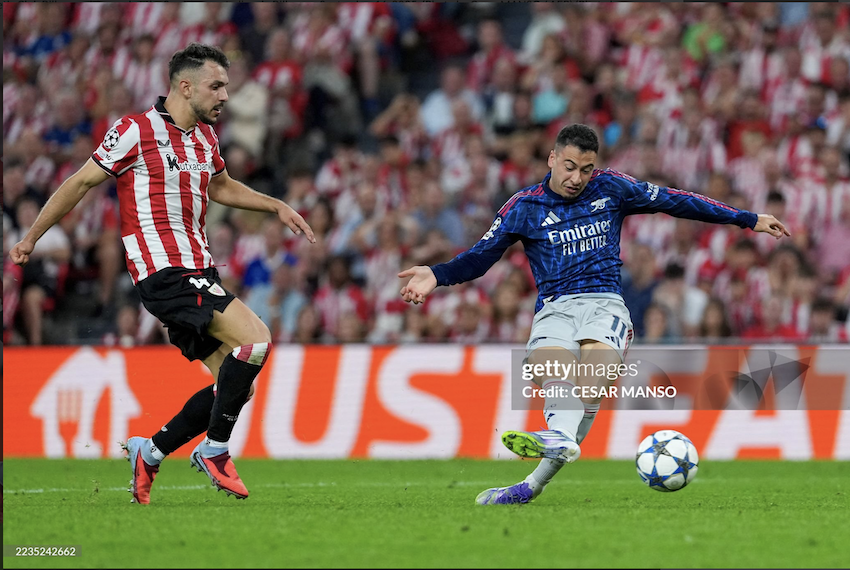
On 70 minutes, Eze, after an anonymous game, was taken off and recent boo boy – why is clearly beyond my pay grade – Martinelli scored after less than a minute.    I was in Madrid that night in April where we sang his name for an hour post match while locked in at the Bernabeu. The same chant rang out from the 2,500 Arsenal fans again. “Bella Ciao” has fantastic ictus and is joyous to behold, thus it’s a most appropriate song for Martinelli. 

After the goal, the game increasingly came to resemble an episode of M*A*S*H, with bodies everywhere requiring medical attention. Madueke was rightly booked for time wasting at a corner.

On 86 minutes, the two subs connected again, with an excellent pacy run from Martinelli who cut the ball back from the bye line to Trossard whose shot from the edge of the 6 yard box deflected up and over the keeper. 

On 90 minutes, Madueke came off for Nørgaard with Calafiori making way for debutant Hincapié.

Full time: Bilbao 0 Arsenal 2

Conclusions

1. Cast your mind back 1, 2, 5, 10, 20 years. Have The Arsenal ever had such a strong bench?  And this is without White, Ødegaard, Saka, Havertz, Jesús.  

2. Beyond that, it was an uninspiring match, with Bilbao much better than they were at the Emirates in pre-season. At the same time Raya was never really troubled and they looked a bit toothless. 

3. Eze was pretty quiet. Perhaps this goes to show just how lop-sided our play is, making it difficult for whoever starts on the left.

Anyway, onwards for The Arsenal.   Next up the in-no-way financially doped C130y.

« Newer Posts - Older Posts »