Feed on
Posts
Comments

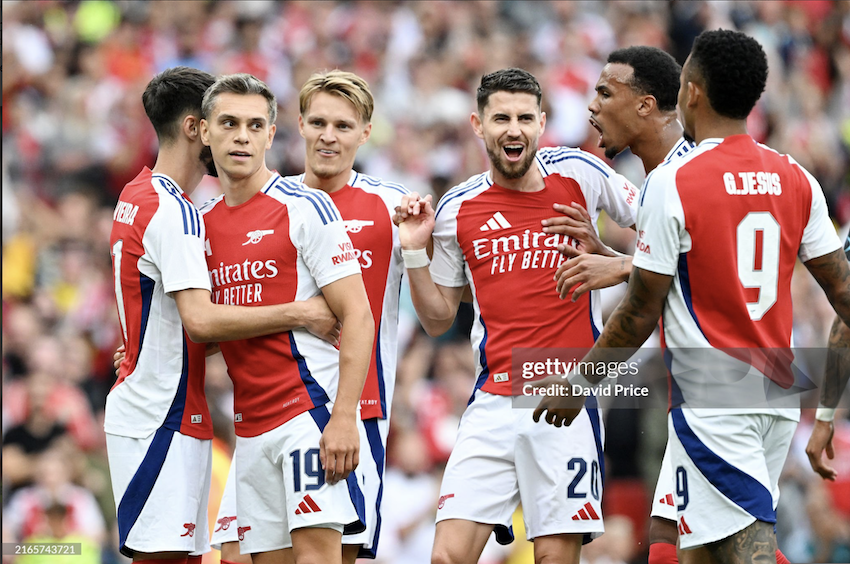
81 days on from the anguish of missing out on the title on the final day, The Arsenal were back in N5. Bayer Leverkusen were in town for the first of two friendly matches on the carpet, with The Gunners facing Lyon on Sunday. 

Arteta named a strong team to take on the Bundesliga champions, although, disappointingly, Timber and Calafiori were nowhere to be seen. Saka and Rice were on the bench hoping for their first involvements of pre-season following their exploits with England at the Euros. Havertz began in midfield and Vieira was given a go on the right.

Arsenal started strongly and we took an early lead on eight minutes through Zinchenko. The Ukrainian played a line-breaking through ball to Havertz down the left, who picked out Zinchenko, who had found more space following Trossard’s clever dummy, and our new number 17 drilled it hard and low into the ‘keeper’s bottom left. 

Almost immediately, we doubled our lead. Trossard stole the ball off the returning Xhaka’s toes, and a few incisive passes later the Belgian sat down the defender and goalkeeper in one fell swoop as he passed home.

We found a third shortly before half time and it was another sensational effort this time from Jesùs. The Brazilian seized possession well inside his own half from a terrible Leverkusen throw in, drove forwards with no Bayer defenders anywhere near him before driving the ball into the ‘keeper’s bottom right corner. Leverkusen were getting carved apart.

Arteta made a couple of changes at the break as the likes of Saka and Myles Lewis-Skelly were given the opportunity to get some minutes into their legs. Whilst Leverkusen sharpened up a notch or two, Arsenal were still comfortable and added to their lead halfway through the second period through Havertz. Nwaneri drove forward from midfield, fed Saka on the right who darted into the box and saw his cross diverted towards Havertz who had the simple task of prodding home for his second goal of pre-season. 

The German outfit found a consolation 15 minutes from time through Adam Hlozek but the Gunners sailed through to full time with a very comfortable win over Xabi Alonso’s “Invincibles”. 

All in all, it was an enjoyable evening back at the Emirates after three months away. You do really miss the whole vibe after such a long break. And these friendlies are always a great opportunity for those who don’t often get a chance to go to games to watch their heroes in the flesh and sample the atmosphere. Whilst I do believe those participating in a Mexican wave and chanting, “Stand up if you hate Tottenham” ought to be banished to Siberia for all of eternity, those of us who do go regularly sometimes take for granted how lucky we are. 

Our annual pre-season trips to the States or to South East Asia as it often was under Wenger, hits home just how global AFC really is and demonstrates how we attract support from all corners of the globe. I only stayed up to watch one of the three stateside friendlies and it makes you realise how big a commitment it is for so many fans to regularly get up in the very early hours to watch Arsenal games, often before going into work or school. If I ever find myself living on a different continent, would I set my alarm for half three in the morning two or three times a week to watch all our games? I’m not sure but for the many that do exactly that, we salute you. 

It was certainly a very exciting performance and one which only fuels the excitement ahead of next weekend’s big kick off. Our pre-season performances up to this point haven’t been bad but they lacked the zip on show yesterday evening. But that’s to be expected when you’re this close to the start of a new campaign. Leverkusen were a week behind in their preparations as the Bundesliga starts a week later and that does make a big difference in pre- season. Having said that many of their stars from last season featured at the Emirates. Ligue 1 starts at the same time as the Premier League so we may see a more physically demanding game on Sunday afternoon. But this was a good run out, nonetheless. 

Onto Sunday!


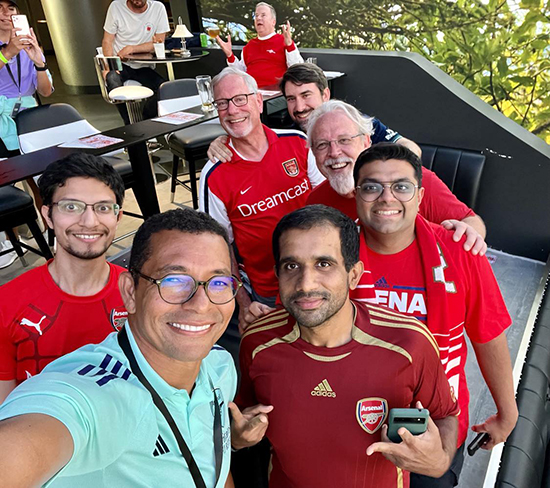
Prad, Amogh, Sumit, your humble scribe, and Julian representing SVG

Another year, another visit to Los Angeles for a pre-season match at the SoFi Arena. Do I sound blasé? Very well, you caught me out. I’ll do better 🙂 This is being posted about ten days later than I’d hoped. Thank you for your patience. Having waited this long for something you probably didn’t know was coming, I hope you enjoy what’s to follow…

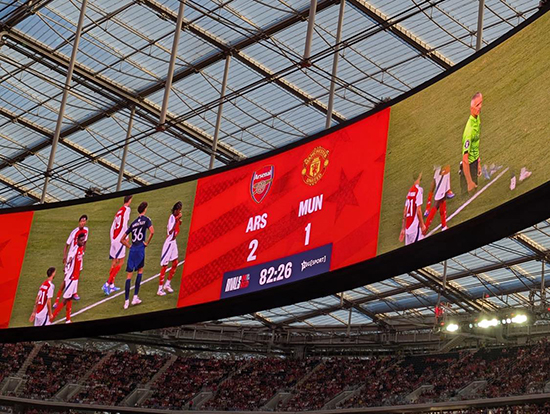
Compared with last year’s trip (memorialized here), this was a marathon that lasted two days longer. The same feelings of cameraderie and care and excitement for the team and sharing that joy with other supporters was present. This time, though, it all seemed a bit more remote from the team itself; that might just be the nature of “second time around”, or it might be that the events generated less frisson and more of a slow burn. In any case on 27 July I got to see Arsenal defeat Manchester United 2-1 (though United “won” the penalty exhibition) at the SoFi arena with 60-some thousand friends, fellow Arsenal supporters, and “enemies”.

What follows is a somewhat linear photo-heavy travelogue, focusing more on my fellow SVGs and the times we had across three days and nights of Arsenal celebration (and, in some cases, a bit of drunkenness).

Thursday

Bobby (left) and Bob, aka the Dufflebags

After parking my car at SVG capo Sumit’s house, I took a Lyft to San Jose airport. I was running late, after working some in the morning, and had to text ahead to Bobby and his dad Bob, who were on the same flight, to tell them to hold it for me :). I was just about the last one on the plane, and ended up one row away from the Bobs. They were heading to other places on arrival at Los Angeles; I stayed at the same Culver City hotel as last year, and after getting settled my sister picked me up for a drive over to the first event, at COSM, an entertainment space in the SoFi stadium universe. She and I had a lovely couple hours drive and chat, waiting for the event to begin.

She left me, and I went into the event space and met up with Bob, Bobby, and Prad, and then Nikunj and Lakshya; I’d seen the latter three at our supporter’s bar (Jack’s in San Jose) but hadn’t really chatted with them before. I was pleased to get to know them better over the coming days.

We sat on the left side facing for the event, which included some awesome highlights of the 23-24 season and a podcast by Andrew Mangan, James McNicholas (Arsecast), and Clive Palmer and Elliot Smith (ArsenalVision). Their discussion was interesting, though I cannot remember much of it given the Manhattans I was drinking… COSM was incredible visually, similar in my imagination to the Sphere in Las Vegas, with fewer seats and less scope.

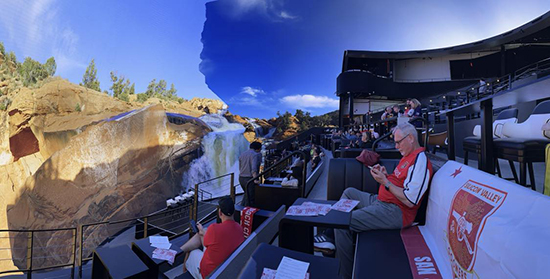
The color change in the sky was the changing of the image. Bob was on his phone.

Theo and Gilberto were wandering in the crowd. We didn’t get to meet Theo, but Gilberto came down to where we were sitting and I introduced myself again after last year. He (no doubt) didn’t remember me, but his sweetness and kindness and joie de vivre was evident as he took a selfie (an ussie, actually) with our group; oddly the background turned to Brasilian rainforest just for this picture.

Who’s happy? We’re happy!

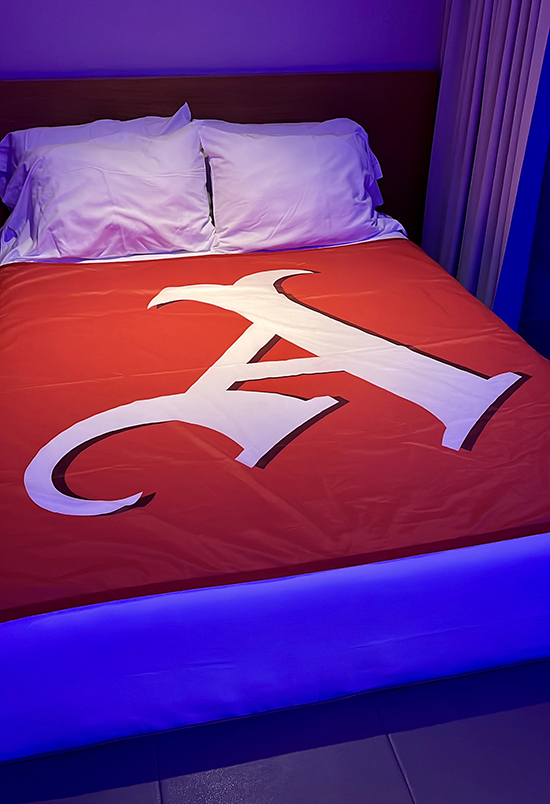
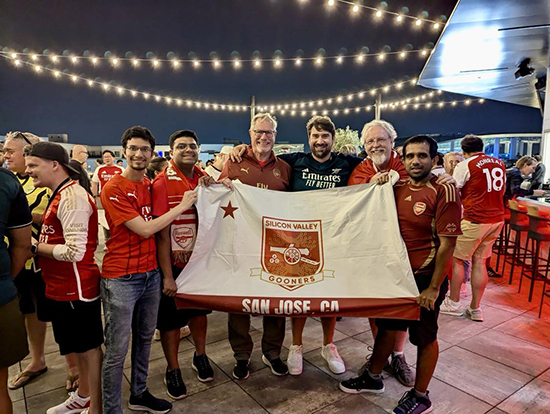
At some point as all this was going on the folks from Arsenal America (one of them, anyway, who shall remain unnamed) was tossing out flags for lucky recipients. I asked if there were more that she was going to throw, and she invited us to take a flag that had been flown at the Emirates last season that was spread out on the tables on the level below. I used it as a bedspread that night.

We all went outside to have some drinks on the terrace after the show inside. I met Justin, who’d just moved down from the Bay Area to be a rocket scientest in Los Angeles, and had a nice chat with Stuart Macfarlane; he told me some stories about Mø the Photographer, and Jack Wilshere at the 2014 FA Cup Parade I’ll be glad to share over drinks some time when we meet…if you’re buying.

Lakshya, Nikunj, the Dufflebags, me, and Prad on the COSM terrace.

Friday

After a late start on Friday I again got sandwich at Sorrento Market (see last year’s post), did some work, and then met with best friend from high school for the first time in 12 years. He picked me up, and we drove to the garment district downtown and the Bendix Building, to visit the Track 16 Gallery and see his art on exhibit (“Number 101”). Weirdly enough, my mother’s father used to work in the Bendix Building in the 50s and 60s! It has great views of downtown, and Track 16 had some excellent art that brought me right back to my days as a young man in Los Angeles. Best of all, I got to spend time catching up with my friend and assessing current events. What a lovely (re)connection; I look forward to future visits!

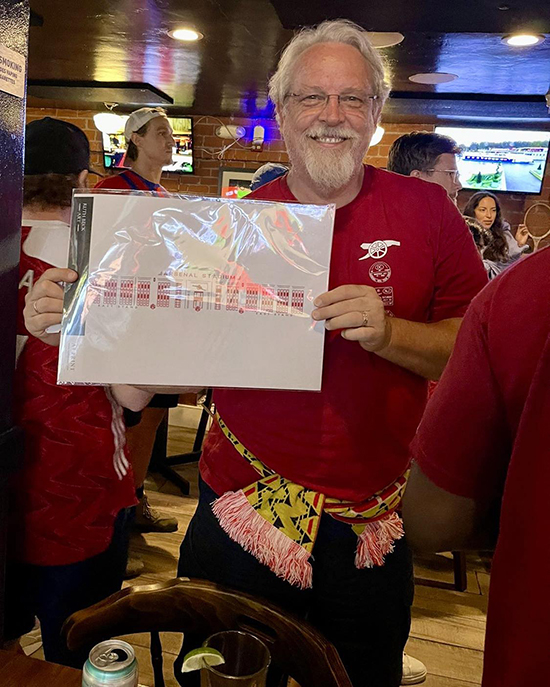
He dropped me on the border of Santa Monica and Venice, and I had to make my way via Uber to Hermosa Beach at rush hour. There was a gathering of Arsenal fans at the Underground Pub in Hermosa, which included a fundraising raffle for Mike Feinberg’s Gooners vs. Cancer charity. I ate some small dinner while drinking beer, and had a chat with Mike as the pub filled up with Arsenal fans. And then I won the first prize of the raffle! This led to more drinking, and we repaired to another bar after midnight that was still serving food and had a band. We were all tucked in by about 2 am.

My raffle prize. I’ll have it framed and hang it in my office.

Saturday

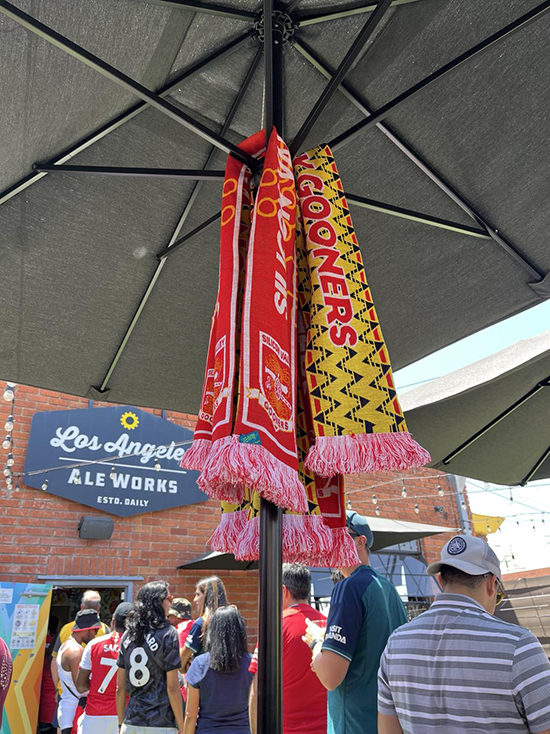
It was another late start, this one even a little groggy, but I was downstairs for breakfast at 8…and upstairs for a nap at 8:30. It was the day of the game, and there were pregame festivities at the LA Aleworks in Hawthorne (not terribly far from the stadium). I got there just about 11:30 am, and was one of the first SVGooners there…but met Rishi and his lovely partner whose name I just cannot remember. To mark our table we had our own scarf tree!

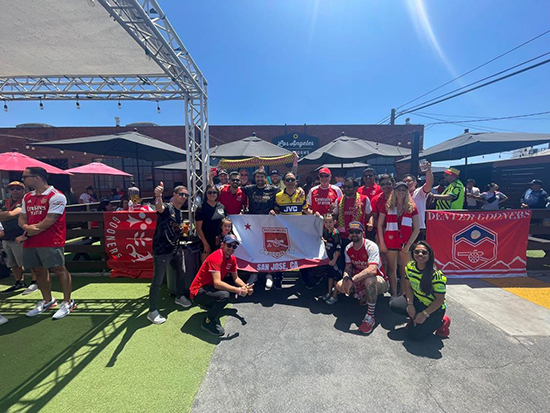
Eventually there were a couple hundred Arsenal fans gathered, including most of our SVG crowd, drinking and laughing, anticipating what was to come in a few hours.

Mike Feinberg joined us, rear left by the space frame post.

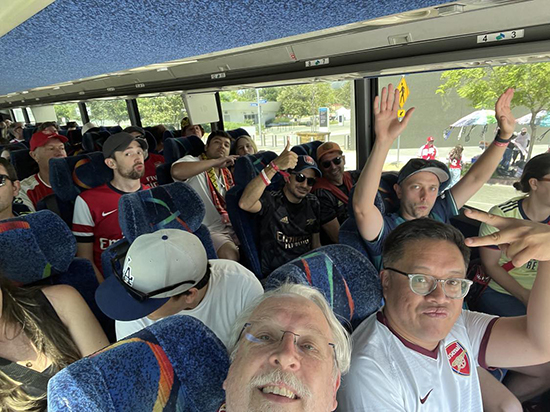
Eventually we loaded into bus that would take us to the game. Last year I think the small size of our group, and the intensity of it being the first time at SoFi led the busride to be full of chants and laughter. This time there was some of that, but it was much more diffuse. That happens, I guess!

On our way!

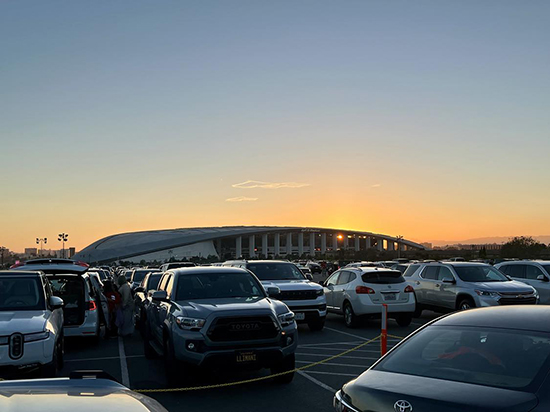
The bus dropped us very close to the stadium this time, rather than in the local neighborhood. However, we had no idea where it was going to pick us up! Nonetheless we went straight to the “tailgate” hosted by Arsenal America where there was (bloody expensive) food, swag, a crowd of Arsenal fans, and lots of sun.

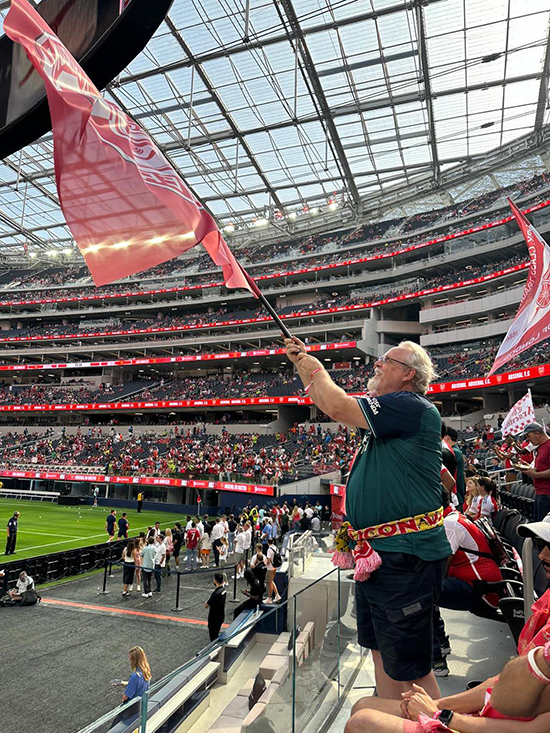
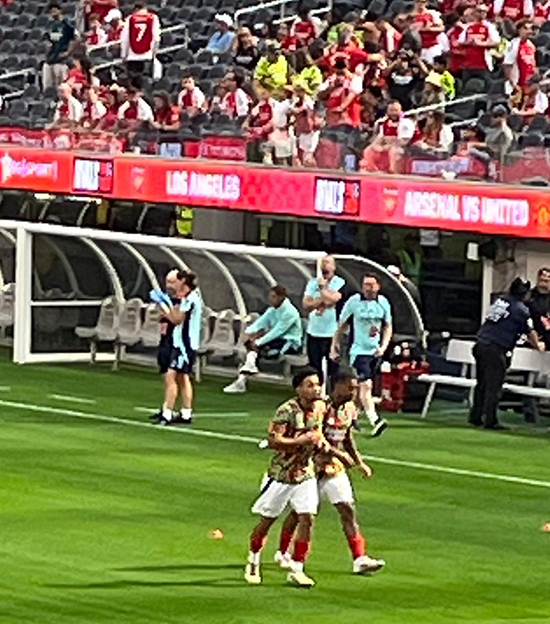
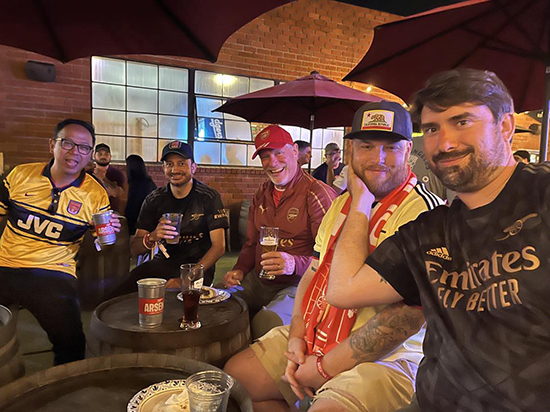
Finally the stadium gates opened and I made my way down to the front of Section 102, right behind one goal. I met up with Sumit, Beau, and Amogh, with whom I was sitting in row 8; Prad and Julian joined us from their seats in the next section pregame. Walking the area between goal and stand were various players and people we all know, including Stuart Macfarlane, Theo, and Stubbsy (who would hold his own vocally against a United fan singing “Gooooooooooooooooooaaaaaaaaaaaaaaalllllllllllll” in the pregame festivities…well in, Frank!). When Theo heard our “Theoooooo” chant and looked up at us, I held up his famous 2-0 to the Arsenal (from his stretcher on the way off the pitch against Tottenham), and he saw it and laughed. We saw Stuart going back and forth taking his usual pictures…so we yelled for him, and sang “We love you Stuart, oh yes we dooooo…”, and stood there miming he should take our picture. Well, you can see the result at the top of the article! Thanks, Stuart!

Arsenal’s staff had left flags on poles to be waved in our section; we grabbed one and carried it to our row, where we four were sat both in front of and behind *gasp* ManUre fans…and in a so-called Arsenal section! We did our best not to hit the sweet family in front of us, but if we blocked the view of the folks behind, well, too bad…sit in the United section next time.

Pregame joy!

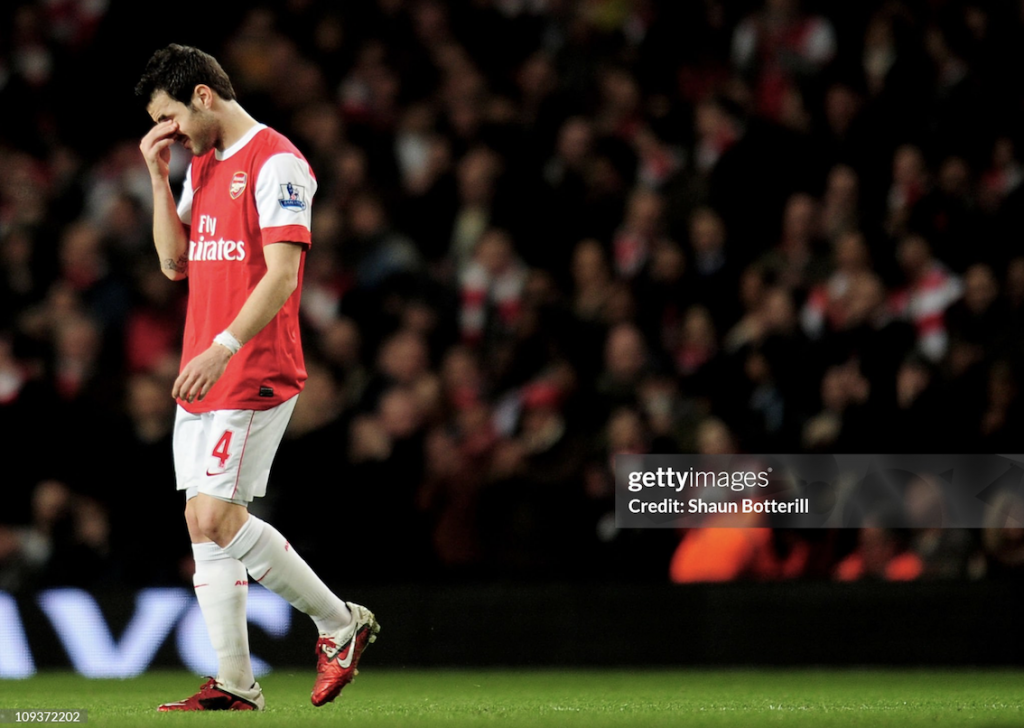
We saw ESR trudging across the pitch and sang to him, but he wasn’t having it. He cut a really sad and lonely figure throughout the evening, and we knew he was gone (as we have since had confirmed last week on the .com). So, so sad.

ESR with his legs crossed…he was just so sad, we could feel it in the stands.

The game was interesting, with United hitting us relatively easily on the break in the first half, but conceding a goal 15 minutes after they scored the opener. The rest of the half was played roughly at evens, and the second half we held our own strongly, winning out on Gabigol’s 82nd minute goal right in front of us…

After we clapped the team down the tunnel it was back to the bus, and on to Aleworks for Doner kebab/wraps with Belgian sauces, and finally back to my hotel for bed.

A group of SVG staying South of the airport went out to another bar, but having partied nearly every waking hour since turning 60 three days earlier, I was cooked :).

Julian, Sumit, Bob, Zach, and Bobby trying to generate some energy after the game.

Sunday: As before, Exhausted and Replete

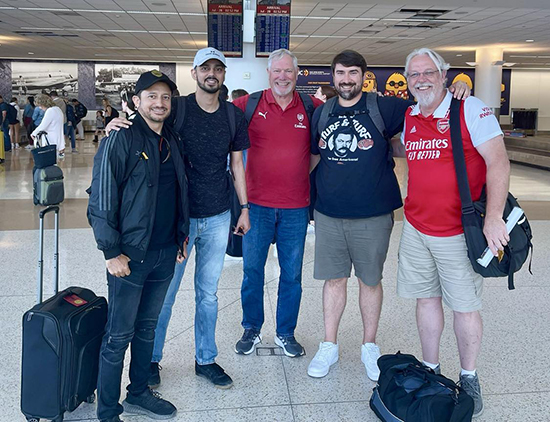
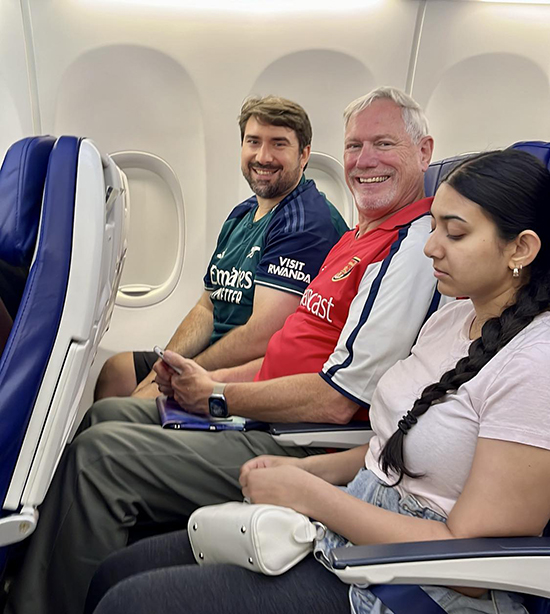
It was time to go home. One more stop at Sorrento after checking out of the hotel, this time sopressata with provelone and all the fixings (except mayo!). The Uber picked me up in front of the deli, and I met up at the LAX gate with the Dufflebags, Sumit, and Amogh. We were all just that bit worse for wear, comparing notes on what we’d heard about ESR, Molino, and the finalization of Calafiori’s signing. Then it was onto the plane (we all sat in adjacent rows), and home to San Jose and one last picture.

Much fun was had!

Overall it was an exhilerating and fun trip. What was a two day whirlwind last year (wherein we kept the intensity high all the way through) was less of a sprint this year, spanning just about four days of events, bars, sun, and excitement. As with last year the people we met were excellent, and meeting other Arsenal fans, and especially getting to know better the folks from my Silicon Valley Gooners supporter’s group, was a real treat. If Arsenal ever pre-season in your town, or come within a couple-three hundred miles of you, I highly recommend going…you’ll meet some great people, have a great time, and probably will get to see some lovely football. In any case, your Arsenal supporting will take on another dimension, and will bring you joy…

The Twenty Tens – A sea change of a sort

Arsenal found themselves under pressure as the new decade opened. It had always seemed a matter of time before Cesc Fabregas returned to his boyhood club in Barcelona, and eventually he did make that move; only his loyalty to Wenger delayed it for a season or two. Barcelona managed by Guardiola and featuring several World Cup winners just had too big a pull for Cesc, who had signed a remarkable seven-year contract with Arsenal. Samir Nasri moved  to the Etihad badmouthing Arsenal in the process. Good player but the prevailing feeling was good riddance. Wenger made some equivocal statements about big clubs not selling their best players but at the same time he seemed to accept the financial rationale for the major sales Arsenal were forced to make. City had already raided Arsenal for Clichy, Toure, and Adebayor.

The season after, to the disgust of many Gooners Robin van Persie, possibly the hottest striker in Europe, revealed a hitherto hidden affection for Manchester United. Viewed objectively it was a ruthless decision, just as was Sol Campbell’s a decade earlier, and it paid off as he immediately led United to the title. But it also underlined that Arsenal could no longer realise the ambitions of their best players and van Persie’s mind might have been made up by a catastrophic 8-2 defeat at Old Trafford the season before where a side quite unworthy of the traditions of Arsenal took the field against United. It was humiliating in the extreme and many thought it unnecessary that Arsenal should go into a season with such a threadbare squad. Though Wenger righted the ship as he so often did, bringing in Per Mertesacker and a Spanish lad called Arteta who were to play a huge part in the development of Arsenal (and still are), the feeling persisted that Arsenal were not serious title contenders anymore. It felt much worse to be patronised by Ferguson than it did to be hated by him! Arsenal embarked on a trolley-dash after the United humiliation (with very mixed results) but only after knowing that qualification for the Group stage of the Champions League was assured. That illustrated the financial pressure the club was under. It is probably fair to say that despite the massive debt that Spurs have incurred with their new stadium they appear to be under less financial pressure despite a significantly bigger debt burden than Arsenal were six years after moving into the Emirates. Is this a tribute to the better financial planning of Daniel Levy, a sign of the changing financial dynamics in high-level sport or might it be a condemnation of poor commercial management by Ivan Gazidis as Arsenal failed to generate anything like the funds Spurs have in terms of commercial revenue after moving, a move which was ostensibly to improve Arsenal’s financial situation?

On the football front , one of the most emotional returns we have seen at the club occurred in 2012 in the third round of the FA Cup. Thierry Henry had returned on loan from New York Red Bulls before the US season began and was on the bench for a third round tie with Leeds. The game was locked at 0-0 when the great man returned to a huge ovation. Superstars write their own scripts and to no one’s surprise a few minutes after he arrived, Thierry took a Song pass and slipped a trademark finish into the right hand corner for the only goal of the game. The ground erupted. Thierry hadn’t scored his last goal for the club as we feared four years before and even the Leeds fans seemed caught up in the drama of his return.

Tottenham achieved Champions league qualification again two years after their first spell in the competition but were generally eased out by Arsenal in this respect over the next few years, often on the last day of the season! Redknapp had made them competitive and had overseen their first victory at Arsenal for years when they recovered from a 2-0 deficit to triumph 3-2. But ‘Arry was jettisoned in favour of Andre Villas Boas, who remains a divisive figure both at Tottenham and at the Bus Stop to this day. Bale was sold to Real Madrid, a sale as inevitable as Fabregas’s sale to Barca, just as Arsenal brought in Madrid’s Mesut Özil, a record purchase to be followed by the addition of Alexis Sanchez the season after. Tottenham were accused of wasting the bounty produced by Bale’s transfer fee and there was a feeling that he would be impossible to replace. But Tottenham were still  improving steadily. St. Totteringham’s Day arrived with increasing drama and uncertainty but Wenger’s Arsenal achieved a flurry of success winning the FA Cup against Hull in 2014 and Villa in 2015. In retrospect if Wenger had exited then his reputation would have been even higher among the fans. But then again he had built one of the best sides in the league — why leave at that moment?

The following year Spurs, having brought in Mauricio Pochettino, put in their best challenge for the title in most peoples’ living memory. It was the season when Leicester proved triumphant and Arsenal frustratingly dropped out of contention although they beat Leicester twice. Tottenham eventually handed the title to Leicester after a frenetic draw at the Bus Stop where they had led 2-0. Harry Kane was now the idol at White Hart Lane and was a formidable striker who liked to score against Arsenal despite a series of pictures suggesting that as a boy his first love was the Gunners! Arsenal had rejected him at eight years of age for being too tubby!

What gave the season an ironic twist was that having failed to match Leicester, Tottenham‘s form completely collapsed and they subsided to a 5-1 defeat at Newcastle on the last day of the season as Arsenal slipped by them into second and invited in St. Totteringham again. But Pocchetino was at last proving the leader that Tottenham had craved for years. Players like Kane, Dembele, Dele Alli, Eriksen, and Lloris gave them a quality squad, and Pochettino managed to remove the curse of St. Totteringham in 2017 as Tottenham finished second, albeit seven points behind champions Chelsea, their highest finish for almost sixty years. Arsenal failed to reach the Champions League for the first time in nineteen years but still won the FA Cup 2-1 at Wembley against Chelsea. Wenger used this as a springboard to negotiate a new contract with Stan Kroenke the day after the final. That was, in retrospect, a mistake for both parties. In 2019 Tottenham were the kings of North London and to everyone’s surprise, not least their own, came back from a 3-0 deficit against Ajax to reach the Champions League final in Madrid against Liverpool. This was the biggest moment in the club’s history and for a few weeks leading up to the final Arsenal fans were fearing that Spurs surely couldn’t land the Champions League, could they? They had a slightly fortuitous run to the final, looking likely to be eliminated at the group stage before Barcelona played a weakened side in their last game and being the beneficiary of some eccentric VAR decisions at the Etihad. Their win in Amsterdam was the stuff of pure legend as Lucas Moura notched an epic second half hat-trick.

When the final arrived Spurs were hugely unlucky to concede one of the softest penalties ever given in a major match in the first few minutes, Salah scoring, but in truth they gave a supine performance with Kane clearly not fit and lost 2-0. The Collins dictionary actually describes a condition called ‘Spursiness’ –  to snatch defeat from the jaws of victory or to fall short with the prize in sight.  Spurs showed their Spursy side in their last two League Cup finals and could have put up a much braver show in Madrid. But they seemed to lack intestinal fortitude under pressure.

Nevertheless, reaching the Champions League final underlined their progress in a major way. Plans advanced for a super stadium to be built on the existing site in Tottenham High Road, one of the least accessible places on earth. While the stadium was being built Spurs played at Wembley Stadium, a place that they had not visited very regularly before! To be fair Tottenham had overtaken Arsenal in terms of team quality even if Arsenal had retained the knack of winning trophies.

Arsenal’s failure to make the Champions League in 2017, was a huge blow to the club in both financial and status terms. There was a well of toxicity at the Emirates which made home games quite unpleasant experiences on occasions. It became a club divided. Marches in protest began as banners claiming ‘In Wenger we rust‘ were unfurled and were a very sad way for the Wenger era to unwind.

Arsene Wenger eventually left Arsenal in 2018 and was given the gold Premier League trophy in commemoration of his service to the club. It was so sad that his later years saw rancour and division. By the time of his departure most fans, certainly those who were regular attenders felt his time was up, indeed it was generally felt that it had been for some time, but there was an enormous well of affection and respect for a man who gave his life to the club and achieved so much. He was a visionary, a control freak, a man of huge integrity, and he gave Arsenal fans memories they will  never forget. But he stayed too long.

His replacement , Unai Emery began well and almost achieved Champions League qualification in his first season; he led Arsenal to the Europa League final in Baku where the team gave an anaemic performance in a 4-1 thrashing by Chelsea. In his second season things deteriorated quickly with a very divided dressing room and some of the most highly-paid players at odds with the club. His eventual replacement, just in time for the new decade, was Mikel Arteta, the former captain of the club who had coached at Manchester City under Pep Guardiola after retiring from playing. His close friend Mauricio Pochettino looked set to lead Spurs up that final step but within a year football was hit with a crisis it could never have envisaged and had to adapt to a very different world.

2020 vision- what is the trajectory of the clubs?

There may be readers of this analysis who were hitherto largely unfamiliar with the respective  histories of the clubs. Trying to look objectively at Tottenham’s story it would seem that for years they had sought a leader who could bring the combination of stability and quality that Wenger had brought to Arsenal. In May 2019 Tottenham had contested the Champions League Final in Madrid. It was the high water mark for the club as it would be for almost any club and their manager Mauricio Pochettino had achieved it whilst recapturing the style of football that Spurs’ fans had claimed was the club’s birthright. But in November 2019 Daniel Levy decided to remove Poch, as a slow start saw some Spurs fans suggest he had ‘taken the club as far as he could’. How often that label has been pinned to  managers who have radically overachieved at a club. They have usually gained access to new, unprecedented horizons by very good coaching. They replaced him with the controversial Jose Mourinho, that most abrasive and unpleasant of characters. If Arsenal fans had been polled to suggest the most divisive new  coach for Tottenham, and one likely to create a stress fracture in the club, it would almost certainly have been Mourinho who  they would have nominated.

Levy had overseen the move to Tottenham’s new stadium, the new White Hart Lane. It was completed some time behind schedule but it brought excitement to a club that were desperate for some sort of positive differentiation from their North London rivals. It had a number of state-of-the-art design features which enabled it to be used for NFL fixtures, Rugby league finals, boxing, and pop concerts. It was a very clear way of generating significantly increased revenue. In the dozen years since the  Emirates opened, stadium features and technology had advanced a great deal. You could even now fill your beer glass upside down! It made the new stadium a goldmine. But a number of Tottenham fans were asking what was the point of generating this increased revenue whilst the side continued to underperform on the field.

ENIC Group is owned by the family trust of Joe Lewis. ENIC’s Bahamas-registered subsidiary, ENIC International Limited, currently holds 86.58% of the total issued share capital of Tottenham Hotspur. Daniel Levy and his family own 29.88% of the share capital of ENIC International Limited, while a discretionary trust of Lewis’s family owns 70.12%. Levy has become a very rich man during the almost quarter century that he has been in charge at Tottenham. A lot of simple Spurs folk claim with a mixture of pride and anguish that Daniel Levy ‘is a very good businessman‘ and ‘a great negotiator‘. But what he manifestly isn’t is a Chairman with a stellar record of onfield achievement. When he became chairman Tottenham had won eight FA Cups to Arsenal’s seven. Since he has been chairman Arsenal have won the trophy another seven times. Spurs have never reached the FA Cup Final during his tenure. One trophy in twenty three years (and that the least significant of the domestic triple ) is not a cause for celebration and makes it very hard for Spurs to claim that on playing record they are a really big club. They have a wonderful stadium and a tradition of fine football played by great players but they are not consistently in the mix for the big prizes.

Mourinho did get  Tottenham to a League Cup Final in 2021 but was fired before the final where Ryan Mason took charge; Mason was then replaced by Nuno Espírito Santo, and then quickly afterwards by Antonio Conte. In a period of five years they have had (not including temporary sticking plasters ), five big name managers — as many as Arsenal have had in thirty-eight years. Hire and fire worked effectively for Chelsea in the Abramovich era but it was coupled with astute purchases in the transfer market. The sense is that Tottenham lack an effective touch in the market, and they are a harder sell to world-class players who like to fill their own trophy cabinets rather than just see the shareholders making themselves richer.

Arsenal had made Unai Emery their new manager, the successor to Wenger. Emery has an impressive record in Europe but seemed to become less and less effective in his second season and Arsenal replaced him with Mikel Arteta. KSE, Arsenal’s shareholders, were not warmly regarded by most Arsenal fans. Stan Kroenke was known as ‘Silent Stan’ because he was not a frequent or effusive communicator and his early strategy seemed to be to  pile in behind Arsene Wenger who had turned Arsenal into a cash cow.

The choice of Arteta, who was seriously considered when Emery was appointed, was brave. It was his first managerial job and a few months into the job he was the first major soccer casualty of the Covid virus. He made a steady start with a woefully unbalanced squad and then had to face the extraordinary challenge of empty stadia and all that Covid brought. He halted a potential slide towards relegation and switching to three at the back took Arsenal to Wembley in the FA Cup where they first beat Manchester City in the semi final 2-0, and then overcame Chelsea 2-1.  All four of the goals were scored by Pierre Emerick Aubameyang, who was subsequently given a huge contract which gave him in excess of £300k a week. It proved in hindsight to be a poor decision although Auba helped Arsenal to a Community Shield a few weeks later; but Arsenal’s form fell away thereafter. At the end of the season Arsenal finished 8th, out of Europe altogether, and Spurs qualified for the Conference League in 7th. Bale returned on loan to clinch the poison chalice of Europa Conference League football. 

Towards the end of the 2020/ 21 season 12 European football clubs collectively issued a letter of intent to form a new European so-called ‘Super League’, of which they would be the founder members. Spurs and Arsenal both signed up to a project that unravelled almost as quickly as it appeared. Both North London clubs distanced themselves from the project fairly quickly and in apologetic terms which seemed to presage a different approach to the fans at both clubs. One could be forgiven for thinking that Arsenal in particular had felt a penny drop about what English football fans expected of their club owners. The ESL project is certainly not dead, but is currently quiescent and it will be interesting to see what might happen if Manchester City are heavily sanctioned by the Premier League if found guilty of the charges lined up against them. The ESL debacle threatened to undermine the relationship between owners and fans but it seems that it may, inadvertently, have improved owner understandIng of what constitutes a football club, especially a Premier League club situated in North London.

Antonio Conte was a successful winning manager who had just helped Inter Milan to the Italian title but he was not reticent about making public pronouncements about the support he expected from his board. Arsenal‘s board was effectively irrelevant in the decision-making process after KSE became the only shareholder in the club, and changes were made with Raul Sanllehi following Ivan Gazidis and Sven Mislintat out of the club. Tim Lewis was playing a much bigger role in the governance of the club, and Josh Kroenke was appearing to be an emotionally very intelligent and supportive confidante of Arteta, who needed one as Arsenal began the 21/22 season disastrously. Arsenal lost the first three games, the last a humiliation at the Etihad. Josh kept the faith, refusing to panic, and he was proved right.  Arsenal almost made it back into the Champions League at the end of that season. In mid-season Arteta insisted the club get rid of Aubameyang and the owners backed him. What made it very painful was that Tottenham overtook Arsenal to claim the 4th place and Champions League football,  winning a crunch match at the Lane 3-0. In that match Tottenham looked a much more mature match-winning machine than Arsenal, who fielded players like Cedric and Rob Holding (who was sent off early on). But overall Arsenal had shown progress and it continued the next season as Arsenal raced into a huge lead in the League, in a season interrupted by a winter World Cup. City eventually overtook Arsenal but the Gunners were in a clear second place and did the double over Tottenham who finished out of the European places after they disposed of Conte. There was again a feeling that Arsenal had stability and vision and Tottenham were back to square one looking for a Messiah to lead them out of the football wilderness.

They chose as their Messiah Ange Postecoglou, the Celtic manager and a straight-speaking Aussie. A lover of the high press but someone whose inability to make eye contact was reminiscent of a previous Spurs manager, Gerry Francis.

Arsenal built ambitiously on their fine season in 22/23 with the huge purchases of Declan Rice and Kai Havertz. Postecoglou bought well too, obtaining the rapid Dutch defender Micky Van de Ven, and Vicario an upgrade on Lloris in goal. But the loss of their record goalscorer Harry Kane to Bayern Munich was a grievous pre-season blow. Arsenal carried their challenge to City right through to the end of the season but City put together win after win until with two games to go they travelled to the Lane where they had an atrocious league record.  The preamble to that game encapsulated all of the toxicity we have noted accumulating over the years between the clubs. Surveys in the media and articles in the press suggested Spurs’ supporters would prefer relegation to Arsenal winning the league. To his credit Postecoglou rubbished this attitude but one sensed he was shocked by the way this obsession with Arsenal defined Tottenham in their fans’ eyes.  Spurs played well on the night but Son clean through with an easy chance near the end saw Ortega make a fine save, and Arsenal’s chance of the title was gone as City triumphed 2-0.

I had many bitter discussions with Spurs fans around this time. The gist of their argument was that Arsenal are deeply arrogant and they could not take more songs about winning the title at the Lane or stealing away Tottenham’s captain on a free or seeing Arsenal emerge supreme in the Premier League.  It is hard not to feel that  their obsession with Arsenal limits the potential of the club. Sixty plus years without a title has taken its toll but beyond that they have only won two League Cups in thirty five years . They start next season outside an expanded Champions League when a few weeks before they looked likely to finish above Aston Villa. Can Postecoglou reverse this inferiority complex and can Arteta take Arsenal beyond City at the third attempt?

The present day – Business as usual?

This has been a much deeper dive into Arsenal/Tottenham history than I expected it to be. I wouldn’t claim for a second that it is a truly balanced view, but I have genuinely tried to discover and reveal the culture and traditions of Tottenham Hotspur Football Club as well as those of Arsenal. I haven’t touched on things like the ‘Y’ word and why Tottenham consider themselves the club who represent the Jewish community in North London, when there is evidence that Arsenal has just as many Jewish supporters. One senses Tottenham crave a unique identity even if it is not truly authentic.

The toxicity that I allude to often is a product of modern society. Local rivalries all over the country seem to be channelled into more and more aggressive, a confrontational aggression illustrating a keen lack of respect for the other club. Social media facilitates this…

I was in Norwich recently, and the rivalry with Ipswich is deep and heartfelt and very uncompromising. Southampton and Portsmouth reflect the strong  city rivalries through their football teams. United and City in Manchester, and Liverpool and Everton, are very strong rivalries and reflect intense tribalism. Frankly I don’t feel that strongly about Spurs as rivals because consistently over the last fifty years Arsenal have out-performed them. I certainly wouldn’t prefer Arsenal to be relegated to Spurs winning the league. It is a ludicrous notion and maybe that is why I don’t consider it seriously. I suspect most sane Arsenal fans feel the same.

This season Arsenal are genuine contenders for the league title but much will depend on what punishment (if any) is meted out to City. Tottenham are probably not contenders for the title but they could be a top four side, although Postecoglou’s naive ideas on high lines and when and how to press may prove their undoing if they continue to be ultra-aggressive. If Tottenham don’t start well Postecoglou will come under pressure. His popularity waned a little as last season went on and Tottenham dropped several home points or made heavy weather of beating struggling teams. One day Tottenham have to find a good manager, back him and stick with him or the rinse and repeat cycle will go on. And while Spurs fans have to regard Arsenal as rivals they must not allow Arsenal to live rent-free in their heads, nor to decide whether Spurs have a good season or not by how well Arsenal have done.

It is an intense rivalry, frankly it is too intense, and last year’s City debacle underlined how obsessional and toxic things have got. But in the frenzy of competition I don’t expect that to change any time soon. The two North London giants are great clubs but given the size of their followings a peaceful co- existence is unlikely!

Arsenal have a motto ‘Victoria Concordia Crescit‘ (Victory through Harmony) which is a fair and meaningful assessment of how to succeed in football (and in life). Tottenham’s motto ‘Audere est Facere’ (To Dare is to Do) has always bemused me largely because, unless I am missing something, it is effectively meaningless. It seems to speak to a bold, gladiatorial approach to life, and Postecoglou certainly has rekindled that passion, but that isn’t really what the motto says. It is ill-defined and one would expect that if it correlated to the football approach they have, the motto might change slightly every few years and never quite epitomise what the club wants to be about.

The rivalry continues, often producing the most exciting head-to-head derbies in the league, and the passion and dread of defeat never wanes. One thing that unites almost all Spuds and Gooners is that before each Derby they dread the outcome. It is a wonderful game to win but a hideous one to lose. It is a rivalry that is white-hot and bitter.

Underneath it all I choose to remember those eminently decent Spurs fans gently bowing their heads in 2001 as a stadium wept for Rocky. Decency writ large. I hope that respect and understanding can always underpin the passion but recent events suggest it is a forlorn hope.


Enjoy the new season playing the Goonerholicsforever Prediction Contest, in aid of the Willow Foundation!

Can you harness your inner Mystic Meg and out-predict defending champion Pangloss in foreseeing the final Premier League table for the 2024-25 season? 

Will you be more clairvoyant than CER and GSD were last season in predicting the FA Cup winner? Or TTG and Uply when it comes to the League Cup? 

What’s your bet on the first manager to get the tin tack this season? Have you got a better inside track or insight than Dr F. Jnr?

You can only find out by entering the 2024-25 edition of the GHF Predictathon.

Again, the purpose of the contest is twofold. Firstly, it is to increase your enjoyment of the upcoming season by providing a degree of light-hearted competitive rivalry as the season progresses. Secondly, it will enable us to support the Willow Foundation with a further source of charitable funding.

Check out the “GHF Contests” tab at the top of the page for The Rules, the entry blank and information about how to enter the contest, and how the contest will be scored.

Good luck!
The Nineties – Only one side in  it

As the nineties began both Spurs and Arsenal could face the future with excitement. The team from N.17 had recruited as manager arguably the best coach they have had in the fifty years or so since Bill Nicholson retired. Terry Venables was a hot property when Spurs acquired him in 1987, and he had a squad that had some stellar talents in Paul Gascoigne and Gary Lineker. Arsenal had failed to retain the title they won in 1989 but the team that took the title in 1990/91, while rarely compared with the Invincibles, came extremely close to going unbeaten through a season — and a very difficult season at that. They lost only one game, at Chelsea in February, and weathered the significant handicaps of having skipper Tony Adams ‘banged up‘ for several weeks for drink driving and having two points deducted for a brawl at Old Trafford in October.

Before the season, Graham had shown his ruthless streak by replacing John Lukic with David Seaman from QPR, who had probably the best season I’ve ever seen an Arsenal goalkeeper have. Arsenal also signed a mercurial Swedish winger, Anders Limpar, who the fans loved much more than Graham did! They strolled the league and were expected to do another double when they ran up against Spurs in the FA Cup semi-final at Wembley. An extraordinary free kick from Gascoigne and two Lineker goals gave Spurs an unexpected 3-1 win. A hyped-up Gascoigne ended up destroying his knee in the Final and Lineker had a penalty saved but Tottenham added another FA Cup to their collection with a 2-1 victory.

It was at this time that Alan Sugar arrived as Chairman at the Lane. Bemused by what passed for normal practice in the football world, especially relating to governance given his corporate background, he crossed swords with Terry Venables who decamped eventually to become England coach. A court case subsequently ensued between the two men as Sugar sued Venables for libel after the publication of Venables’ autobiography in 1994. It was hard to run a football club successfully with all that going on….and Tottenham didn’t! Since Venables took the helm at White Hart Lane up to the present day, Tottenham have had 24 managers, not including some caretaker partnerships that probably few of their fans can even remember. In the same period Arsenal have had five! That tells its own story; but the lack of stability at the Lane was largely of their own making. There were bright moments: Ossie Ardiles took the helm in 1993 and seemed to favour five upfront. For a brief period it was exciting but over time it looked naive and Ardiles eventually went the way of so many other Spurs’ bosses.

George Graham, having built a killing machine of  a team with an extraordinary defence and a fine attack, decided to sign Ian Wright from Crystal Palace, a brilliant and irrepressible goalscorer. But having done so Graham dumbed down the midfield with some of the dullest combinations ever seen in N5. Arsenal continued to accumulate trophies, winning a Cup double (both against Sheffield Wednesday) in 1993, getting revenge for the ’91 semi-final on the way to the FA Cup success. Their football was attritional, relying hugely on Wright to conjure goals (which he did regularly) and then shutting out the opposition with that superb defence. Arsenal took the Cup Winners Cup in Copenhagen a year later, against a very talented Parma side, with an Alan Smith goal. When Arsenal reached another Cup Winners Cup final in Paris the next year (losing to that long range Nayim goal) Graham had been relieved of his duties having been accused of taking a ‘bung’ from an agent for the transfer in of Pal Lydersen. He was replaced by Bruce Rioch, the fortunate benefactor of a decision (driven by Dein ) to sigh two bona fide world superstars in Dennis Bergkamp and David Platt. Rioch lasted one season, having fallen out badly with Wright, but his signing of Bergkamp was loudly criticised by Alan Sugar who suggested the trend to sign  ‘any Carlos Kickaball‘ was ill-thought out and a waste of money. Tottenham nevertheless made one of their most successful forays into the transfer market to sign Juergen Klinsmann, the German striker! Bergkamp was undoubtedly a catalyst in turning Arsenal’s fortunes ’round although he was initially concerned by the firing of Bruce Rioch. A few years ago I nearly bought a house in Norfolk that used to belong to Rioch and the vendor told me some fascinating tales about  Bruce’s time at the Arsenal. But I can’t consign them to print! Let’s just say Arsenal circa 1996 was not an easy club to manage!

Rioch was replaced by a little-known (in England) Frenchman called Arsène Wenger who had been working in Japan after a successful period in charge of Monaco. Wenger faced serious issues with Tony Adams admitting his alcoholism and Paul Merson acknowledging multiple addictions. It was a difficult environment to come into. But, armed with Graham’s back four, and able to harness Platt and Bergkamp and add his own signings like Vieira, Petit and Overmars, Wenger oversaw a revolution in the way the club was run and led Arsenal to its second Double in 1997/8. At the start of the season Ian Wright overtook Cliff Bastin’s record as Arsenal’s all time top goalscorer. But Wenger sensed injuries were marring his effectiveness and brought in a brilliant French striker, Nicolas Anelka to ultimately replace him.

Tottenham’s response was to hire George Graham, whose appeal to most Spurs fans was akin to a cup of cold sick, but Graham led Tottenham to the League Cup in 1998/9. Wenger, working closely with Dein, was transforming Arsenal on and off the field, but Sugar hadn’t helped Spurs to overcome the loss several years before of Glenn Hoddle…who had moved to Monaco to rebuild his career under Arsène Wenger!

Arsenal fans were amused as Sugar publicly berated Klinsmann when he decided to jump ship for Bayern Munich after a couple of personally productive but trophyless years. Sugar suggested he wouldn’t wash his car with Klinsmann’s shirt! When Klinsmann was re-signed a couple of years later on loan from Sampdoria it seemed that Sugar must have found another method of buffing up his Roller! But in his second spell, in a struggling team, Klinsmann failed to make the same impact.

As the new millennium approached Arsenal were a Champions League side  engaged in a titanic contest with Manchester United for supremacy . The treble that United obtained in 1999 might have been an Arsenal double had Schmeichel not saved Bergkamp’s penalty in the dying moments of the Cup semi-final. As we moved into a new century, Tottenham still faced an uphill battle to regain former glories whilst Arsenal were about to reach possibly the most exciting moment in their history.

The Noughties – The Campbell cataclysm

A new century brought a familiar pattern to the positions of the two North London rivals. Wenger was building an Arsenal side that were still trailing Manchester United in the league and starting to adjust to the Champions League. The Champions League was a distant dream for Tottenham who eventually turned from an old Arsenal star to one of their own, Glenn Hoddle, to chart their path forward. Hoddle was a massively talented  superstar and had become a moderately successful England manager. But he faced significant problems. He graduated to the role as Arsenal began to assemble a hugely talented team…and then he was hit with a blow so serious that it still resonates in North London.

Sol Campbell was the rock on which Tottenham’s team was built. As the expiry of his contract grew near there was feverish anticipation as to what his next move might be, with many of the Tottenham faithful hopeful that he would commit to a Tottenham renewal. Many of the biggest clubs in Europe courted him, as he was effectively on a free transfer. It would be wrong to say that he wasn’t linked to Arsenal but the enormity of what a switch across London would signify made such a transfer seem highly  unlikely. But on an early July morning in 2001 Sol Campbell walked into a press conference (that most journalists felt was arranged to announce the signing of Richard Wright) to announce that he was signing for Arsenal! POW!

If there was one moment when the level of toxicity increased between the two sets of supporters it was this one. Not only had Tottenham’s captain switched clubs, inviting a hail of abuse and condemnation from his boyhood club, but he had moved to Tottenham’s deadly rivals..and for free! It was a sensational moment for Arsenal, who didn’t have a bad defence to begin with, adding Campbell at the peak of his powers. To rub a bucket of salt into the wound, Campbell’s first season (which had seen him return to White Hart Lane with effigies hanging from lampposts around the ground) ended in him completing the league and cup double — Arsenal’s third. If ever a move justified the huge personal cost it was that one. Nothing underlined the differing status of the clubs more starkly.

A few weeks before a poignant moment prior to a tense a North London Derby illustrated that some situations transcend rivalry. Just minutes before the 2001 derby at Highbury the tragic, early death of David ‘ Rocky’ Rocastle was announced to the crowd. I winced at the thought of a minute’s silence with thousands of Spurs fans in the ground but to our immense relief the Spurs fans observed it impeccably. They did their club huge credit. A week later the teams met in a third FA Cup semi-final in nine years, this time at Old Trafford. An early Docherty goal threatened an upset but Vieira, who was monumental on the day, equalised and Robert Pires scored the winner.

Robert Pires  had signed from Marseille and Thierry Henry signed the season before from Juventus. Henry’s signing didn’t thrill me initially  because I saw him as a speedy winger but profligate finisher. Early signs were that this was a good estimate as he failed to impress, only scoring his first goal with the winner at Southampton several games into his new career; he disappeared for a while only to re-appear against Derby at Highbury as a much stronger-looking central striker. He was a revelation, and from then on his Arsenal career never looked back. He became the most thrilling attacker we had ever seen in an Arsenal shirt. Arsenal failed to win the Cup in a final at Cardiff against Liverpool where serial handballer Stephane Henchoz got away with murder and Michael Owen ran an ageing defence ragged in the last ten minutes after Arsenal  had dominated and led the game.

Arsenal returned to Cardiff twelve months later with a stronger team including Freddie Ljungberg on fire, but were sadly unable to field Pires, who had ruptured his ACL a few months earlier at a time when he was the most exciting player in the Premier League. Ray Parlour and Freddie notched two second half goals and a few days later produced a performance of defiance and resilience to beat Manchester United at Old Trafford 1-0 to clinch the title. It was a delicious way to wrap up that precious third double.

Tottenham were not enjoying such a good start to the new Millennium. Their first five seasons in the new century saw them finish 12th, 10th, 9th, 14th, and 8th again. It was hard not to feel that Sol Campbell was a very good judge! In 2001 Alan Sugar gave way as Chairman to Daniel Levy. Levy has since been Chairman of Tottenham for 23 years. We will examine his record as we go through the Noughties and beyond.  Hoddle gave way to Pleat, Santini (briefly) and then Martin Jol. We had returned to the sixties in reverse with Arsenal significantly stronger and St. Totteringham’s Day a formality, often occurring in early Spring. Arsenal won another FA Cup in 2003, and should have clinched another double but the zenith of Wenger’s reign was just about to occur, with Arsenal having arguably the greatest league season any club has ever experienced n English football.

Wenger had invited derision a few years earlier when he suggested that it was possible to go through an entire league season unbeaten. By this stage Roman Abramovich had arrived in English football, and as Dein put it ‘was firing fifty pound notes across our lawn!’ But in 2003/4 Arsenal were significantly stronger than any other league team, and their first target was securing the league title. The team contained some wonderful players, among the greatest not only to have worn the red and white of Arsenal but to have played in the Premier League: Ashley Cole, Sol Campbell, Patrick Vieira, Robert Pires, and of course Bergkamp and Henry, were genuinely world-class players. Arsenal had taken the decision to build a new ground at Ashburton Grove, within a stone’s throw of Highbury, but the realisation dawned that it would constrain the spending power of Wenger over the next few years. Some banks were only prepared to lend Arsenal money upon guarantees that Wenger would stay. He was the hottest manager in football and could have walked into any club job in the world. He chose to remain loyal to Arsenal despite working financially with one hand tied behind his back because of his loyalty to and love for the club, Arsenal were truly lucky to have had him at the helm at that time.

This stability and leadership contrasted sharply with Tottenham where Levy continually churned managers to seek success or at least some sort of parity with Arsenal. There are inevitably moments when the gap between rivals appears to be unbridgeable and this period represented one of the most difficult for Tottenham fans.

Arsenal didn’t race away in the ‘Invincible‘ season but they did steadily accumulate points and at times with the group of players that they had they were sublime. A slight stumble at home to Portsmouth where Arsenal trailed, that infamous game at Old Trafford where United got the sort of penalty at the end that only they got, after Vieira was sent off and Van Nistelrooy (Horseface for short) hit the bar — divine retribution served early. I remember watching the NLD at Highbury in Singapore in the early hours after spending the evening drinking with an exiled Tottenham friend. We trailed for over half the game after Anderton scored but Pires got his regular goal against the Spuds and a fortunate deflection of a Ljungberg shot earnt us the points on a day when Tottenham’s play had belied their modest league position. Arsenal tightened their grip on the league with a nine game winning run in the New Year, and had the opportunity to wrap up the title at White Hart Lane with five games to go. It was a game I barely took in at the time as my mother had been taken desperately ill, but it was a triumphant return to the glorious scenes in 1971 (although I am told the Arsenal fans there were in fear of their lives after the latter game). Two early goals by Vieira and Pires set us on our way, but a Redknapp goal midway through the second half was followed by a farcical ending where Mad Jens tried to poleaxe Robbie Keane and conceded a penalty which the Irishman converted to give Tottenham something to celebrate on an otherwise bitter day for the Lilywhites.

Many Arsenal players and Arsene Wenger have shared how difficult it was to motivate themselves to go unbeaten in the last four games and we trailed for a while in a sticky game at Portsmouth until Jose Antonio Reyes, a surprise January signing, equalised. We even trailed to bottom of the table Leicester in our last game at home but an Henry penalty and a beautifully worked move between Bergkamp and Vieira gave us victory. The only sadness of that season was that we exited the Champions League in the quarter finals to a Chelsea team we had beaten three times previously, having drawn with them in the first leg at the Bus Stop. If ever an Arsenal side should have won the Champions League it was that one. It would have been a fitting accolade for a quite wonderful side. Much was made of the attacking brilliance of that side, but we only conceded 26 goals all season and only conceded two goals in a game three times that term.

That era must have been utter misery for Tottenham, although they regularly produced spirited performances in the North London Derby including a 5-4 defeat at the Lane the following season . That season Arsenal won the Cup fortuitously on penalties against a United side that had earlier  kicked them to pieces in a shameful game at Old Trafford that saw the end of a 49 match unbeaten run. Conspiracy theories abound about the game that ended in ‘Pizzagate’.

Martin Jol moved into the hot seat at White Hart Lane and started to improve the quality and resilience of the Tottenham side but again envious glances were cast towards Arsenal in 2006 when Arsenal reached the Champions League Final in Paris. Arsenal’s team was changing. Vieira had left, Pires was about to and there was speculation about Henry and Cole’s futures. We set an amazing defensive record of fourteen clean sheets with a defence of Eboue, Toure, and Senderos, with Flamini as a makeshift left-back. Much credit was given to Martin Keown, who drilled the defence that season. Ten minutes or thereabouts from glory with ten men after Lehmann’s dismissal, we took an unlikely lead through Campbell and had great chances to make it 2-0. That game still creates an ache in my heart as it did in Dave Faber’s. The Cup with Big Ears still eludes us.

Arsenal had closed Highbury in an emotional ceremony a few weeks before the final after a season where Spurs threatened to deprive them of a Champions League place. On the last day of the season Arsenal played Wigan in the Highbury farewell whereas Tottenham travelled to West Ham. No Arsenal fan could have chosen a better team  to confront them with and their hopes were hit even further when it emerged that their team had been hit by a stomach bug. ’Lasagnegate‘ lives on in North London football folklore and has again spawned conspiracy theories that suggest foul play on behalf of a devious Arsenal chef. Whatever. Tottenham lost 2-1 and as Highbury closed it was incongruous to hear the Highbury North Bank singing ‘ I’m forever blowing bubbles’ whilst the Bobby Moore Stand at Upton Park erupted in ‘Good Old Arsenal‘. Two old football citadels that no longer exist.

Tottenham’s much improved season pointed to a brighter future and a team that possessed quality and potential. There was a real battle for supremacy again even though Jol left in 2007 to be replaced by Juande Ramos. Tottenham were now genuine contenders for the Champions League and Arsenal were feeling the pinch after moving into their new stadium. They had to sell Henry to Barcelona after he had overtaken Ian Wright as Arsenal’s record scorer. Every Arsenal fan had a heavy heart after that deal even if they recognised the financial imperative of the deal. The thought that Henry had played his last game for Arsenal and scored his last goal was too tough to bear.

The struggle to remain competitive whilst under cash constraints did not cow Wenger, in fact it was one of his greatest achievements: to build a  vibrant young team around the young captain Cesc Fabregas, who had joined from Barcelona  and made his first team debut for Arsenal at 16. Juande Ramos did not have a stellar career in North London but he did win the League Cup, in 2008 beating Chelsea 2-1 after extra time. It was the last trophy that they have won and remains Levy’s only trophy during his tenure but Tottenham were at last on a playing par with Arsenal and very close to elite European qualification. It took a change of  manager to achieve it with Harry Redknapp taking over the reins but in 2009 Peter Crouch notched the goal at the Etihad that took them into the Champions League where they acquitted themselves capably.

Their shining star was Gareth Bale, a converted Welsh left back who became a superstar, and seemingly the go-to player who could win games single-handedly as evidenced by a brilliant hat-trick against Inter Milan.  Redknapp liked to play the incorrigible old rogue but he shouldn’t be underestimated as a tactician and he improved Spurs largely because he persuaded Levy to invest in players like Van de Vaart, Modric, and Defoe who allied with Bale and the underestimated Ledley King to give them more than a veneer of class.

Tottenham felt rightly that they were now among the elite of English football. Arsenal were still regularly qualifying for the Champions League and had both established stars like Fabregas and Van Persie, augmented by rising stars like Wilshere and Ramsey, but there was a feeling that the price paid for the move to the new stadium was handicapping the investment in the team and behind the scenes there was a power struggle at Arsenal.

David Dein had introduced Stan Kroenke of KSE to the board as a potential investor despite a vitriolic response from Arsenal chairman Peter Hill-Wood.  Kroenke became a director in 2007 and steadily began to buy shares. Dein then had a change of heart and backed Alisher Usmanov, the now disgraced Uzbek oligarch. Tensions rose on the board, and Dein left after stellar service for which he was very well remunerated by the sale of his shares. There was no doubt that Arsenal owed a huge debt to Wenger in helping them to stay competitive but at the same time it was hard to imagine Arsenal challenging for the title again. Losing his great confidante and sounding board, Dein, undoubtedly affected Wenger who never seemed quite as authoritative again. Tottenham felt, with some justification, that  they had Arsenal in their sights and could overtake them.

In the final part we will see what happened as Tottenham assembled the best side they have had since that 1961 Double side and found a manager who helped them to re-connect with the traditional football style they were  associated with. Arsenal fans began to turn against Wenger despite his continued ability to win trophies. And we will try to decide what the future will hold for the two North London giants.


Enjoy the new season playing the Goonerholicsforever Prediction Contest, in aid of the Willow Foundation!

Can you harness your inner Mystic Meg and out-predict defending champion Pangloss in foreseeing the final Premier League table for the 2024-25 season? 

Will you be more clairvoyant than CER and GSD were last season in predicting the FA Cup winner? Or TTG and Uply when it comes to the League Cup? 

What’s your bet on the first manager to get the tin tack this season? Have you got a better inside track or insight than Dr F. Jnr?

You can only find out by entering the 2024-25 edition of the GHF Predictathon.

Again, the purpose of the contest is twofold. Firstly, it is to increase your enjoyment of the upcoming season by providing a degree of light-hearted competitive rivalry as the season progresses. Secondly, it will enable us to support the Willow Foundation with a further source of charitable funding.

Check out the “GHF Contests” tab at the top of the page for The Rules, the entry blank and information about how to enter the contest, and how the contest will be scored.

Good luck!
I last went to the men’s team North London Derby at Tottenham in 2007. I went with my son-in-law who sadly supports the Marshdwellers. Before the game we went into a Tottenham pub – the home  support was rabid. At the bar I asked one of the lads queuing what he expected to happen today. “We’re gonna lose aren’t we, we always lose to that lot,” was his reply. When,  rather mischievously, I enquired why, he commented, “Because they are miles better than us!” (expletives deleted). We were in the middle of an unbeaten run against them which extended to 17 games. For the record, we conceded a last minute goal by Jermaine Jenas which gave Tottenham a fortuitous point. From the reactions leaving the ground you would have thought they had won the Champions League!

While we were drinking we went into the beer garden. As you might expect, a lot of anti-Arsenal songs were being sung. I expected this but what I naively didn’t expect was the level of hatred for Arsenal. Vitriol was dripping from every pore. Obviously at our place we sing a lot of derogatory songs about Spurs but (and this may be my imagination) they are sung with a degree of humour and amusement. In that garden there was sheer naked aggression. I recalled that moment when I was wending my way through Liverpool Street station on the afternoon when Spurs played that notorious recent  game with C115y. The hate towards Arsenal was tangible in the media, among Spurs fan sites and in conversation. It struck me that the relationship, on their side anyway, had become profoundly toxic. I thought I would take a look at how the rivalry has developed since I first followed Arsenal and why it has reached the extremes of toxicity we see now. And importantly, how the balance of power has altered in North London over sixty years. I will look at the different eras and the respective fortunes of the teams and the big off-field incidents that have created the level of animosity which we are seeing today.

About twenty five years ago I was driving back from an Arsenal home game on a Saturday evening listening to the TalkSport phone-in programme at the time. (I know,I know!) The host provoked a whirlwind when he posed a question about what made Spurs ‘a big side’. His very clear contention was that there was an elite in the Premier League but that Spurs weren’t members of it. I remember the first call. It was a Tottenham fan who was apoplectic at the host’s provocation and pushed back strongly. “Everyone in football knows that Tottenham are a big team” he said, without defining what exactly constituted ‘a big team’ and why Tottenham deserved that accolade. The host was a real agent provocateur and went through all the qualities he felt big teams have – from memory it was domestic achievement, European record, size of fan base and average attendance, quality of stadium and what he called ‘influence’ – were they a mover or shaker in the game? One by one he dissected Tottenham’s claim in each category and in doing so drove the caller into a frenzy. The Spud clearly felt that Tottenham had a divine right to be ranked as a big, successful club but apart from the fact that they had quite a lot of fans he had little in the way of facts to back up his argument. For the record (and it was a generation ago) the host  claimed  that the only big sides were Manchester United, Liverpool and Arsenal with a suggestion that Chelsea were almost there and were certainly bigger than Tottenham. 

I thought I would examine the relationship between the clubs a generation on, and try to achieve an objective comparison of where they are but also, intriguingly, how they got there. If you are under 40 and an Arsenal fan you may never remember a time when Tottenham were consistently more successful than Arsenal other than a short period recently, under Pochettino and Conte, when they held bragging rights.

Before that, we were able to celebrate St. Totteringham’s Day regularly. But, taking a longer historical perspective the ebbs and flows in the rivalry have created some very dramatic shifts. So, let’s examine the historical evidence.

Firstly, let us look at the playing records of the two clubs:

As of 28 April 2024, 195 games have been played between the two teams since their first game in the Football League in 1909, with 82 wins for Arsenal, 61 wins for Tottenham and 52 games drawn. Interestingly, in the early 1970s I remember the two clubs were locked at an identical number of victories. 

The Honours Board 

Honours won by Arsenal 

Football League: 10

Premier League: 3

FA Cups: 14 

League Cup: 2

European Cup Winners Cup: 1

Fairs Cup: 1

Total trophy haul: 31

Honours won by Tottenham 

Football League: 2

Premier League: None  

FA Cups: 8

League Cup: 4

European Cup-Winners Cup: 1

UEFA Cup: 2

Total trophy haul: 17 

The presence of the clock on the Goonerholic blog means that the disparity in league titles will be no surprise to Holics everywhere. As I was writing this I noticed it is 63 years, 2 months and 26 days since Tottenham won the league title.

However, I am going to begin my examination of the respective fortunes of the clubs by looking at the sixties which is when I became aware of the rivalry. 

The Sixties – The Cockerel Reigns Over the Cannon 

When I began to support Arsenal in 1958 I was very young (even I was young once!), following them from a South London base, not attending matches and there was virtually no television coverage, so the extent of the rivalry in North London was lost on me. I remember being happy that Spurs won the double in 1961 and seeing the incredulity and disgust on my Dad’s face that he had sired offspring that didn’t hate Tottenham! Tottenham were a very elegant team then who played great, flowing football and were in the market to sign the biggest players – among them Greaves, England, Gilzean and Chivers. Arsenal were defensively a shower but were full of goals and my first real experience of a North London Derby was a titanic clash at Highbury in the autumn of 1963. With the crowd spilling onto the pitch for safety reasons, the game was a classic. It is one of the games that live with me even now over sixty years later. Spurs took a 4-2 lead at half-time but two Eastham goals, one a penalty, had kept us in it. The score stayed the same until five minutes from time when Joe Baker made it 4-3. In the last minute Geoff Strong headed in a corner at the North Bank end and bedlam ensued. 

The game underlined to me the playing superiority of Tottenham then and they were unlucky not to win. Apart from the Double in 1961 they won the Cup again the following year with Greaves in tow and then became the first English team to lift a European trophy beating Atletico 5-1 before winning another FA Cup in 1967. 

It is worth pointing out that it was then not unusual for people to watch Spurs one week and Arsenal the next and for them to regard the neighbours as their second side! I used to travel occasionally to games at the Lane with two delightful characters who lived in Stamford Hill and, while rabid Spurs men, had a soft spot for Arsenal. That is impossible to envisage now. I also know that the Arsenal and Spurs players regularly went drinking together in North London hostelries and to underline the different relationship that existed then when George Graham got married he chose Terry Venables as his best man. What made this particularly significant was that the ceremony took place on the morning of a North London Derby at Highbury. George had an early wedding present as Arsenal won the match 4-0! 

Arsenal drew a blank in this decade and had gone 17 years without a trophy. But they reached two League Cup Finals at the end of the period  and had found in Mee and Howe a management team to compete with the legendary Bill Nicholson. While the Swindon debacle is etched on my memory, two finals in two years was nevertheless a clear sign of progress and, tellingly, we reached the 1969 final after winning a two leg semi with Tottenham due to a late equaliser from John Radford. It was clearly Tottenham’s decade in terms of achievement and trophies but momentum was shifting towards Arsenal.

The Seventies – An Arsenal Double Sets off a Decline at White Hart Lane 

This momentum was slow to flower as we entered the seventies. Arsenal exited the FA Cup ignominiously to Blackpool and had lost to Tottenham at Highbury at the start of the 1969/70 season. But we had Europe to cling to and as the team gelled we ended up winning our first European trophy in 1970 against Anderlecht. I remember going to White Hart Lane a few days after the Fairs Cup triumph for a meaningless end of season game (if ever such a thing exists between these two clubs). There was a real sense that a new era was beginning even if Gilzean, our Nemesis, scored again to decide the game. 

That new era feeling was in full swing as soon as the next season began and the first part of a glorious Arsenal double was clinched, unforgettably at the Lane. That season Tottenham actually finished third and won the League Cup but they were very much put in the shade. Nicholson departed and Tottenham went into a decline that was even steeper than Arsenal’s, despite a solitary Spurs League Cup triumph.  The departure of Don Howe set Arsenal back enormously but Tottenham’s decline saw them cling to survival on the last day of the season in 74/75 only to be relegated the following season. Arsenal were also very poor but there were obvious green shoots with the emergence of Brady, O’Leary, etc. and the transfer of a useful young goalkeeper, Pat Jennings, who was ditched by Tottenham when still one of the finest keepers in Europe. Arsenal had three ex-Spurs in their team with Willie Young and Steve Walford by the end of the decade and had purloined Tottenham’s manager, Terry Neill, who had spent most of his career at Arsenal and had rebuilt Tottenham after their instant return to the top-flight. 

Arsenal started to develop a much stronger team, mainly because of the return of Don Howe to Highbury, and reached four finals in three years at the end of the decade. Three FA Cup finals saw us win against Manchester United in the legendary five minute final but lose the other two and fall exhausted against Valencia in the Cup Winners Cup in Brussels on penalties.  A game no Gooner will forget was a 5-0 triumph at the Lane at the end of 1978. Tottenham had created a sensation by signing two Argentinian World Cup winners but even with the addition of Hoddle they were murdered by Brady, Rix and Sunderland providing  one of the most glorious pre-Christmas moments Arsenal fans have ever had.

Visiting White Hart Lane for an Arsenal fan was becoming increasingly precarious as hooligan spectators abounded (on both sides) and ‘aggro’ was a regular and frankly terrifying feature of attending football in the late sixties, the seventies and the eighties. After entreating my mother to let me attend my first away NLD, I returned home after a harrowing day and then managed to persuade her that everything had been serene at the Lane that afternoon. She would have believed me had the news not immediately relayed the fact that an Arsenal fan was arrested in the Park Lane End with a rifle in his possession! So much for rigorous stewarding! But all Football was dangerous then, not just the NLD and I did visit Tottenham several times to see non-Arsenal games without suffering severe mishap.   

Arsenal, in collecting four trophies , including our first Double , and avoiding  relegation clearly had a much better decade than Tottenham. But Tottenham had made ambitious moves to get back towards the top table of English football and these moves were about to pay off. 

The Eighties – Tottenham’s Heyday is Cut Short by George 

The Eighties were one of the most interesting decades in the Arsenal/ Tottenham rivalry. They began with successive victories for Spurs in the FA Cup followed by a UEFA Cup win via a penalty shootout. Ardiles and Villa had written their names into Tottenham folklore and Crooks, Archibald and Hoddle gave them a cutting edge that Arsenal strikers Lee Chapman, John Hawley and Ray Hankin failed to match (those who will remember them know I’m using supreme irony!). Arsenal had made Don Howe manager but then tried to recruit Terry Venables from Barcelona. Howe left in understandable disappointment (at a time when Arsenal had an outside chance of the league). At this stage the two sides were very close in terms of games won/ lost against each other. Step forward George Graham who was to build a successful and resilient Arsenal and one that won trophies too. Tottenham parted company with Keith Burkinshaw and memorably recruited David Pleat who is best remembered by Gooners for his kerb- crawling activities.

Graham was an elegant player with a reputation for enjoying the finer things of life but he built a very well-organised team with a superb defence built around the colossus that was Tony Adams and through harnessing some exciting youth team players in Rocastle, Davis, Thomas, Quinn and Merson who had come through the  ranks at Arsenal. A few years into Graham’s reign I was part of a tribute to George after he had won a second title. One of the biggest accolades came from the editor of one of the Tottenham fanzines who claimed that it was George who started to create clear blue (or perhaps red) water between the clubs. 

The decade opened with Tottenham success and a degree of coherence that hasn’t always been the case with that club and ended with George Graham’s first title success in 1989 in dramatic style at Anfield. But shuffle back two years and we saw Arsenal eliminate Tottenham in the League Cup semi-final (shades of 1969) with a late goal by Rocastle. It felt like tectonic plates were shifting in North London as it did when we beat Tottenham four times at White Hart Lane in 1987. And Arsenal won their first League Cup at Wembley in 1987, despite Ian Rush scoring first for Liverpool, the finest moment of Charlie Nicholas’s stay at Highbury.

The demise of the unfortunate Mr. Pleat led to the eventual recruitment of Terry Venables who might have preceded his friend George Graham in the Arsenal dugout. Arsenal had overtaken their rivals and secured their first title for 18 years and importantly had done so without spending huge amounts of money. One of Graham’s gripes was that Arsenal had severely restricted his spending but by intensive coaching and careful recruitment he built possibly the most efficient defence in Arsenal’s history.

A new chapter was about to begin. Fascinatingly it pitted two old friends against each other: Alan Sugar who had become Tottenham chairman against David Dein who had bought his way onto the Arsenal board in the early 1980s. Dein was a successful commodity trader who suffered some terrifying business traumas but built up an incredible network in top-level European football. Despite his reputation as a business guru, the next few years were to expose Sugar as a man with a limited vision of how to develop Tottenham. Dein was starting to hatch plans that would make Arsenal a major English football super-power. We will see how in our next instalment. 

« Newer Posts - Older Posts »