Feed on
Posts
Comments

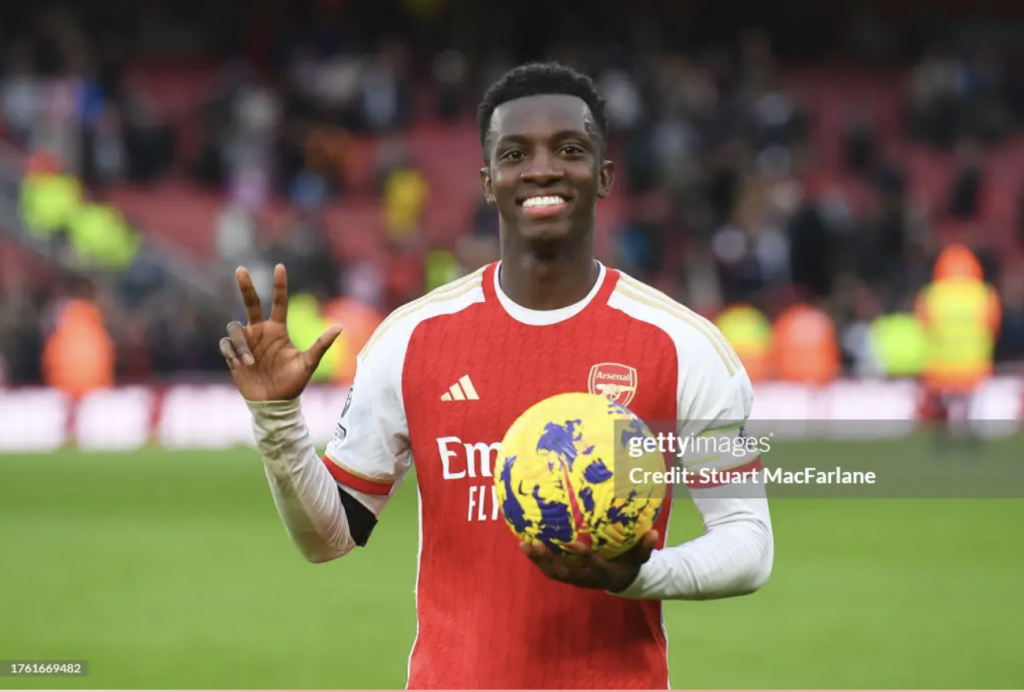
A prestigious gathering of Holics at our spiritual home in Stroud Green Road was a pleasant preamble to a pleasant amble as Arsenal put a pitiful Sheffield United to the sword – or should it be Blade? 

Eddie Nketiah was assassin in chief with his first hat trick for our senior side and we were able to work on our goal difference in a second half extended by ten minutes by a combination of several tedious VAR delays and a couple of physio treatments for Gabriel Martinelli – who was kicked to pieces by a thuggish right back called Bogle who might have received five or six yellow cards. When Bogle eventually got a yellow card in the second half he was immediately subbed. 

It seems that you can’t score from a corner nowadays unless it’s checked to determine whether you have fouled the keeper, fouled a defender, handled the ball or perhaps even, broken wind in the penalty area. Two of our goals were checked before being allowed, a crude challenge by Trusty (once of this parish, sort of, and poorly named on this evidence) was given the all clear and the referee, Tim Robinson, was called to the monitor to award a penalty that was clearly a foul (he had given nothing) but may have been outside the area – it was clearly inside!

Arteta had rung the changes with our guesses in the preview  at the starting eleven being a little bit wide of the mark. Kiwior replaced Gabriel at centre back, Smith Rowe came in for Ødegaard and Havertz was nominally a left 8 but played as a right 8. Arteta really likes inversion but they can’t touch you for it! Our front three was as expected by most and Bukayo was given the captain’s armband. 

It was a bigger mystery than the Murder on the Orient Express how the Blades recently entered injury time at the Toilet Bowl ahead of a Tottnumb side that are clearly the finest team that have ever graced the Premier League. I don’t know if David Raya smokes but he could have enjoyed a crafty Castella or two this afternoon so little employed was he.

I will gloss over the first twenty five minutes of the game because the teams did! Almost nothing happened except Bogle kicked Gabi M a lot. Then after a break to administer first aid to the ailing Gabi in which the teams were able to take on water to combat the searing heat in North London this afternoon, we scored.

I can exclusively reveal what Arteta said during the break 

“Thees muchachos are seriously crap. Why not try passing to Eddie in the box?”

A few moments later Declan Rice did just that. Eddie showed a silky touch and turn in the box to evade his defender and slid the ball home. 

Arsenal 1 Blades 0 – Nketiah 25 

The rest of the half took on the shape of games I used to play at the age of seven when we would put all the good players in one team and all the less talented in another and basically batter the life out of them. I was a nice kid. We failed to score again before the interval 

Half Time: Arsenal 1 Blades 0 

The second half was an example of why it can be a mistake to promote teams from the Championship into the Premier League and expect them to compete.

Paul Heckingbottom, the harassed Sheffield coach (has any Yorkshiremen ever had a more fitting name?), watched as Arsenal took the handbrake off and thrashed them. 

Wes Foderingham (another piece of perfect naming) pawed at a Saka corner and the ball fell to Nketiah who lashed it home. Game over although in fairness this game was over much earlier! 

Arsenal 2 Blades 0 – Nketiah 50

This was the most exciting moment of the match. Emile Smith Rowe  slid a short pass to Eddie who had enough space and time to swivel and blast a shot past Foderingham’s right hand . Superb goal and a lovely celebration in the corner as Bukayo handed Eddie his first Premier League matchball. 

Arsenal 3 Blades 0 – Nketiah 55

We then started the VAR shambles in earnest and the second shout saw Oliver Norwood commit a foul on the excellent Vieira who had come on in place of Smith Rowe. Bogle had gone by this time.

After an interminable delay during which the VAR pondered then the referee himself pondered, the penalty was awarded and Fabio Vieira was given the kick which he placed emphatically to the goalkeeper’s left. (I can’t be bothered to keep writing Foderingham -oops!)

Arsenal 4 Blades 0 – Vieira penalty, 86 mins 

We then had a special moment – the first Arsenal goal for Tomiyasu. He hit home after substitute Elneny had flicked on a corner. His huge grin was wonderful to behold!

Arsenal 5 Blades 0 – Tomayisu 99 mins 

Final score: Arsenal 5 Blades 0 


If I may borrow a technique from Mike McDonald to sum up… 

Positives from the game for us 

– A fine Nketiah hat-trick. He worked very hard all game and has a predatory instinct which Jesús hasn’t to the same degree 

– We managed to rotate very effectively. All five subs – Nelson, Tomi, Elneny, Trossard and Vieira came on to relieve key players and we still coasted through the game. 

– Declan Rice was superb again. I can’t remember a better signing for a very long time.

– Raya kicked very well which is difficult with a cigar on! He didn’t have any shots to save. 

Negatives 

– I  just don’t get Havertz. One of the most ineffectual players I can remember. He is paid more than Rice and Saka and Saliba. Words fail me!

– It rained as I went for the tube it always does nowadays!


In conclusion, a nice day and a very stress free match….unless you are Paul Heckingbottom!

Back to league action

Embed from Getty Images

Following a successful trip to Sevilla, we return to league action on Saturday, playing hosts to Sheffield United. Although the records at 11v11.com show this will the 118th match between the two clubs, it might be argued that it is the 119th, but the FA Cup fith round game in the image above, on 13th February 1999 has been expunged from the record. Why was that, I hear our younger readers ask? Draw near, gentle readers, and I shall relate the tale at mercifully short length.

In the 76th minute of the non-game, with the score at 1-1, Sheffield United’s Lee Morris went down injured and their keeper booted the ball off to allow the trainer to come on. Play restarted with a throw-in and Ray Parlour attempted to give the ball back to the Blades only for Nwankwo Kanu, making his debut after signing from Internazionale and unaware of the prevailing etiquette in the Premier League at the time, to intercept the ball and pass it to Marc Overmars, who scored. Cue pandemonium. Hard as it might be to believe, the referee refused to disallow an Arsenal goal and the match ended 2-1. Arsene Wenger offered to replay the game and the FA, no doubt relieved that someone, anyone, was prepared to attempt to restore some sporting integrity to their flagship competition, accepted the offer. The replay followed 10 days later with Arsenal again running out 2-1 winners. I am indebted to the Guardian‘s contemporary report of the game. Those with access might care to read Amy Lawrence’s account of the incident on The Athletic site.

Sheffield United have a reasonably successful history. Invited to join the new Second Division of the Football League in 1892, they went on to finish top of the division thus becoming the first team ever to be promoted. Five years later, they topped the First Division. They remained in the First Division until the 1933-34 season, never matching their 1897-98 success but as a fairly solid middle to upper-middle of the table team who picked up four FA Cups. After five seasons in the Second Division, they finished second earning a promotion that had to be deferred for seven years owing to the suspension of football during the Second World War. There followed 30 years of see-sawing between first and second tiers of the football pyramid until five disasterous seasons that saw them relegated first to the Third and then, for one season only to the Fourth Division. After a couple of years in the Third Division, they won promotion to the Second only to be relegated again at the end of the 1987-88 season. back-to-back promotions saw the Blades return to the First Division for a couple of years before it was rebranded as the Premier League. Since then, they have yo-yoed between the top three tiers of English Football, with three years in the top tier, twenty in the second and six in the third. When they won League One in 2016-17 they became one of only five clubs to have been champions of each of the top four tiers.

The opposition

Our record against the Blades provides grounds for optimism

Competition Won Drawn Lost
League Division 1 36 19 33
FA Cup 7 3 7
League Cup 4 1 3
Premier League 4 4 2

although our mediocre Premier League record should give pause for thought.

“What is the strongest city in the world of football?” runs the old joke. “Sheffield,” comes the answer, “because it can prop up two tables at the same time”. Indeed our opponents are not enjoying the greatest results this season and currently stand bottom of the table with a single point to their name; their average of a little less than one goal scored and three conceded per match gives them a goal difference of -17.

Talk on the forums I found veered between dispirited and downright dejected, with Blades fans seeming to recognise their team is playing poorly at presnt and spending their time in the traditional search for a scapegoat. Sadly I was unable to penetrate the fog of nicknames to identify any particular targets. Suffice it to say that Arsenal should have enough talent available to deal with whatever team Sheffield United put out.

The Arsenal

There are two competing schools of thought over Arsenal’s team. Many will argue vociferously that you shouldn’t change a winning team without good reason while others will say equally loudly that playing a team currently adrift at the bottom of the Premier League offers the ideal opportunity to rotate the squad and allow some of the fringe players some game time. Take the goalkeeper, for instance – should we play Raya in this game to give him the chance to rebuild his confidence after a couple of dubious performances, or is it time to reintegrate Ramsdale into the first team and allow the essential understanding among the defence to re-establish itself in a game where there may be less, rather than more, pressure? I am delighted that Mikel Arteta is the man who is paid to resolve this type of conundrum as I’m confident that his decision will be made on a better basis than mine would be. I anticipate his starting XI will be

Raya

White-Gabriel-Saliba-Tomiyasu

Zinchenko-Rice-Odegaard

Martinelli-Nketiah-Saka

If he’s feeling frisky, Arteta might start one or two from Kiwior, Nelson, Vieira, Smith Rowe or Trossard but I would expect to see them on the substitutes bench, coming on after around 60 minutes, or hopefully a little earlier in the second half if we have the match nicely wrapped up.

The Holics’ Pound

I am not a big betting fan. Maybe this is why I am so surprised to find odds of 1/7 on the winner of a two-horse race. Clearly a flutter on a win for Arsenal is not for you if you are looking to make your fortune. Specific results seem to offer better hopes of a decent return with 10/1 on offer for our old favourite 1-0 or 11/1 for 2-1. For those of a more optimistic turn of mind, 25/1 is available for 6-0 or 5-1, while pessimists might consider 19/2 against a draw of whatever score. Surely only the real doom mongers among us will be drawn to the impressive 22/1 against a Sheffield United win?

So there you have it. I hope those going to the match have an experience to savour that lives long in the memory – I wish I were going with you.

COYG

Credit: Reuters

A big game loomed in beautiful Andalucía as the reality of the Champions League became real. After a home romp against PSV and then a subdued defeat against Lens, it was time to get back on the horse and, just three short days after a tough game at Stamford Bridge, cope with a tricky trip to Sevilla, a multiple Europa league winner. They are struggling in La Liga, but with a new coach showed their mettle last weekend with a draw against the mighty Real Madrid. A strong Arsenal team was called for and Arteta duly delivered.

Raya
White, Saliba, Gabriel, Tomiyasu
Jorghino, Ødegaard, Rice
Saka, Jesús, Martinelli

On the bench: Ramsdale, ESR, Nketiah, Kiwior, Cedric, Trossard, Viera, Nelson, Elneny, Havertz, Hein, Zinchenko.

So, Raya remains the number 1 and Tomi replaced Zinny at left back, a reward for some strong performances off the bench. The other change that so many of us wanted to see was Thomas Partey next to Rice in midfield. However, he has evidently picked up a muscle injury in training and wasn’t in the squad. For Sevilla, their very experienced three of Ramos (age 37), Navas (age 37) and Rakatic (age 31) were all in the starting XI. 

Before the game, the travelling Gooners sang Jose Antonio Reyes’s name and were loudly applauded by the Sevilla faithful. A nice touch for a player with strong links to both clubs.

So, with Arsenal in teal, 1800 away fans in the stadium, many of whom travelled on Sunday to enjoy a mini break, we were off. A fairly bitty first five was notable for how far forward Tomi was playing. The first great chance came from a defence splitting pass from Tomi to Jesus, who moved it on to Martinelli in the area. He should probably have scored, but the keeper blocked it. 

In the warmest city in Spain, you could see the rain pouring down. Arsenal were playing well, moving the ball quickly and efficiently. Saka was being closely and physically marked by the left back, Acuma, who was, to say the least, a big old unit. Raya loosened the bowels of your correspondent by passing straight to a Sevilla player. Fortunately it came to nothing, but was another play out error by Raya.

What was noticeable was how little Ødegaard was on the ball, just like against Chelsea. The theory of the GHF cognoscenti is that he doesn’t get the same space when Jorghino plays rather than Partey. Whatever the reason, our super little Norwegian captain seems to be going through a bit of a slump at the moment.

As we moved towards half time a pass from Jorghino was intercepted and Sevilla counterattacked. It broke to the centre forward in the box, but under pressure from Tomi, he steered the ball wide.

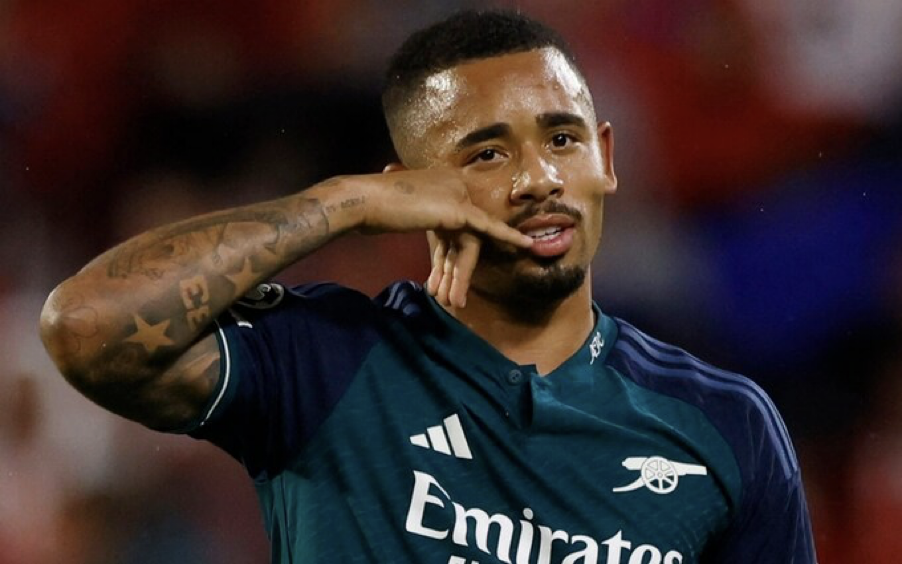
Right on half time, Arsenal scored a superlative goal. From a cleared corner by Gabriel, Jesús spun the two men pressing him with a delicious Cruyff turn, then played an absolute peach of a pass through the middle for Martinelli, on his Champions League debut, to run onto. He burnt past Ramos, went round the goalkeeper and slid it home. A truly great goal. Gabi to Gabi to Gabi. Martinelli has now scored on his CL debut, Europa league debut, Premier League debut and League Cup debut! 

Half time: Sevilla 0-1 Arsenal (Martinelli 45+4)

A first half of few chances, but the counter looked on for both teams. We made it count, they didn’t. 

There were no changes at half time. Early in the second half, Jesús pressed hard and the ball fell to Ødegaard who blazed over when he should have done better. But five minutes later, we were 2-0 up. Jesús, who had been everywhere, scored a worldie. He picked up the ball wide on the left with nothing really on. He jogged towards the area, made himself a half yard of space and absolutely smashed a curler into the top right hand corner. 

What!

A!

Goal!

Sevilla 0-2 Arsenal (Jesus 52)

Five minutes later, Sevilla won a corner on the right. Gudelj rose unmarked and powered a powerful header into Raya’s net.

Sevilla 1-2 Arsenal (Gudelj 58)

The game was now frantic. Sevilla were back in the game and their crowd were loud and proud. The ball was being pumped into the Arsenal area at every opportunity. Jorghino was booked for a high foot. Rice made a storming run through midfield but Saka miscontrolled the pass he gave him. 

In the 72nd minute the ineffectual Ødegaard was hooked for Kai Havertz. He became the immediate target for David Raya to launch high passes at. The ex-Sp*rs player, Lamela, dived in the penalty area after Saliba breathed on him He was rightly booked for simulation. Cheating spud bastard!

On 80 minutes, Jesús, who had been quite brilliant, went down holding his hamstring, and was replaced by Eddie. At the same time, Saka went off for Trossard. On 90 minutes, Kiwior came on for Martinelli. The board went up showing six minutes added time. This was real backs to the wall stuff.

At 94 minutes, Sevilla won a corner from a poor Raya punch that could have ended up in the net. The Sevilla keeper came up. It was beaten away. More crosses came into our box. Eddie was sent away with a few seconds left and corner flagged expertly. The final whistle went.

A famous win, made possible by two moments of outstanding skill. Our first CL win away in Spain since Real Madrid in 2006.  Jesús was off the scale. Tomiyasu, Rice, Saliba, White, Gabriel and Martinelli were all excellent.

An absorbing game. A big win for the Gunners. Top of the table and in control of the group with two home games left. In the other game PSV and Lens drew. The table looks like this, all played 3.

Arsenal 6 points
Lens 5 points
Sevilla 2 points
PSV 2 points.

And breathe!

And so to the Estadio Ramon Sanchez Pizjuan, the compact and intimidating home of Sevilla FC, for our third group stage game in this season’s Champions League.

Like Boca Juniors’ iconic ground on the outskirts of Buenos Aires, with which the near-43,000-seat, refurbished 1950s Sevilla stadium shares a nickname, La Bombonera, ‘the chocolate box’, the pitch is FIFA’s minimum allowed size, 106 x 68 metres (or 115 x 74 yards in old money). Steeply banked stands start close to the touchlines and reinforce the sense of confinement. They appear to hang over the pitch, especially the long, high-roofed stand that runs the length of one side and forms the open lid of the chocolate box, ready to unleash an avalanche of white-clad Sevilla ultras after every home goal.

We have visited once before, in November 2007, also for a Champions League group game that we lost 3-1, having won at the Emirates. We had already qualified for the knock-out rounds, and injuries forced a makeshift XI. At full strength, Sevilla duly got the point they needed to qualify too, but the three let them top the group. 

‘A defeat against the other strong team in Group H, particularly given the make-up of the team, is not something I’ll be losing sleep over,’ the Guv’nor wrote with his habitual common sense, even as the sky fell in other corners of the Goonerverse. 

Sevilla fell at the first knock-out hurdle, eliminated by Fenerbahce. The Europa League and its predecessor, the UEFA Cup, is more their thing. They have won it a record seven times, including last season and three times under Unai Emery, subsequently of this parish.

Vic Brits abroad

The presence of British expatriates among Europe’s mercantile classes in the late Victorian and Edwardian eras left an indelible mark on European football. Inter Milan, Genoa, Honved, Standard Liege, Athletic Bilbao, Bordeaux and even Bayern Munich are among the clubs where British expats played prominent roles in their founding.

Sevilla FC was founded in 1890 by Scots for the most part. Reputedly, the idea for a football club was born during a Burns Supper in 1890. Edward Farquharson Johnston, co-owner of a shipping line that carried Seville oranges to the marmalade factories of Dundee and the British vice-consul in the city, was the club’s first president, an office he occupied in parallel with the presidency of the Sevilla Pigeon-shooting Society. 

Only nearby Huelva, now playing in the third tier of Spanish football and also founded by Scots, two engineers working in the local mines, is older, if by barely a month. In March 1890, the two teams contested the first club match in Spain. Sevilla won the game, played under FA rules, 2-0. Johnston refereed. No pigeons are known to have died.

By the by, the Scots also played a pivotal role in the history of marmalade, turning it from a paste-like preserve into a jam-like spread and moving it from the dinner to the breakfast table.

The Opposition

Sevilla has only been out of the top tier of La Liga for seven seasons since getting there in the 1930s. In the two decades since its last promotion, it has established itself as a top-half team, challenging, if not eclipsing, the giants of Barcelona and Madrid.

This season got off to a stuttering start under José Luis Mendilibar, appointed manager in March, with Sevilla at risk of relegation for the first time this century. Despite winning the Europa League in May, he got the tin-tack just before the interlull, with the team having won only two league games and drawn both their CL matches. 

Mendilibar was an old-school coach with long success in getting a tune out of average players and keeping minnow La Liga clubs in mid-table security; the Europa Cup was his first trophy in three decades of coaching. However, his formula of doing the basics well and having his players run through brick walls for him came up short with the quality of players at his disposal in Sevilla. 

His replacement, Uruguayan Diego Alonso, 48, has elite experience and is a more modern manager. He likes his teams to press high, be aggressive in transitions, play with quick interchanges and dominate through possession (sound familiar?). At his introductory press conference, he almost sounded like Arteta: ‘We have to focus…and take it game by game to develop our idea and our game. Preparation is even more important; you have to prepare well to play well and be ready for everything that comes.’ Only the ‘for sure’ was missing. 

Alonso will be more familiar to followers of the game in the Americas than in Europe. He was most recently in charge of the Uruguay national side, turning around a team on the brink of failing to qualify for the Qatar World Cup. He quit after Uruguay did not progress from the group stage. 

At club level, he has managed in his home country, Paraguay, Mexico and the United States, where he was Inter Miami’s first coach. He had the most success in Mexico, being the first manager to win the CONCACAF Champions League with two clubs, Pachuca and Monterrey. 

While this is the 48-year-old’s first coaching job in Europe, he played for several Spanish clubs. He was part of the Atletico Madrid side that won promotion from La Liga 2 in 2002 and was the division’s top scorer. A peripatetic playing career included his homeland, Argentina, Mexico and China. His uncle, Daniel, played a handful of games for Sevilla in the mid-1970s.

Alonso has had one game in charge at his new club, a visit from Real Madrid on Saturday evening, hardly the debut a manager would wish for. Nonetheless, Sevilla considered the 1-1 draw two points dropped rather than one gained, having outplayed the league leaders for long spells with a high-energy performance. Hopefully, that takes care of the new manager bounce.

Old Familiar Faces

There may be some familiar faces on show against us, none less so than Sergio Ramos, the veteran Real Madrid and Spain centre-back, now 37 and back at his boyhood club. Ex-blue Manc right-back Jesus Navas, who played in the 2007 game, is another 37-year-old World Cup winner who has similarly returned to his Andalusian roots. He is club captain. Ex-red Manc Adnan Januzaj and ex-Spud Erik Lamela, lately returned from injury, are younger but will also be familiar names, as is Boubakary Soumare, on loan from Leicester.

Alonso has plenty more talent at his disposal: top-scorer this season, Youssef En-Nesyri, is a much-capped Moroccan striker; wingers Dodi Lukebakio and Lucas Ocampo are Belgian and Argentine internationals; attacking midfielder Ivan Rakitic has 106 Croatian caps; DM, Djibril Sow, newly arrived from Eintracht Frankfurt, is a Swiss international. Nemanja Gudelj has more than 50 caps for Serbia. His rival to partner Ramos at centre-back, 23-year-old Loïc Bade, was William Saliba’s cover in the French side at the 2021 U-21 Euros. Left-back Marcos Acuña has more than 50 Argentina caps. Ørjan Nyland is Norway’s first-choice keeper. 

Like many South American coaches, Alonso favours 4-4-2. However, he mutated Mendilibar’s preferred 4-2-3-1 into a 4-3-3 against Madrid, with Sow and Soumare starting as a double pivot ahead of an experienced back four all over 30. Expect something similar against us.

The Arsenal

Arteta will likely play a strong side after the setback in Lens. Defeat could leave us bottom of the group at the halfway stage if PSV wins at Lens and facing a mountain to climb. A point is the bare minimum, but we need to take all three to get back on track.

Although I write ahead of Arteta’s pre-match press conference, we seem to have come through the Chelsea game unscathed. I fancy Havertz for Jorginho will be our only change. Tomi for Zinchenko and Ramsdale for Raya are possibilities, but what do I know?. Thus:

Raya

White, Saliba, Gabriel, Zinchenko

Ødegaard, Rice, Havertz

Saka, Jesus, Martinelli

The ‘Holic Pound

This will be a tough match on a cramped pitch in a daunting atmosphere. Sevilla will be difficult to stretch and smother. They don’t often lose European home games. 

Given the current scandals around player betting, I will eschew the usual survey of the odds on offer. Suffice it to say, I expect our away defence to rediscover their hard centres at La Bombonera after the ooey-gooey errors at the Bus Stop and the team to deliver a classic if hard-fought 1-0 to the Arsenal.

Enjoy the game, ‘holics, far and wide.

I have always liked to discover similarities between jazz and football, highly dissimilar even though they are. It is possible that my simple anthropic pattern seeking mind mistakes a merely accidental topographical similarity between two entirely psychological landscapes – landscapes that I am naturally drawn to – as hidden clues to some greater understanding, but in days as inexplicable as Arsenal’s weekend derby away at Chelsea, I tell myself that even a very well rehearsed quartet of great musicians occasionally can have an evening of uninspired performances, from one mediocre solo to another.

Since the end of the invincibles era, and the beginning of English football’s enthusiastic acceptance of financial doping, the historical trend of Arsenal utterly dominating the west London outfit got reversed for a while. But in recent years there has been a return to the old normal, all the more pleasant because of it being achieved despite the habit of frantic accumulation of players by Chelsea becoming an even more intense exercise. Before this weekend’s match, Arteta’s managerial record away at the blues had been deliciously good: 2-2, 1-0, 4-2, 1-0.

Combined with the fact that we haven’t yet conceded a single goal away at PL this season, going into this match there was a quiet (and maybe among some Arsenal supporters, not so quiet) confidence in the Goonerverse that we will continue our winning ways to climb up to the summit of the league table.

The first team availability and the team selection further reinforced that belief. Everyone returned healthy, thankfully, from their peregrinations to the far flung corners of the planet and playing on novelty surfaces, and the lip smacking combination of Martinelli-Jesus-Saka was expected to be too much for a defensive outfit that can most generously be called evolving in this season.

Raya
White – Saliba – Gabriel – Zinchenko

Ødegaard – Jorginho – Rice
Saka – Jesus – Martinelli

The only pre-match negative was that the Raya vs. Ramsdale narrative rumbled on, especially given Aaron’s absence from the bench, even though everyone knew that he was away to experience a moment of personal joy to which football or profession pales in comparison.

The bench wasn’t shabby either – Trossard, Havertz, Nketiah, Nelson, Smith Rowe, Tomiyasu…

In the recent weeks Chelsea had found some form and consistency, which was only to be expected, sooner or later, given the strength of their squad and a manager with a known combination of competence and composure. So even though an away win was what most had predicted, it was not thought to be an easy affair.

Once the match started in pouring rain it became evident that Arsenal is going to have one of those days where they will have to dig deep to overcome themselves as much as their spirited opponent to get the three points.

Pochettino had set Chelsea up with no central focus to their attack – probably influenced by Saliba’s masterful neutralizing of Haaland a couple of weeks back – and a congested midfield that pressed, harried and hurried Arsenal and challenged for every ball. There are days when a tactic like this will play right into our hands, with Ødegaard orchestrating beguiling patterns around the press and finding our menacing winger duos in empty space. But this was not one such day: we were taking a second or two longer to move the ball, the passes were going astray, the close control and first touches were alarmingly poor, and there seemed to be a lack of urgency in winning duels. Our front trio were deprived of any services, Saka and Martinelli being (expertly, one must admit) double marked out of the game, and Jesus having to drop back further and further to satisfy his natural instinct to remain a part of the game.

In these early moments one decision I felt should have gone in our favor: Palmer’s reckless tackle from the back on the achilles of Jesus should have drawn a red card (Aubameyang against Crystal Palace being my benchmark), but the Chelsea winger got away with a yellow. Zinchenko earned a yellow too for rather uncharacteristically clattering his compatriot Mudryk while, more characteristically, floating around in the improbable right midfield space.

A few moments later Palmer put in an excellent cross in the Arsenal goalmouth, Mudryk and Saliba went for the header, Mudryk’s header bounced off Saliba’s hands which were in their natural position if you want to look at it simply from the biodynamics of the movement, but this natural position also happens to be an outstretched one. A penalty was given by the intervention of VAR – call me a cynic, but I am not convinced that Arsenal in PL would ever benefit from such literal and liberal interpretation of penalty rules – and Palmer slotted one in after sending Raya in the wrong direction.

Chelsea 1 (Palmer 15’) – Arsenal 0

Conceding a goal, somewhat paradoxically, settled Arsenal a bit and we started to bring a level headed control to the game that we have lately learnt to desire most. We were enjoying better possession, more passes, more entry to the final third, but there was an alarming lack of inspiration, inventiveness, movement and sharpness around the Chelsea penalty box. On the base of the midfield, Jorginho was nowhere near fast enough to spring counters, and Ødegaard had one of his quietest games for us. Rice, playing as the left side #8, and Martinelli on his outside were the only ones who looked capable of creating opportunities. Saka and Jesus too were bereft of their natural spark, but the discipline and workrate of the Chelsea defense, admirably orchestrated by Thiago Silva, in containing them played a big part in that.

Raya – based on pure statistical analysis of the last season, a better short and long passer of the ball than Ramsdale, and better at gathering crosses – looked entirely unconvincing. One of his attempts to play through the middle almost gifted Chelsea a second goal, and his attempts at long range distributions were ordinary to say the least.

At the break Mikel introduced one change. Zinchenko – never a traditional left back – was being given a difficult time by Sterling with his speed on the flank, and being already on a yellow card, and maybe even carrying some injuries from the midweek exertions away at the Euro qualifiers, was replaced by a more natural defender in Tomiyasu. I felt Jorginho should have been substituted at the break as well, with Rice dropping deeper and Trossard or ESR coming in to provide more vertical movement on the left side.

At the beginning of the second half we started playing more positively, but within a few minutes we had conceded one more goal from one more of our umpteen turnovers of the evening. We lost the ball easily on our right flank, White didn’t get much defensive support from his right sided colleagues, Mudryk was allowed a lot of time on the ball to execute what seemed like a cross for Sterling on the far post, the ball swerved in the air and looped inside the goal over the perplexed Raya’s tentative stretch. It doesn’t really matter to us whether Mudryk meant that or not, it’s Raya’s positioning for that goal that should be worrying. But thankfully we do have another top level keeper for us to be able to rotate and give the Spaniard some time to refresh his art.

Chelsea 2 (Palmer 15’, Mudryk 48’) – Arsenal 0

All signs at the stage pointed to the end of our undefeated start of the league season. Martinelli, never one to give up, kept probing the best he can, and fashioned in a couple of half chances for him that didn’t really trouble their keeper. We did earn a series of corner kicks but still didn’t really threaten from those even though both Saka and Gabi sent in some tantalizing deliveries.

Sensing the match slipping away, Arteta made his second set of changes: Nketiah replacing a sub-par Jesus, and Smith Rowe coming in to play the left sided midfielders with Rice dropping deeper and Jorginho leaving the field.

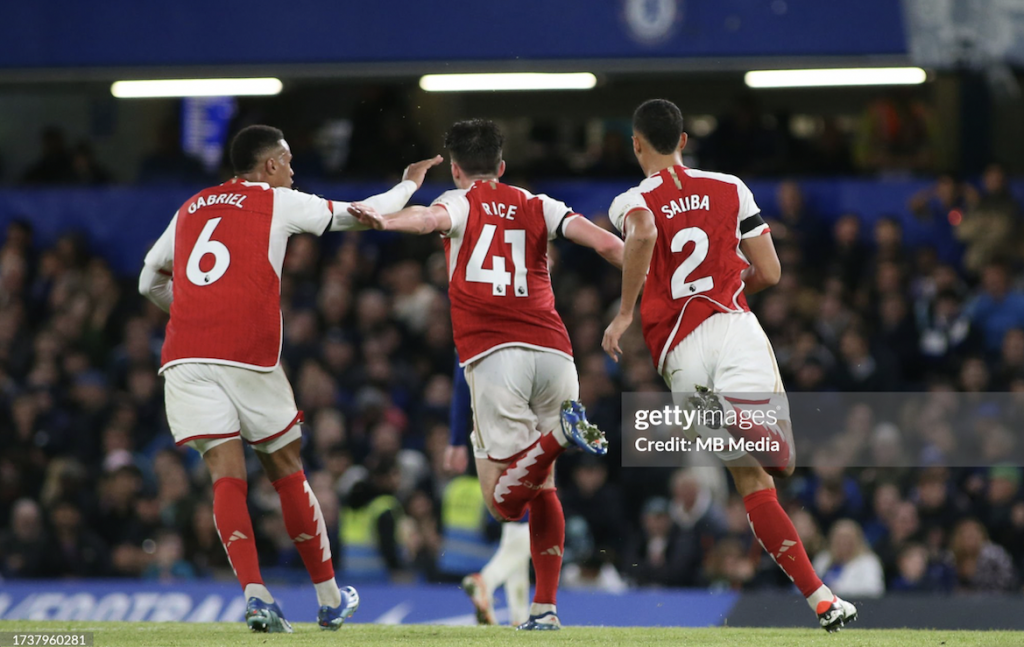
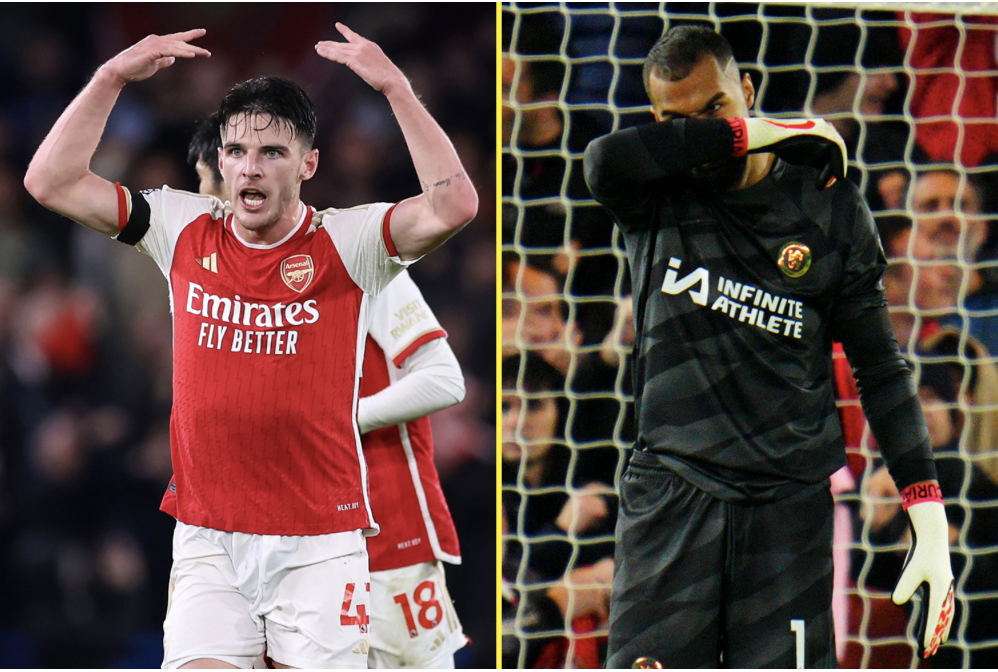
ESR, understandably rusty though he is, brought in a sense of directness which presented different types of questions for Chelsea. Rice now also had a wider field of vision in front of him, and from that came a moment where the ridiculous was lifted to the sublime in a fraction of a second. Sanchez in the Chelsea goal attempted a through pass to their left midfield. Rice expertly judged the path of the ball and noticing Sanchez being away from the goal pounced on it with a superb curling long distance finish. Whereas much of the discussion around this goal seemed to be centering around the mistake from Chelsea, I felt the combination of intuition, self-belief, situational awareness and technique shown by Rice deserves a lot of praise.

Chelsea 2 (Palmer 15’, Mudryk 48’) – Arsenal 1 (Rice 77’)

Sensing a window of opportunity, Mikel made his final set of substitutions: Trossard came in for Martinelli, and Havertz replaced our captain. Maybe it is too early to get alarmed, but Ødegaard’s recent form has been somewhat indifferent. My guess is that he is doing too much of a defensive minded midfield glue duty for the sake of control truly to have the freedom and energy to exert influence in the final third. Let us hope a return to Spain in the CL this week will freshen him up and Sevilla will be at the receiving end of his punishing artistry.

I like Trossard. He complements the flair and verve of our young attacking group wonderfully with his understated, precise, efficient craftsmanship especially in the final third. His finish for our equalizer was a beautifully crafted goal, an elegantly simple idea executed with a mixture of street-wise efficiency.

Saka, well contained for much of the game, found himself with a few extra seconds to be able to shift the ball on his left foot and have a mini run at the defense, and then, noticing Trossard on his run, providing an inch perfect delivery to the back post. Trossard finished with the outside of his right foot. Nothing any defense could do.

Chelsea 2 (Palmer 15’, Mudryk 48’) – Arsenal 2 (Rice 77’, Trossard 84’)

The unlikeliest of recoveries was now on the cards. At this stage Arsenal seemed to be the only team poised to win the match, and Nketiah almost made it happen with an inventively executed volley, while being surrounded by two defenders, past the onrushing Sanchez. The ball rolled agonizingly past the far post.

Despite the seven minutes of extra time there were no big threats on either end of the goal. Chelsea was a bit shell-shocked, and the traveling Arsenal fans were evidently enjoying this unlikeliest of recoveries.

On a day when we played so poorly, a point away at a London derby against a well coached team of talented players is not the worst outing. As Rice – my man of the match – accepted with admirably brutal honesty, the team indeed was really poor for much of the match.

But it’s just one game, and one more opportunity for the squad, and the coaches, to learn more about themselves and each other.

Chelsea 2 (Palmer 15’, Mudryk 48’) – Arsenal 2 (Rice 77’, Trossard 84’)
« Newer Posts - Older Posts »