Feed on
Posts
Comments

Double Bill

Arsenal Suffer The Kicks and Elbows of Outrageous Fortune and Win

by ClockEndRider
Arsenal players nurse their wounds at half time

On we moved from AC Milan to the second game of pre-season and the game against Newcastle. The team which started was Raya, White, Saliba, Calafiori, MLS, Zubimendi, Merino, Nwaneri, Saka Trossard, Havertz.  

Under Howe and that curious orange man – who oddly never attracts the ire of mental midgets such as Gary Neville for being outside the prescribed area or waving his arms about and is never more than 2 paces apart from his Leader- their style of play has increasingly come to resemble that of a marginally more sophisticated Stoke.  Many of us doubted the wisdom of playing this antediluvian throwback side and it didn’t take long for Guimaraes and Co. to go do that voodoo that they do so well, pretty much kicking anything that moved from the off.  And talking of throwbacks, we were behind to what was their first effort of the game after five minutes when Elanga, entirely unmarked in the box, seemed to cannon his shot off his standing foot and then off the post into the net.  There followed a period of about 15 minutes in which our defensive security owed less to the Beefeaters at the Tower of London and more to the Keystone Cops. 

Gradually, though, as the half wore on, we forced them back and found ourselves yet again in a low block scenario.  On 32′ Merino scored a really good equaliser. Having won the ball back in their final third he passed to Trossard outside him. Trossard fired a low pass in to Havertz on the edge of the box who controlled and backheeled the ball into Merino’s path for him to caress it the remaining 17 yards into the corner of the net.  Stokecastle were now under real pressure and less than 2 minutes later were behind.  The referee gave a foul again in their final third. While several troglodytes were making shapes with their mouths and struggling to force out any coherent sounds – evolution is a slow process – Trossard took a quick free kick, putting Havertz away down the left-hand side. He looked up from the edge of the box and hammered in a low cross looking for Saka, running in at the far post.  However, someone called Alex Murphy decided today was his day and pre-empted the inevitable strike from Saka by absolutely hammering the ball past his goalkeeper into the net from two yards wide of his own goal. Well played young man!  We went in for oranges at 2-1 up.

The second half started and oddly we had only made 1 sub – Ødegaard for a very subdued Nwaneri, while Stokecastle had made 9, most notably substituting the kickin’-an’-a-gougin’ Guimaraes for the languid subtlety of Joelinton. Our sub quota was increased on 49′ when Calafiori appeared to pull up – yes, I know – with nobody around him and was replaced by Kiwior. Newcastle found renewed energy, but Arsenal had the best chance when a Trossard cross from inside the box on the left-hand side was met with a spectacular flying volley by Saka and well saved by Pope. 2 minutes later though, Newcastle’s renewed energy showed when Jacob Murphy hit a pass-shot from 22 yards out into the bottom left of the Arsenal goal. A very good finish, assisted from some laboured non-defending from Arsenal’s midfield and defence. Cue more subs as Raya, Saka and Havertz made way for Kepa, Dowman and Gabi on 59′. Straightaway 2 things happened. Dowman massively raised the energy level. And Newcastle decided to kick lumps out of the 15-year-old making apes of them.  On 70′ he received the ball in midfield, turned smartly and left 2 players for dead with his acceleration and notably tight control, before loosing off a shot which the keeper pushed round the post for a corner. This upping of energy went through the whole team and on 72′ Ødegaard hit a stinging shot from 15 yards, pushed wide by the keeper. Dowman had another effort 5 minutes later, cutting in from the right a la Saka and shooting at the top right, Then on 82′, Dowman, again, picked the ball up on the right hand touchline on the edge of the final third and drove forward, jinking inside some bloke pretending to be a left back, then putting on a burst of speed which surprised the chasing pack, until the Brazilian Vinnie Jones could do nothing but push him over in the box for what no doubt from what I have witnessed at St James Park would be a Newcastle free kick. Fortunately, this game was not being refereed by the football regulation relativists at PGMOL so the actual rules as written were applied and a penalty was given.  Laughably, as well as laughingly, Joelinton – the least Brazilian Brazilian since Sandro played for Sp*rs – complained to the referee.  Ødegaard took the pen. Arteta looked unsure, but he scored in any case and that was that. 

Apparently Gyökeres was introduced to the crowd and will accompany the team to Hong Kong where they play an East Middlesex Swamp Dwellers XI on Thursday. 


Holics Look to the New Season

by TTG
I am very grateful to four very helpful Holics who accepted my invitation to take a look at what they believe  is currently happening at the club and  who shared some of their hopes and fears for the new season. Inevitably this was written before all our recent  signings had been confirmed and before some other developments at our rivals. The four Holics were Osaka Matt (OM), North Bank Ned (NBN), Sancho Panza (SP)  and Bergkamp the Man (BtM) so we have certainly achieved a degree of geographical diversity! Here are their thoughts:

Are you happy with the direction and progress of the club under Mikel Arteta?

BtM: Absolutely! Arteta is an excellent leader, communicator and coach who is driven to succeed on his own and the club’s behalf. Despite their jibes, I suspect that he and his leadership style are the envy of a multitude of opposition fans. Mikel has patiently renewed virtually the entire playing squad, patiently, methodically and in accord with a plan to elevate the Arsenal’s playing style to the very competitive heights of world football. In this regard, he has won the confidence and respect of the vast majority of Gooners and, more importantly, the club’s hierarchy and stakeholders. Two thumbs up from me.

NBN: Yes. Football fans’ memories can be short-lived. We forget at our peril that the club faced a sliding doors moment at the time of Arteta’s appointment. That we are looking forward to Champions League, not Championship football (thus sparing C100 from trips to Hull, Stoke and Watford), is testimony to the turnaround that Arteta has achieved.

SP: Yes, I am very happy. We have a once in a generation manager who is brilliant at both managing players and coaching them. It’s not a case of who else is there to replace him? There isn’t anyone out there I would rather have. The direction is spot on. It can’t be argued that we had a poorer season, but we need to take into consideration factors both in and out of our control when looking at the season as a whole. We still did better than everyone else bar Liverpool, including all the cup winners. Progress is taking shape. Our squad is much stronger season on season, and we can’t expect a splurge on players every summer.

OM: Yes, certainly in terms of direction. Like everyone else (including MA and the team!), I’d like tangible signs of progress like the PL or CL title.

It is early days, but what are your initial impressions of Andrea Berta?

SP: The initial impression is that he seems to know what he is doing, and he has a process that he is following. The amount of plates he is spinning is impressive with all the buying, selling, and retaining he has to do. I presume Tim Lewis is helping out a lot.

OM: At this moment there is no confirmation on Gyokeres, Madueke or the young Spanish defender but if they join then I think that with Kepa, Norgaard and Zubi, we will have completed Step 1. In which case, so far, so good.

NBN: It is way too early to tell. Unfairly or not, he will be judged on the success of the striker he lands this window. The quality of the 2026-27 squad will be a better yardstick. A second-order hope would be that he proves as good at selling as buying, and we get more for the players we move on, both the seniors and those coming out of the Academy.

BtM: These are indeed early days and so the basis for comment is limited. I’m pleased by the recruitment of Kepa, Norgaard, Madueke, Mosquera, and Zubimendi – particularly the latter, although the slipway for Zubi’s move was well greased by Edu prior to his move into the depths of the Forest. It’s pleasing too that Gabriel, MLS and Nwaneri have all been re-signed. Berta appears to be being tested though by Sporting and Leipzig in his efforts to land Gyokores or Sesko and failure to land either would severely dent his credibility. If he can complete the Gyokeres deal, seduce Eze and persuade Big Willy to sign for five more years, his first summer window will have been stellar in recruitment/retainment terms. Finding suitors for Zinchenko, Trossard, Vieira, Nelson, Lokonga and Kiwior would add a rich layer of icing to this summer pudding.

Which of our signings or prospective signings excites you the most?

NBN: Tying  down Saliba, Gabriel, MLS, and Nwaneri to long-term contracts to secure the team’s current and future core is a major goal. Clearly, a striker is likely to be the pivotal signing. I only hope that there is not an undue weight of expectation heaped on his shoulders and that whoever it is, is given time to settle in (think Havertz). My concern would be that the e-haters pile in if he fails to notch a hat-trick in the first fifteen minutes on his debut. 

BtM: Zubi, Zubi, Zubi! Gooner, Gooner, Gooner! A splendid song waiting in the wings for a player who I believe will speed our transitions forward, strengthen our midfield defensively and free Martin Ødegaard, in particular, for a more attack focused and goal scoring season ahead. TP5 (at peak fitness) was always going to be difficult to replace. I’m optimistic that Martin Zubimendi will transcend Partey’s contribution quickly and become a vital contributor to our trophy safari.

SP: Dare I say Noni? I really like the thought of him coming on as a game changer and also starting some games to share the load with Saka. Zubi will be quietly efficient rather than exciting.

OM: Of course Gyokeres would be the exciting CF signing everyone has been wanting but for me Norgaard and especially Zubi are the possible step up in quality that might win us the PL

Have you concerns about any of the deals we have done so far?

OM: There are always risks with every signing so yes of course – for example, simple things –  Can Zubi / Gyokeres adapt to the PL? Is Norgaard too old? Can Madueke improve his end product? Will Kepa’s form fall off a cliff at the first howler?

NBN: The three confirmed incomings, Norgaard, Zubimendi and Kepa, all seem sensible acquisitions at appropriate prices that improve the squad (and Zubimendi, the first XI). Of the outgoings — KT3, Jorginho, Partey, Marquinhos, Tavares and a bunch of Academy players who have aged out — the only concern might be Tavares’s price, but that was a deal structured a while back, so it is what it is.

BtM: There’s a huge deal of negativity surrounding the Madueke capture, based primarily, I believe, on price point and his Chel$ki heritage rather than his lack of talent or potential. I find both surprising and I’m very pleased to see a high calibre winger, able to play as a disruptor on both wings, and providing essential cover for Saka and also Martinelli, being added to the talent pool.  He may well need some of Arteta’s famed coaching focus to reach his full potential – but, with that, let’s hope he makes the doubters ‘do one’ and the boys at the Bus Stop regret his departure as much as that of Salah and De Bruyne.

Is there any business you would additionally like the club to do?

SP: I would love to see Eze coming in and being something completely different from what we are used to seeing. It is great to be unpredictable.

OM: Depends who we sell really.  If Tross leaves then I still want one more who can play wide left. I accept it is a difficult balancing act but I hope we won’t leave ourselves short. It’s gone quiet on Eze but let’s see, as he’d be nice to have.  

NBN: Apart from the obvious incomings still needed at the time of writing (striker and all-purpose winger/10/Ødegaard, Saka cover), the situations of Vieira, Lokonga and Nelson need resolving, sooner rather than later. 

BtM: I would love to see Eze join. He’s a very skilful, impactful talent and would add greatly to our attacking repertoire, particularly in low block situations. I’d like to see Zinchenko, Trossard, Vieira, Nelson, Lokonga and Kiwior join Tierney in finding new homes in which to be happy and develop their careers. If some of these were to be used as make-weights for Eze, I’d be happy.

Which Arsenal player would you least like to lose for next season?

BtM: Without a shadow of a doubt, unquestionably William Saliba. Superb generational talent who is an outstanding contributor already but who is at the same time far from his peak.

NBN: Saliba. If the question is really about losing Trossard or Martinelli, I would let the Belgian go before the Brazilian. Of other mentioned possible departures, I would keep Kiwior at least until the other fill-in centre-backs, Timber, White and Calafiori, have confirmed their returns to full fitness. I would also put young Max Dowman on the must-keep list.

SP: Well, it’s either Martinelli or Trossard. I would rather Martinelli stays.

OM: The issue is drop off in quality, so it’s still Saka for me. Raya would hurt too. 

Without giving too much away about your Predictathon entry where do you expect Arsenal to finish in the Premier League next season?

OM: I predict The Arsenal to win it every season ! 

SP: 2nd or 3rd. Everyone has strengthened, unfortunately, and I still think there is genuine referee bias against us. That is not to say we can’t win it if we make it impossible for decisions to make a difference.

NBN: Top 20, definitely! 

BtM: Winners. It’s time, and if the recruitment and divestment programmes I’ve outlined above come to fruition, we’ll have the squad to make that happen. The vagaries of PGMOL are, however, unpredictable and avoiding another six  (disgraceful) “Arsenal only” red cards will be essential. Beware the dark Webb!

If Arsenal enjoy a similar season to last campaign but do not win silverware should we sack Arteta?

SP: Absolutely not! That’s not to say he won’t walk, but sacking Arteta would be completely stupid.

NBN: Assuming ‘a similar season’ means remaining competitive with Europe’s elite clubs, then absolutely not.

BtM:  Absolutely not! Retaining Arteta’s services should Man Cheaty, Bayern, Real Madrid, PSG or Barcelona come calling will merit more focus and attention.

OM: No, I don’t believe so. Unless, of course, he loses the dressing room in the process of not winning, then the decision becomes much more difficult.

Any other comments ? 

SP: I  really fear the Club World Cup is going to change football for the worse. Maybe a super league is taking shape regardless of opposition to it. 

OM: Just that I want us to start the season a little better than last.

NBN: I suspect many will say that winning a trophy should be the priority for next season, as ‘the project’ has reached the stage where one is due. Silverware is important, symbolically, to fans and because winning things tends to become a habit. However, my two cents are that the key goal for next season is to consolidate our position among Europe’s elite. Arteta has returned us to top table, but we are not yet seated in the middle by right rather than at the end.

As I compile this article Joe Root has scored another sublime century and transfer nerds are charting the flight path for Victor Gyokeres’ plane from Majorca to London for his medical. I would reiterate my thanks to the correspondents that answered my call for their opinions, made in an atmosphere of pre- season uncertainty and who were brave enough to venture their thoughts before we know exactly what we may be facing next season and who we will be facing it with. The good sense and understanding of the game which Holics traditionally exhibit is much in evidence here and suggests optimism for the season combined with concern that events outside our control might interfere with our ambitions. The season is approaching fast. Let’s hope it’s a special one! 

Singapore Chilli Crab. Take me now, Lord….

Are we sitting comfortably? Then I’ll begin.  After a sleepy summer with no meaningful football (outside of the Ladies Euro’s) for nearly two months, it was time to rouse ourselves from our collective slumber. A trip to the Lion City is always a treat and even from 7,000 miles away, I could smell and taste Chilli Crab wafting over from the Newton Circus hawker centre with the promise of a few cold ones to be sunk later at Harry’s Bar at Clarke Quay.  Unfortunately, it was only the waking remembering of times past. Ahh, thems the days.   Damn you, Marcel Proust.  

In keeping with the preamble, this will be a suitably impressionistic rather than detailed match report, as much in the interests of time as the fact that there is not much to be gleaned from the first pre-season friendly. 

And so, to the game. The Arsenal started with a strong line up.

Raya

White, Saliba, Calafiori, Zinchenko

Norgaard, Nwaneri, Rice,

Saka, Havertz, Martinelli

A fair side, it has to be said. The only tourist not on the bench was Gabriel, which was odd as he was shown in pretty full-on training in the video released ahead of the game.  I’m all for slowly reintroducing him back in though, so I managed to put down my pitchfork and flaming torch.

Milan, I thought, started pretty slickly and were the more impressive side for the first 20 minutes.  After this point, it was all Arsenal though really. Nwaneri worked his way into the game and looked threatening in the Ødegaard role, with a couple of really clever manipulations of the ball making his victims look very uncomfortable. He also managed a really good shot which well saved by the Milan keeper. As the half wore on, the game settled into the pattern so familiar to us from last season, wherein a fairly pedestrian Arsenal build-up was thwarted by an 11-man defence. 30-degree heat and 90% humidity are, though, a genuine excuse so once again I managed to fight off the urge to incite the peasants to burn down the evil baron’s castle.  Everyone acquitted themselves well and Milan were restricted to Leao running down blind alleys, pretending he was comfortable to take on Saliba without actually doing it. Saka was far and away the most impressive player on the pitch.

Half-time went and I reached for a Singapore Sling and considered throwing some peanut shells on the floor.  The wife was not pleased. For I was not in the Long Bar at Raffles.  So, water and an apple it was for my half-time refreshment.

We were treated to a mass team change for the second half and the team which started was:

Kepa

White, Saliba, Kiwior, MLS

Ødegaard, Zubimendi, Rice

Saka, Trossard, Havertz 

Again, a fair side.  We were immediately brighter with Ødegaard bringing a little more zip to proceedings, ably assisted by Kiwior who played some very nice passes from the back. And it was Kiwior who provided the excellent bending cross from 10 yards outside the box on the left-hand side over to Saka on the right-hand side of the 6-yard box to scuff in for the only goal of the game.   It was in truth well deserved. On around 70 minutes Arteta introduced Salmon, 15, for Saliba and Dowman, 15, for Saka, as well as Nichols, a hoary veteran who will be 19 at the weekend, for White. After a bit of a tentative start, Nichols settled in and had a good 20 minutes,.  Dowman started like he belonged from minute one, although his tendency to hold on to the ball a bit too long does grate a little. Of course, at that age none of us ever did that. He is not 16 until December.  Salmon played as if he were Saliba. By which I mean faultlessly, assuredly.  

The game ended and we won probably one of the most comfortable 1-0’s you will ever witness. We were then treated to penalties as a bit of a digestif. Ødegaard missed our first to keep up his recent habit of poor striking of the ball at set pieces.  Both keepers saved a good few. Dowman and Nichols both took excellent pens but unfortunately Salmon missed the last for us and we lost the shoot out when the next Milan player scored. 

It was all jolly good fun and a nice work out. Expect to see the pace picked up increasingly over the next couple of weeks. Next up Geordie Arabia, also in Singapore, at the weekend.

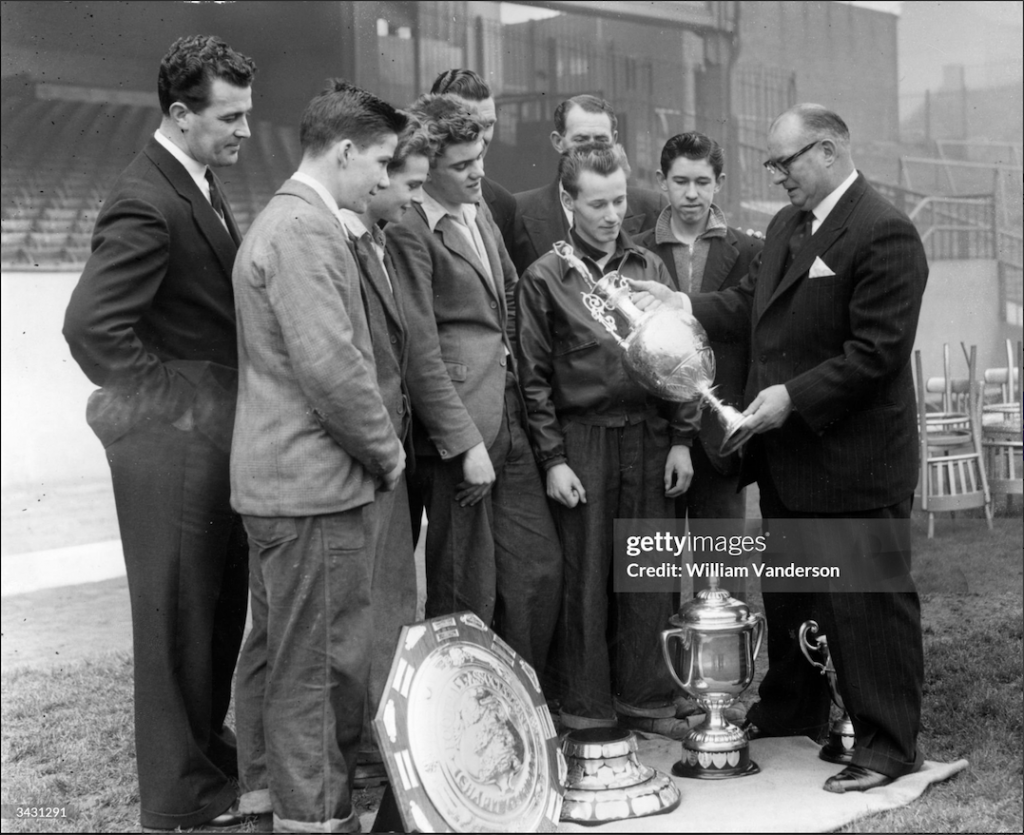
11th December 1953: Manager Tom Whittaker and coach Leslie Compton (left) showing some younger members of Arsenal the trophies which the club have won including the Football League Championship Cup and the FA Charity Shield.

It is nice that blogs on this website are read by a number of generations. In fact, mixing historical recollection with current opinion is one of the reasons this blog exists. Dave Faber who founded the original ‘Goonerholic’ was born a few years after me but started to follow Arsenal from a very early age. So our recollections of games were pretty contemporaneous. We often exchanged comments on past matches or Arsenal giants of the past and on our previous title seasons.

There can’t be many reading this who actually remember us winning the league in 1953. My Dad gave me a blow by blow account of the final game of that campaign which he marked by throwing his friend’s trilby onto the pitch as the final whistle blew. I come from a long line of hooligans! The first title won in my supporting lifetime was in 1971. This article will be part reminiscence and part comparison of how we prepared to win titles back in the day  and how we now need to prepare to try to win them and will illustrate how football has changed  fundamentally in this supporter’s lifetime. 

I started supporting Arsenal in  1958. I was conscious the club had a glorious history but they were then struggling to match the achievements of the great sides of the past. I would wend my way back from Highbury chatting distractedly as little boys do with their dads and I’d constantly be asking  about the relative merits of Alex James and Vic Groves and Alan Skirton and Cliff Bastin. Suffice it to say the versions I was watching rarely compared favourably to the giants of the past though Dad was a great fan of George Eastham  and Joe Baker whom I (and Holic) idolised. Season followed season without Arsenal looking remotely likely to win the league and it took thirteen attempts after I started supporting them for Arsenal to get beyond the fifth round of the FA Cup.

When the 1970-71 season dawned there was no particular reason to believe that Arsenal might win the title. They had broken their trophy drought the season before by winning the Fairs Cup but that season had finished in mid-table and their best finish in the fifteen years before that was third place. Bob Wilson believes that the Fairs Cup triumph, following on from reaching two League Cup Finals, was an indication that the team  was on an upward trajectory. It  gradually became clear that he was right  and a very unexpected title tilt began to develop. It is hard to compare transfer activity in the old days and now because in years gone by transfers could be conducted throughout both the season and the close season up until the transfer deadline, which was usually towards the end of March. There was no such thing as  a transfer window. Arsenal undertook no extra extravagant buying spree in 1970-71, in fact the two bits of business they did were to sell Bobby Gould to Wolves and David Court to Luton. 

Arsenal had brought Peter Marinello to the club in January 1970 and he was akin to a glamour signing but Bertie Mee began the season with the squad that had ended the previous campaign. 

I think we all know how that season ended with the glorious double. The league title was secured at White Hart Lane and Liverpool were overcome at Wembley and it is staggering to think that Arsenal played 42 league games to win that title with a squad of just seventeen players (remembering that there was then only a single substitute permitted per game). It just seems inconceivable that Arsenal could plan a title campaign relying on such a small group of players and with no apparent strengthening in the preceding close season. 

It took us eighteen years to win the title again on that glorious Anfield night where Mickey Thomas fired that never to be forgotten late goal. It truly was up for grabs then …. and we certainly grabbed it! If you looked at the preparations for that season George Graham had gradually melded a group of lads who had come through the club’s junior ranks (Adams, Rocastle, Thomas and Merson) with modest acquisitions like Dixon, Winterburn, Richardson and Smith. Bould joined in the close season. The big transfer opportunity at the start of that season was the potential signing of Tony Cottee from West Ham. If he had signed we might never have embraced Paul Merson but Cottee chose Everton and later in the season we were rebuffed by Cottee’s old  partner in  crime Frank McAvennie who went back to West Ham. George took an iterative approach weaving an exceptional group of young players with judicious defensive acquisitions and he worked very frugally that season.

When we repeated the title triumph in 90/91 we had allowed George to spend a little more. In the close season he made three acquisitions. David Seaman replaced John Lukic, who did very little wrong (shades of Raya and Ramsdale in recent times) and Andy Linighan was bought to bolster an already strong group of centre backs. The exciting acquisition was Anders Limpar a slight Swedish winger, purchased from Cremonese. I can only remember speaking to one person who didn’t love Anders….and that was George himself! I had the pleasure of interviewing him in the early nineties a couple of days after a brilliant piece of Limpar improvisation but George was singularly unimpressed! “That’s bloody typical of him! You never see him [all game] and he pops up like that”. We weren’t ad idem on the appeal of Anders but he was one of the reasons we won that 91 title. Points deductions, captain imprisoned but only one defeat. We were a scrappy game at the Bus Stop away from being Invincibles thirteen years early! The following year we signed Ian Wright. Had he been available the season before, our winning margin might have been even bigger. 

Arsene Wenger joined us in 1996 and again did not announce his arrival with a transfer spree. Before he actually joined the club, he advised us to acquire Remi Garde and Patrick Vieira and during the season made a modest purchase of a young French striker Nicolas Anelka. During the next close season, Arsene acquired Ajax’s Marc Overmars who had survived major injury issues, Petit and Grimandi from Monaco, Boa Morte from Portugal, Alberto Mendes and, as the season started, Christopher Wreh. That team went on to do the double in glorious fashion helped particularly by the brilliance of Dennis Bergkamp who had been purchased before Wenger’s arrival, in the days of Bruce Rioch. Anelka was a particular success as was Overmars, although Arsene had to separate them physically on occasions! Petit and Vieira formed a tremendous double pivot in midfield. Judicious purchases had enabled Wenger to build a formidable machine.

Arsene, supported loyally by David Dein, became more extravagant in the transfer market as time went on.  In 2001 we acquired a ‘fox in the box’ – Francis Jeffers, a second goalie Richard Wright, Gio van Bronckhorst but most significantly the incredible addition of  Sol Campbell. A team with Henry, Pires, Adams, Vieira, Ljungberg, Kanu, Wiltord and Bergkamp was just too strong and we cantered  to our third double. Before this we had finished second three times in a row (sound familiar?), had been runners up in the UEFA Cup as it was then and were mugged by Michael Owen in the 2001 Cup Final. It took Wenger four years to win again following his first success.

As the Premier League era advanced and as we moved into the era of the transfer  window more emphasis was placed by the media on the drama of the window. Ironically we were skint as we entered the 2003/4 season and our only addition pre- season was Jens Lehmann, a rather eccentric but very talented keeper  from Dortmund. During the season, despite our impoverished situation, we acquired Jose Antonio Reyes from Seville and he played an important part in the denouement of the Invincible season. Wenger, like Graham before him, had built carefully and assembled possibly the greatest team that Arsenal have ever had. But it should be noted that that squad contained players like Cygan and Stepanovs! 

So are there any lessons to be drawn from the way in which our title triumphs have been put together? What is the main conclusion to be drawn that can help us to go that one step further in this coming season? I could pore through detailed data but the reality is that football has changed fundamentally. The timing of the window makes a difference but it is not possible to recruit a  high quality PL winning squad in one window. It is a cumulative process and title teams emerge after several years of squad husbandry. 

Arsenal have never known a window quite as active or spectacular as this one is shaping up to be! Three second  place finishes have resulted from a clear strategy of investing initially in high quality PL hardened young talent with a high ceiling and bringing enormous  talent into the squad.  Two seasons ago we really went big on Declan Rice, Kai Havertz, Jurrien Timber and David Raya and so nearly took the title. As I write, it appears that we are possibly going to bring seven new players into the club before the season starts.

Kepa arrives to replace Neto as back-up keeper, Martin Zubimendi and Christian  Norgaard replace Jorginho and Partey in midfield, Noni Madueke and Mosquera  look likely to provide squad strength on the wing and at centre back and we await with bated breath the formal announcement that Viktor Gyokeres is our new ‘fox in the box’ and if the links to Eberechi Eze are true we will have brought a real star into the squad.

Big decisions about who will leave will have to be made but I think we can confidently say that KSE are prepared to invest very heavily into the playing squad, Mikel Arteta has very specific ideas about who he believes will strengthen us and in Andrea Berta we  have  a Sporting Director who really does make things happen and has a very clear methodology in making purchases.

It’s a far cry from 1970 when we did nothing in the  close season to boost the squad but football is a very different game now and Arsenal have metamorphosed into a very modern football outfit . I would be interested to know how fellow Holics feel about how this window’s business is progressing and how well this modern Arsenal is preparing for another attempt to become champions.

From the moment of his appointment, Mikel Arteta has been the focus of heavy criticism from sectors of the Arsenal fanbase and, but for a brief pause after the FA Cup victory in 2020, occasional calls for his head have persisted. Some criticisms have been constructive, many have been bizarre and sadly, some from so-called fans have been, frankly, vile. At this point, I should come clean. I believe Arteta has done a marvellous job at Arsenal, being the prime mover in the transformation of a club that was in serious disarray both on and off the park and building a team that is, at long last, challenging again for the big prizes. Here I take a look at criticisms that I have seen thrown at him. I apologise if I have overlooked your favourite brick-bat and urge you to fire off in the Drinks to rectify my omission.

1. Arteta is too inexperienced and is learning on the job

This was clearly the first criticism aired. It was a bold move by the Arsenal board to appoint Arteta to the role of first-team coach when his only coaching experience was being assistant to Pep Guardiola at Manchester City and he only retired from playing some 3 years earlier. That decision was all the bolder in that the then sainted (though now somewhat blemished by a recent court judgement over tax avoidance) Carlo Ancelotti was also in the frame and had expressed strong interest in the job. However we now know from Arteta’s many interviews and press conferences that he talks a very good game and his ambition, focus and drive come through very strongly. Indeed, it was observed after the first interview when he lost out to Unai Emery that he had impressed the panel then and would one day be a successful coach. So it has proved and I am certain that the impact of that first interview was a factor in his ultimate appointment. As to learning on the job, I would observe “Who doesn’t?” and the day you stop learning on the job, you might as well retire. As one of my old bosses said, “The only remediable flaw in a candidate for a job is inexperience!”

2. Arteta’s teams play boring football

This was the next criticism I came across, both in the Twittersphere and from some people whose judgement is often quite reliable. I would go further and observe that we were playing not just boring but frankly terrible football at the beginning of Arteta’s first full season (2020-21). Arsenal had a truly awful run of results after a decent league start of 3 wins and a 3-1 away defeat to Liverpool where we scored first but had only 2 more shots on target. After a creditable, narrow 1-0 away defeat to Man City on 17 October (creditable compared to the June 2020 visit when we lost 3-0 and had no shots on target) we lost 0-1 at home to Leicester, achieved a surprising 1-0 victory at the Old Toilet when an Aubameyang penalty separated two poor teams each with only 2 shots on target. Then the show went completely off the rails with a 0-3 home defeat to Villa, 0-0 away draw to Leeds, a 1-2 home defeat to Wolves, a 0-2 away defeat  to ‘That Lot’, a 0-1 home defeat to Burnley (!), 1-1 at home to Southampton and a 1-2 away loss to Everton. One win and two draws in ten games with some absolutely shocking home performances. On 21 December Arsenal sat in 15th place with 14 points from 14 games, 4 points above the drop zone with a goal difference of minus 6. That bad run saw the growth of the ‘Arteta Out’ movement which has never completely died out. The press uniformly observed that, had Arteta not engineered our FA Cup win the previous season, the Board would have given him ‘his jotters’. I am sure that there were internal discussions. Had they sacked Arteta at that point the ‘Arteta Out Brigade’ would have got their wish though I’m not sure whether they’d worked out who they wanted instead. The Board held their nerve and Arsenal turned their results around beginning with a 3-1 Boxing Day home win over Chelsea that is memorable for the performances of Saka and Smith Rowe (who were said by some to have saved Arteta’s job) bringing youthful energy and dynamism to a previously lethargic and pedestrian side. Arteta’s team went on to produce some decent away results but also had further dispiriting home defeats to City, Liverpool and Everton (!) and bore draws at home against Palace, United and Fulham. They finished in eighth place below Leicester, West Ham and ‘That Lot’. Was Arteta lucky to have a patient Board? He certainly was. However, he had sold his vision for the team and the 5 year project it required in his interview and the Board had bought into it. What effect did the Coronavirus pandemic and lock down have on the situation? It’s not clear. I’ve seen it argued that it saved Arteta’s job but also that it delayed his project.

However, Arteta had inherited a squad that comprised a mixture of washed out, lazy and mediocre players with a sprinkling of young talent, in a dressing room riven by difficult personalities and cliques and a prevailing culture of comfort persisting from the latter years of Arsene Wenger: Leno, Martinez; Bellerin, Maitland-Niles, Luiz, Sokratis, Mustafi, Chambers, Holding, Mari, Kolasinac, Tierney; Pépé, Saka, Xhaka, Willock, Torreira, Guendouzi, Ceballos, Özil, Martinelli, Nelson, Smith Rowe; Aubameyang, Lacazette, Nketiah. Spot the survivors. It was clear to anyone regularly watching games during Arteta’s first three seasons where Arsenal finished 8th, 8th and 5th that the players he inherited could not play the system he wanted the team to play. I still have nightmares about those players defending like clowns and playing out from the back like headless chickens. Major surgery was required to deliver the project he had sold to the Board – and they had bought into it and knew that it would take time. We may still have problems with low blocks and have drawn too many games last season but this Arsenal team usually isn’t boring to watch.

3 Arteta doesn’t trust flair players, iced out Özil, Aubameyang and Guendouzi and sold Smith Rowe

There were cries of outrage when Arteta stopped selecting Özil after the 1-0 victory over West Ham in March 2020 and again when the player left on a free transfer. However, the rot had set in when Özil was given a £350k pw contract in January 2018 (the very day we bought Aubameyang) when the club broke their wage structure to ensure that we wouldn’t lose a second marquee player that season after Sanchez engineered a move to United earlier that window. As has been seen before and was to be seen again, the large contract seemed to affect the player’s motivation. The outrage was all the louder because Özil had developed a massive social media following, vastly greater than the club’s. Yet Arteta didn’t freeze out a first choice player. Unai Emery had quickly begun to question Özil’s motivation, used him sparingly throughout his tenure, rarely for a full 90 minutes, and openly raised concerns about his fitness and commitment. Arsenal tried to move Özil on in the summer of 2019 but no-one would take on his salary. It was clear after Baku that the player’s relationship with Emery was poor. On taking over as interim coach, Freddie Ljungberg restored Özil to the team but quickly lost patience with his petulance and dropped him. However, Arteta played Özil in his first ten games in charge. The 1-0 victory over West Ham on 7 March 2020 was Özil’s final game for Arsenal. The final straw for Arteta was Özil’s refusal to display solidarity with his teammates in taking a 12.5% salary cut during lockdown. Arteta saw that as a breach of one of his ‘non-negotiables’ and the German never played for the first team again. Özil was left out of the Premier League and Europa League squads for 2020-21 but continued to train alongside the first team and to court his personal fanbase on social media commenting on the team’s results and his relationship with Arsenal. The club sought an exit strategy and paid the bulk of his remaining contract to allow him to join Fenerbahce on a free transfer in January 2021. A sad end to what had seemed a dream signing, an Assist King for several seasons but his relationship with the club had soured before Arteta took over and sadly it could not be rectified. In Turkey, Özil didn’t exactly find a revived commitment to football.

Arteta was certainly the moving force behind Aubameyang’s exit. Aubameyang was stripped of the captaincy, exiled from the first team and subsequently sold leaving only Lacazette and Nketiah as central strikers though the club did try unsuccessfully to bring in Alvaro Morato from Juventus. Only 16 months earlier, in May 2020, Aubameyang had scored twice to secure Arsenal’s 14th FA Cup by beating Chelsea 2-1, following which Arteta had played a key role in securing the £250k pw deal that Aubameyang signed in September 2020. Aubameyang played his last game for Arsenal on 5 December 2021. Six days later he was exiled from the first team and left out of the squad for a warm weather training camp in Dubai. He left Arsenal “by mutual consent” in February 2022, joining Barcelona on a free transfer after four years at the club. He had shown superb form from debut to Cup Final victory. Aubameyang scored 49 goals from his debut in February 2018 to his brace against Everton in February 2020 (equalling Salah’s tally and beating Kane by 12 goals over that period). However, after signing his new contract in September 2020, performances and goals fell away and he appeared to be a player in decline. The disciplinary issues that forced Arteta to act are clear. As a senior player, let alone club captain, Aubameyang was setting an awful example to the emerging young squad. He had been dropped from the squad for turning up late to the NLD in March 2021, having been reprimanded in February 2021 for a breach of Covid-19 regulations. The final straw was a late return from an authorised trip to France. Arteta said, “What I expect from any person at this football club that is representing this badge [is] that he has passion, that he gives absolutely 100%, that he puts the club in front of any personal interests and is able to do anything to fulfil the badge that we have on that chest. Apart from that, you can listen to the individuals, you can understand the different cultures but that commitment, that passion has to be there and unfortunately it wasn’t.” Later Arteta observed, “I know he is our best goalscorer, he is the club captain, he is the highest earner at the club but for disciplinary reasons I don’t want him at the club!” Once again the Club Directors backed the coach. It was a brave move by a coach with a clear vision and utter conviction who demanded high standards. Aubameyang’s subsequent performances at Barcelona and Chelsea confirmed that he was incapable of reproducing his form from 2018 to 2020.

Guendouzi was another talented footballer whose future at the club was compromised by “attitude and general conduct” and who felt the metaphorical boot of Arteta. The first public indication of a problem was his alleged taunting of Neil Maupay (I know!) about wages during an altercation in which he gripped the Brighton player by the throat. However Guendouzi had crossed the line before. On the first occasion, he was offered an olive branch. He fell out with Arteta during Arsenal’s 2020 winter training camp in Dubai, soon after the Spaniard’s appointment. Arteta was unhappy with the Frenchman’s attitude towards a training session and dropped him from Arsenal’s next match day squad. He was then brought back into the fold, but made just four further appearances before his clash with Neal Maupay. Arteta’s anger did not purely stem from the incident itself, but more from Guendouzi’s refusal to apologise during internal disciplinary meetings. That further breach of Arteta’s non-negotiables signalled the end of the road. His behaviour was deemed to display a lack of maturity and fell below Arteta’s demand for high standards of conduct, discipline and professionalism. Their relationship broke down and Guendouzi was subsequently excluded from the squad, sent on loan to Hertha Berlin then sold to Marseille for £10m in July 2021, significantly below market value.  

On his arrival in December 2019, Arteta repeatedly spoke about the standards he expected from his players and warned that those who opted not to meet them would be shown the door. He was true to his word. To anyone upset by Arteta’s handling of these three players, I would suggest that it’s unlikely that you have ever been or will ever be a key member of a successful team.

Smith Rowe’s Arsenal career was impaired by recurrent fitness problems rather than by Arteta. Arteta admitted that he hadn’t “got the best out of” the player, noted his struggles with injuries and fluctuating form and acknowledged that he couldn’t guarantee the regular playing time that Smith Rowe needed and wanted. Thus he was sold in the 2024 summer window to Fulham for £34m though sadly he hasn’t set the Cottage on fire. When challenged on the sale of Smith Rowe during Ødegaard’s absence last season, Arteta observed, “It was a very tough decision to let Emile go, especially because personally I feel really grateful for what he did for the club and for me in a period of time that I think he was instrumental to change something around it. But at the end, players have to play. He had a lot of difficult moments, a lot of struggles with injuries when we were together and he needed a fresh start. It’s normal, we understood that and we allowed him to go.” He added, “We allowed Fabio [Vieira] to go [to Porto on loan] as well because we wanted to create the room and the space for Ethan [Nwaneri].”

4. Arteta is too controlling, driven, stubborn and intense

Arteta is clearly a driven and intense man highly focused on his project and on making his players and team better and successful. It is difficult for a simple fan like me to say whether he is stubborn or not. He clearly has a group of trusted coaches around him to whom he appears to give a lot of authority and to whose advice he almost certainly listens. The extent to which he is seen as controlling probably depends on one’s own perspective. He has a clear idea of how he wants his team and the individuals within it to play. Watching him on the touchline during a game is quite exhausting and he appears to be constantly telling his players (or at least those that can hear him) where he wants them to stand/move/run if he thinks they aren’t doing what he expects of them. He is clearly more controlling than Carlo Ancelotti or Harry Redknapp both of whom allegedly choose their teams and simply tell the players to “go out and play”. He knows what he wants from his players and has no compunction about telling them. My view is that that is his prerogative as coach and it’s what he’s paid for.

A related criticism is that as a result of Arteta’s controlling personality, his team is too robotic (aka boring). Arteta has been accused of treating the team as if he’s playing a computer game. I think he is a driven guy who spends hours coming up with a strategy to win every game and knows exactly what he wants his players to do at any moment within every game. I really can’t see him changing.

Another related criticism is that as a result of his need to control the team and his risk aversion during build ups, these are too slow and as a result we always face an organised low block that we then have great difficulty breaking down. I think the players we have had in midfield have been a significant factor in these slow build ups and hopefully the replacement of Partey and Jorginho with Zubimendi and Nørgaard will see an improvement in the speed of our transitions and attacks. It’s definitely a problem but I don’t believe that Arteta wants these slow transitions.

5. Arteta doesn’t trust or develop young players

I don’t think this criticism holds any water. It first emerged when Saliba was sent on loan to Marseille for the whole 2021-22 season. He had signed for Arsenal at the age of 18 in July 2019 and spent 2019-20 back on loan at St Etienne then he spent 6 months (because of a cock-up it wasn’t a full season) of 2020-21 at Nice without playing a single first team game for Arsenal. The centre back made his first team debut for Arsenal more than 3 years after signing. Another way of looking at this is that Arteta looked after a promising young defender, ensuring that the young player gained necessary experience out of the English media spotlight and played him when he was ready. Centre back is a position where experience and good decision making is critical and young defenders have to learn through their mistakes. Arteta inherited a defence that was hapless and he knew from his playing days that the Arsenal fanbase had crucified a series of centre backs over recent years. His man management of Saliba was exemplary. 

There are a legion of talented young players whom we have seen play well for our youth teams but who have barely made it beyond the bench for the first team before being transferred or merely released. If you haven’t already done so, you should read CER’s excellent review of the hurdles that face aspirant youth players. Although the fanbase love ‘one of our own’ coming through and have looked eagerly for many prospects to progress to the first team, young players can be psychologically damaged by a poor performance if thrown into the first team too early. The list of nearly-men, though still really boys in first team terms, is long and many fans have bemoaned Arteta’s failure to throw them into the fray when we have had absences or been toiling in games. 

I think Arteta gets the big decisions right. He did not plan to make MLS our first choice left back when he introduced him to the first team last season but he judged him a more reliable choice than Zinchenko who had let him down twice before and whom he no longer fully trusts for 90 minutes. MLS grabbed the opportunity and has made himself first choice in that position. Nwaneri has been introduced to the first team squad and, unlike several other nearly-men before him, has established himself there. He has aspirations to play more regularly – indeed many fans thought he should have done towards the end of last season. However, Arteta chose not to overwork him as had been required of Saka at a similar age and rested him after a couple of games in which he had run out of steam and fallen below the standards he had set earlier in the season. Young players are often inconsistent and progression is rarely (Saka’s was astonishing) a linear ascent. Arteta has indicated that he sees him as a central attacking midfielder, a back-up or successor to Ødegaard, if you will, and, importantly, if Nwaneri has the patience to build up his game time. As we move towards a larger squad with two top quality players for each position, and a greater use of rotation both in starting positions and as games progress, there will be plenty game time. 

Recently, we have seen talented young Academy players like Omari Hutchison, Chido Obi Martin and Ayden Heaven chose to move to Chelsea and Manchester United because they were convinced that their path to a first team place was easier there than at Arsenal. They are undoubtedly talented but from an Arsenal perspective they have been poorly advised. Hutchison played only two games for Chelsea before being sent on loan then sold to Ipswich. Heaven played 6 games for United after his January defection so probably benefited from joining a club with a shambles of a defence while Obi Martin made 5 substitute appearances and became United’s youngest ever starter in their final league game last season as their strikers continued to be expensive embarrassments. So in terms of choosing an easy route to a first team place the latter pair probably made the right decision. Undoubtedly winning a first team place at Arsenal is challenging but only players with self belief and the will to fight for that place will make the cut.

6. Arteta trains players so hard and plays them so often that he breaks them

Last season we had a disastrous injury record, notably hamstring tears, that unquestionably damaged our challenges  for the Premiership and the Champions League. However, in contrast, we had few major injuries and absences during season 2023-24, which may have led to a degree of complacency/optimism that led to the gamble of not signing another striker in either the summer window or the January window. I know nothing about the Arsenal training regime and have to trust that we have taken a professional approach to fitness development. For more information about the modern science of fitness development and muscle injury avoidance you should read Trev’s excellent piece earlier this summer if you haven’t already done so.

The work load on key players like Saka, Saliba, Havertz and Gabriel has certainly been too high in recent seasons principally because of the lack of alternates of an appropriate skill level whom Arteta trusts as well as the congested match schedule. The reluctance to use back-ups is increased by the pressure on the team to win every game because of the standard set by creative accountancy fuelled Manchester City. The club is taking steps this window to address the lack of quality back-ups but it was inevitable as we rebuilt the first team with better players that the backups in some positions would be a significant step down in quality. A measure of the improved quality of the first team over recent years is that two players who were clear upgrades to the first team in 2022, Jesus and Zinchenko, have effectively been left behind by current first choices though the former has been handicapped by recurrent injury.

A legitimate beef with Arteta is the lateness of his substitutions when the team needs to be changed up to try to win a game but that again brings us back to his trust in the quality of the back-ups for the key players whom he expects to create and score to turn draws into wins. We have to trust his judgement as he sees these players every day but he doesn’t always get his decisions right (who does?). In 2023 when we lost Tomiyasu and Saliba in the first 20 minutes of a Europa League match against Sporting SP for the rest of the season Arteta chose to play Holding in Saliba’s place and our title challenge evaporated with a series of draws and defeats against mid-table clubs. Kiwior had joined Arsenal only 7 weeks before those players were injured and clearly had not yet won Arteta’s trust but, using the retrospectoscope (always dangerous), Kiwior’s excellent stand-in performances for Gabriel in big games at the end of last season raises the question of whether the choice of familiar slowcoach Holding over newbie (but faster) Kiwior was the correct one. I should add that there are two further mitigating considerations here: firstly that Arteta has shown a clear preference for playing a right footer at right centre back and a left footer at left centre back and secondly Kiwior’s excellent performances last season were, of course, at left centre back rather than right centre back. Nonetheless the enforced replacement of Saliba by Holding was a major factor in our failure to win the Premier League that season.

7 Arteta buys more left backs and goalkeepers than forwards and signs too many players from Chelsea

In my opinion Arteta has taken a systematic and rational approach to building a competitive team. 

A look at Arteta’s signings window by window shows a tentative first January window, only a few weeks after he commenced his new job, making loan signings of frankly mediocre players in an attempt to stiffen the porous defence which was the team’s major problem when he arrived. In the next three windows he added quality to the defence and stability and creativity to the midfield and then in the summer of 2022 the team was invigorated and turned into challengers with the addition of Jesus and Zinchenko. Subsequent windows have prioritised acquiring quality players to fill gaps in the team with the summer of 2023 being an outstanding window, probably to be bettered by this summer’s business. Indeed, purchases have tended to get progressively more successful with the exception of last summer’s failure to sign a striker (too focused on Sesko?) and desperate last minute loan signings of Neto and Sterling. We do tend to do our business in the summer but the addition of Ødegaard on loan and Trossard were outstanding additions in January windows. 

Of course there have been turkeys. Every signing is a gamble but to my mind the successes beat the turkeys  18 v 11. Actually it’s 7 goalkeepers (mostly turkeys), 4 left backs (1 turkey) and 8 forwards, if we include Gyokeres (3 turkeys). 

As for the chavphobia, I understand that we still bear scars from William Gallas. Arteta has signed 5 players from Chelsea: two have been a success, two were complete failures and one has yet to be tested.

January 2020: Cédric (loan + free), Marí (€8.00m loan fee + €6.00m)

Summer 2020: Partey (€50.00m), Gabriel (€26.00m), Rúnarsson (€2.00m), Willian (free)

January 2021: Ryan (loan), Ødegaard (€2.00m loan fee + €35.00m)

Summer 2021: White (€58.50m), Ramsdale (€28.00m), Tomiyasu (€18.60m), Lokonga (€17.50m), Tavares (€8.00m)

January 2022: Trusty (€1.80m)

Summer 2022: Jesus (€52.20), Vieira (€35.00m), Zinchenko (€35.00m), Turner (€5.90m), Marquinhos (€3.50m)

January 2023: Trossard (€24.00m), Kiwior (€19.50m), Jorginho (€11.30m)

Summer 2023: Rice (€116.60m), Havertz (€75.00m), Timber (€40.00m), Raya (€3.50m + €31.90m)

January 2024: –

Summer 2024: Calafiori (€45.00m), Merino (€32.00m), Neto (loan), Sterling (loan)

January 2025: –

Summer 2025: Nørgaard (€11.60m), Arrizabalaga (€5.80m), Zubimendi (€70.00m), Madueke (€60m), Mosquera (€19.04m) ?plus Gyokeres (€73.40m)

8 Arteta should have won the PL by now in view of the money he’s spent

It doesn’t work like that in a league containing clubs funded by state treasuries. The reasons for our failure to finish first rather than second in the last three seasons are clear. The simultaneous loss of Saliba and Tomiyasu without adequate cover in the run in of 2022-23; an exhausted, overplayed, small squad ran out of steam collecting just 12 points from their final 9 matches in 2023-24; last season a combination of bizarre refereeing decisions that we will never see again and an appalling sequence of serious injuries torpedoed our bid for first place against a Liverpool team that had the luck of the Devil.

9. If Arsenal don’t win the Premier League or Champions League this season, Arteta should be sacked.

This is a mantra currently being recited by hostile pundits on sports channels, snide press hacks and some intellectually challenged Arsenal ‘fans’. I have never heard them name a successor who is guaranteed to do better.

10 Conclusions

I don’t play Football Manager or any other simulator on my laptop so I have no sense of my own brilliance as a manager of a top team and how much better a job that I would do as the Arsenal manager than Mikel Arteta. I just watch the games we play and as a result I think he’s done a bloody good job to date given the scale of the challenge he faced in December 2019. This summer the club is addressing the squad issues that have handicapped our title challenges in the last three years. The team will be stronger but so too will Liverpool, City and Chelsea. Let battle commence! I do know that we will miss Arteta, his drive, his intensity and his tactical ingenuity when he finally moves on. May that day be a long. long way off.

COYG

Over the years, I have been fortunate enough to see many players come through the ranks of the youth team and go on to become undoubted greats.  

I was a little too young to see Charlie George come through but even so, social osmosis for a 5-year-old Islington boy made sure that I, along with everyone else in the playground, was aware of the greatness of Charlie.  A few years later, we had the great Irish contingent to idolise – Brady, Stapleton and O’Leary. In those days, it was normal for top clubs to scout youngsters across the UK and Ireland, with Liam coming over at the age of 15 in 1971.  Islington, and certainly the area around Highbury was very Irish at that point.   In my primary school classroom, it used to take 5 minutes to get from the Mac’s to the O’s in the morning register, so in many ways Arsenal was perhaps something of a natural destination for these lads.  Of course, by this point we already had Rice and Nelson and would go on to add others, such as John Devine.  Aah, happy days! 

After this golden period, there was something of a drought, from memory, until Paul Davis came along. He joined while at school and signed professionally in 1979, making his debut in 1980. He was a lovely languid player, but that laid-back appearance hid a core of steel. His debut came away at That Place, in a heavily changed side, necessitated by the fact that we would play at home to Juventus in the Cup Winners Cup in a game watched by 55,000 at Highbury, which saw us kicked off the park by a team which had so many Azzurri greats in it – Zoff, Scirea, Cabrini, Tardelli, Causio, Bettega and the laughably inappropriately named Claudio Gentile. Gentile can be rendered as “kind” or “fair” in English.  Something he assuredly never was on the pitch. Away in Turin two weeks later was that glorious game in which the young Bermondsey boy Paul Vaessen, another Arsenal youth product, would famously score the winner. Returning to Davis, he was hugely unfortunate to come through at a time when we lost both Brady and Stapleton and were in a transitional period. As a result, he was forced to play in a dysfunctional team and for a while became the butt of a certain amount of barracking from the Arsenal crowd, some of it very unpleasant. Shame on you! On us! 

As the youngest player in a frankly pedestrian midfield, he rightly ought to have been shielded from this criticism, but at the time far too many teammates were just not up to the job and left him out on a limb.  On the other hand, perhaps it was exactly this tempering in the fire that helped make him the fine, strong player he was.  Perhaps it also played a part in his subsequent mentoring, on and off the pitch, of other young Arsenal kids who came through a few years later, particularly the Black kids from South London with whom he shared a common background- Rocastle, Thomas and later Campbell.  This was an undoubted golden era for Arsenal products. A bloke called Adams came through, as did Keown and Merson, along with Martin Hayes who never quite hit the heights of the others but deserves his place in the Anfield ‘89 season pantheon, having scored the crucial winner during the run-in, away at Middlesbrough. More recently, we saw the likes of Cole and then Wilshere, and more recently still, Iwobi, Maitland-Niles and then Saka and ESR.  For sure, it’s a heritage of which the club, and we, ought to be proud.

For every one of the above-mentioned greats, however, there are far, far more players who started with dreams of playing in front of us, only to have those dreams snatched away. A 2023 study by Idsoccer Consultancy indicates that only 0.012% of boys playing in organised youth football will play a single minute in Premier League football.  Less than 0.5% of players signed by professional teams as a whole at under 9 years old – already the cream of the crop – go on to play for the first team. 

As a result of these numbers, it is unsurprising that youngsters coming through such hot-house treatment seek to clarify their pathways, the closer they move towards to key older age groups, particularly at 16 where they receive their first “apprentice” contract.  Then again a couple of years later there is the first professional contract which may be offered. While most of us are suffering this same “culling” at these ages in terms of O (GCSE’s) and A levels in the UK educational system, the cliff edge for boys – becoming young men – is considerably more vertiginous, as shown by the numbers above. If the clubs are essentially culling numbers each year, it is only logical for those potentially on the receiving end to look after their own interests.   By the time they get to youth team level, they will have seen a large number of friends already cut, some of whom will have struggled to find new clubs. Suddenly the childhood dream is confronted with harsh reality. 

Thus, we have a situation where the two parties – player and club – engage in something of a dance. For all but the most talented – and therefore in demand – youngsters at this age, the power balance is firmly on the side of the club. For the small fraction for whom first team promotion is seen as the likely next step in their development, the balance is tilted in favour of the player.  These players can, to a certain extent, make demands of the club.  Chief of these has become that the club needs to set out a pathway to first team. For the top teams, this can be very difficult indeed, as invariably they will already have a top player – or multiple top players – in the position into which the budding young first teamer is likely to be suited. The incumbents will already have fought their way up the same near vertical slope themselves.  We have reached a fork in the road at this point and for the player to continue at the club there needs to be a coincidence of desires.

The Loan Approach

One pathway the club can offer to a young player considered too good for what used to be called reserve team level, but not yet ready for the first team  is the loan.  Lest we forget, at 15, Ødegaard moved to Madrid and played a total of 124 minutes in 2 seasons for the first team. This was followed by 3 seasons of loans at lower-level clubs in Holland before he made a breakthrough, while on a 4th season loan, at Sociedad, at the age of 20. Less haste, more speed perhaps.

At the same time, Arsenal don’t have a great recent history in sending players out on loan and then bringing them into the first team.  Lord only knows what Wenger was thinking, if he was at all, when he sent Gnabry to West Brom to play for the high priest of low brow football that was Pulis. No wonder the player left.  Most recently those players selected for a loan seem to be destined to leave the club. Brooke Norton-Cuffy looked a promising right back, but was sent out in loan to Lincoln at 18, followed by further loans to Coventry, Rotherham and Millwall before leaving for pastures new in Italy with Genoa in Serie A.  Perhaps his experience is indicative of just how difficult it is to break through at a Premier League club, and Arsenal in particular.  He would have seen Bellerin ahead of him, and then more recently White, Tomiyasu and Timber – All full internationals.  Another example is that of Balogun. He was tearing it up as a striker at under-21 level and didn’t get a loan until he was 21, spending a season at ‘Boro, before another at Reims where he really broke through. Impatient for first team football, he was sold to Monaco at 23, for a reported fee around €30m. One of Edu’s better sales. 

One loan which might be seen as instructive by the parents and advisers of bright young midfield rising stars is that of Charlie Patino. Seen for a number of years as being a star in the making, Patino was sent on loan at 19, after a couple of substitute first team appearances, to Blackpool in the Championship. Here he shone and was regarded so highly by the fans that he quickly had his own song. The following season he was also sent out on loan, also to the Championship but this time to Swansea City. This time his experience wasn’t so great and he found opportunities limited.  At the start of last season at the age of 21 he left for Deportivo La Coruna. He made 7 appearances in the Spanish second division.  

All of the players highlighted above were considered exceptional and all have gone on to play at a high level. None of them can be said to have seen a clear pathway to the first team. It is of course hugely pleasing to see them making a career in high level football and hopefully earning a good living. There is no hardship involved in living in Monaco or Genoa or La Coruna. The loan route is certainly a pathway which both club and player can use to develop further. It is also, however, an opportunity to put the player in the shop window, and it seems as though this has been the favoured approach at Arsenal for a while. 

Leaving at the End of the Apprenticeship, Before The Initial Breakthrough

The road to professional football success is strewn with examples of players who have seemed to have it all in front of them but who subsequently failed to meet their potential. Often this is through poor decision making. Many of these kids-becoming-young-men are from backgrounds which haven’t afforded them or their families exposure to a wider commercial world.  It can be as daunting for working class parents as it is for the boys themselves to be faced with a wall of information relating to financial and investment advice, legal advice, as well as agents and commercial offers. How are they to discern what is in their best interests when they have a limited frame of reference? Finance is an important building block of the whole package they seek. It is tempting for a kid and his family to be blinded by the numbers and look at the short term.  However, for the most talented and in-demand, understanding how the club in question sees the development of the player is the key element.  

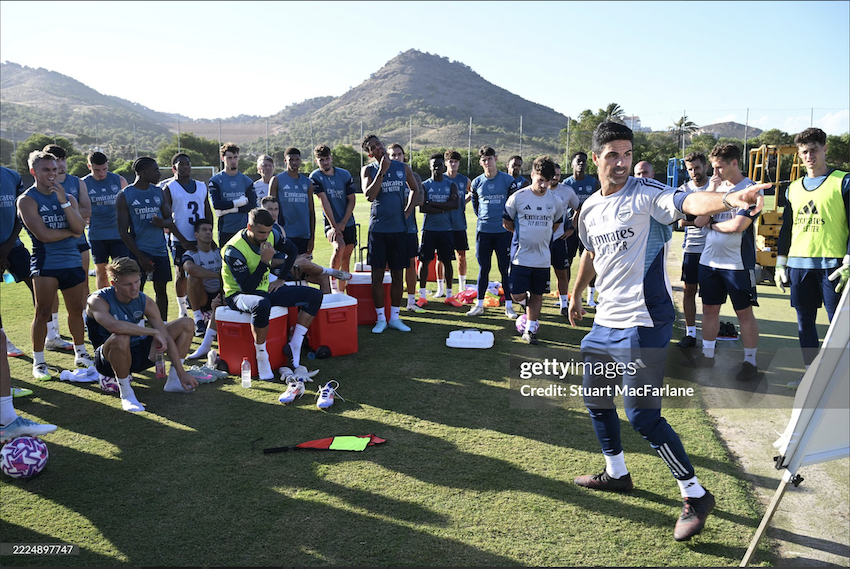
There are a number of building blocks which the club can put in place to assist on the pathway.    Gently folding players into the first team set up is one such. One aspect is inviting the more talented players to join on pre- or mid-season training trips. At these, the young players get to mix with and hopefully learn from the first team in a less pressured environment. It shows that the club considers the player highly. The club also have an opportunity to assess the players social and mental maturity in an alien environment.  Each year it is instructive to see which of the youngest players are allocated the limited number of these slots. It is a signpost on the way, however, and not the destination. In the past we have seen many promising players taken along, who have then not made the final cut.  

Arsenal clearly also use intra-season first team training access as a significant tool for winning young players over by showing that they are regarded as being on a first team pathway. From the club’s perspective, both of these approaches are as much developmental as assessment opportunities. There is no such thing as a free lunch. MLS, Nwaneri and most recently Max Dowman have all been invited into first team training sessions at certain times while in their youth team phases.  Clearly this has be managed as they are still boys at this point and even if they have an advanced degree of physical development, it is unlikely that they will be able to sustain extended exposure to the power of full grown men.  There are exceptions of course. We think back to the adolescent Wayne Rooney.  These tend to be the exceptions that prove the rule, however.  Neither MLS, Nwaneri nor Dowman stood/stand out as being physically super-developed.  Most recently, we have seen Chido Obi leave for the perceived greener pastures of Manchester United (you, boy, at the back, why are you laughing?). He was clearly physically in advance of his years while at Arsenal and played for the U-21’s while only 15 and attended first team training around this time. His sheer physical size stood out at this point. Clearly he was being shown a pathway, one trodden by the likes of Fabregas, Wilshere and to a lesser extent thus far, Nwaneri.  However it didn’t seem to be enough and he eschewed signing the pro-contract he was offered in order to move to United last summer, for whom he made 7 appearances for the first team, totalling 165 minutes, as well as another 53 minutes in the FA Cup 5th round match against Brighton, also with no goals, all by the age of 17 and a half.  He also played 360 minutes at U-21 level, scoring twice and assisting once. It has to be said that even with our paucity of options up front, it is difficult to see how he would have gained the first team minutes with Arsenal.  Perhaps there were other reasons behind Obi’s move. Perhaps he looked at Højlund and Zirkzee and fancied himself against such clearly limited opposition. Perhaps the financial offer, in the light of the competitive journey through youth football as set out above, was just more compelling. We will never know.  He has made his choice and good luck to him. At the same time, Nwaneri (of whom, more later), born in the same year but 8 months older, played 895 Premier League minutes, scoring 4 times and assisting twice in a team challenging for the Premier League and 224 Champions League minutes as well, scoring twice for a team which reached a CL semi-final. If you’re good enough you’re old enough.  Clearly, Arsenal offer a pathway, but it is highly selective and needs to be appropriate to the player.  I am sure that Max Dowman and his family and advisers are watching closely. Dowman looks to me to be in the mould of a number 10 type player, as perhaps does Nwaneri, rather than the wing role each has been played in for the most part when playing above their age groups. 

Post First Pro-Contract, Pre- First Big Contract

This is a key turning point for many players.  They may have been invited on pre- and mid-season tours; been on the bench multiple times; made a few appearances for the first team; have individual development plans for the most talented.   As such they can almost, but not quite, touch the big time and the fame and riches the upper reaches of the game can offer. They may well be impatient for it. They may well have seen others get close and then not make the final push and will be determined that this doesn’t happen to them.  Crucially, they are likely to have offers from other clubs, against whom they will have been playing at U-21 level, as well as being watched at any or all of the junior international levels up to u-21. The club will need to convince them that there is a pathway to the first team if it is to have any chance if keeping them.  How do you do that when someone like Bukayo Saka is ahead of them in their favoured position?  This, I suspect, is exactly the position two shining stars of the youth set up have faced in the last few years. First Omari Hutchinson, who left for Chelsea just short of his 19th birthday. At this age, when you leave out of contract, the signing club is required only to pay a fee to cover development costs for the player. They are, to all intents and purposes, free transfers.  Something of an enigma, this decision, given that he had already been released twice by Chelsea by the age of 10 and that their bulk-buying of talent at first team level makes it difficult to see how his pathway into their first team could possibly have been clearer than had he stayed at Arsenal. Perhaps there were other forces in play. Indeed, having signed for Chelsea in the summer of 2022, he went on to play a grand total of once in each of the Premier League and FA Cup. Both times as a sub, for a total of 51 minutes.  He was then loaned and then sold to Ipswich where he has subsequently become a regular.   The galling thing here is that he was sold for a reported club record fee for Ipswich.  A clear case of Arsenal leaving money on the table. Could the set-up not have figured a way to orchestrate such a loan?  Indeed, this approach may well have been replicated a mere two years later, when Amario Cozier-Duberry decided not to sign his second pro contract and leave for Brighton, also on a relative free. ACD too had Saka in front of him. In his case, Brighton didn’t even try to integrate him into the first team and simply put him out to loan at Blackburn last season and Bolton for the coming season.   Both clubs have a record of flipping players for outrageous profits. I suspect both players may well have been offered contracts more fulsome than we offered, given that an obvious pathway wasn’t available directly at their new clubs either. Food for thought. 

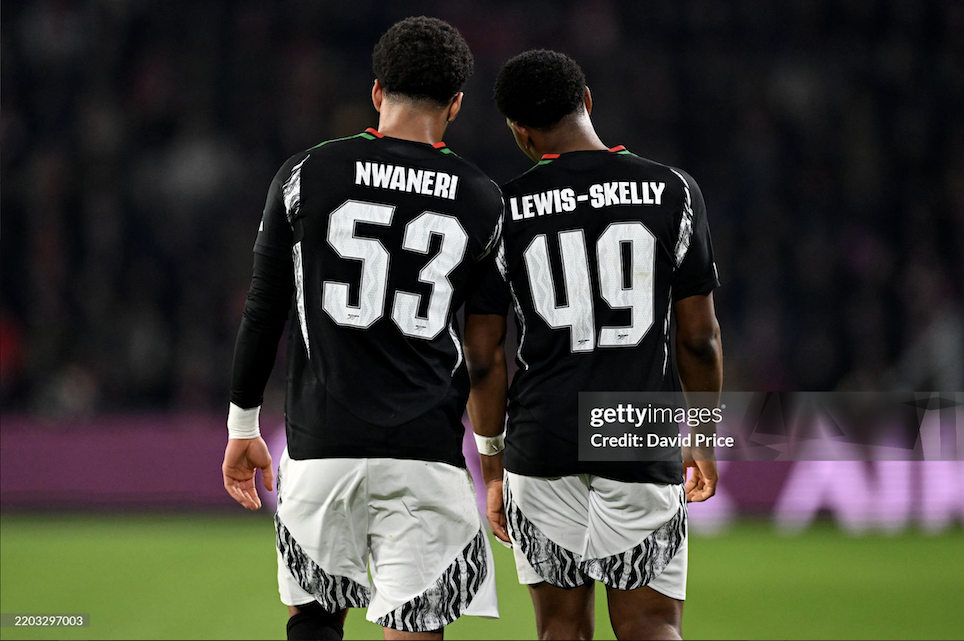
Next in line in this category is Ethan Nwaneri. The difference with him is clear in that he has made the transition firmly into the first team and is now fighting for a starting role.  He has both Saka, again, and Ødegaard ahead of him. Both generational talents themselves. Ødegaard will only be 27 in December and Saka is still, unbelievably, only 23 until September. How does the club sell a genuine first team pathway to a player who has himself been regarded as a generational talent at all levels thus far?  We cannot afford for him to run down his contract and leave for a relative pittance. He will know that. He will also know that he can walk into a first team slot at any club outside the top 4, on a particularly good financial deal. Or tread the well-worn path to European clubs with a record for player development, such as Dortmund.  He would almost certainly attract more first team playing time. He wouldn’t necessarily have the degree of physical pressure on him, and he could build into his contract a sell-on in 2 years giving him a route to global stardom.  This will come down to whether the club’s representatives, chiefly Berta and Arteta, can convince him that he is best served by taking an apprenticeship at a club genuinely pushing for trophies, European and domestic, and that he will be allowed space and time to develop physically and mentally. Arteta will be looking to call on examples he has seen at City. Foden springs to mind. At Nwaneri’s age, 18, Foden had played 18 times in the Premier League for City, for a total of 384 minutes, with 3 starts. Nwaneri has played 28 times in the league, with a total of 910 minutes and 11 starts. More than comparable. Martin Ødegaard is currently 26 and a half and approaching his peak. It is not difficult to see how Nwaneri can be groomed to replace him over a decent time period, if he has the patience to stick around.  Arteta and the team will explain about the problems of overplaying at an early age.  We can all remember the cases of Fabregas and Wilshere who were played, out of necessity perhaps, to destruction, far too early in their careers.  The player and his advisers will also need to see a contract which backs up this view financially.  Over to you, chaps.  Get it done.

As the club continues to develop and moves to being a genuine European top table mover, providing Academy players with a route to the first team will become increasingly difficult.  As I write, we have just signed Christian Norgaard, a full Norwegian international and captain of Brentford, effectively to understudy for Martin Zubimendi, club captain of his former club and Spain regular.  This makes it imperative for us to offer the best deal to genuine talent and convince young players that their best interests lie with us. We have recently managed to do this very successfully with Myles Lewis-Skelly.  The next players are clearly Nwaneri and then Max Dowman. Neither of these players look like loan candidates as they are both regarded as being in the very top drawer of national talent.  As a result, they need to be convinced of short, medium and long-term plans customised for each.  They also need to be remunerated appropriately.  At the same time, you can’t have a 15-year-old being paid the same as the first team captain.  Agents are not renowned for being subtle and there is, no matter who they are (with the possible exception of MLS’ mother who is also his agent, I believe) the possibility of an inherent conflict of interest.  This is what Berta and his team get paid the big bucks for. A job, frankly, to which they are welcome.

We need to maximise returns for those in the next category – not prodigies, but highly talented players who, with the right nurturing, can develop into first team players, either here or elsewhere.  In these cases, the loan route may well be more appropriate. We can’t just allow money to be left on the table.  Hopefully, our new Director of Football can oversee an improvement in what, in the past, has largely been a disappointment.

Finally, we as fans need to accept that even young players, once they have gone through the meat-grinder of the Academy system, don’t necessarily retain the same blind love of the club that we do.  Some will simply choose to leave. What we have to do, in a highly competitive market, is make that decision as difficult as possible.

There are no easy answers.

« Newer Posts - Older Posts »