Feed on
Posts
Comments

What it Means…

– Although conventional wisdom holds the seeds of this reborn Arsenal were planted with Mikel Arteta’s hiring in 2019, I maintain the foundation of something much more important was laid on Sunday, 13 March 2022.
Any parent, when asked, will affirm one of life’s great mysteries. How can siblings be so different? As this is not a recitation of biological inheritance, I’ll spare you any discussion of genetic phenotypic probabilities, but, suffice it to say, it never ceases to amaze me just how different my daughter and son are. Maddy has my darker complexion. She is quite intelligent (straight-A student, National Junior Honor Society), is socially engaging (when she wants), and is a conventional beauty. She is also a natural athlete. Gifted with speed, strength, and balance, Maddy stands out on the pitch, in a dojo (she earned a black-belt in taekwondo), or on the waves (she took to surfing straightaway…during her first visit to Mau’i, her instructor called her a natural “goofy foot”). On the other hand, my younger child, Josh, has his mother’s lighter complexion (colorism is one of America’s many awful legacies from slavery, but, alas, that is a discussion for a different blog) and is more “distinctively” handsome. Generally more comfortable with a book or his computer, he is wicked smart (testing into one of the top private schools in the country). Josh enjoys writing stories, playing video games, and practicing his computer coding. Although he is a good athlete, he has to work at it much harder than his big sister. 

Now, as a stereotypical father who came of age playing several sports reasonably well (American football, basketball, tennis…even rugby) sports were a huge part of my identity and always on the television. As Maddy began to show promise on the pitch, I poured all my football enthusiasm into her and, later, into Josh as well. Thing is, even as Maddy got better and better on the pitch, I could tell she didn’t (and doesn’t) love the game…at least not as much as I do. She couldn’t (and still can’t) be arsed to watch a match or review her game film or practice on her own time at home. As Josh got older, he, too, eschewed football’s siren song. Imagine my predicament. I wanted nothing more than to share my love of football and the Arsenal with my kids, but that yearning remained unrequited. 

Fast forward to March of 2022. For the previous couple of years, in addition to playing club soccer, Maddy had qualified for and participated on the North Texas Olympic Development Program team (a program ostensibly designed to identify talented players and provide them additional training and competitive soccer opportunities, in addition to club soccer, it was also another opportunity to separate parents from their hard-earned). She and a couple other girls were invited to join the South Texas ODP team on an exhibition tour to England. Over nine days, the girls would play three matches, attend a Premier League and a WSL match, have a training session with a Premier League club staff, and see all the sights in London and Manchester. Parents and siblings could also join the trip for the low, low, price of…oh nevermind that.

The trip seemed an opportunity of a lifetime, and I signed-up the family. I also checked the calendar and surreptitiously snagged two club-level seats for Arsenal v Leicester.

The tour group arrived at London Heathrow on Thursday, 10 March, and we were on our way to the hotel in Hammersmith. My wife was unsurprised to learn that I had tickets to the Home of Football but disappointed to learn it meant Josh and I would miss Maddy’s first match against the Haringey Girls Academy under 14s. I mean, I was disappointed, too, but there was absolutely no way I was missing the opportunity to see the Arsenal in person. And I was going to take my main man with me? Come on, now.  
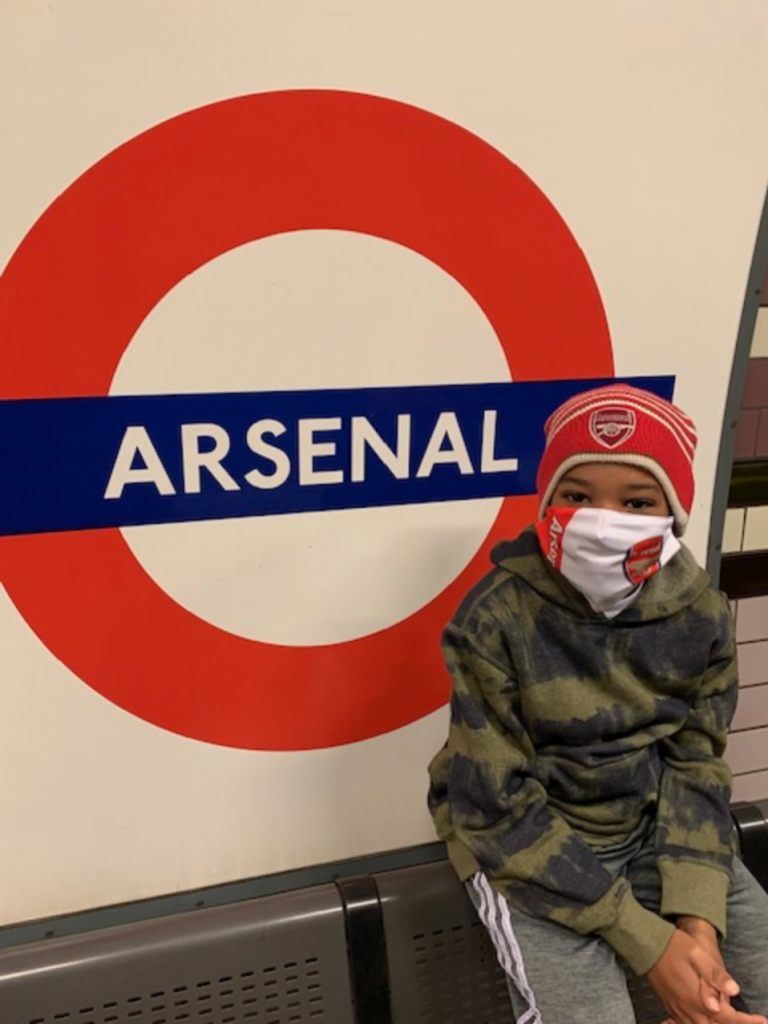
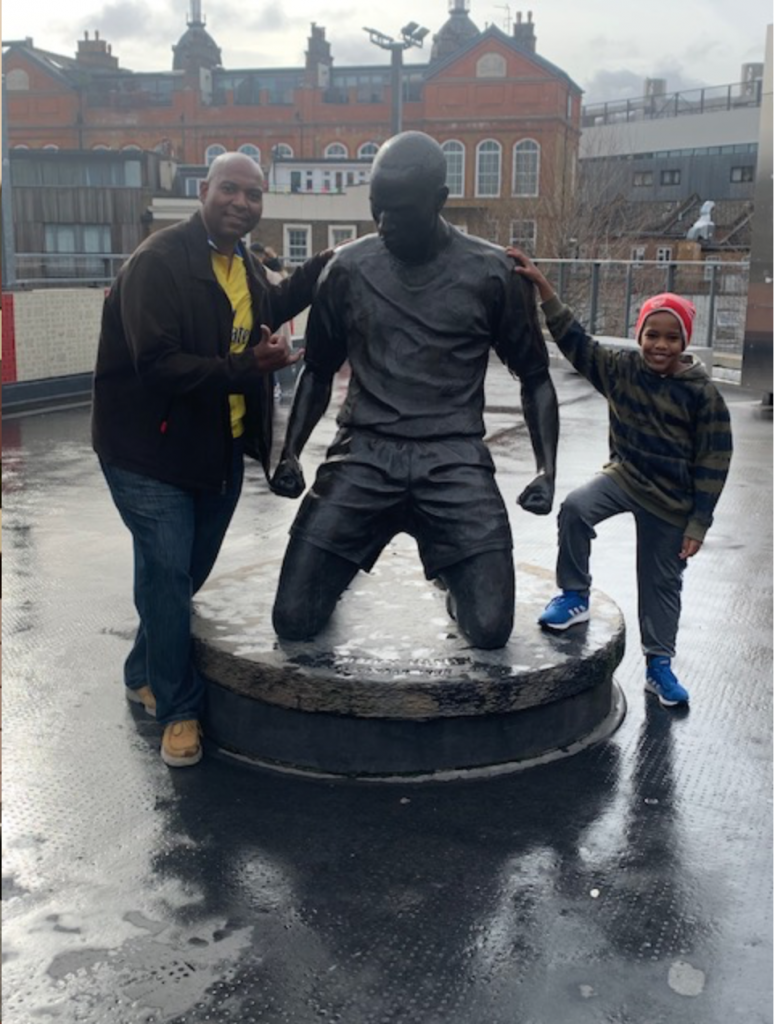
Sunday arrived, and, after a brief pep-talk with Maddy, Josh and I struck out for the tube and the start of a grand adventure. We made our way onto the Piccadilly Line and exited at the (wait for it) Arsenal station. The vendors were already out in full force, and I bought Josh a hot dog (which he did not enjoy) and a Sprite (which he did) as we made our way to The Arsenal: Highbury Store. We rendezvoused with a mate of my mate in Dallas who gave us a walking tour of Islington where he grew up. We took pictures in front Highbury and had pints at the Bank of Friendship and Che. Josh got the full matchday experience as our guide recounted what it was like “going up the Arsenal” with his dad, and we took pictures at all the necessary places. By the way, top man, Rustum. Many thanks for your hospitality. 
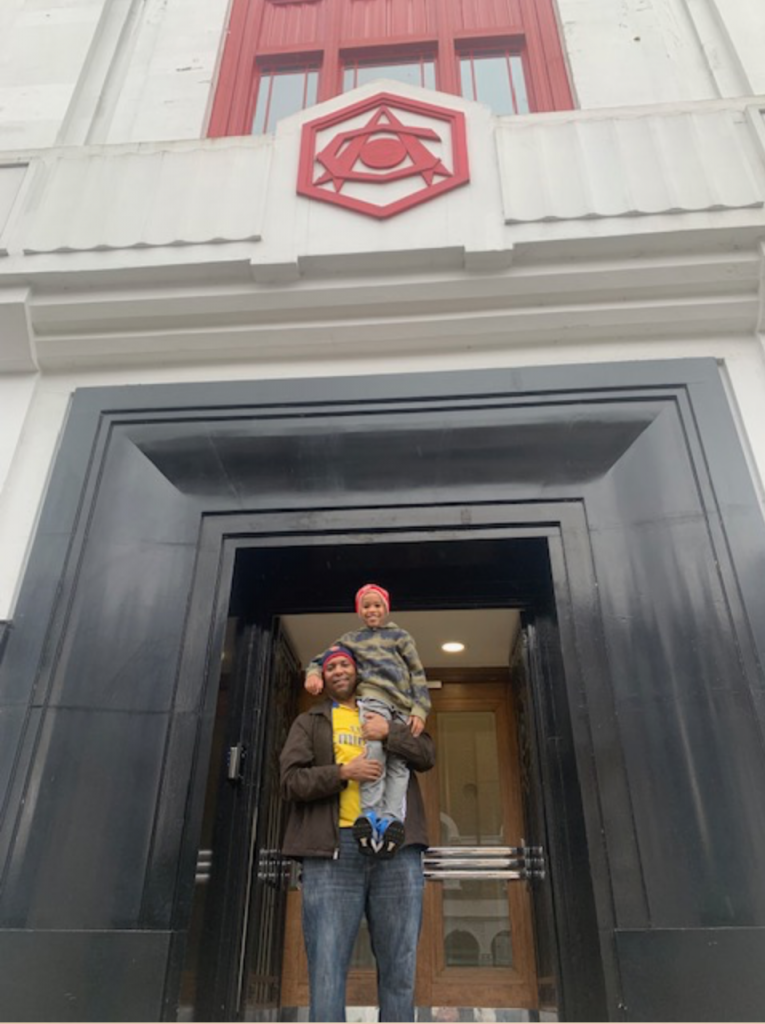
Before I knew it, it was time to get to our seats. Rustum, a season ticket holder, guided us to the proper club-level entrance and then hustled over to his seat. It was just me and Josh, and, I swear, entering the stadium felt like what I’d like to think every Roman was taught the Elysian Fields must be like. Euphoric, bustling, vibrant, and, yet, comforting. Josh’s ear-to-ear grin showed off his braces…cute little bugger. We soaked in the atmosphere, and the Arsenal did the rest. A headed goal from Partey and a Lacazette penalty secured the victory. A lifetime of memories was created. Josh and I sang (of course I taught him and his sister various chants instead of traditional lullabies) along with the “boisterous” club level denizens (Arteta was already having an atmospheric effect), and a stranger seated next to Josh hugged him in celebration. There were no strangers that afternoon. At full time, we leisurely ambled through the maze of hallways at the Emirates, and, when the ushers finally more firmly suggested we make our way outside, we headed over to The Armoury. After buying more gear for the wee lad and his sister and his mom, we took a meandering route back toward Gillespie Road.
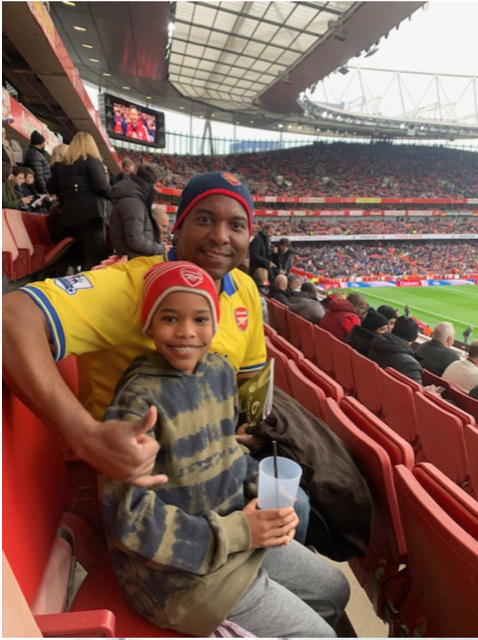
We saw fans being interviewed. We joined in the singing as feral bands of supporters passed. As we neared the Ken Friar Bridge, Josh grabbed my hand. I knew there’d be a day when his hand wouldn’t be so small. “Dad?”

“Yes, Buddy-boy.”

“Today was a good day. Wanna know why?”

“Sure.”

“Because we won.” I grasped his hand a little tighter.

“You’re right, Buddy-boy. We did.” 

MCMBD. 
Postscript

The South Texas ODP team lost to Haringey 6-3, but Maddy scored one and made another. The touring Texans won their final two matches, and Maddy had a very respectable total of four goals and two assists in those matches.

Josh has been made-up ever since his visit to the Arsenal. We have watched almost every game together since then, and we played fantasy premier league for the first time this past season. Saka is his favorite (of course), but his general interest in football has blossomed. Whether it’s playing FIFA, listening to Arsenal podcasts, or discussing transfer gossip with his old man, Josh is now my partner in football. AND, his play on the pitch has become unrecognizable. He might not have his sister’s natural athleticism, but his passion eclipses hers. No matter what happens for us as a family, for Maddy, or for Josh, I will always remember that trip, and I will always be grateful to the Arsenal for adding a sparkling facet to this relationship between father and son. 
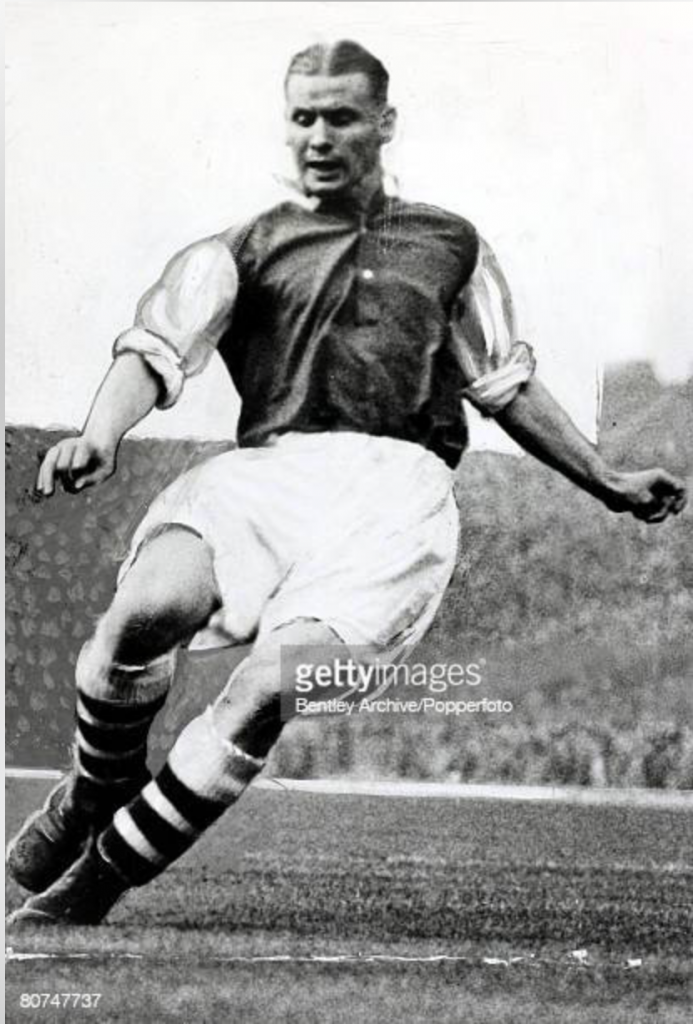
TTG’s recent piece on the most impactful transfers of his lifetime made me think about where the £2,000 Herbert Chapman paid for Cliff ‘Boy’ Bastin in the summer of 1929 would rank. 

Less than seven months earlier, Chapman had shattered the British transfer record by buying David Jack from Bolton Wanderers for £10,647, making him the first five-figure player. However, Jack was in his late twenties, a proven First Division goalscorer and an England international. Bastin had barely turned 17, with just six goals in 17 Third Division South appearances for his hometown club, Exeter City. 

Spending £2,000 on a teenager — worth £163,000 in today’s money but upwards of £20 million in the inflated currency of football transfers — raised eyebrows.

The story goes that in April 1929, Chapman ‘discovered’ Bastin when scouting a Watford player but was so impressed by the young inside left playing for Watford’s opponents that he signed him the next day. Bastin was likely more of a known entity than that story implies. First, he had turned professional and made his league debut at the notably young age of 16 and second; he had played representative football, including for England Schoolboys against Wales in 1926 when he was 14.

The meticulously well-informed Chapman would likely have been aware of that. Wherever the truth lies, Bastin became an Arsenal player in June 1929, making his debut nine games into the new season on October 5 in a 1-1 draw against Everton at Goodison Park. 

He played the next game, another draw, against Derby County at Highbury, but not again until the Boxing Day visit to Portsmouth. There, he was switched from inside to outside left. Chapman had finally found the player to fill the winger’s role the way he saw it. After that, Bastin was rarely out of a team that would dominate the 1930s, playing at least 35 games a season until injury restricted his appearances in 1938–39.

By then, Bastin was an Arsenal legend, collecting five First Division title winners medals, two FA Cup winners medals and 21 England caps. When England picked him in November 1931, still only 19, he was the youngest player to have won an England cap, a League title (1930-31) and the FA Cup (1930).

Proto-Pires

Moving Bastin to the left wing was the final piece in the puzzle that completed Chapman’s first trophy-winning side. Wingers then were typically mazy dribblers who hugged the touchline, beat their full-back on the outside and swung over crosses aimed at the forehead of a battering-ram centre-forward who would bundle ball, keeper and anyone or anything else in the way into the back of the net. 

Chapman wanted his wingers to score goals, not just provide them. He moved them in from the touchline into what we now call the half-spaces, ready to latch onto the long passes that Alex James and the underrated Bob John threaded inside the full-backs. They then used their pace to cut in directly on goal. Whether or not Chapman invented the role or, as with his WM formation, refined to perfection ideas being experimented with by others, it was key to his unorthodox counterattacking game that brought Arsenal its first sustained run of silverware. 

It also let Chapman deploy an additional player in midfield to give the overload needed for his system of covering that was key to Arsenal’s renowned defence. Exceptionally, Alex James played more like a 6 than the 10 that inside lefts of the day were numerically and positionally.

In Bastin on the left and Joe Hulme on the right, Chapman had two of the first inverted wingers — although not in the modern sense; Bastin was left-footed, and Hulme right-footed, so both played on their ‘natural’ wing. Hulme was famed for his blistering pace, but Bastin was quick and had the composure in front of goal to perfectly play this new role. His tally of 178 goals in 396 games stood as the club record until 1997 when Ian Wright surpassed it. His club record of 150 league goals lasted until 2006, when Thierry Henry topped it.

Bastin was only 27 when the Second World War broke out, and the Football League was suspended. Had the war and leg injuries that sidelined him for nearly half the 1938-39 season, in which he scored just four goals, not denied him several more years at his peak, he would almost certainly have added the eight goals to his tally needed to push Wrighty down a notch and possibly the 51 to do the same to TH14. 

His place as Arsenal’s third-highest goalscorer will be secure for a while. Our current career highest scorer, Starboy Saka, will have to score more than 20 goals a season for the next seven seasons to catch up.

The war years

Bastin spent the war as an ARP Warden. The Army rejected him for active duty because of his worsening deafness. There are stories that he had such trouble hearing teammates’ shouts against the crowd noise that Alex James would flash him hand signals to indicate where he was going to pass the ball. 

The war also brought a cameo in the classic 1942 propaganda film One of Our Aircraft is Missing, Bastin’s second film role after a part in the Arsenal Stadium Mystery shot in 1939.

More bizarrely, in 1941, an Italian radio broadcast said that he had been captured during the Battle of Crete — claiming the demise of prominent Allied personalities was a practice of Axis propaganda broadcasters seeking to weaken civilian morale. However, this fake news was undermined by the fact that Bastin was on duty on the roof of Highbury along with his fellow ARP Warden Arsenal physio, Tom Whittaker. 

The broadcast might also have been payback for Bastin’s participation in the ‘Battle of Highbury’ in 1934. An England XI with seven Arsenal players beat the Italian national side that had just won the second FIFA World Cup in what is regarded as one of the most violent games ever.

Bastin played some wartime games for the club and was still an Arsenal player when the Football League resumed. However, deep into his thirties and a shadow of the winger he was because of his injuries, he played only seven more times without scoring. His final competitive Arsenal goal had come six and a half years earlier, against Sunderland at Highbury in February 1939.

His final match was a 5-2 defeat by Manchester United at Maine Road (Old Trafford was unusable because of war damage) in September 1946. He formally retired the following January and went to run a cafe on the North Circular Road with his wife, Joan. There, a teenage Brian Granville interviewed him for a ghostwritten autobiography published in 1950. While far from a ‘kiss-and-tell’, it became controversial because of Bastin’s forthright opinions on some teammates’ shortcomings and those of Chapman’s successor, George Allison, whom Bastin accused of losing ‘the Chapman way’. In 1938, Allison had told Bastin to take a month off ‘to recover his appetite for the game’.

Bastin subsequently returned to Exeter, where he became the landlord of the Horse and Groom pub. He died in 1991 at the age of 79.

Legacy

In an age when young men generally looked older than they were, the Boy Wonder, as Whitaker had called him, was the opposite. His youthful looks and slight frame — 5’8″ and weighing barely 150 pounds throughout his career — famously earned him the soubriquet, ‘Boy’ Bastin. Even in his wedding photographs — he married in the summer of 1939 in the same church in Hendon where Chapman lay buried — he looks younger than his 27 years and even than his bride, four years his junior. As you will hear in the stilted interviews in the Pathe News film below, shot ahead of the 1932 Cup Final, even Bastin called himself Boy.

Len Shackleton, the great Sunderland and England inside forward in the late 1940s and 1950s, wrote in his autobiography that growing up in Yorkshire, he and his schoolmates all wanted to be Bastin in their playground games. Yet the quiet, almost introverted Bastin’s legacy is not to be Arsenal’s first superstar. Alex James, who joined the club at the same time as Bastin, would outrank him in that crowded firmament, and the accolade probably belongs to Andy Ducat, who played for the club three decades earlier. 

Bastin’s career achieved so much so early and ended too soon. He said the 1930-31 side that delivered Arsenal’s first title was the finest he played in. Your correspondent would contend that assertion, but Bastin’s prodigious and particular talents — speed, clinical finishing and a sharp football brain — were the key to Arsenal’s innovative counterattacking football that swept all before it in the 1930s. Without that, none of the Chapman-era teams would have been as great and successful as they were—two thousand pounds shrewdly spent. 

Charity Begins At Home …

Image by Arsenal Ladies/Adidas

I offered to write a piece for the close season on the basis that I would supply subject matter as soon as something rooted itself in the old noddle. The aim was to provide something Arsenal orientated, importantly, not too serious because summer is supposed to be relaxing and fun, and not just a stream of done-to-death, boring, speculative and inconclusive transfer tittle-tattle.

However, Transfers – The Club Plan
Well, the boring, speculative, inconclusive transfer tittle-tattle has turned out spectacularly well. Declan Rice, Kai Havertz and seemingly Jurrien Timber, from Ajax, all done. Amazing work by the club and a massive commitment by the owners, KSE, to the manager, Mikel Arteta, and the squad. We are all well aware of our signings, of course, and there may yet be more to come, but then we’re getting into speculative, inconc…… etc. However, there will certainly be departures as some clubs – cough – actually have to balance the books, trim the squad and so forth. For now, they can be the subject of the speculative, inconclusive tittle-tattle …..

This past season saw the Kroenke-owned franchise, the Denver Nuggets, edge out Miami Heat to claim their first championship since they were founded in 1967. As owners of other sports teams like the LA Rams and Colorado Avalanche, the Nuggets’ win marks a third major KSE achievement in as many years and the blueprint followed is strikingly similar to the one currently being executed in north London. After 20 years of negligible impact in the basketball stakes, KSE finally transformed the Nuggets’ fortunes by building around a young core – namely Michael Porter Jr., Jamal Murray and star man Nikola Jokic, no less than 41st pick in the NBA draft – and hiring Michael Malone, a coach who they believed could successfully manage their development. Their competitive ambitions were regularly rubbished in the media, and poor finishes in 2018, 2019 & 2022 served to justify such low expectations. However, Malone used his brilliant management style to help them scale new heights and the Nuggets now hope to assemble some squad depth in the upcoming draft, as well as tie their youthful talent down to extensions – just as Mikel Arteta has done at Arsenal.

The Charity Work
This blog, thanks to a lot of sterling behind the scenes work by organisers and technicians, has previously highlighted the work of The Willow Foundation, founded by Bob Wilson in the memory of his daughter, Anna, which provides chances for young cancer sufferers to make special memories in their too short lives.

So, I thought, staying with the charity theme, why not take a look at the work currently undertaken by the club’s own Arsenal Foundation. Early searches appeared to hit the jackpot. There was footage online of The Foundation’s ‘A Night To Inspire’, which combined a video of the charity work and music at their annual event, the fun and relaxing element I was hoping for. While some excellent work and people were featured, including Arsene Wenger and Alex Scott, prominence was given to Petr Cech, Mesut Özil, and Ivan Gazidis ! Ok, time to look for a different angle then ! It has been hard, not to say impossible, to combine the charity work and music successfully, so I have simply split them up. – charity first, music to follow.

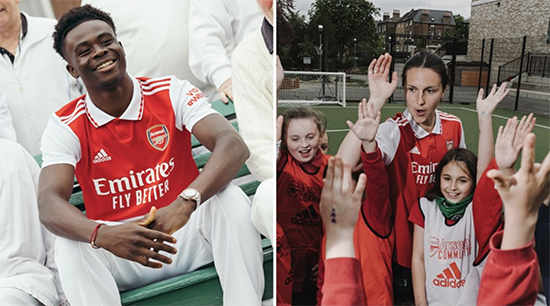
We may have just lost out to Manchester City in the Premier League title challenge but one championship the club wins every year is surely that in the field of community and charity work. Arsenal’s charity arm has a long and proud history of working to support the club’s local community, delivering sport, social and education programmes to more than 5,000 individuals every single week. The 2022/23 home kit can authentically claim to be part of the fabric of the community. At it’s launch in May 2022, Arsenal and Adidas teamed up and pledged £5 from every direct shirt sale to the club’s charity arm.

“We’re extremely proud of the work we’ve been doing to bring our community together and support the lives of people in our local area for more than 35 years,” said Freddie Hudson, Head of Arsenal in the Community. “People are the heartbeat of our community and the £5 donation from our home shirt sales will provide vital support for the local projects that serve our diverse community in north London so well.” “The last couple of years have been especially tough and the impact continues to be felt, but it’s amazing what we can achieve when we all come together to support each other. We continue to draw inspiration from those who make the Arsenal family so special, and we’re thrilled to be able to give a little back in this unique way.”

Ensuring the community thread ran through the campaign, players like local boys Bukayo Saka and Emile Smith Rowe were pictured wearing the new kit while engaging with local community groups. One of the club’s core members – both on and off the pitch – is defender Lotte Wubben-Moy. The born and bred Londoner, made a long-term commitment to actively work with Arsenal in the Community as part of her contract renewal, signed in May 2022. Over the coming years, Wubben-Moy and the organisation will work together on a number of projects which will use the power of football to help girls and young women build self-confidence, develop communication skills and try new activities on and off the pitch.

Of her own role, LWM3 said, “It’s important with community work to give it the time and energy it deserves. Obviously, that is hard for me because I have to balance my responsibilities as a professional footballer. But I’m not here to just add my name to an initiative and move on. I want to give what I can, to whatever it is I am involved in. Right now, that is focusing on the community programme that I’II be running in collaboration with Arsenal in the Community starting this year. We’ve got some exciting things happening that I can’t wait to put into action for the kids of Islington, Hackney and Camden.”

She feels that having a shirt involved in the campaign will make it more visible and bring the projects to life. When asked about her favourite features of the new shirt she said, “The vibrant RED. I love the little features too, they’re so intricate, but every Gunner knows a shirt is made great by the colour that runs deep. And that’s only ever going to be RED for us.” And her favourite ever Arsenal shirt? “The 2001 SEGA GOLD shirt”. Well, that’s women for you!

Lotte Wubben-Moy has just been named in Sarina Wiegman’s England squad for the upcoming Women’s World Cup. The centre-back made 35 appearances for the Gunners in all competitions last season, the third-highest outfield minutes in Jonas Eidevall’s squad. The 24-year-old will hope to be included when England travel to Australia and New Zealand in July. The tournament will be Wubben-Moy’s first World Cup, although she previously captained the U17 Lionesses to a third-place finish at the 2016 U17 European Championships.

She is the only Arsenal star to feature in Wiegman’s 23-player squad, with Leah Williamson and Beth Mead both currently sidelined with anterior cruciate ligament injuries. Mead, who ruptured her ACL in November, revealed earlier this month that she was “ahead of schedule” in her recovery but Wiegman said it would be too risky to include the 28-year-old in her squad. Gareth Southgate, please note!

The 2023/24 Home Kit
As yet there has been no sign that a similar donation to the 2022/23 charity work will be made from 2023/24 sales, but there have been some frustrating issues for buyers.

This season, Adidas has opted for a design inspired by Arsenal’s 20th anniversary since the ‘Invincibles’. It includes the Invincible’s record printed on the seams and a golden crest, symbolising the iconic Golden trophy. However, the standard home strip costs £80, meaning that the shirt has been made £10 more expensive for the last two consecutive years. To receive the Invincibles’ record stitching and the rubberised club crest, it is an extra £30, amounting to a total shirt cost of £110. In addition, there is an extra charge to have a competition badge and a name and number on the back.

That is a fairly eye watering figure in a cost of living crisis, especially say for a dad with two eager sons, or daughters, and it is disappointing to see the club take advantage of the fans and their loyalty, in the knowledge that the shirt will still be bought – after the first two days of sales in apparently record numbers too ! On the other hand, I guess record transfer fees and salaries have to be paid for somewhere along the line. What is disappointing is that in addition to the high prices, many fans have received damaged shirts, with names being wonky on the back and numbers being burnt during printing. One Arsenal fan received three shirts in poor condition, including the new goalkeeper strip having no printed name set at all. Hopefully the club will be happy to rectify such issues. After all, these shirts are going to be worn in a title winning season!

The Music Bit
It was about a year ago when I first became aware – tuning in by chance to a radio programme – of The Dualers.

The Duelers

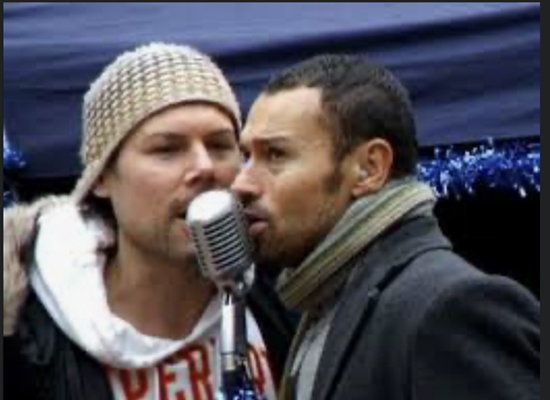
The Dualers are a nine piece ska and reggae band from south-east London. Initially comprising brothers Si and Tyber Cranstoun, and now led by Tyber following Si’s departure in 2010 for a solo career. They first developed a commercial profile when the single “Kiss on the Lips” entered the UK top 30, peaking at 21, in October 2004 despite no industry backing. They began busking on the streets in Bexley Heath, amongst other places, before their popularity eventually won them a recording contract and performances at much bigger venues, including Wembley Arena.

Si Cranstoun: “Nobody ever believes we’re brothers. I take after our mother, who is from Sierra Leone, and Tyber is a dead-ringer for our dad, who is white. One hot summer when we were quite small, Mum took us shopping in Croydon and Tyber wandered off and got lost. His hair had been bleached by the sun and when Mum eventually tracked him down no one could believe that this black woman could possibly be the mother of this little blond boy.

I think most people assume Tyber and I play primarily black music because our mum is black, but our dad has also been a huge influence. He used to be in the merchant navy and fell in love with ska when he spent some time in Jamaica. When he came back to London he became one of the first white promoters of ska and played regular club nights all over London with his Savoy Sound System. He met my mum at the Locarno Ballroom in Streatham, London and Tyber and I grew up listening to the Blues Busters, Lord Creator, the Skatalites and Otis Redding, to name a few. Dad’s family has a music-hall background – playing the spoons, whacking washboards – so it’s not surprising we’ve ended up as performers. I’m completely driven by music and I find it hard to switch off. Every time I hear a piece of music I’ll be thinking about how it’s constructed or what the producer is trying to do. The only way I really get to relax is when I go fishing, and I don’t go as much as I’d like so I really enjoyed our afternoon on the Grand Union canal (before the Champions League SF), even though we didn’t catch anything. It was great spending a couple of hours doing nothing, away from the buzz of life. When we were kids, our dad used to take us fishing nearly every weekend. I was always in awe of him because he’d catch something nearly everv cast. I’d be doing well if I caught something every 60 casts, but it never dampened my enthusiasm.

l used to be just as keen on football. The first match I went to see was Crystal Palace at home playing Bolton Wanderers and I’ve been a Palace supporter ever since, although my interest is fairly casual these days. I didn’t mind watching the Arsenal match at Tyber’s as there were some other mates there so I tried to think of it as more of a social occasion. I watched bits of the match, but I spent most of the time on my mobile in the garden. I do think it’s a cop-out supporting a side like Arsenal that’s got loads of money when it isn’t your local team. But I suppose I just have to accept my brother is a Gooner through and through.”

Tyber Cranstoun: “Si didn’t really understand the importance of the match. I’d watched so many hours of Champions League football, and to see Arsenal’s chances nearly go out the window because of one player’s play-acting in the penalty area was … well, I can’t describe it. As any die-hard football fan knows, you experience tremendous highs and lows throughout any match, but that game was particularly intense.

I know Si thinks I’ve jumped on the Arsenal bandwagon, but I’ve supported them since I was a kid. Admittedly, when I first got interested in football I just wanted to support a team that was glamorous and successful, but that’s what kids are like. It’s gone way beyond that now. When I watch Arsenal playing, the rest of the world simply melts away.

I’d say we’re good mates and we do socialise with each other but not all the time. It’s great that we know each other so well because we don’t feel we have anything to prove, although there is possibly a slightly competitive edge to our performances. We’re both singers, but we don’t sing passively out to the audience like a boy band, we sing to each other, almost as if we’re trying to outdo the other one – a bit like the soul singers Sam and Dave. That’s partly why we’re called the Dualers, because it conjures up this idea of conflict.

We’ve been performing at venues and busking on the streets around the south-east for the past eight years, and sold 35,000 copies of our first two CDs on the streets alone. We’ve got completely different voices; mine is deeper, quite gravelly, like a baritone, whereas Si can hit high notes I couldn’t dream of, but when they come together it seems to work. There isn’t any serious rivalry, though. Just enough to fuel our music.”

(The interviews are my edits taken from a piece by Hilary Whitney in The Guardian, from July 2006.)

Some Dualers tracks: ( some live in the street, some recordings / videos)

Don’t Stay Out Late
Red Light
Kiss On The Lips
Written In The Stars
Good Thing Going – Under the Bridge at Southend
Commoner to King
Enjoy Yourself (4 year old mystery dancer)

Hope you enjoy !

The most important transfers in the last 60 years at Arsenal 

The close season is a time for reflection, nostalgia and expectation. While the transfer market appears to be hotting up and Arsenal are linked with a host of players, I thought I would take a personal view of the transfer deals that have occurred during my time in supporting the Club. 

Let me preface my suggestions with a bit of context. To make the choices I have looked at three things, although I have not assigned specific values. It is the close season after all and rather hot to work that hard! The three elements are: drama and excitement (effectively the impact a transfer has); the quality of performance of a player over time; and, to what extent they represented value for money. So, here are my thoughts in ascending order of the ten most significant transfers at Arsenal over the last sixty years. Please remember… it’s very subjective and just to prove how subjective it is I qualify this piece at the end by suggesting that I might have completely missed one of the most significant deals! 

10. Malcolm Macdonald 

SuperMac joined us in 1976 for a fee of £333,333 from Newcastle where he was idolised. The mid-seventies had been a very depressing time at Arsenal but we had started to develop a core of home-produced players like Brady, Stapleton and O’Leary who lifted the quality of the squad and Macdonald was a statement signing that we were on the way back. To an extent that was right and he did a good job. Supermac had two seasons with us before his knee injuries forced him to retire. He scored 42 goals in 84 appearances and towards the end of his time with us he was seriously incapacitated.  He didn’t get on with Terry Neill and he and Alan Hudson (another very exciting signing) were sent home from a close season tour to Australia.

He was a big personality who brought glamour and star quality to the club but he didn’t achieve enough with us to figure any higher on this list.

9. Joe  Baker

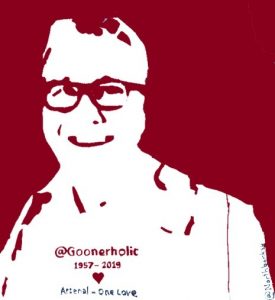
Dave Faber (‘Holic) and I shared many things especially concerning Arsenal and one of them was that we loved Joe Baker. Joe was an Englishman brought up in Scotland who came to Arsenal after an ill-fated spell at Torino where he was badly hurt in a serious car-crash. He cost £70,000 in the summer of 1963 and was a regular scorer topping our goal-scoring charts for four seasons and forcing his way back into the England team. His fallout with Billy Wright when he and George Eastham were transfer-listed in 1966 was cataclysmic to a young schoolboy who idolised the dapper and exciting Joe. He went on to star briefly at Nottingham Forest. He and Eastham (who nearly made the list) deserved a better team and a better manager but they brought many great moments to a free-scoring team who were sadly unable to challenge for honours. 

8.Robert Pires 

I wrestled with this one. Pires was not a mega-transfer. He didn’t attract huge attention when he signed. But what a player! Probably the finest wide player I’ve seen in an Arsenal shirt. He signed from Marseille in 2000, struggled in his first season and then became increasingly influential. It was so sad to see him subbed off in Paris in the Champions League Final – his last moment in an Arsenal shirt. We were so lucky to have him during the peak years of his career . He is still strongly involved with Arsenal as a club ambassador.

7. Patrick Vieira

In 1996 I remember reading at an airport about this new Arsenal manager, Arsene Wenger, just after his appointment was confirmed.  David Dein was explaining how good he was going to be and that he had asked us to sign two players to precede his arrival. They were Remi Garde and Patrick Vieira who joined us from AC Milan for something like £3.5 million. It was an extraordinary deal. He was an amazing player, a huge influence in midfield and a great captain. Wenger’s prescience paid off massively. Vieira is one of the legends of our club and I feel privileged to have seen him play. What a transfer! 

6. Charlie Nicholas 

This is the most subjective pick of the lot. After rising in the late seventies we let fine players like Brady and Stapleton slip away and signed absolute dross like Hawley and Chapman to play upfront. Charlie Nicholas was the sensation of British football in 1983 and chose us over Manchester United because he didn’t like Ron Atkinson and over Liverpool because he wasn’t sure he could get in their team! He was probably right – but I loved Charlie. I loved his habit of scoring against Spurs, the clear pride he had in playing for Arsenal and of course, he had that one afternoon at Wembley in 1987 when we beat Liverpool to win the Littlewoods Cup. He still exudes great love for our club and most supporters regard him as one of the most colourful players ever to represent us. 

 5. Alan Ball

It is Christmas 1972, long before the concept of a ‘transfer window’. We are Double champions but lacking a little sparkle in the following season. Just before the festive season began Bertie Mee decided to buy Alan Ball, World Cup winner, genuine superstar and to try to revamp our midfield. I remember my father who worked in newspapers bringing home copies of all the dailies and the Sun predicted the Ball transfer. A few hours later it was a done deal (remember those days?). It was a new British record fee of £220,000! 

Ball’s style and his personality did not gell with all his colleagues as I have been told by some of them. Leaving his payslip in the dressing room in his first week didn’t endear him to men who’d just won the Double! 

But he was a fine player who was forced to carry a poor team as Mee’s attempt at restructure went disastrously wrong. He stayed until Alan Hudson arrived in 1977 by which time Brady was already starring for the team. Ball left for Southampton later that season. 

4. Thierry Henry 

We are now at the stage where the players we are assessing are so important in the history of our club that agreement on their relative significance is effectively impossible. I was largely unmoved by the Henry transfer at the time because seeing him play for France I didn’t think he could finish and I thought he would be a poor man’s Anelka. I was actually more excited by the simultaneous signing of Davor Suker from Real Madrid! How wrong I was! Henry was transformed by Wenger’s coaching, the support of a brilliant team and the love of an adoring Arsenal public. He gave us wonderful service, breaking our goalscoring record and remains an absolute legend at our club. He was quite extraordinary value, an ‘Invincible’ and we made a profit on him when he went to Barcelona. Arsenal is his club in a way that Barcelona never will be and who can forget his return for the FA Cup tie with Leeds when he scored that trademark goal. That really was box office! But so was Thierry! 

3. Ian Wright 

I was in the Isle of Man on a business trip (not a place I love) when I heard on a radio bulletin we’d signed Wrighty. I was very surprised because we were champions, heavy scorers and I didn’t think George Graham would spend that amount of money on another striker when we had Smith and Campbell. I’m so glad he did. 

Wrighty gave us personality when we lacked quality in many positions and when, after losing in the European Cup to Benfica, Graham decided that we needed to become more solid – a synonym in this case for unexciting; cue the era of Selley, Jensen, Hillier, McGoldrick and Jimmy Carter. Wrighty carried the team in this era and we became a successful Cup side.  Many of his goals were outrageous and he stayed long enough to be part of our 1998 Double side. He was another who loved playing for Arsenal. He is synonymous with the club and has matured enormously as a pundit and a strong supporter of women’s football. If only he could turn off the tears! 

2. Sol Campbell 

In many ways this was possibly THE most exciting capture although it was technically a free transfer. I have to say that a couple of weeks before he signed, I had been at a conference in the South of France with a financier who had confidently predicted that Sol would sign for us. It wasn’t the great secret some suggest. But it was a massive affirmation of the difference in status between the two North London clubs.

Sol went on to win the Double in his first season, to become an ‘Invincible’ and to score in the Champions League Final. He left in odd circumstances but subsequently returned to play for the club again. He was another real statement signing. The statement was ‘Arsenal are a much bigger club than Spurs!’ 

1. Dennis Bergkamp 

I had been at Harvard Business School for almost a week, working very hard and hearing nothing about football. One morning I picked up USA Today which spelt out the details of Bergkamp’s £7.5 million deal. ‘Inter Milan sell Dennis Bergkamp to Arsenal London’. I really wondered about the veracity of this story from such an unlikely source. There was no internet to check details and no mobile phone so I dialled my Dad from my  room to confirm the news. Money well spent, just as the fee for Dennis was. Bruce Rioch got the ostensible credit for the deal but it was done by David Dein with advice from a bloke called Arsene Wenger in Japan.

Bergkamp’s arrival was a real game changer. Over ten glorious years we had the privilege of seeing a master at work, a man whose presence lifted and inspired his teammates and who terrified the opposition. I believe Dennis Bergkamp is our most important inwards transfer ever because of the impact he had on our standards and our belief.


As I said earlier, this is a subjective list and as I was compiling it I realised something important which I have alluded to in the article. Most, nearly all of these great figures are great ambassadors for the club. Men who regard Arsenal as the club of their life – that’s interesting isn’t it? Wright, Henry, Vieira, Pires, Nicholas love the club with a passion.  Maybe their love for the club fired their performances? 

I missed one – a big transfer in October 1964 which saw Frank Mclintock join from Leicester for £80,000. Transfers could happen at any time up to the transfer deadline in March and Mclintock’s arrival was unheralded. He went straight into a rather flakey team who lost the next night 3-0 at home to Nottingham Forest! An inauspicious beginning but he became another huge figure in the history of our club even though his initial transfer didn’t perhaps have the drama of other deals. 

Please let me know which deals you think were the most significant and exciting…. and, in a few years, might we be recalling the famous day Kai Havertz joined us and became a player who changed the potential of our club? 

Lauri Patterson / Getty Images 

The HolicsRopeyLeague!!

In accordance with the time-honoured traditions of the service here at GoonerholicsForever we are following up TTG’s excellent in-depth end of season review with a brief trip to the land of fantasy and wonder that was, if memory serves, the 93rd edition of the HolicsRopeyLeague. In this fantasy land there are only two rules, every team requires an Arsenal player and nary an elf spud must be seen. 

As mentioned in the title GHF once again outperformed every G7 economy as 14 runners were loaded in the stalls this time, an astonishing 40% increase from the 21-22 season!  The usual collection of highly-seasoned holics were joined this time by Depressed Gooner, Up4GrabsNow, Lonestar and Young Lonestar in the merry month of er.. August and we set off on our 38-week trek across more fences than the Grand National. A strained analogy perhaps, though one did suffer from hold-ups because of some absurd fanatics who wanted to promote their radical views and I heard the Grand National had issues too. 

Elbows flew left and right in the early season jostle before The Mikelin Stars dinosaured their way into an early lead. Now I know what you’re thinking – did dinosaurs even have elbows? But worry not, this isn’t Fox News and extensive research has shown they absolutely did. By the time of the World Cup hiatus however, the technical wizardry of ATG had seen Polonia Bytom FC posing the question to the pursuing horde of ravenous holics. We answered by turning the league off and then turning it on again in December. As Winter ground inexorably on and the old titans fell away it came down to the final few. High Bar had taken the lead in December and battled nip and tuck with ATG and an elite force of Kentish Vikings but just behind there was something stirring in the East.  Whilst not quite a sleepless malice, the beady, greedy eye of the Ovinae having set its sights upon the ultimate prize, hovered a while and then pounced in March (seriously? sheep do not hover or pounce, Ed.). A furious fight to the finish through April and May ensued before your writer, in the guise of High Bar, eventually triumphed by the slender margin of 9 points. Ultimate Sheep, managed by Young OM, made it a family one-two and that staunch Scandinavian, TTG, finished a respectable third. To finish off the season, as you may have already seen in the drinks, the first-ever HolicsRopeyLeagueConference Cup was won by Los Tejas Gooners after a thrilling stomp through fields of giants proved the truth of the golden oldie “the bigger they are the harder they fall”. It really was up4grabsnow. 

As a matter of tegriddy, I would note that as organiser of our august competition I felt it only right and proper to decline The Management’s kindly offered prize of a case of 1964 Chateau Petrus and a Peerage. We all know service is its own reward 😉

Cheers to one and all for a fun competition – the drinks are on the High Bar!

A new Predicatathon from GHF!!

From next season I am happy to say there will another opportunity to put your best wits forward against your fellow ‘holics in a new competition…..and TTG is here to tell you all about it below. Take it away, TTG!

…………………………………………………………………………………..

We are introducing a prediction competition for ‘holics for next season. The object is to predict in which position the 20 Premier League teams will finish the 2023-24 season.

Ned will send you an entry blank in late July. All you have to do is rank the teams in the positions you think they will occupy at the end of next season. He must receive your completed entry before the first match kicks off on August 12. There is no opportunity to revise your predictions once you have submitted them.

We will score your predictions using a calculation based on squared differences between actual and predicted positions. The player with the lowest total score wins. We will produce regular updates to enable you to follow your fortunes over the season. 

The calculation methodology has been used successfully in a competition called ‘The Aficionados’, which has been running for 20 years (and involves several mathematicians and actuaries who are satisfied with the soundness of the calculation). 

The entry fee will be £10. All money collected will go to Willow via TTG, who will act as a banker. 

The Aficionados also have an additional competition (entry fee £5) which enables competitors to pick who will be the first Premier League manager to be sacked. If there is an appetite for this to be added, it will let us increase our donation to Willow by 50%! 

We hope all ‘holics will enjoy this new competition, which provides enjoyment and interest throughout the season.

« Newer Posts - Older Posts »